Social Media, Distraction and Guilt

Me and social media have had a bumpy ride to date. There was the initial stand off, followed by sluggish efforts, which were then followed by a relationship that can only be described as love/hate. In this day and age, social media is essential for indie authors who want to connect with more readers and build a following. I accepted this early on, but I didn’t have to like it. It felt really odd in the beginning. I needed to be active on as many sites as possible, but didn’t really want to be on any. The whole networking thing was a complete mystery to me and I didn’t know where to start. And then when I did make the brave move of starting this blog, joining Twitter and setting up a Facebook author page, I found I had two main problems. I didn’t know what to post and when I did post, I was just talking to myself!

Is there anybodyout there-.jpg

These days things are very different. I’m happy to report I now have a far more positive and realistic relationship with social media. I have my little following, for which I am extremely grateful. I have learned what to post and when to post, and hopefully, I maintain likes, follows and engagement, by posting interesting things!

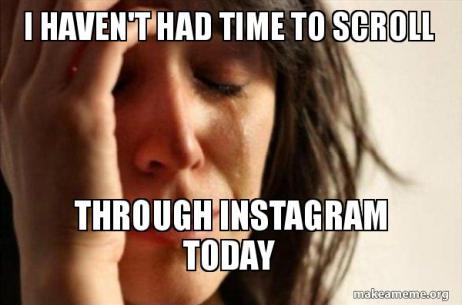
The problem I have these days is a little different, and it might be one you are familiar with. Social media, now that I have fully embraced it, is one major distraction, for which I feel endless amounts of guilt. Know the feeling?
i-havent-had-56u62s


As a new author, I started with this blog, Facebook and Twitter, but I obviously wanted to spread the word far and wide, so I collected a few more here and there. Goodreads, LinkedIn, Pinterest and Wattpad. And just last week, I added a shiny new one to the social media collection, Instagram.

I thought it would kick me up the bum a bit to try a new one. Nothing ventured, nothing gained, and all that. And as I already mentioned, the problem I have these days is rather different to the one I had in the beginning, where I viewed promoting via social media as a kind of cold sell out that somehow devalued what I was trying to do. These days, the problem is it is too tempting to be on as many as possible and for as long as possible!

It’s great that I genuinely enjoy social media these days, but it can be incredibly addictive and it can be hard to strike the right balance.

A while back I deleted Facebook from my phone as I was scrolling through my feed and posting things all through the day, and this was making me feel constantly depressed and angry about the state of the world, as well as terribly guilty for being on my phone whilst I have a beautiful little boy to care for.

I felt much better after it was gone. I limited myself to social media in the evenings only, a bit before writing and a bit after.

But now I’ve got Instagram on the phone. And…um, Facebook is back too.

I have to be strong though, and keep reminding myself that I am on both of them for business, ie book promoting reasons, only. I don’t have the time to go scrolling through feeds all day and missing time with my child. If I only have a few minutes here and there in the evening, then that’s all I’m going to get. Of course, I would love to spend hours and hours on social media, finding interesting articles on Twitter and Medium to share to my pages. I would love to be pinning all day and adding to my boards, and I won’t even go into how joining Instagram has had me viewing everything in hashtags since last week. It’s just weird!

social-media-updates

So, how to you avoid getting totally distracted by social media and then feeling guilty as a result? My advice is to set yourself rules and stick to them!

You don’t need to post on all of them, all of the time. I posted on Instagram for the first time a few days ago. I decided to start off I would post a series of photos in the style of a ‘day in the life’ type thing, I took pictures of things that happen in my life every day, ie walking dogs, baking, gardening, parenting, and at the and of the busy day, writing followed by reading. This was really fun to do. But now I intend to leave it alone until I next think of something worth posting, for example, scenes that inspire or are in my books, front covers, extracts of work, events and so on. I don’t want to get addicted to it as a site.

The same applies to Pinterest. It is very addictive and a lot of fun to play around with, but I only dip in and out when I need to. This is the sort of site you can totally ignore until you need to make use of it. I update the boards when I have a reason to, and will be paying much more attention to the site when I have a new book to launch and promote.

There are going to be times when it is much more important to use certain social media sites, such as when a new book is coming together or about to be launched. But my advice would be the rest of the time, to stick to the three that you deal with daily or weekly, and take a break from the rest.

It’s not a good idea to dip in and out of all of them for example, so if Facebook and Twitter are your thing, then stick with them, and post consistently and engagingly in order to build a loyal following. Just don’t feel like you have to be doing this all day every day with ALL of the sites you are on.

My last piece of advice? Give yourself one day or night totally OFF. I’m the sort of person that would be writing all day every day if I could. I hate not writing and when I am not writing, I always wish I was writing and I am constantly thinking about writing. This includes time spent increasing my social media content. But once a week I turn it all off and step away from the wi-fi. It’s a no go area, and it really does me the world of good. I curl up with my kids, leave my phone off, watch TV and chill out.

It genuinely feels like a day off ‘work’ and of course, we all need those.

Please feel free to comment or share! How many social media sites are you on? Do you feel guilty about the amount of time you spend on them? How do you strike a balance between work, social media and home life?


 

Changing Perspective

Last week I explained how my beta readers have shaped the direction of my next novel Elliot Pie’s Guide To Human Nature. (Beta Readers: How and Why? I mentioned how some of the issues that have been addressed thanks to my betas were pace, showing rather than telling and point of view. So today I thought I would talk a bit about point of view and perspective in storytelling.

It’s a subject that can prove quite divisive. I know I was shocked the first time I realised not everyone loves first person viewpoint! Apparently, some people really despise it! Obviously, it has its limitations. Here are some of the disadvantages of climbing entirely inside the head of just one character;

  • you only get the viewpoint and opinions of one character
  • this can limit the amount of information and back story the reader receives
  • other viewpoints are neglected, including the potential scenes between other characters when the narrator is not present
  • it gives the story one voice, the narrative voice of the character telling the story which can be a bit restrictive
  • if the reader dislikes or does not connect well to the first person viewpoint, it can really deter them from the book
  • it’s a very personal way to tell the story, and can impose biased and subjective viewpoints which may grate on the reader
  • it runs the risk of becoming boring and/or repetitive
  • there is a danger of relying too much on ‘telling’ rather than ‘showing’

Now I am not ashamed to admit that I LOVE first person. I think this may have something to do with how obsessed I get with characters. It’s character over plot for me all the way, hence why The Catcher In The Rye is still my favourite book ever. If I like a character, I don’t mind being inside their head one bit. Anyway, these are the reasons I think first person can be a really effective way to tell a story;

  • it allows the reader to fully connect with the protagonist/narrator
  • it’s much easier to gain sympathy and empathy from the reader
  • easier to construct a consistent style and voice
  • can make it easier to explain/justify a characters motivations and behaviour
  • can be much more emotional, drawing the reader in
  • it brings a vivid sense of immediacy to the story
  • done well, can be extremely powerful

But how do you know which is the best perspective for your story? There is also alternating points of view, which can be done in first or third person. Then there is the authorial third POV where the narrator is the all seeing eye of everything and everyone.

I think every author has their preferred perspective to use, but it is important to think about the story being told and what will best suit its needs. I know for a fact I am way too tempted to use first person. I did so with The Mess Of Me; a YA drama written in a tell-all, confessional diary style. We climb inside Lou’s head and never get to see through the eyes of any of the other characters. I could have explored third person, and jumped from character to character, but there was a reason I didn’t. As well as being about body issues, family drama and first love, The Mess Of Me is a story about those people we sometimes have in our lives, yet do not really know. eg Travis, Leon and Marrianne, for Lou are all deeply involved in her life and the drama of the story, yet are all as good as strangers. The story needed to revolve around her mind set and emotions in order to get this across. So it just had to be first person.

The Boy With The Thorn In His Side was a different matter. I originally wrote and rewrote this story in third person. Yep, you got every character’s viewpoints, and there are a lot of characters! The action jumped around all over the place. But it didn’t work. I didn’t feel close enough to my two main characters, protagonist Danny and antagonist Howard, and the more I rewrote it and got into their mindsets the more I realised that this was their story. Truly, this book is about their warped and dangerous relationship. So I changed it to first and boy did it work then. I must have worked with a constant smile on my face! You see I knew them both so well by this point that it was a piece of cake to climb into their heads and write from their POV. I used alternating POV from both characters in the first person. You get to examine their twisted relationship from both their views. This is a fantastic way to make first person narrative more interesting and varied.

With the sequel, This Is The Day, I wrote it in third person to begin with and then again switched it to first, but this time using alternating perspective from five characters. This was fun to do because I got to really explore the motivations of the characters who were introduced in the first book. And I think it worked; it was the best way to put the story together.

So, as you can see, there was a growing tendency and fondness to using first person narrative. I had found my comfort zone and made myself extremely comfortable! I forced myself to break out of this warm little zone with This Is Nowhere. (And I would strongly recommend forcing yourself to break away from the familiar every now and then.) Third person. It had to be. But with the chapters zipping back and forth from the past to the present. However, I still stuck to one point of view, Jake’s. This was not intentional at the time but now I can see why it makes sense. Jake’s story is the unpicking of two mysteries; what happened to his mother in 1996 and who he is. The other characters didn’t really need a say in this, although their behaviour and secrets helped pave the way for the climax where Jake discovers the truth about everything. I also think this was the best way to tell the story. Third person worked with jumping between time frames, as we got to see the young Jake and how his mind worked then, helping us to understand the person he was in the present. Other characters perspectives would have made this way too muddled and complicated.

Tree Of Rebels. Uh oh, I was back to the first person again. You see my problem? I really do like that comfort zone!! This book is still awaiting a final rewrite so I will not pass judgement on it yet as there is still work to be done and decisions to be made, but at the moment is feels right to leave it in first person.

Which brings us up to the two latest works. The unexpected rewriting of Elliot Pie, and the quickly thrashed out first draft of A Song For Bill Robinson.

Before I started writing Elliot Pie, I knew it would be written in the first person viewpoint. I think this was because he had been in my head for so long by that time, I knew him inside out, knew what he thought and felt, and how he looked upon the world. It was scarily easily to climb inside his mind and allow him to tell his story. But there are lots of other characters of importance in this story, and there was no way Elliot could know everything about them. I had to switch to third person whenever an adult character stepped into the plot. There was no real intention to do this; it just sort of happened. So, all of Elliot’s chapters were in first person, present tense. Very YA. Very Catcher In The Rye. And all of the adult’s were in third person, past tense. Which felt very grown up and evolved. It actually surprised me how smoothly writing that way became, especially as I had sunk so deeply into the first person comfort zone.

I was initially happy with this, and thought, that although different and challenging, it worked. I told myself it was good to try something a little bit different!A little bit brave.

While Elliot Pie was with another beta reader, I thrashed out a first draft of a YA drama called A Song For Bill Robinson. This is based on a book I wrote but never finished aged sixteen. It was written in third person back then, so it seemed apt to write it again this way. I was also feeling confident after the third person narrrative in Elliot Pie had gone so well and become so enjoyable. Third person, multiple viewpoints worked best for this latest book because again, there are so many characters and so much going on, it really would not work in first person. And also, a bit like with Jake in This Is Nowhere, I didn’t really want to climb into these people’s heads. I felt a bit of distance was needed.

When I received final feedback from betas on Elliot Pie, there were several issues, some of which I discussed in last week’s post and some of which I will probably mention another day. But what dawned on me more and more as I went through them, was how many of them could be solved by changing Elliot’s narrative to third person. Which is what I am currently doing. Just to see how it works.

So far, it’s working. It suddenly feels more adult (it is to be aimed at adults) and I do feel relieved to be out of his head. It gives me as an author a whole new perspective on the story, on his character, and on the best way to tell this story. I noticed there were many problems with writing his parts in first person. For instance, he was rambling too much, daydreaming, going off on tangents, all of which slowed the pace down, and may have proved dull for some readers. However, writing his parts in first person initially have helped me truly understand his character, which I really hope shines through when it is all completed.

The moral of the story today is this; sometimes as a writer you want to tell a story in a certain way, for whatever reason. But sometimes, you have to stand back, take a look and admit that it may not be the best way to tell it. This may concern other things, such as structure and pace, but if your story is not working out the way you hoped, maybe changing the narrative perspective is worth considering.


Beta Readers; How and Why?

Several months ago I was convinced that my new novel, Elliot Pie’s Guide To Human Nature was ready. I sent it to a tried and trusted beta reader who very patiently and kindly informed me that it really wasn’t. I listened, realised she was right, and tackled it again. And again. And…well, you know how it goes. Finally, a few more months down the line, I thought, okay, this is it, I’m happy, really happy! I’d addressed all of her concerns and it was definitely a much better book. I then sent it to another beta reader, quite arrogantly expecting her to gush with excitement about how ready it was. She didn’t. It wasn’t. Repeating these things to my husband, he asked a very important question. How do I know the beta readers are right?

This is an excellent question and one worth addressing. But first of all what should you look for in beta readers and why do you even need them?

You need them because you are far too close and subjectively involved in your marvellous work of art to see its flaws. It is very difficult for an author who is in love with their story, to be able to see where the pace is too slow, or the information repetitive. You may not realise how much of you and your beliefs and opinions are seeping into the book. You may not realise that there is too much dialogue, or not enough. It is your baby, your child, your masterpiece. Yes, your relationship with it is up and down. You love it and then you hate it. You are filled with self-doubt one moment, only to be surging with confidence the next. Either way, you need beta readers to bring your down to earth. You need them to tell you what is good about the book and what is not so good about the book. Of course, you don’t have to accept their advice, and you certainly don’t have to act on it, but to release a book or submit it to publishers without using beta readers would be, in my opinion, insane.

So, what should you look for in a beta reader? I think this is quite a personal thing and may also depend on your genre of writing, but here are the things I look for and require in my beta readers.

  • they need to have already read my work and connected with it
  • they need to be somewhat connected to me and my life, and have some knowledge of my beliefs etc
  • they need to be highly educated, or at least way better at grammar than I am!
  • they need to be an avid reader, someone who consumes books like an addiction
  • they need to be open to most genres, not snobbish or narrow-minded
  • they need to be breathtakingly honest and not scared to offend
  • they need to be able to understand how a book could be made better
  • they need to be prepared to read the book at least twice and make notes

What sort of things should a beta reader be looking out for when reading your work? Well, again this is very personal, but I will explain the way I often approach it. With Elliot Pie, I wrote the book quite naturally, just letting it flow as you do with a clumsy first draft, worrying about the finer details later. I finished the very first messy draft just over a year ago, and I honestly didn’t think it would need too much more work! This goes to show how blind you can be about your own writing. I did a few more drafts before sending it to the first beta. At this point I was looking for opinions on the plot and the actual story and on the characters. Did they work? Were they real enough etc? What about the structure of the plot and the flow of the narration?

What I got back was very interesting and resulted in me changing a lot of the chapters around. The beta had loved the characters (yay!) and the story but she found the pace too slow in the middle of the book and she guessed the ending. Not too big a problem, as it’s not supposed to be a real twist at the end or anything, but she did help me work out ways I could knock the readers off course a bit. She was also right about the pace. It was too slow in the middle and lots of it needed to go.

Job done. I attacked the book again, and again and again. Each time I went through it, I cut bits out, added bits, fleshed the characters out more, and wrote lists as I went which consisted of the things I still needed to do when this draft was done. I considered my work done when the lists ended. As far as I was concerned I could do no more. Yes it would need some more proofreading and a few more read throughs, but I was happy. More than happy.

I sent it to the second beta reader as she is my biggest critic and I knew she would be intensely honest. There was no way she would hold back if there was anything about it she thought could be better. We ended up having several Skype chats while she went through her very detailed notes on the novel. I made lists, nodded and listened. The more she talked, the more I realised how right she was, and the more I felt my own subconcious misgivings becoming unearthed. Everything she said about the book was true. I had written it in both first and third person. A bit of a challenge, yes, but that was just the way the story presented itself to me in the first draft and so I went with it and ended up sticking with it. This meant that all of Elliot’s, (the 12-year-old protagonist) perspective is in the first person. We are entirely inside his head. And in my opinion, that’s a wonderful place to be. I find him interesting and funny and amusing, you see. Of course I do, I created him! But would the reader think the same? Or would they find the narrative repetitive as he talked them through his little world? Was I telling them far too much detail when a lot of it could be shown rather than told, or omitted altogether?

I sat and nodded grimly and knew that my beta was right. I had climbed inside his head and got lost there. I was way too close and way too involved. I loved him too much but I needed to get back out and get some distance. I suggested changing his view to third person and the beta had thought the same thing. The more we thrashed it out, the more I realised how many problems this would solve. I actually began to get excited. There were other issues too, aside from POV, but I won’t go into them now as they will probably pop up in another blog post.

We talked about how I’d had a similar problem with The Boy With The Thorn In His Side. (Again, this is where history, friendship and connection aid the beta/writer relationship) Originally written in the third person, from all the characters point of view, it was eventually rewritten into the first person, and from two points of view. At the time I was both terrified and excited to take this machete to my work, to slice it up and stitch it back together again, to tell the story in a totally different way. I knew I would lose tons of scenes and perspectives and dialogue and this saddened me beyond belief. But it worked.

With Elliot I have the same problem but in reverse. I need to lose the first person, get some distance from Elliot and tell the story in a different way. There is a lot of work to be done, but the groundwork is all there. The second beta also loved the actual story, the plot and the characters and found the pace just right.

I am so glad I gave it to her to dissect. But back to the original question? How do I know she is right? How do I know either of them are right? I know because as soon as they voiced their opinions, I knew I had been thinking the same thing all along. All they did was confirm what I already knew deep down inside. I just didn’t want to admit it to myself, because admitting it meant even more work, even more drafts, even more editing and proofreading, and it means the other books that are on hold waiting for this one to be done have to keep waiting and waiting and cramming my mind and driving me insane! I wanted the book to be ready so badly I had convinced myself it was.

But I can’t let a book go until I am sure it is the best it can be, and in my case, my betas are there to help me get to that point. I can’t thank them enough for the time and effort they invest in me and my books. I trust them implicitly and I know I am extremely lucky to have them.

But what about you? Do you use beta readers and if so how did you find them? What do you look for in a beta? Have they ever felt differently to you about a book being ready for release? How have they helped your books reach their full potential? Have they ever been totally wrong? Please feel free to comment and share!


Prove Them Wrong

Sometimes I think that the best piece of advice I have received in my life came from a fictional character I created myself. Strange, eh? In The Boy With The Thorn In His Side , Michael is often nudging Danny along by suggesting he ‘prove them wrong’. Now is not the time to go into who ‘they’ are, but I am sure you have your own ‘they’. I’m sure that whatever your passion, whatever your dream, there is or has been someone somewhere expecting you to fail.

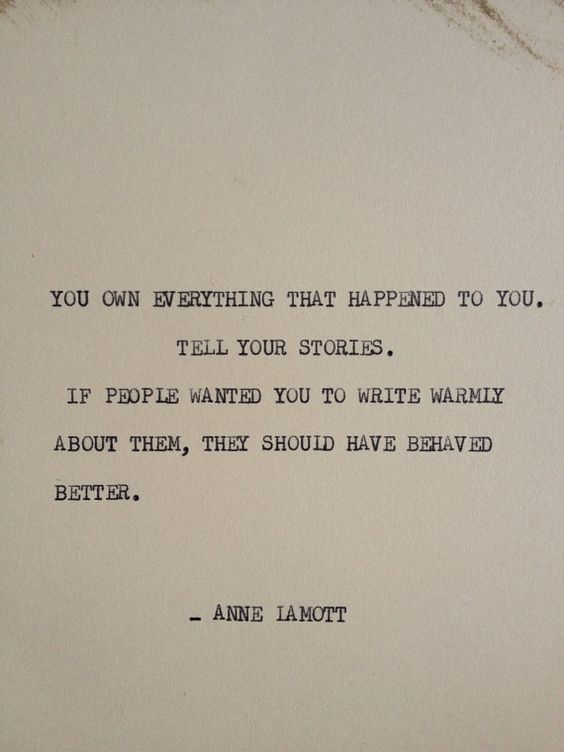
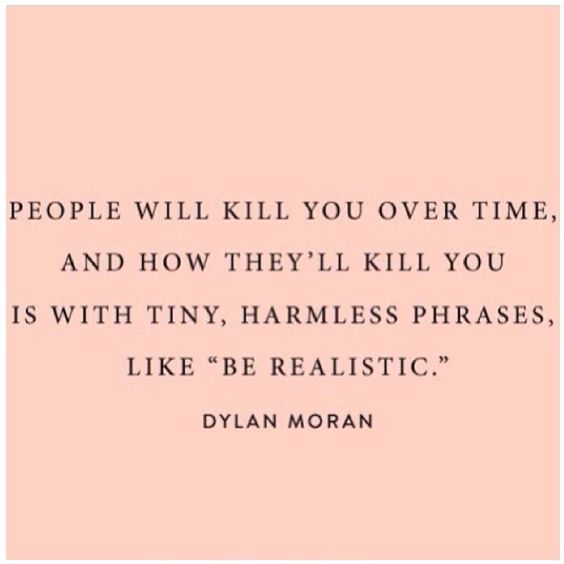
When I was a teenager, I called them the Plan B Realists. They liked my Plan A, which was to become a writer. They smiled at it and nodded and thought it was sweet, but they didn’t think it was realistic or sensible. It wasn’t a real plan, they said. There is no money in it, they said. I tried to ignore them at the time but fear becomes ingrained. Not being successful, not being able to support yourself, not making your loved ones proud of you, becomes too much to risk. It took me a long time to realise life is about pleasing yourself, not other people, and that maybe all the Plan B Realists had Plan A’s too once, ones that they failed to follow.

c93cee3c9b380d6a0a991d14837565f8

As well as the ones who like to piss on your fireworks, I’m sure you’ve got a fair share of the eye-rollers too. You know the ones who basically change the subject if you talk about what you do. Fair enough. Then there are the ones who are so impossible to please, you could become the highest earner in the family, own a yacht, buy them a house and still be the person they just cannot see.

Michael’s words come back to me whenever I am feeling unsupported or ignored and whenever I experience doubt in my journey as a writer. The words stir a steely resolve inside my quivering belly and help hold me still. If you sometimes feel like no one is listening anyway and perhaps they never were, like no one sees you or remembers you, like your voice is too small, like it fades away before it even begins, then perhaps you could also take some advice from Michael and tell yourself to prove them wrong. And that really mean proving yourself right.

5d0fbaff309327783f82445fcc27ba8a

Even if it hurts to acknowledge it, and it’s like there is something loose and rattling inside of you that is scrunched up, and batting around from one side to the other, and it’s like you can’t breathe properly when you think about it, when you think about them – it’s like you’ve been running from something that wants to crash into you if you ever let it catch you up – try to remember this. That there might never have been intentional malice in their words or actions, just a carelessness with your soul. That maybe you are family who really shouldn’t be, that you are so different  from each other that it makes it impossible to recognise what you see – Remember that maybe they did the best they could with all that they had, and that maybe they did better than their parents did with them, and remember that you will do better still.

You will never make your children feel less than wanted and valued and longed for, and you will never have favourites, those that shine and those you allow to fade, and you will always allow them their rightful dreams and be there by their side to guard them so that they are never lost to cold realism.

Maybe they weren’t there and didn’t care, maybe they turned their back or simply looked past you. Maybe you were not what they wanted, or not what they needed. Maybe they will see it one day when it is all too late. Maybe they won’t. Maybe one day all of your dreams will come true and you will finally be able to turn around and say look, I did it, I told you I could, and maybe they will still not care.

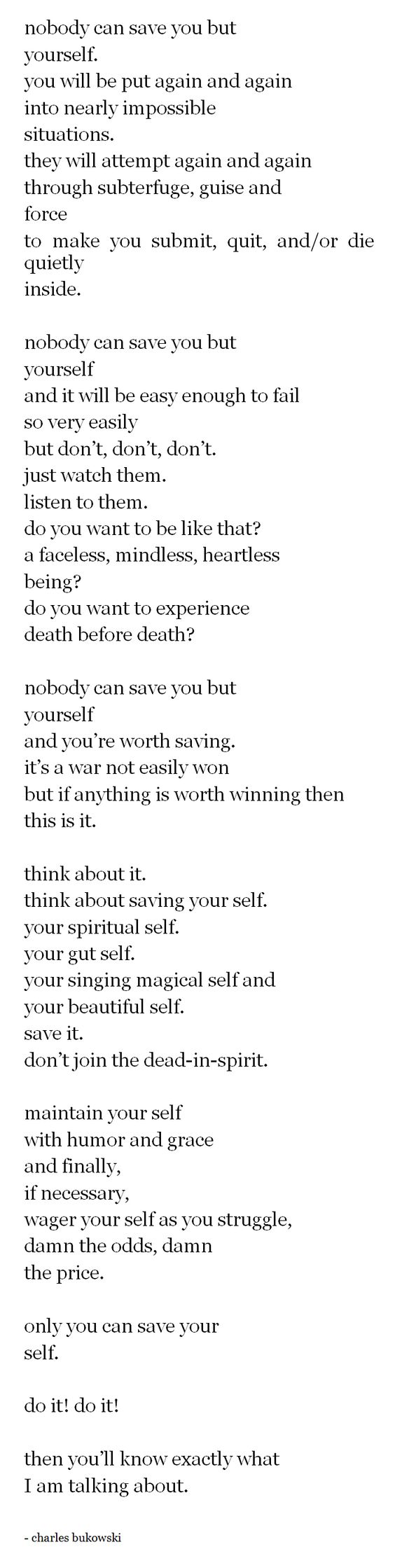
If they doubted you or mocked you, ignored you or neglected you, if they turned you away because they knew no better, then prove them wrong and do it well. Whatever it is, whoever you are, whatever your passion, do it anyway, and make it your life’s duty and purpose to prove them wrong. Do it anyway and do it well, and do it for yourself, and let their scorn and disinterest spur you to work ten thousand times harder than you would have without it. Let it be the fuel from which you draw the energy to keep going, to hold your head up high, to hear your voice getting surer and stronger. Let it make you harder and faster and brighter and smarter than you would be had you had all the love and support in the world.

Rise above. Move on, and may they choke on their words as you prove them all wrong.

7b57b9013804663cc3d017f00da4ff60.jpg