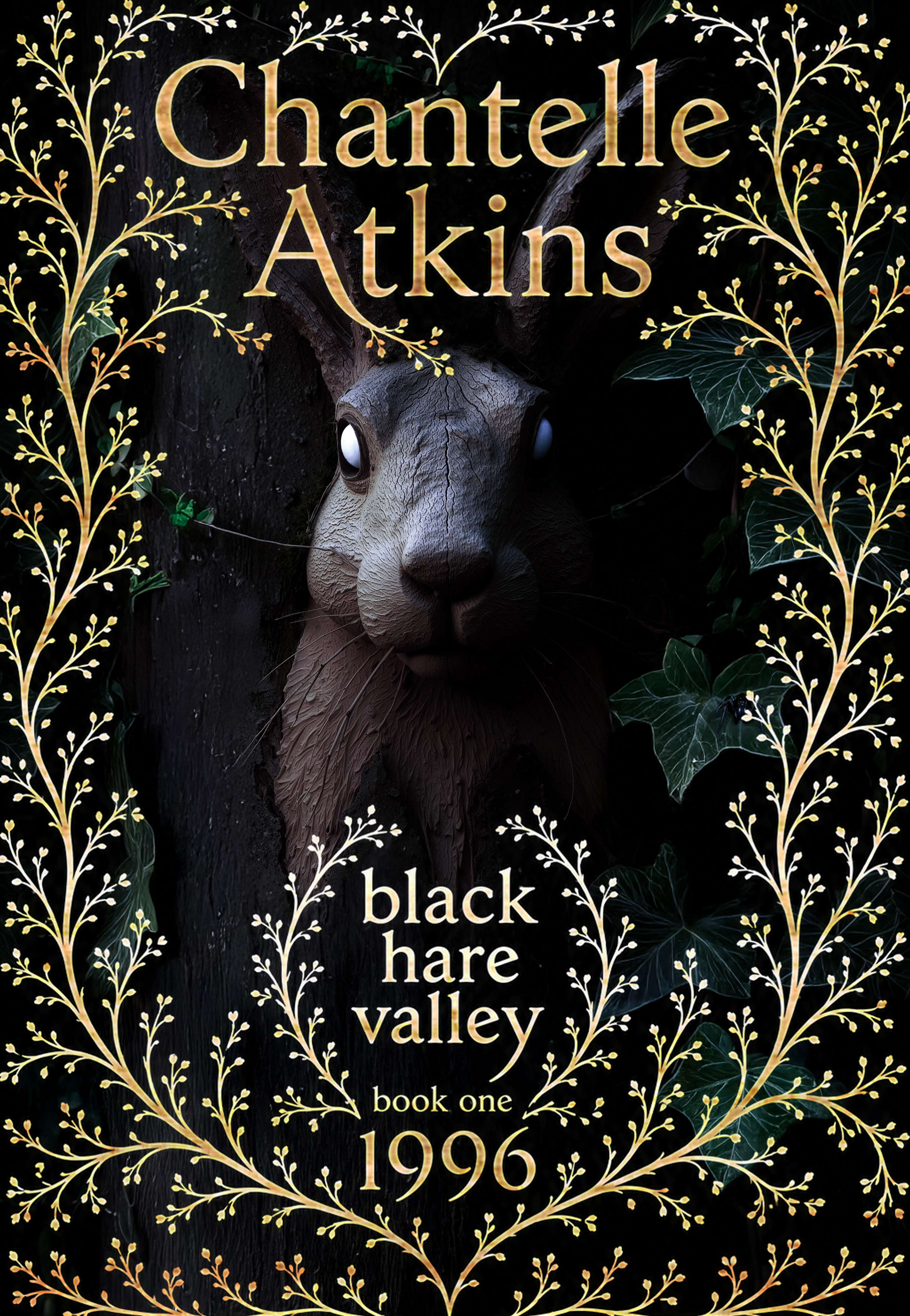
Black Hare Valley Book One: 1996 was released on 25th June and the ebook is still just 99p across all platforms! I was due to publish this post on release day but we had an internet outage for a week and I had stupidly not scheduled it.
When I first came up with the idea for Black Hare Valley, all I had was the genre, (horror) and the town, which I created as a map on a long piece of roll-out paper. I knew I wanted a missing child to be central to the storyline and I knew I wanted an unlikely group of misfit teenagers to be the ones attempting to solve the mystery.
It was not until years later, in 2023, that I started creating and developing my characters. Now that the book has developed into a 5-book series, it feels odd to me that I ever had to sit down and work on these characters. They are so real to me now and I am very much in love with them all. That, I think, is one joyful benefit of writing a series – getting to know the characters so well and seeing them grow and develop over time. In this post I am only concentrating on the main characters in book one. I will probably do a follow up character post on additional characters when the next book is out…
So, here they are. The main characters, both heroes and villains, in the Black Hare Valley Book One: 1996:
The heroes:
Jesse Archer: Aged 15. Tall for his age. Shoulder length dark brown hair, dark eyes, high cheekbones. As one of the notorious and much-maligned Archers, his reputation precedes him and he is hated in Black Hare Valley. Known as a thug, a bully and a hooligan, he is not expected to amount to much. His mother supposedly went crazy and ran away when he was ten, and since then he’s been dragged up by his useless, drunken father, Nick and his two criminal older brothers, Billy and Wyatt. On the surface, Jesse appears to be a typical Archer but underneath he has a gentle side that few see. He is hiding dark secrets and lives his life in constant fear. When he starts a friendship with mild Paddy Finnis, most assume he is bullying the boy, but nothing could be further from the truth. Jesse has found someone who wants to know him for him for the first time in his life. So, when Paddy vanishes, Jesse is as determined as anyone to find him. Jesse is at heart a hero, selfless, courageous and loyal. His negative traits are keeping secrets and being reckless.
Paddy Finnis: Aged 14. Small, dark-haired, wears glasses, lives with his father in a flat about The Magic of Books, which his father owns. Studious, but not shy, Paddy is a thinker. He questions everything and anything and never gets bored of learning new things. He is particularly fascinated with space and has two telescopes to watch the night skies with. His best friend is Willow Harrison, though they are quite different, they have been friends since early childhood. Where Willow is cynical and negative, Paddy tries to see the best in everyone and always looks on the bright side of life. A cheerful optimist, he happily welcomes Jesse Archer into his life and his world, despite Willow’s warnings that the boy must have ulterior motives. Paddy reads constantly and devours information. Was his thirst for knowledge what got him into trouble and led to his disappearance?
Willow Harrison: Aged 14. Tall and thin, long black hair, often dresses in dark or black clothes. Mocked around town and called ‘witchy Willow’. Her parents own a gift shop in the town and she lives with them in the flat above. Like Paddy, she is often found helping out in the shop, and in her spare time her hobbies are writing and wandering the town with Paddy. Willow is sarcastic, cynical and usually assumes the worst of people. Her mother suffers from depression which fills her with a constant fear that she might lose her. Willow also fears she may suffer from depression herself. Willow both loves and hates Black Hare Valley. She often covers for her mother when the strange Vicar Roberts comes into the gift shop asking for her. For some reason her mother seems afraid of him. Willow is fiercely loyal to Paddy and at first jealous of his new friendship with Jesse Archer. She has no need for other friends, but when Paddy vanished without trace in the night, Willow realises she must let her walls down just a bit, and joins forces with Jesse, new girl Jaime, and Ralph Maxwell to uncover the truth. Willow is strong and independent, loyal and kind-hearted.
Ralph Maxwell: Aged 13. Brown curly hair, sturdy build. Outdoorsy. The youngest of the group, Ralph is a loner at the start of the book. He lives in the caravan park with his young single mother, Charlotte, a widow since his father died in a boating accident when he was just a toddler. Charlotte is a hard worker and loved by the town. The mayor, who employs her, is especially fond of her and Ralph. Ralph is an explorer at heart with a nose for mystery. He has been tracking and recording strange footprints in the town for a while now, and constantly wishes he had a best friend or reliable side-kick. He finds a whole gang of friends when he accidentally gets caught up in the mystery of missing Paddy Finnis. Ralph is sweet-natured, humble and hard-working. He is loyal and brave and develops a crush on Jaime.
Jaime Perry: Aged 14. Short and round with blonde hair and blue eyes, Jaime is the new kid in town. Her new step-father, Mark Aster, owns The Hare and Hound public house and her mother is now pregnant with his child. Mark seems thrilled with his read-made family and is keen for Jaime to explore his beloved town. He adores the valley and looks up to all of the committee members. This adoration puts him on a collision course with his step-daughter when she starts questioning things… Jaime wants to be a reporter and is known for being nosy. When she first arrives in town, she finds herself ridiculed and bullied by the local teen girls, but then spots Jesse being arrested by Sergeant Mayfield. Her curiosity in overdrive, she starts following and snapping photos. This leads her to Paddy and Jesse in the treehouse. Jaime is intelligent, determined. curious and level-headed. She tends to believe there is a rational answer for everything. There is a hell of a story in her new home-town and she is determined to crack it. She is sweet-natured, loyal and fun-loving but can be a bit shy and lacking in confidence.
The Committee:
Mayor Margaret Sumner: Aged, who knows? Tall and slim, athletic build, with silver hair and grey eyes, Margaret cuts an imposing and authoratative figure around town. No-nonsense, practical, single-minded, she always gets her way. She lives up on Hill Fort Farm where she has a perfect view of the town she created. Her roots are very deep and the town is her precious baby. She will do anything to protect it. As head of the committee and mayor of the town, what she says goes. She cannot understand anyone not appreciating the unique beauty and magic of Black Hare Valley. She is cold and manipulative, but occasionally develops a ‘soft spot’ for someone, and tends to like collecting ‘waifs and strays.’ At heart, she is controlling and not to be messed with.
Edward Bishop: Aged? Looks like he is in his late forties. Tall, thin, but with a pot-belly, greasy black hair, bad skin and a hooked nose. The head-master of the local secondary school, Edward Bishop is feared and loathed by the children of the town. He seems to actively enjoy terrorising and humiliating children and has a particular hatred for Jesse Archer. Edward is vain, bitter, vindictive and sly. He is good friends with Sergeant Mayfield but sometimes feels Margaret is too soft on the Archers. He is a proud and long-standing member of the committee and takes his duties very seriously. A dark and dangerous man.
Sergeant Aaron Mayfield: Aged? looks like he is in his late fifties, and built like a bear with white hair, full beard and moustache. Twinkling blue eyes that look full of mirth and joy but inside he is as cold as ice. Around town, he is loved and feared in equal measures. A sly and deceitful man, Mayfield has a penchant for blackmail. He blackmails Jesse Archer to do jobs for him, and camera by camera, he is spying on the entire town. Like Margaret, he enjoys power and control but is far less subtle about it and enjoys brute violence just as much. He has a lust for blood and violence that Edward Bishop sympathises with. It makes Margaret rather uneasy, however. He and Margaret work well together and share a close bond, often acting and feeling like ‘mother and father’ to the town. He loves the town and will do anything to protect it. A proud, calculating and vengeful man, he is capable of anything.
Bob Rowan: looks to be in his late sixties. Black, greying hair. Dresses like a scruffy farmer. A recluse, Bob Rowan is rarely seen around town. He owns almost half of the land and resides on the opposite side of the valley to Margaret, in a farmhouse surrounded by trees and barbed wire. He used to be on the committee but seems to have broken ranks and gone his own way. Is said to have a pathological hatred of children. He has a ancient Holloway, or sunken path on his land, which he refuses anyone access to. Bob lives like a grumpy secretive hermit, close to nature, with little need for human company.
Sylvia Gordon: looks to be in her early thirties. Small, petite, well-groomed and made-up. She has blonde hair styled like a 1950s Hollywood starlet. She dresses in an old-fashioned manner, but exudes sexuality. She teaches piano at the secondary school but despises children. She acts as the committee secretary. She is flirty with most men, but in particular with the vicar, Greg Roberts. She is sly and manipulative by nature and has a dark sense of humour. Not to be trusted, she will stab anyone in the back to get what she wants.
Vicar Gregory Roberts: Looks to be in early forties. Red hair, has a wife and twin daughters in book one, but they mysteriously disappear later on in the series…. Is conducting an extra-marital affair with Sylvia Gordon. Seems to have a strange and unhealthy interest in Willow Harrison’s mum, Lizzie, and can’t seem to keep away from their gift shop. Lizzie always hides when she sees him coming. Seen by most of the townsfolk as an upstanding and Godly man, our heroes soon realise this couldn’t be further from the truth. A proud, vain and petty man, who like most of the committee, is prepared to do anything to protect the town and conceal the truth.
Eugenie Spires: Looks to be in her late sixties. Small, trim, grey hair scraped into a bun, glasses, old-fashioned practical clothes. Eugenie is the town librarian and comes across as a dour, humourless and severe woman. She has a secret habit of stealing pointless items. She is a gossip at heart and is usually twitching the curtains of her home to spy on townsfolk. She is one of life’s great observers and nothing much gets past her. She is loyal to Margaret and the committee in general and thinks those that question them are ungrateful and selfish.
Neville Hewlett: Looks to be in late thirties. A smooth-faced pudgy man with a nervous vibe about him, Neville is the pastoral care worker at the school and also runs various groups at the town community centre. He comes across as friendly and affable, and will seemingly do anything for anyone. A weak-willed anxious man, Neville shies away from conflict and doesn’t like nastiness. He is loyal to Margaret and the committee, however, and as much as he dislikes confrontation, he knows he must always do as he is told. He has a girlfriend called Tahlia who is a barmaid at The Hare and Hound, but he enjoys a secret relationship with teenager, Nathan Cotton.
Iris: Looks to be in late seventies, early eighties. Iris is small but fierce with a halo of white fluffy hair. She dresses in whatever she picks up off the floor, but often it is dungarees, jeans, dresses and boots, woollen jumpers and woollen hats. Iris lives alone as a recluse in the oldest house in town, Black Hare cottage, on the outskirts of town. She is a long-standing member of the committee but seems to despise them all and doesn’t have much to do with them. It is believed that she hates children, even though she had a son who died, who produced a grandson, Nathan, with a local called Sarah-Jane. They try to keep an eye on Iris but she doesn’t think much of them and prefers to be alone. Often called a witch, townsfolk are naturally wary of Iris and tend to gossip about her behind her back. At one with nature and solitude, Iris often vanishes for weeks at a time without a word to anyone. Iris has a dark heart and is a lover of tricks and mischief.
Well, that’s the main characters from book one! Don’t forget to grab your ebook copy while it is still 99p!
Thank you!