One More Writing Project Won’t Hurt…

If you follow this blog you probably already know how many writing projects I tend to work on at the same time. I used to think working on more than one book at a time was a bad thing, but eventually I came to accept that it’s just always going to be this way. Writing truly has me hooked and I just can’t stick to one thing until its done. I like to have a few things juggling around me!
Image by Pexels from Pixabay

Currently, those things are: The Day The Earth Turned series, which is in the process of edits and proofreads and I hope to release book one in May 2023. The Fortune’s Well trilogy I co-wrote with Sim Sansford – we hope to release book two next month. The spin-off from The Boy With The Thorn In His Side series – about half way through first draft. And Black Hare Valley – finished in rough first draft!

As if this wasn’t enough for me, lately I’ve been getting all sorts of small ideas for small pieces, either poetry, flash fiction or short stories. I would be an idiot to ignore these things when they come to me, so of course I have been writing them down, and would you know it, a new story/poetry collection is already emerging. In the spirit of adding to this collection I recently asked my Facebook page followers to suggest writing prompts to me. I have a pinned post and people have made some amazing and enticing suggestions.

I went with one about an ordinary day becoming an endless day and I had so many different ideas for how to do this, that I have the start of a few different stories I may pursue later. One started off as a post-apocalyptic thing but started going off on a tangent that didn’t fit with the endless day theme. The one I went with actually started life last week as a short story about an adult’s memories of the monsters that lurked at the end of her grandmother’s garden. I will finish that one, but parts of that then grew into a different story about an endless day. I am nearly at the end of it and I will publish it here and on my blog at the end of this month before asking for more ideas from people.

It might sound utterly mad to be adding to my writing workload, but I love playing around with different writing formats, genres and ideas, so it’s impossible to say no. I also think that asking my small but lovely group of followers to make suggestions is a great way to connect with them and involve them in the process. It’s basically asking for writing prompts and choosing the best one each month to respond to!

I should have the finished story for you next week, but in the mean time maybe you would like to make some suggestions for my August challenge? Any ideas welcome! Just leave them in the comments. Maybe a story title, a phrase or sentence or piece of dialogue, images, a certain character or even lyrics from a song.

Thank you for reading, see you next week!

Come Back To What You Know

I’m feeling nostalgic.

I don’t look back on the past with rose-tinted spectacles. I think every decade in human history has been seeped in tragedy, usually man-made, of some kind. But there is something in me at the moment constantly yearning for simpler times.

I wouldn’t do away with the internet or mobile phones, but only for one reason. I’d never sell a single book without either of them!

But I find myself tiring of it all. I suppose everything becomes tiring after a while. Everything loses its shine. Sometimes though, we go back around again, we go full circle and return to things we once turned our backs on.

For me lately, this has been bringing some unexpected comfort in an increasingly fraught, depressing and uncertain world. I’ll just talk about a couple today; things I have returned to and how they are helping me navigate these seemingly endless difficult times.

Walking

I’ve always liked walking. I feel I have some sort of affinity with it, like it is something I am supposed to do. I like how it is so solitary and gives me time to think. So many stories and ideas came from walking when I was a teenager. I thought nothing of walking an hour or more to get to a friend’s house and I hated buses. I would always rather keep walking. I used to run too, mostly in my late teens and my twenties when I got rather caught up in trying to control my figure. But these days, 44 year old me is a bit kinder to myself (most of the time anyway,) and I worry about falling over or hurting my back or my knees. So I think my running days might be over but my walking days have begun again in earnest. I now walk to save money on petrol and I feel good about this. It’s good for my wallet, my body and the planet. I also sort out all my plot holes and writing struggles when I am walking.

Letter writing

During the lockdowns of the pandemic my eldest sister who lives in a very rural location a few hours away from us, started writing letters and cards to my youngest son. He loved this and wrote back every time and they have kept this up ever since. A few months back I decided to join in, so now me and my sister converse through letters. Of course, we text, phone and Whatsapp each other too! But there is something so calm and patient about writing a letter, posting it and waiting for one to fly back to you. Whenever I receive one, I wait for a special moment to read it. I need peace, quiet, a comfy spot and a cup of tea. I have also started writing letters to two friends. It’s not something you do instantly. It’s something you wait until you have time for. And then you go back over everything that has happened since you last wrote and make sure you also address and respond to all their news. This all takes time and that’s what is so nice about it. Knowing that someone took time over doing something for you, knowing the extra effort that went into it – it really is lovely and I feel like people talk differently in letters too. It’s interesting.

Wearing a watch

I got my first mobile phone when I was 19. I think that must have been the last time I wore a watch. I can remember that last watch too because I had it all through my teens and I really loved it. It was a chunky silver Timex and rather than a strap and a buckle to fasten, it was attached to a stretchy silver bracelet. Weird, I know, but it made taking it on and off easier! Gradually it started falling apart and I really missed it. I think I kept the clock head for a while somewhere. After that, phones took over and recently I realised that whenever I need to check the time, I check my phone. I think we all do. But carrying a phone everywhere is getting annoying. They’re not just phones anymore, are they? They’re mini computers we lug around with us, which means we have the entire world in our pocket weighing us down. It’s annoying, especially in the summer when you are less likely to have good pockets! I also thought about all the post-apocalyptic TV I watch and books I read. In that eventuality, phones become useless but watches return. My husband bought me a lovely watch for my birthday and I’m in love with it. I absolutely adore it. I don’t have to take my phone everywhere anymore and I am prepared for the end of the world. Win, win!

Childlike curiosity

There are so many things I don’t know about. I am 44 years old and I still can’t identify that many birds, trees, or plants for example and I know barely anything about the Universe or space… As adults I think we stop being curious. We stop asking questions. I am sure you have all experienced the incessant questioning from a young child who wants to know why, why, why…. I am trying to get back to that. If I don’t know what something is, I am trying to find out. Mostly nature based things! For example, I have a plant identifying app that has helped me learn the names of a lot more plants and trees lately. And I just got this cool app that records and identifies birdsong for you! It’s really addictive.

Collecting stones

Walk around my house and I can guarantee you will find a pile of stones in every room thanks to my youngest son. Like most young children he still has the habit of picking up natural objects that look or feel nice. Sticks and stones mostly. There are sticks everywhere too, though of course really they are guns of various sorts. But stones… I looked the other day and found a pile on the kitchen window sill mixed in with fossils. Another pile on the table. A few more on the side. Some on the stairs. A few in the lounge on the coffee table. A whole gang of them in his room which seem to have been decorated with various spots which apparently mean different things. This stone obsession reminded me that when I was his age I had a whole shoe box of them under my bed. I wasn’t as good as he is at finding cool ones though! He really does have an eye for it. The other day I emptied his school bag and found a whole pile of smooth brown pebbles at the bottom. They were all almost identical in size and colour. Today he brought home a big stone which had been sheared in half at some point, so we could see inside it. My son is right about stones. They are fascinating – apparently pebbles on a beach can be as old as 4 billion years! It’s not like we often get the chance to hold something so ancient in our hands… They can be beautiful, colourful, smooth, jagged, tiny, large. I recently found one with a sad face but then I lost it again, which was sad. Anyway, thanks to my son, my love of collecting random stones just to hold them for a bit has been well and truly rekindled.

Longhand writing

If you follow my social media writing updates, you will know that I often write in longhand. This is also something I have returned to. As a kid I wrote in notebooks of all sizes and shapes. I wrote on anything I could. I was very excited when I got my first electric typewriter! Years later, and it’s all laptops and Word and Google Docs and so on. I still use these things, but I love starting a story off in a notebook. It means I can carry it about with me, write in it at weird times, like when cooking dinner or waiting in the car. Sometimes I end up writing the whole thing in a notebook, just like Black Hare Valley I blogged about last week. Sometimes I’ll get so far then start typing it up. Short stories and poems nearly always start their lives in notebooks these days. There is something about holding a pen in my hand, scratching words out on paper that returns me to me, that makes me feel more connected to it.

What about you? Are there any ‘old-school’ things you have returned to? Or any you never gave up in the first place? I’d love to know so feel free to leave a comment!

The End Is Really The Beginning

Over the weekend my excitement and sense of victory was growing.

I was ever closer to finishing the first draft of one of my current WIP’s, Black Hare Valley. To recap, I had the idea for this book a few years ago. At the time, my son and I were both reading Stephen King’s It and enjoying the new film adaptations of the story. I suddenly had an urge to pay homage to the master of horror by penning a story set in a weird and eerie little town, where unlikely heroes (ie teenagers) are pitted against forces of evil. That was all I had. I wanted to create a town though and came up with the idea of Black Hare Valley. This was because I am rather obsessed with hares. Around this time we had also visited a well known iron age hill fort and after a bit of research on folklore and magic, my ideas started to grow. But what we needed first was a map. So, my son and I rolled out a long piece of paper and together created Black Hare Valley. It was so much fun, and as the town grew, so did my characters and their lives. That was as far as it went at the time. I was busy on other books and my son didn’t want to help write it. I folded up the map and tucked it inside the notebook alongside some ideas, research and character bios.

Around three years later, last February we had a 5 day power cut and a two week internet cut. This made it impossible for me to continue editing my 4-book series ready for release (The Day The Earth Turned) or work on what was my current WIP, the spin-off book from The Boy With The Thorn In The Side; working title At Night We Played In The Road…

With no TV or internet, surrounded by candles and fairylights, I decided to pick up that notebook and unfold that map. I had an idea of how and where to start the story and thought I would just kill some time by writing the first paragraph. The paragraph morphed into a chapter, followed by another, and another, and another. I was then fully immersed and addicted and before I knew it, I had filled a notebook and started another. Since then, I have been scribbling down this story most days. There was a three week break in May where I concentrated on editing priorities and the release of the book I co-wrote with author Sim Sansford, (Hangman’s Revenge.) Also, I was abit stuck.

I had reached a point where I seemed to be heading towards some sort of climax but at the same time, I wasn’t sure what it would be or how it would happen or even what it would mean. This stuck feeling was made worse by the fact I had not yet gone back and read through anything I had written. It’s easier to do this when using Word on the laptop – with a scruffy notebook and illegible handwriting, it’s a bit tricky. So I just kept going, adding notes, extra ideas and so on to the front of the first notebook where my planning and character bios were. One day on a long walk I got the ending in my head and it all made sense. I was nearing the finish line and it felt great!

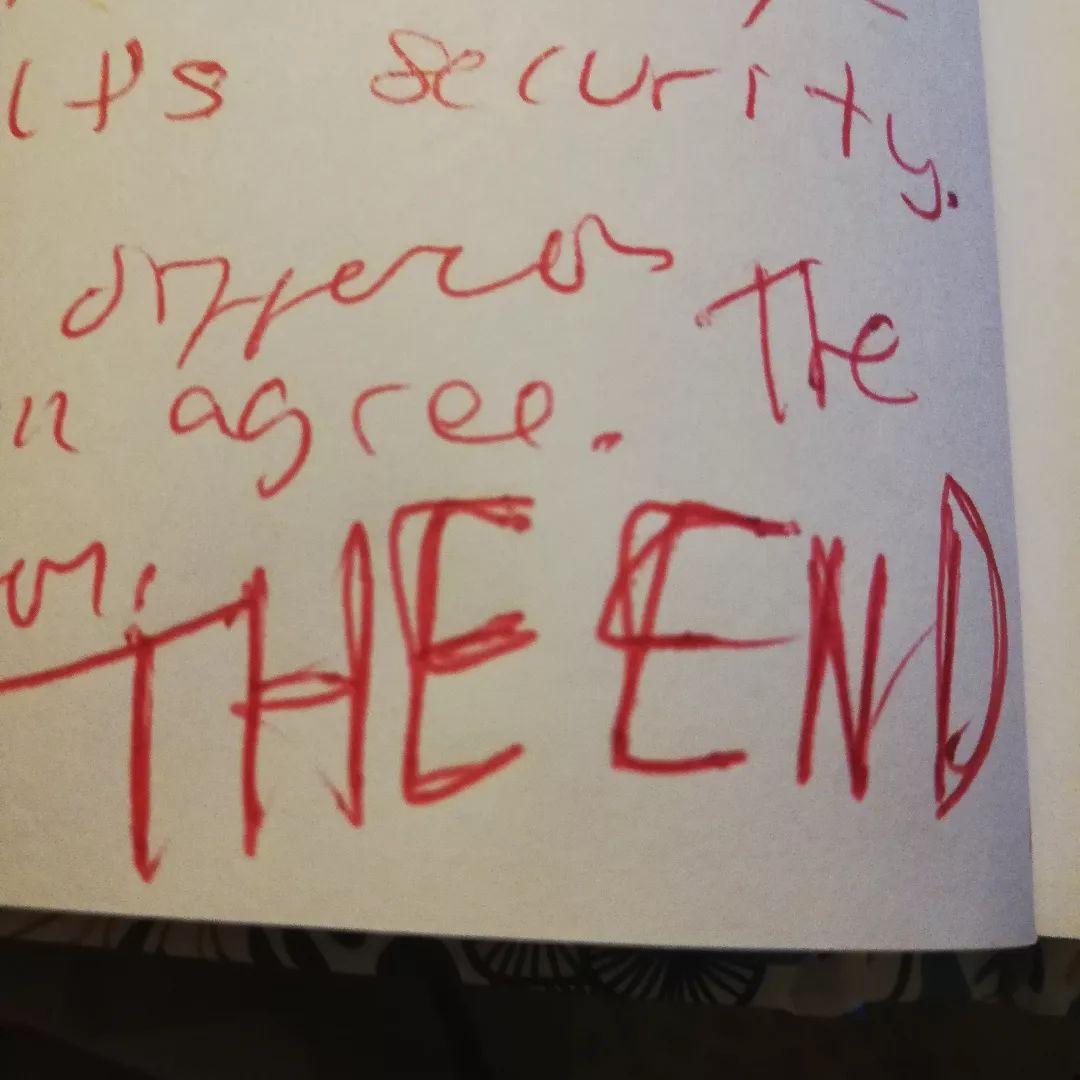
Knowing how it would end spurred me on and I wrote several chapters last weekend, just trying to get it down. Finally, on Monday night I wrote the last chapter, the last paragraph and the last sentence, followed by those delicious, victorious words; The End.

I felt amazing. It always feels amazing to know you have got there. You didn’t give up. You battled through plot holes and writer’s block of varying degrees, time constraints, lack of energy and all the other books wanting you to work on them! I did it! I was so happy, so excited and I still am.

Now though, the real work begins. For the end is really the beginning. I have a town, some characters, (all of whom need fleshing out, particularly with work on their families and back stories) I have a plot I really need to check through, ideas I need to embellish, scenes I need to add and a whole lot more. In short, the second draft will feel like the real story is being written. What I have here in these five scruffy notebooks, written in my horrific handwriting, covered in question marks and lines and arrows and bubbles of thoughts, is a skeleton waiting to be fleshed out. Waiting to come fully alive. I have the bones of a story, the beginnings of characters, and the idea of a world.

The second draft is my favourite because you find out what you have done. At this point, I am excited and in awe and I feel a bit like someone else wrote it! Was that really me, filling notebook after notebook, at night, in the car, while cooking dinner, by candlelight? Yes, it was me, but I feel like the real me is the one who has to now pick this thing apart and make it shine, make it work. The real work starts now. Well, not immediately now because I am going to give myself a break from it to let it breathe, and so that I can pay the same level of crazed addicted energy to my other WIP.

The first draft is a slog; a hesitant crawl to the finish line plagued by self-doubt and blocks of all sorts. It’s a battle, no doubt. The second draft is seeped in victory but its where things start getting technical. I am really, really looking forward to it. I know there will be countless drafts after the second to really polish it up, respond to beta reader feedback, edit, revise, edit, proofread and so on. But the second draft is all mine. It’s me and this book alone in a room and I cannot wait to get started!

How To Keep Going When Your Story Gets Stuck

When you first get a solid idea for a story, it feels exciting, like anything could happen. You write it down, start building on it and thinking about it. You start crafting character bios and researching locations. You put the work in and hope that when the time comes to start, the words will just be there, waiting to flow. Starting the story is sometimes the trickiest and scariest part of writing. There are so many things to figure out, for example. What point of view to tell it in, what tense to use, how to structure the plot, how to keep up the pace and so on. Once you get past the start, it feels easier. You have a great idea, you’ve put the work in and you’ve worked out how and where to start it. Then, you get stuck. Inevitably, you run out of steam, or get lost, or run out of energy or get some form of writer’s block…

Don’t worry if this happens to you – it’s very common! This is the really tricky part, you see, the part where the whole thing could get derailed and fade to nothing. This is the danger zone, potentially at least. So many stories never get past this point and so many writers of all ages and abilities give up when this happens and move on to something new. Because new is exciting right? And chances are, there is another great idea knocking around inside your head! I see this all the time with young writers and it was a trap I fell into too at that age. So, what can we do to avoid it? How can we get a stuck story unstuck? Here are a few ideas that have worked for me over the years.

  • talk it out – find a willing friend, family member or even a fellow writer to talk to about it. This has helped me numerous times over the years. As the writer, you are so connected to the story it can be hard to separate yourself enough to stand back and figure things out. Sometimes just talking to someone else about your story can be enough to get it going again. They might suggest a way out of a plot hole if you are lucky, but even so, sometimes just relaying the story to another person can be enough to get you inspired again.
  • go back to the start – You might not be sure why you are stuck but going back to the start can be really helpful. Read it through, edit, get invigorated by what you’ve already written and hopefully inspiration will hit you again
  • try to figure out what the problem is – It is important to try to figure out why are you stuck, because there are so many potential answers. Are you bored of the story, if so, why? Are the characters flat? Do you need to do more research? Has the plot unravelled? Or is your attention being stolen by a new idea?
  • be honest with yourself – it’s vital to be honest with yourself if you want to get this story going again. Does the story flow? Is the pace fast enough for the genre? Are your characters fully fleshed or do they need a bit more work? Being honest with yourself at this stage is difficult because acknowledging that something is wrong with the story means you are going to have to redo things! But it will be worth it.
  • experiment – If you have been honest with yourself, you may now have figured out what is wrong with the story, or what is stopping you from writing it. Perhaps you need to change something, for example, the narrative point of view or the tense it’s written in. This means more work but experimenting could be the answer to getting unstuck so it is worth exploring.
  • go for a long walk and try to figure it out – This always works well for me. Long walks alone or with my dogs tend to get my brain whirring again. It’s definitely preferable to sitting in front of a blank screen for too long. Go for a walk and see what happens.
  • have a break and write something else – If your story is stuck, rather than giving up and writing a new one, why not try tackling a different form of writing, like poetry or non-fiction? This way you are still writing, and it will feel fresh to try something new, but you won’t be fully abandoning your story. You will just be having a little break from it while you try something else creative.
  • remember why you started it in the first place – Ask yourself what made you start this story in the first place, why was it important to write? What were you trying to say and why? Sometimes reminding ourselves of why we started can give us the push to carry on.
  • write a bit each day – When writing gets tough we can either give up and walk away or we can keep battling through it. The best way to do this is just to write a little bit of it each day. Even if it is just a paragraph, even if it is just a sentence! Even if it doesn’t really move the story on and doesn’t solve why you are stuck – just try writing a tiny bit, a few words each day to move it forward. It is possible to write our way through a hump or a block.
  • remember it doesn’t have to be good yet – sometimes we get stuck because our first draft feels so clumsy and ugly. It doesn’t feel as if it is going well. But remind yourself that it is just a first draft! It can be messy and chaotic, it can have notes and bullet points and question marks all over it. It doesn’t matter. The first draft is just you telling the story to yourself. Getting it out of your head. Getting it done so that you can start to polish it up in the second draft.

These are all things that have helped me get unstuck in the past. I hope it keeps you going too! Feel free to leave a comment. What helps you when you are stuck with a story?