The End Is Really The Beginning

Over the weekend my excitement and sense of victory was growing.

I was ever closer to finishing the first draft of one of my current WIP’s, Black Hare Valley. To recap, I had the idea for this book a few years ago. At the time, my son and I were both reading Stephen King’s It and enjoying the new film adaptations of the story. I suddenly had an urge to pay homage to the master of horror by penning a story set in a weird and eerie little town, where unlikely heroes (ie teenagers) are pitted against forces of evil. That was all I had. I wanted to create a town though and came up with the idea of Black Hare Valley. This was because I am rather obsessed with hares. Around this time we had also visited a well known iron age hill fort and after a bit of research on folklore and magic, my ideas started to grow. But what we needed first was a map. So, my son and I rolled out a long piece of paper and together created Black Hare Valley. It was so much fun, and as the town grew, so did my characters and their lives. That was as far as it went at the time. I was busy on other books and my son didn’t want to help write it. I folded up the map and tucked it inside the notebook alongside some ideas, research and character bios.

Around three years later, last February we had a 5 day power cut and a two week internet cut. This made it impossible for me to continue editing my 4-book series ready for release (The Day The Earth Turned) or work on what was my current WIP, the spin-off book from The Boy With The Thorn In The Side; working title At Night We Played In The Road…

With no TV or internet, surrounded by candles and fairylights, I decided to pick up that notebook and unfold that map. I had an idea of how and where to start the story and thought I would just kill some time by writing the first paragraph. The paragraph morphed into a chapter, followed by another, and another, and another. I was then fully immersed and addicted and before I knew it, I had filled a notebook and started another. Since then, I have been scribbling down this story most days. There was a three week break in May where I concentrated on editing priorities and the release of the book I co-wrote with author Sim Sansford, (Hangman’s Revenge.) Also, I was abit stuck.

I had reached a point where I seemed to be heading towards some sort of climax but at the same time, I wasn’t sure what it would be or how it would happen or even what it would mean. This stuck feeling was made worse by the fact I had not yet gone back and read through anything I had written. It’s easier to do this when using Word on the laptop – with a scruffy notebook and illegible handwriting, it’s a bit tricky. So I just kept going, adding notes, extra ideas and so on to the front of the first notebook where my planning and character bios were. One day on a long walk I got the ending in my head and it all made sense. I was nearing the finish line and it felt great!

Knowing how it would end spurred me on and I wrote several chapters last weekend, just trying to get it down. Finally, on Monday night I wrote the last chapter, the last paragraph and the last sentence, followed by those delicious, victorious words; The End.
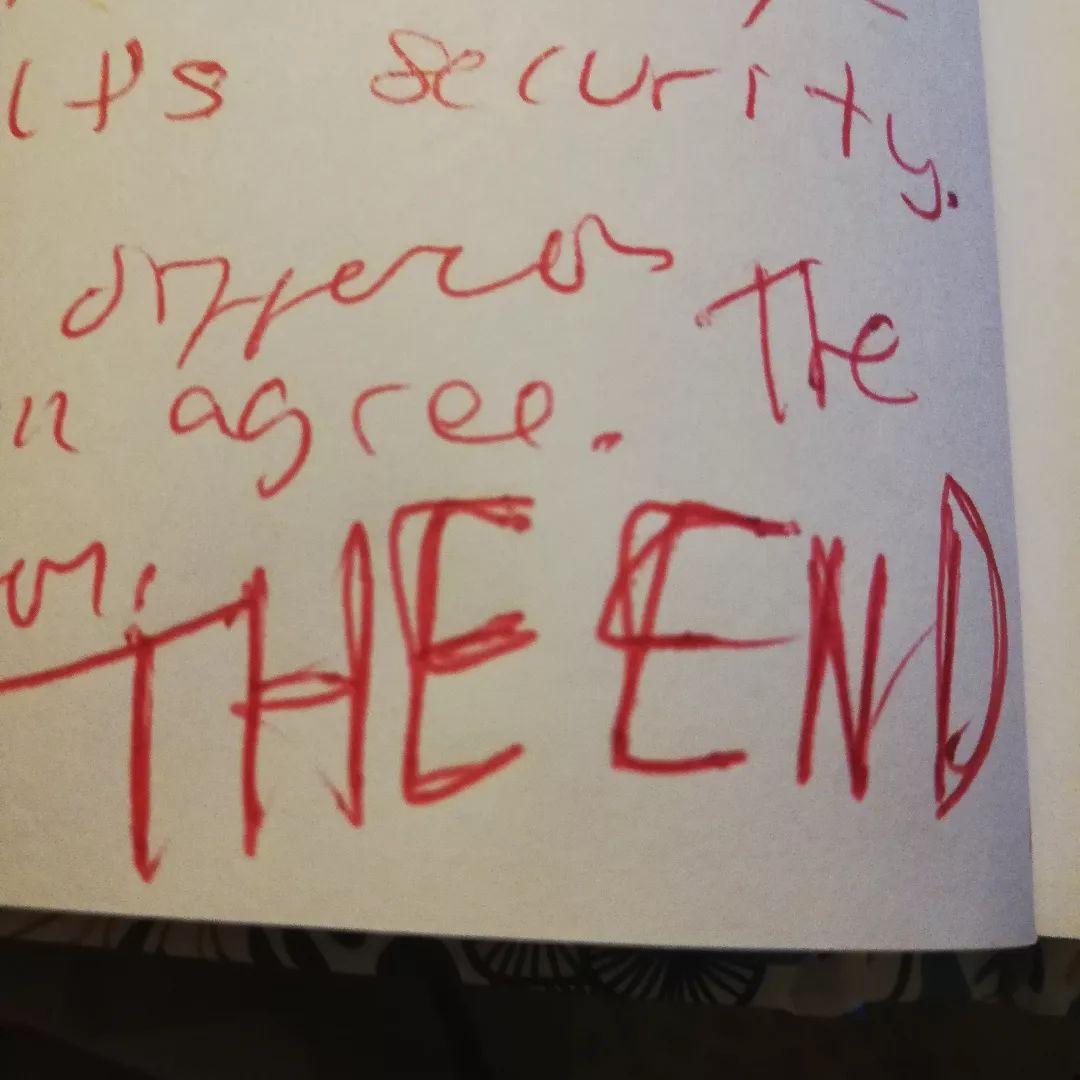
I felt amazing. It always feels amazing to know you have got there. You didn’t give up. You battled through plot holes and writer’s block of varying degrees, time constraints, lack of energy and all the other books wanting you to work on them! I did it! I was so happy, so excited and I still am.

Now though, the real work begins. For the end is really the beginning. I have a town, some characters, (all of whom need fleshing out, particularly with work on their families and back stories) I have a plot I really need to check through, ideas I need to embellish, scenes I need to add and a whole lot more. In short, the second draft will feel like the real story is being written. What I have here in these five scruffy notebooks, written in my horrific handwriting, covered in question marks and lines and arrows and bubbles of thoughts, is a skeleton waiting to be fleshed out. Waiting to come fully alive. I have the bones of a story, the beginnings of characters, and the idea of a world.

The second draft is my favourite because you find out what you have done. At this point, I am excited and in awe and I feel a bit like someone else wrote it! Was that really me, filling notebook after notebook, at night, in the car, while cooking dinner, by candlelight? Yes, it was me, but I feel like the real me is the one who has to now pick this thing apart and make it shine, make it work. The real work starts now. Well, not immediately now because I am going to give myself a break from it to let it breathe, and so that I can pay the same level of crazed addicted energy to my other WIP.

The first draft is a slog; a hesitant crawl to the finish line plagued by self-doubt and blocks of all sorts. It’s a battle, no doubt. The second draft is seeped in victory but its where things start getting technical. I am really, really looking forward to it. I know there will be countless drafts after the second to really polish it up, respond to beta reader feedback, edit, revise, edit, proofread and so on. But the second draft is all mine. It’s me and this book alone in a room and I cannot wait to get started!


How To Keep Going When Your Story Gets Stuck

When you first get a solid idea for a story, it feels exciting, like anything could happen. You write it down, start building on it and thinking about it. You start crafting character bios and researching locations. You put the work in and hope that when the time comes to start, the words will just be there, waiting to flow. Starting the story is sometimes the trickiest and scariest part of writing. There are so many things to figure out, for example. What point of view to tell it in, what tense to use, how to structure the plot, how to keep up the pace and so on. Once you get past the start, it feels easier. You have a great idea, you’ve put the work in and you’ve worked out how and where to start it. Then, you get stuck. Inevitably, you run out of steam, or get lost, or run out of energy or get some form of writer’s block…

Don’t worry if this happens to you – it’s very common! This is the really tricky part, you see, the part where the whole thing could get derailed and fade to nothing. This is the danger zone, potentially at least. So many stories never get past this point and so many writers of all ages and abilities give up when this happens and move on to something new. Because new is exciting right? And chances are, there is another great idea knocking around inside your head! I see this all the time with young writers and it was a trap I fell into too at that age. So, what can we do to avoid it? How can we get a stuck story unstuck? Here are a few ideas that have worked for me over the years.

  • talk it out – find a willing friend, family member or even a fellow writer to talk to about it. This has helped me numerous times over the years. As the writer, you are so connected to the story it can be hard to separate yourself enough to stand back and figure things out. Sometimes just talking to someone else about your story can be enough to get it going again. They might suggest a way out of a plot hole if you are lucky, but even so, sometimes just relaying the story to another person can be enough to get you inspired again.
  • go back to the start – You might not be sure why you are stuck but going back to the start can be really helpful. Read it through, edit, get invigorated by what you’ve already written and hopefully inspiration will hit you again
  • try to figure out what the problem is – It is important to try to figure out why are you stuck, because there are so many potential answers. Are you bored of the story, if so, why? Are the characters flat? Do you need to do more research? Has the plot unravelled? Or is your attention being stolen by a new idea?
  • be honest with yourself – it’s vital to be honest with yourself if you want to get this story going again. Does the story flow? Is the pace fast enough for the genre? Are your characters fully fleshed or do they need a bit more work? Being honest with yourself at this stage is difficult because acknowledging that something is wrong with the story means you are going to have to redo things! But it will be worth it.
  • experiment – If you have been honest with yourself, you may now have figured out what is wrong with the story, or what is stopping you from writing it. Perhaps you need to change something, for example, the narrative point of view or the tense it’s written in. This means more work but experimenting could be the answer to getting unstuck so it is worth exploring.
  • go for a long walk and try to figure it out – This always works well for me. Long walks alone or with my dogs tend to get my brain whirring again. It’s definitely preferable to sitting in front of a blank screen for too long. Go for a walk and see what happens.
  • have a break and write something else – If your story is stuck, rather than giving up and writing a new one, why not try tackling a different form of writing, like poetry or non-fiction? This way you are still writing, and it will feel fresh to try something new, but you won’t be fully abandoning your story. You will just be having a little break from it while you try something else creative.
  • remember why you started it in the first place – Ask yourself what made you start this story in the first place, why was it important to write? What were you trying to say and why? Sometimes reminding ourselves of why we started can give us the push to carry on.
  • write a bit each day – When writing gets tough we can either give up and walk away or we can keep battling through it. The best way to do this is just to write a little bit of it each day. Even if it is just a paragraph, even if it is just a sentence! Even if it doesn’t really move the story on and doesn’t solve why you are stuck – just try writing a tiny bit, a few words each day to move it forward. It is possible to write our way through a hump or a block.
  • remember it doesn’t have to be good yet – sometimes we get stuck because our first draft feels so clumsy and ugly. It doesn’t feel as if it is going well. But remind yourself that it is just a first draft! It can be messy and chaotic, it can have notes and bullet points and question marks all over it. It doesn’t matter. The first draft is just you telling the story to yourself. Getting it out of your head. Getting it done so that you can start to polish it up in the second draft.

These are all things that have helped me get unstuck in the past. I hope it keeps you going too! Feel free to leave a comment. What helps you when you are stuck with a story?

The People In My Head

Being a writer means spending a lot of time observing people, writing down ideas, getting plot twists hit you in the middle of the night, hours leaning over a laptop keyboard pounding away and just as many hours staring helplessly at a blank screen. It also means editing, revising, proofreading and then all those on repeat. But one aspect of being a writer is a little less talked about and that is the phenomenon of having people living inside your head. And it really does feel like they live there. They don’t go away. Not for me anyway, not ever. All the books I have released have characters who at some point in my life have crawled inside my brain and set up camp. They’ve ignored the fact I am already working on a book and they have whispered and nudged and shouted and whined until they got their turn. You would think that once I have given them attention and written their story they would leave me alone, but you would be wrong. They stay there forever and sometimes pipe up again with ideas for a sequel… Writing their story does seem to shut them up a bit though. They seem happy enough to step back and take a back seat for a while. I guess they get bustled out of the way by all the desperate new ones. I have all my old characters in my head, and then I have the new ones too. These are the really noisy, insistent ones. They all want to be next. They overlap and jump the queue and keep me awake at night. They make it hard for me to concentrate on what people in real life are doing or saying! They distract me and overwhelm me and ultimately, they don’t stop talking until they feel they have been heard. So, as well as the old ones, these are some of the new characters I currently have living in my head. You’ll get to meet them all properly in time, but here is a sneak peek, if you like. Maybe introducing them to you will give me a little respite from them!

Hello Johnny – I know you are still there, still lurking, hovering, muttering in the background. I know you have bad asthma and are massively introverted so highly unlikely (at least in your dad’s eyes) to survive a zombie apocalypse – but once you are forced to move and act, you’re going to prove them all wrong aren’t you? You’re going to become a total bad-ass and a hero. Don’t worry, I’ve got the story, all of it, some of it in the notebook and the rest of it in my head because you’ve been very vocal lately. You’ve been through a lot already and you are a survivor. You are secretly in love with Billie, the girl in the cloak you met on the road – and you feel like its important to put down every single undead human even if it means risking your life to do so. A part of you enjoys all this and its that which keeps you awake at night. You are trying to get back home back to where you started, to wrestle it back from those who forced you out. Because you can do it now. You are not afraid. I’m listening, I am. Keep talking, keep moving, keep telling me your journey.

Reuben, Gus, Chess, George, Charlotte.…Gosh there are a lot of you. A whole community, in fact. Picking up the pieces after the adults were wiped out. I’ve left you alone for a while. I needed a break. But you’ve been creeping back, haven’t you? Letting me know that you are still there, hanging out in the remains of the old world, clinging to what you can, surviving, together. I love you all. I can hear you. It’s nearly time for you all to be heard.

Jesse, Willow, Jaime, Ralph, Paddy… yep, I can hear you too. I tried to shut you out for a long time but you guys really started hammering on the door recently didn’t you? I had you, I had your creepy town Black Hare Valley, but I didn’t really have the plot. But you guys started helping me with that and here we are… I’ve got the end in sight now, I know what you have to do, who you have to take down, why and how. It’s going to be quite a fight but you guys are stronger than you think. We’ve still got a lot of work to do as you come alive inside my head. So, keep talking. Knock back. Whisper in the night. Speak up on long walks. Let me know what you want and we’ll keep pushing to the finish line, I promise.

Alfie and Tom… You’ve been getting some attention recently. I’ve been plodding on, listening to you, looking back into your past to see you as children, to see what shaped you to become the men you are today. It’s been interesting, and traumatic, but we are getting there. Sometimes just a paragraph a day, sometimes more. You’ve been in my head for years! It was when I was writing the fifth book in The Boy With The Thorn In His Side series that you came forward, shyly suggesting your own storyline, your own place in that last book. You became so real, so much a part of that world, that I just had to give you your own book, your own time, your own back stories. I’m getting to know you better and I like that.

Lou… I know, I know, I started your sequel, then left it, started it then left it…. I’m sorry! All these other people started showing up, demanding their own time, desperate to be heard. I’ve got it all though, so don’t worry – I know what happens and I am sorry – It’s going to be another tough ride for you, maybe your toughest yet. You’ll grow up in this sequel, both you and Joe. Keep talking, I am still listening. You might just have to shout a bit louder than the rest of them!

There are others too. Once who don’t even have names yet… They wander in from time to time, muttering and shaking their heads. They’re not loud enough yet but one day they will be.

How To Support The Author In Your Life

You know an author. A writer. One of those weird, probably quite awkward and introverted people who like to make up stories for a living. This author you know would absolutely love it if you were a fan of their books, if you read them, reviewed them, recommended or raved about them. Of course, they would, who wouldn’t? But let’s face it; that’s highly unrealistic and there are many reasons why an author’s close friends and family don’t do this. If you like this person though, there are other ways you can support them – but first lets get some common assumptions about authors out of the way.

One of the reasons you might think you can’t be of any help to them, is because of the assumption that they are making an actual living out of writing books. Unless they are one of those famous authors that everyone has heard of, and whose books get made into TV shows and movies, then you can almost certainly guarantee that they have an actual job. A proper job to pay the bills because there is no way in hell that selling their books pays the bills. The average annual wage of an author who has given up the day job is about £11,000, so you can see why so many carry on to work in various jobs to make ends meet.

You might also think they have a budget for marketing and advertising their books, because obviously, these things don’t come for free. In reality though, even traditionally published authors don’t get much help marketing their books. They have to do the bulk of it themselves, any way they can, just like indie authors do. And chances are, they don’t have any budget for this. Chances are, if they do fork out for paid adverts, blog tours, social media blasts, etc, they are doing it with money they really don’t have. Once they have paid for editing, proofreading and front covers, the indie author is already well out of pocket. Authors are not rich. Never have been.

All that aside, you can help support the author in your life in several, easy cost-free ways.

You don’t have to buy their book, read or review it – though obviously they would be over the moon if you did! It might not be your genre. You might not be much of a reader. You might not have time to read. You might be worried your author friend/relative is not very good – and it would be awkward if you discovered that by reading their book. You might think its all a silly waste of time. Either way, I’ll say it again, you don’t have to read their book just because you know them and it appears that this is generally the case with most authors. Since I started my own publishing journey back in 2013 I have constantly been told by other authors that their friends and family don’t support their writing. If I ask what they mean by this, I’ll be told a number of things; some writers have brutal people in their lives who tell them to their face that writing books is a waste of time, so they know full well not to count on these for any support when they are promoting a new book. But usually it’s simply that the friends and relatives don’t notice it or talk about it. They change the subject if the author mentions their books. They neglect to like, comment or share any of the authors posts. It’s a bizarre phenomenon and I never truly realised how many authors it effects until I started digging. I used to think it was just me but now I know it’s a bigger issue and it fascinates me.

Because let me tell you, if this author you know is your friend and/or your relative, they have noticed your lack of support and without a doubt it bothers them. They wrestle with it. Are they too in your face? Are they posting about their book too much? Are they annoying you? Have you read their work and scoffed at it? Do you secretly hate them? They will be thinking this!

To conclude, you don’t have to read or like their books. They probably write in a totally different genre to the one you read in, but you could really make a difference to their self-confidence, their reach, their visibility and yes maybe even their pocket if you supported them in other, smaller ways:

  • Like their posts – it helps them reach more people. It only takes a second to click ‘like’ and it will mean so much to them.
  • Comment on their posts – even a thumbs up or well done will be much appreciated and again, it will help the post reach more people.
  • Share the post! – Probably the most helpful thing you can do apart from reading and reviewing their books. You might not want to read it, but people you know might like it, or people they know! Share the post and see how far it can go. You could be making a huge difference and they will be forever grateful and less likely to give up on their dream.
  • Follow their page or other social media platforms -You could just follow one and again, the odd like, share or comment will help their page reach more possible readers.
  • Read and review the book – This need not cost you anything either. If money is really tight but you would still like to support your friend or relative, you could request a review copy for free and I can guarantee they will be delighted to gift it to you, especially if you leave a review afterwards. Or again, you could share pictures or links for the book to help them reach more readers.
  • Ask them about their book – the easiest and cheapest thing to do to support them. Authors love talking about the worlds and the characters they have created, so why not let them indulge from time to time? It might even be interesting!

So, there you have it. Easy, cheap or free ways to support the author in your life. I can promise you it will mean everything to them to know they can rely on your support. Writers tend to be quite insecure people and as we have already discussed, there is very little in way of financial reward, so to know your close friends and family are ready to jump in and help push your book when it’s released is just the best feeling ever.