My Body Battles

(Warning…not strictly writing related…unless you have read The Mess Of Me or intend to one day…Monday was World Mental Health Day and this post is somewhat inspired by that.)

I feel like I have always been at odds with this flesh covered vehicle of transport I call my body.

I think the only time we’ve been on the same side is when we were trying to push out babies. (Although possibly not during the fourth labour, but that’s not a story anyone wants to hear today!)

I remember how I viewed this casing of skin as a child. I can’t remember ever feeling like it fitted me right. It always felt too big. I can clearly recall being about eight years old and noticing the thin, brown arms of a boy sat close to me in the classroom. They were like little brown matchsticks, and when I looked back at mine they seemed too big in comparison. I couldn’t understand why. They were just too fleshy…just too much.

When I was about ten my body began to develop. I had womanly curves whilst still playing with Lego. I hated it. And I hated all the friendly euphemisms for being a big child as well. ‘You’re a big girl, aren’t you?’ ‘It’s just puppy fat.’ Ugh. I didn’t really want to be a fat puppy, funnily enough.

As I grew I became increasingly aware of my unwanted flesh. I had breasts that jiggled and moved. I had hips and a bum. I had rolls of fat when I bent over or squished up. None of it felt like it belonged to me. It all felt like it needed to be shredded.

The weird thing is, if I look back at old photos of me, I really wasn’t as big as I thought I was at the time. I had a brother and two sisters who were all like stick insects, and I was bigger than them and I looked big for my age, but I wasn’t really fat. I was just developing. Still, it was not the body I wanted or felt I should have, and that feeling has never really gone away.

As a teenager my weight went up and down, and more often than not, I simply loathed the human suit I was forced to wear. I wanted to unzip it and step out, revealing the true me. I would have long, thin, shapely legs. Matchstick arms. A flat, hard belly. A neat, trim waist. Angles on my face. I would shed my skin and emerge looking like the girls I saw on TV and in magazines.

At one point in my teenage years, I submitted to my body and gave in. I hated sports because I felt so fat and slow, so I avoided them like the plague, shut myself away in the imaginary worlds of books and writing, and hence got bigger. I thought I was stuck with this flabby cage forever. I did not want people to see me. I often wished I could cease to exist.

During my later years as a teenager, a full on battle commenced. Much like the one Lou goes through in The Mess Of Me. I went to war with my body. I fought back. I kicked its arse and got control of it. I aimed to change it and remould it, to make it into something I could be proud of. It all started off sensibly enough, but as you can imagine, it soon all got rather messy.

I figured out ways of fighting back and rebelling. I told my body to fuck off. I discovered ways I could eat without getting fat. I figured how easy it was to just not eat at all. I realised that I could run and that once I started, it was hard to stop. So I ran faster and faster and faster, doing all I could to outrun the fat girl, to leave that chubby loser far behind.

During my early twenties, this battle continued. It’s fair to say I treated my body like utter shit. I hated it and felt like it hated me. We would never be friends. I would punish it any chance I got. Away from parental control, my University days were not good for me at all. I became obsessed with feeling hungry. With feeling for ribs and hip bones, with feeling the enthralling darkness of pleasure and fear. At my thinnest, I got more compliments than ever. I got noticed by boys, flirted with, asked out. Things that had never happened much when I was bigger. I loved it when people told me how much weight I had lost. I went to a family wedding and people did not recognise me. The only thing that ever scared me into eating  was each time my periods stopped…and only because I was desperate to be a mother.

I’ve always said having children saved me from myself, and it’s true. The first pregnancy we had ended in a miscarriage and I was devastated and completely blamed myself. I’d still been exercising, still watching what I ate, still waging war with my flesh.

The second pregnancy was a success and in the years that followed I threw myself into being the best mother I could be, and although I worked hard to get my body back, it didn’t occupy my mind in quite the same way as it had. There just wasn’t time. Through pregnancy, birth and breastfeeding I did, at last, learn to feel pride in my body. It wasn’t just a clumsy machine to be hated and abused, it was actually quite amazing. It could grow a baby. I could feed and sustain and nurture a life. Although I am far from happy with my body today, I do feel an element of pride in wobbly bits and stretch marks. They are part of who I am and what I have chosen to do with my life.

I’ve struggled over the years not to return to the old, messed up me. I was lucky enough to receive therapy before I became a mother, and I truly believe that opportunity set me on the correct path of health and fitness and sensible attitudes.

The thing is, you can’t hurt yourself when you have children because you realise that if you did, you would also be hurting them.

And now here we are. Me and my body which is fast approaching it’s fourth decade and still feels to me like it’s not really mine. I can’t say that we’re friends yet. In fact, lately it has been frustrating me more than  ever. It just won’t let me lose weight. I swear it feels like it’s getting revenge for those years of punishment. It’s getting its own back on me. It’s hanging onto the baby weight my two-year-old left behind like there is no tomorrow. He was a large, overdue, ten pounder who has certainly left his mark. There is fat to spare and my body wants to keep it all! It’s not making milk any longer, but it won’t let the post-baby body shrink no matter what I do.

This battle has been ongoing for six months now, and I am starting to take things up a notch out of sheer desperation. I’ve barely touched a drop of alcohol. I am running and skipping almost every day. I don’t make excuses. If I have a cold, tough. If I only have ten of fifteen minutes, tough. My new motto is Do It Anyway!

Is it making a difference? Slowly. Oh, so…slowly.

My body is now a snail, a slug, a tortoise.

It sneers and rolls its eyes and tells me to fuck off.

I jump on the scales every Friday morning and wonder if they are in fact broken.

I get out with the dogs and run faster and further and harder.

I feel my jeans getting looser in the legs and around the waist.

And then the scales say otherwise…

I honestly don’t know what is going on. I mean, maybe it’s just me? Maybe I’m eating more than I realise?? Maybe there is something up with my metabolism!

I only know that I am not going to give up. I am not going to quit and say, okay body you win, I will accept this body wrecked and ruined by childbirth and age. I will take it and be grateful, and I will eat cake and drink wine and never mention it again.

But the problem is the mirror. The old enemy resurfaces. I can’t hold my head up high or look people in the eye when I don’t feel I’m in the right body.

I know it can’t be perfect, and to be honest, perfection was never really the goal. Just feeling happy with it was.


Writing Is An Addiction For Which There Is No Cure

And why would you want one anyway?

But it is this for me; an addiction, an affliction, a certain kind of mental state. Whether you are born with it, or cultivate it, or whether it just gets its claws into you one day out of the blue, the end result is the same.

Once it has you, it has you.

It’s an assault on your mind, an invasion of your inner life, your privacy. A constant influx of voices, people and ideas. You can’t shut it off or drown it out. Everywhere you go you see something or someone to write about.

Like the great man Bob Dylan once said ‘I’ve got a head full of ideas that are driving me insane.’

Never a truer word spoken!

72188459

So, I go out for a walk, I escape the laptop and the notebook, and the home, and this is an instant mistake. Because if I go somewhere quieter, the ideas and the voices just take advantage, and use this as an opportunity for a full scale invasion.

My defences are always too low. I am weak and helpless.

I can’t fight back, I can’t fight them off. In the end I always give in and roll over and let them come.  And they trample each other, they push and elbow their way in. And they never close the damn door behind them.

There is no security here.

I think this constant assault is an exciting privilege, and an exhausting one. Not to mention frustrating, causing panic, because life is only as long as it is, which is short. Very short. And there will never be enough days or hours or minutes to satisfy the constant invasion. Sometimes I want to put up a Closed sign. Be back later.

Anyway, I surrender. I give up. I am open and fully addicted. I am constantly thinking about writing, about the next chance I get to write, and how in many ways, I am always writing. If not with pen, then into my phone, notes for later, or in notebooks, or on scraps of paper, or just in my head. Words. So many words. Not always in the right order, but impatient and scrambling, sometimes hesitant and self-conscious, sometimes awesome and life affirming!

I couldn’t give it up if I tried. I can’t go cold turkey for even one day. I give myself Saturday’s off, but not really. More often than not I sneak onto the laptop anyway, even for a few minutes, or I’m writing in my notebook, jotting down ideas, adding dialogue to conversations, and if not, then it’s all in my head, being laid down bit by bit.

I wouldn’t exist without it. I couldn’t. It’s my oxygen. I need a little fix every day or I don’t feel like me.

Writing has helped me through so many stages of my life. Diaries, poems, songs, stories, novels, blogs, reviews. So many ways to write! So many opportunities to share your thoughts, feelings, and ideas, to offload your outrage and despair, or to channel aggression into something fictional. I find it so exciting, so exhilarating on a daily basis, like a mini adventure every day, not knowing where it will go or what will happen or who will be born or who will die!

Writing is an addiction for me and I wouldn’t have it any way.


It’s Not Done…Until It’s Done!

I often get asked how I know when the book I’m working on is finished. If you’ve been following my struggles with The Tree of Rebels, you will know that I have now lost count of the amount of drafts I’ve done of this book. It’s got to be up to ten, at least! The same applies to The Boy With The Thorn In His Side. There were so many rewrites and drafts of that book that I lost count completely, but at a guess, I would say it easily passed twenty.

This is not true of all my books however. I think there were five or six drafts of The Mess Of Me, only three of Bird People and Other Stories, and probably around five or six for both This Is The Day and This Is Nowhere. For some reasons, those books were just all kind of done by the third draft, and just needed proofreading and polishing after that.

So, how does a writer know when they are done?

yuno

Well, I sort of have a system. If you can call it that.

I’ll explain it using my current work in progress, Elliot Pie’s Guide To Human Nature. As you may already know, Elliot Pie has been written almost alongside The Tree Of Rebels, with me jumping back and forth between the two novels. If one was with beta readers, then I was working on the other one. If I needed a break from one, then it was the other one I’d stick with. Well, it now looks increasingly likely that Elliot Pie will jump past The Tree Of Rebels and become the next release. This is because I’ve decided to stick with it until it is done, and stop jumping between the two books. I also feel it is very close to being finished, much closer than The Tree Of Rebels, which requires a bigger rewrite, with added storylines.

But back to Elliot Pie. How do I know I’m nearly finished? Why is it likely to have a  lot less drafts/rewrites than other books? And how will I know for sure when it is truly ready?

It works a bit like this;

The first draft; ugly, clumsy, galloping, mad, hungry and glorious. An outpouring of ideas with a basic sequence of events, a strong theme, developed characters, all held together by an accompanying notebook of notes, dialogue, bios and so on. While writing, I constantly added items to a list in the notebook; things to add, (extra scenes or dialogue) things to question, research, embellish and so on, or things to reword or cut out. In other words, things to sort out on the second draft!

The second draft; in this case, a read through with a few minor corrections here and there with my list to help me. I was actually surprised by how happy I was with the first draft and at the time, figured I only needed to polish up spelling, grammar and maybe cut out a few bits here and there.

Beta readers; feeling exceptionally brave and over-confident, I made the unusual decision to send it out to two trusted beta readers at second draft. I wouldn’t normally do this so soon, but there were two important things I needed to get their opinions on before I proceeded. One, the tenses change. Elliot is written in first person POV and everything is in the present tense. The adults of the story are written in third person POV and past tense. Don’t ask me why. No decision was made! It just happened this way and I liked it. A lot. Luckily the readers didn’t actually noticed the tenses, but they did have feedback on other issues, such as the middle part dragging and certain bits feeling repetitive.

Third draft; scary, self-conscious, tail between legs, unsure what to do or how to do it. Slowly I came to terms with the critique offered and realised how true it was. I did a lot of cutting out, rearranging and rewriting. I also made a list as I went through, plus I was already using the list I’d made from the readers comments. Things got ticked off the list as I went, so I knew I had answered various questions, or researched particular parts in more detail. By the time I got to the end, I had a new list. I still hadn’t set up a timeline, and one was needed, due to the main character’s disappearance at the end of the novel. What day and time was he last seen and so on?

Fourth draft; list in hand, questions in mind, I tackled it again. Obviously I was correcting typos, spelling and grammar issues as I went through, as well as removing repetitive phrases or words. I had things to add and things to change, for example, I realised too many of the characters were only children, so I had to add a sibling here and there. I also added the timeline and made a list of the exact times and dates the events took place. I needed to exaggerate certain things, leading the reader a particular way, for example, making certain characters darker than they had been. I also added a new scene to the ending and rewrote the first chapter, tightening it all up and hopefully creating more impact. In fact sharpening things up and cutting things out went on a lot!

Fifth draft; (where I am now) another read through, this time on my Kindle. It’s amazing how many more things you pick up on when reading in a different format. Spelling and grammar for example are far more noticeable on an ereader! I’m making another list as I go through, advising myself to reword certain parts, cut out words here and there etc. In fact, quite a lot of my notes this time around involve just cutting words out that do not need to be there as they add nothing to the scene. There is also a separate list above my correction list, which I add to any time something springs to mind. So, for example, while out with the dogs today I realised that a certain object needed to be found and mentioned in a certain scene, as it would add impact and credibility. So far I have seven items on this list; things to add to dialogue and events, things I simply thought of while going about my daily business.

Sixth draft; I will go back to the laptop with this current list in hand, and go through the manuscript methodically correcting the issues, cutting out the words, adding the things I’ve thought of, and so on.

If by the time I get to the end of this draft, there is yet another list on the way, then I will know a seventh draft is needed. Of course there will also be an even more thorough grammar and spelling check, and a proofreading, which will involve sending it back to Kindle to pick up errors.
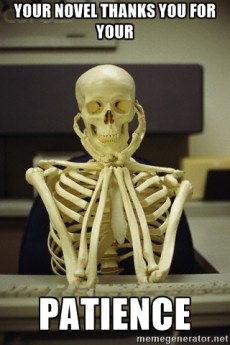
patience.jpg

So basically, I’ll know the book is as good as I can get it when there are no more things being added to the list! When the list is ticked off and stays ticked off, it will be done. But it also more than that. I have to have the right feeling about it. And as I have mentioned before in other posts, I have yet to have that feeling with The Tree Of Rebels, hence it being held back for now.

I have to feel completely happy, completely satisfied, not just about grammar and typos, but about the actual story. Are all the characters doing what I need them to do? Are they fully alive and realised? Could they walk off the page and into my house to converse with me about anything? Is the beginning interesting and powerful enough? Does it raise questions and curiosity? Is the middle doing its job; developing the story, but keeping a steady pace, keeping the reader coming back for more, making promises? And does the ending satisfy, as well as tie things up if need be? More importantly than all of this, does this book make me smile? When I read it, what is my face doing? I’m pleased to say that at this stage, it is making me smile a lot, and I simply cannot wait to share it with you. I hope all the hard work will be worth it and that you will fall in love with Elliot as much as I have!

Now, over to you! Please feel free to comment and share! Do you ever worry that your book will never get to see the light of day? How many drafts is too many? How do you know when it’s done?


Author Interview: Karl Beckstrand

Karl Beckstrand is an American author and public speaker with forty ebooks under his belt. He recently contacted me to see if I would be interested in reading and reviewing his award winning YA novel To Swallow The Earth. I readily agreed, as the book sounded so intriguing;  a suspense filled Western and Winner of the 2016 International Book Award, Literary Classics Seal of Approval, and 2016 Laramie Award Finalist. You can read my Goodreads review here. Having read and enjoyed the book so much, I wanted to know more and Karl kindly agreed to an interview. Here he explains how he came upon the original manuscript for To Swallow The Earth, talks about his journey so far as a writer and offers his advice to others. Enjoy!

1SwallowWestRGBmed.jpg

1) To Swallow The Earth is authored by yourself and Ransom Wilcox. Could you tell us more about who Ransom was and how you came to co-author the book with him?
Ransom Wilcox is my grandfather. I inherited his unfinished Y.A. manuscript. It’s suspense set in the Nevada silver rush–and it won a 2016 International Book Award (also a Laramie Award finalist). My grandfather grew up exploring the Sierra Nevada Mountains on horseback nearly a hundred years ago. My challenge was to develop his characters while preserving the action and authentic language.
2) How much work did you need to do in order to prepare the book for release?
Several months’ worth. He had Carson City as the opening scene, but the other communities were fictitious. I had to look up which real cities would fit his descriptions, develop the characters, fill in some gaps, and polish the overall story.
3) Will the story of Wade and Patricia extend into any more books?
I suppose that depends on how much demand there is for sequels!
4) When did you first know you wanted to be a writer?
It kind of took me by surprise. In college I would get ideas for books and scribble them down (when I should have been doing my homework).
5) Tell us about your writing and publishing journey so far. For example, which paths you have followed and why?
After college I joined a writer’s group and met a gentleman who wanted to publish one of my juvenile manuscripts. Unfortunately, he died the day we were to print. I got a crash course in publishing/marketing. One other publisher asked me to write a true story about an immigrant child. I knew about a girl in my family history who arrived in the USA alone, not knowing English. I developed the account—and then got hooked on family history. Now I’ve written several stories on immigrants and several multicultural books. I’m also working on a graphic novel and an audio version of To Swallow the Earth.
6) What is your usual writing process? Are you a plotter, or someone who starts writing and waits to see where it will go?
I try to write or research every day in the morning. I usually get most of the plot outlined right away, but twists and extra material often strike me at any odd time. For non-fiction I have to research and get the facts right, as well as create a good beginning, middle, and end. These books are rewarding to me because they preserve true acts of courage/faith for new generations to witness.
7) What advice do you have for a new author about to launch their first book?
To launch means you’re about to embark on a lot of marketing (even if you’re with a large publishing house, authors must do a lot of the publicity). If you’re just starting a book, write every day. Write from your heart—from what you know first-hand. Don’t try to write about something that you think is popular (unless that’s what you know). You don’t have to have an agent but you should always have a professional editor. Have several people critique your work—people who won’t gloss over glitches. These people can help you be your best.
8) Can you tell us anything about your next release? What are you working on right now?
I have a book in the works that teaches how to earn and manage money. It’s called The Bridge of the Golden Wood. It will have illustrations (kind of a parable) but I will market it as a business/how-to book.
9) What would you most like readers to take away from reading To Swallow the Earth?
Pure excitement: What if you came home after a journey and your family was no longer there? What if someone else was living in your house, running what you used to manage—and trying to kill you? Could a beautiful woman be behind it? Wade Forester has to stay in the shadows. His father has disappeared, and his sister won’t speak to anyone. Patricia Laughlin is searching for her family as well. Few people gain her trust or approval. Wade must decide if risking his life to help Patricia means aiding the enemy. And Patricia must choose a killer to trust with her life.
10) Tell us three interesting things about yourself
I was raised in paradise (San Jose/Silicon Valley) —the perfect climate, much like Valparaiso (Chile, where I lived for two years [LDS mission]). I have a bachelor’s in journalism (never planned to be a reporter) and a master’s in International relations. I teach media at a state college in Utah and speak on traditional vs. digital/self-publishing. I’m an arts/media junkie (music, art, films, books, theater—oh, and history!)
Karl Beckstrand
Premio Publishing & Gozo Books
Action & language books with black, white, Asian & Hispanic characters


Thanks again to Karl for agreeing to be interviewed! I truly enjoyed To Swallow The Earth and would highly recommend it to anyone who fancies something a little different! It certainly is a page turner, and incredibly visual. Beautiful, in fact. If you want to know more about Karl you can follow him on Facebook, LinkedIn, Twitter and YouTube. You can find his books on Smashwords and Amazon.