The Hitchhiker

A creepy short story

Image by Nils from Pixabay

He walked alone on the road ahead.

Arthur wondered if they all spotted the man at the same time, because it seemed that way. His mother, sitting forward in the passenger seat beside his father, lifting a finger, pointing. His father’s head jutting forward and a single surprised word falling from his lips.

‘Oh.’

And Arthur, his eyes widening as the figure came into sight, emerging out of the darkness ahead. He sat forward too, his fingers curling around the edge of the seat, his breath shortening in his throat.

The figure was tall, broad in the shoulders and wore a long dark coat and a wide brimmed hat. It made a strange sight, thought Arthur, as the car drew closer. Almost looked like a walking scarecrow. The man was using a stick to walk, leaning on it heavily as he trudged along.

‘We should stop,’ his mother said sweetly, as the rain hammered against the windscreen. ‘It’s so awful out there, Frank.’

Arthur saw his father nod, agreeing that it was.

‘No!’ he said sharply from the back seat. ‘We shouldn’t stop!’

His mother looked back at him with a frown and pouting lips. ‘Darling, it’s all right. He probably just needs a lift into town. We’re passing through on the way home. We can just drop him off.’

Arthur felt his teeth clench together. He shook his head at her but no words would come out. Instead all he could do was stare ahead at the figure on the road, as his father slowed the car. His heart throbbed weakly under his winter clothes and his eyes strained in their sockets as his mouth gaped wordlessly. Arthur had no way to articulate the raw fear he felt coursing through his small body.

‘It’s the right thing to do on a night like this,’ his father agreed, as the car caught up with the figure in the road. He rolled his window down as they drew parallel. ‘Do you need a lift, young fella?’

The man stopped walking and looked back at them in surprise. Arthur’s father stopped the car and put it into neutral. The stranger leaned down to see them all better. His eye caught Arthur’s and a smile crept slowly across his narrow face. It was too dark to see well, but Arthur saw sharp cheekbones and large teeth revealed behind thin lips when the man smiled.

‘That would be amazing, how kind of you!’ the stranger enthused. ‘I missed the bus, didn’t I? Was meant to be up in the mountains by evening, but that’s not going to happen now.’

‘What’s in the mountains?’ Arthur’s mother asked, her tone friendly while Arthur’s guts churned and writhed inside him.

‘My sister and her family,’ the man replied. ‘I’m spending a few weeks with them.’

‘Come on, get in,’ Arthur’s father prompted. ‘It’s getting worse out there. There’s meant to be a storm coming, you know.’ He nodded to the trees at the side of the road whipping wildly back and forth as a cold wind screamed through them.

‘Thank you!’ The stranger opened the back door and slid in beside Arthur. Rainwater flew as he took off his hat. ‘You okay, son?’ he asked him, patting his leg in a friendly gesture. ‘Look like you’ve seen a ghost.’

‘Oh, he’s just shy!’ Arthur’s mother laughed. ‘That’s Arthur, I’m Clara and my husband is Frank. It’s a pleasure to meet you.’

‘You too,’ said the man, as the car started off again. ‘I’ve been hitchhiking across the country and rarely have I met a family as friendly and kind as yours.’

Clara beamed at him. ‘That’s just lovely. Thank you, sir.’

‘We only live on the other side of town,’ Frank said then. ‘We can drop you off there if you like?’

‘But everything will be closed,’ said Clara. ‘What with the storm coming in.’

They drove on in silence for a while. Arthur sat rigidly, his eyes fixed on the silent black road. He felt the man relax beside him, leaning back slightly, his legs spread, his hands loose in his lap and the walking stick between them. Outside, the rain grew harder and fiercer and strong winds began to rock the car.

‘This is nasty,’ grumbled Frank, slowing down. ‘But we should make it, all right.’

‘Perhaps you could stay at ours tonight?’ Clara said then, turning to smile at the hitchhiker.

‘He’s a stranger!’ Arthur burst out, his gaze flicking between his mother and the man beside him. He side-eyed the man with a frown, but the man just shrugged.

His mother’s mouth fell open. ‘Arthur, don’t be so rude! What has got into you?’

The man waved a hand. ‘No, no, he’s right. I am a stranger and I couldn’t possibly put you to any more trouble. Town will be fine. I’m sure I’ll find somewhere open.’

‘Have you called your sister?’ Arthur asked him then, his voice thin and strangled with fear. ‘Have you got a phone?’

The man slid his hand into the pocket of his thick dark coat and brought out a slim mobile phone. ‘It’s dead, I’m afraid. Battery died hours back. It’s fine, honestly. I’ll be there by morning, no doubt.’

Arthur nodded silently. The car rolled on. The rain and wind intensified and as they drove through town, it became harder and harder to see.

‘Perhaps we should pull over, Frank,’ said Clara, looking nervously ahead.

‘Everything’s closed, as expected,’ Frank replied, grimacing back at her. He looked in the wing-mirror to catch the stranger’s eye. ‘Sir, we can’t leave you here in this weather. Come back to ours until the worst of it passes. We’ll light a fire, cook food, get warm. Then I can drive you up to the mountains in the morning if you like?’

Arthur wanted to look at the stranger. He wanted to shake his head at his parents and beg them, no, no, no, please no, but he couldn’t move. His lips quivered around his gritted teeth and his fingers dug into the seat so tightly his knuckles ached. It seemed like he had forgotten how to breathe.

The strange laughed softly. ‘I don’t think I can turn down such a kind offer. Thank you so much. That would be amazing.’

With the decision made, Arthur’s father drove on, following the black road until the town was far behind them. The stranger started to talk, engaging his parents in a conversation that ranged from bad weather, to unreliable public services, to how annoying his sister could be sometimes. The three adults laughed and swapped jokes and by the time they turned off the main road and rumbled onto the bumpy track that led to home, they seemed to have relaxed with each other.

Arthur’s bad feeling, meanwhile, bloomed in his chest until he felt like he had been drenched in ice.

The car stopped outside the house. ‘It’s a beauty!’ the stranger declared, looking up at the three storey Victorian building.

‘It’s a work in progress!’ Clara replied, unclipping her seat-belt. ‘We’re gradually updating and modernising it. It’s been in Frank’s family for generations, you know!’

‘I can’t wait to see inside,’ replied the stranger.

One by one they hopped out of the car and dashed through the driving rain into the house. Frank quickly set to work lighting a fire in the living-room while Clara hoisted a large iron kettle onto the stove to boil water for hot drinks.

‘I’ll start a soup,’ she called from the kitchen as the two men and Arthur knelt in front of the fledgling fire. ‘Warm us all up!’

‘This is wonderful,’ the stranger smiled, flames flickering in his eyes as he turned his face to Arthur and winked.

Arthur stared back at him. It was too late now and he knew it. A cold feeling spread through him and the pit of his stomach filled with dread but there was nothing he could do. Not now. Something awful was about to happen to them all and there was nothing he could do to stop it.

Arthur moved backwards when his father picked up the fire poker and brought it down onto the back of the hitchhiker’s head. The stranger never saw it coming, which Arthur supposed was a blessing. Sometimes they knew. Sometimes they changed their minds in the car, panicked or got a bad feeling but even then, there was no escape. Sometimes they turned their head at the last second and saw the poker coming. Sometimes they fought and bit and scratched and screamed and thrashed on the floor, but it always ended the same.

Later that night, Arthur sat in front of the fire while his parents watched TV from the sofa behind him. Their bellies were full. Their teeth stained red. Leg and arm bones joined the logs glowing on the fire and Arthur’s small belly was full of vegetables and flesh.
The Thing In The Woods

Creepy flash fiction

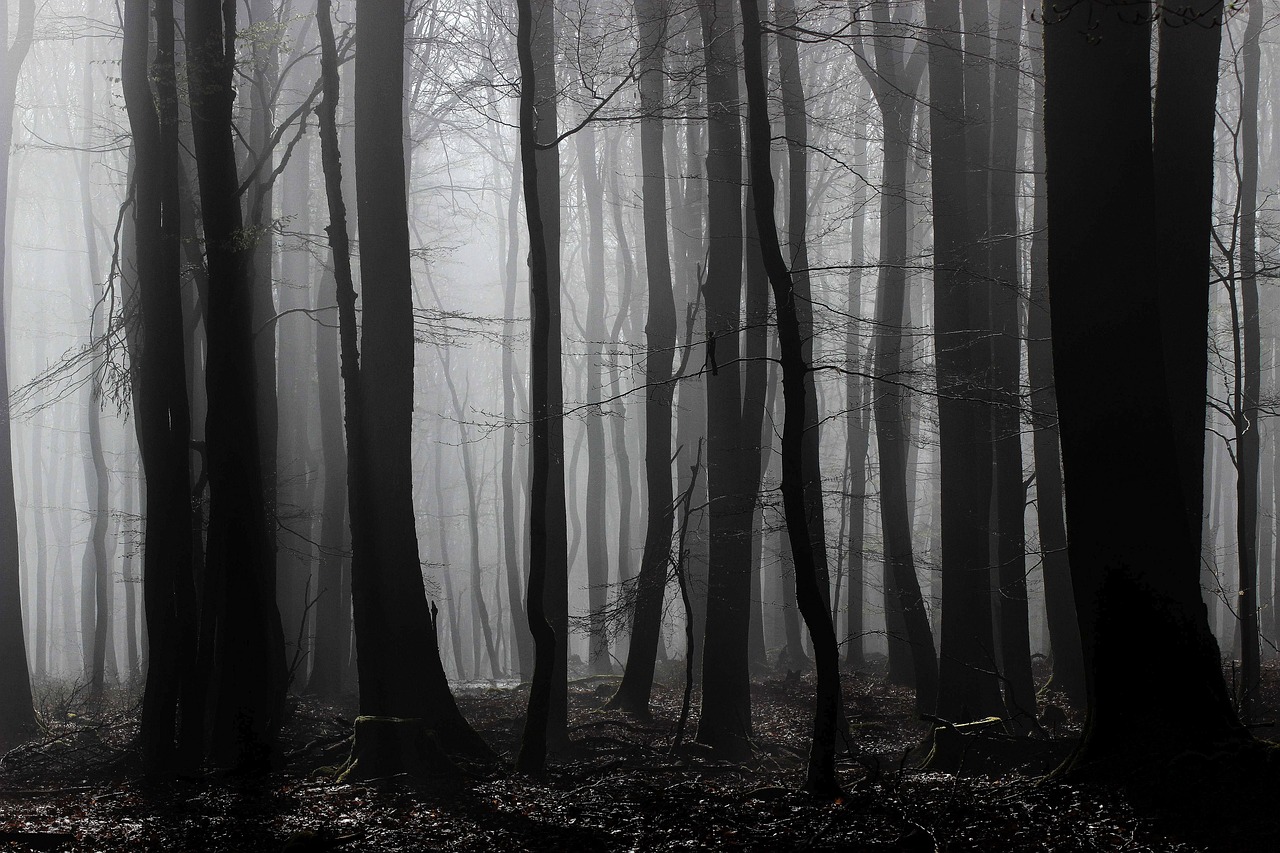
Image by barnabasvormwald from Pixabay

It’s there in the woods.

Dark grey, almost black, hulking yet skeletal, hunched yet clinging.

What does it want? Why is it watching?

I see him every day, when my little car climbs the steep hill and the autumn sun is blinding me through the fragmenting canopies of dying leaves.

I see him hunched and waiting, always watching, dark holes for eyes and something bright and sharp that forms a mouth.

I just get glimpses, just fragments of seconds. I can’t take my eye of the road for too long. I can’t neglect to respect the vehicle in front of me.

Perhaps that is what it wants…

To distract and dismay, to terrify and intrigue. Look its way for too long and you’ll lose your way, get distracted and drawn in, get lost. Maybe that is what it waits for. For the screech of brakes and the smell of burning rubber. For the skid marks on the road, for your dying hand lifting and falling. For scattered glass and broken bones.

The thing in the woods is impossible to fathom or classify. Is it ragged or smooth? On different days, in different light, I see one thing then another. Is it bony or fleshy? Are they folded wings on its bony spine or something else? Some growth or protrusion?

Is it scaly skin it wears, crumpled and dry, or is it matted fur I spy when I glance its way? There is a flash of something in its eyes, sometimes red, sometimes yellow. I know I’ve seen the hole that forms its mouth yawn and gape. I’ve seen silver flashes inside that dark chasm. I’ve sensed movement, something wriggling.

Its hands curl around the trunk of a silver birch tree. Sometimes the thing in the woods is further back… a shape in the background, a glint from its eyes, and sometimes it is almost at the roadside. But always it is clinging to a silver birch tree. Always it is upright and watching.

Always it is waiting.

The Shallows – a creepy short story

This is a story originally posted in my Medium publication, The Wild Writers Club!

The Shallows

July tipped into August.

It did so lazily, like the slow sticky drips from a forgotten ice cream.

The hot weather had dulled and bloated us. Like fat lazy flies we could not move. And the days all had that endless quality, like every hour was twice the length and we had stopped being ruled by clocks, and time.

We existed in our own timeless purposeless bubble. The sun had moved and taken our shade from it. The trampoline where we had lounged all afternoon was now a sun trap.

It was the heat and the boredom that drove us to the river. Not the big river, where there would be chaos and kayaks and fishermen and teenagers dunking each other under the water. We headed to the little river, to the shallows.

We strolled down the hot lane, shaded intermittently by oaks and limes and sycamores. They provided blessed shadows as our bare feet burned on the road.

No cars. No noise save the drone of a gigantic dragonfly.

We dragged sticks behind us and thought about how hot it was. It was always too hot to speak, so Pippa and I had almost given it up. Sometimes all we could think to say was how hot it was. Sometimes summer seemed to go on forever and you started to forget how to live in the normal world.

We took the left at Twisty Corners and it was still too hot to talk, despite the darkness that suddenly enveloped us from the trees above and around. They created a tunnel and we ambled down it sluggishly. Pippa was a year younger than me but we were both on the brink of something else.

‘You’re like a pair of foals,’ our dad always said, ‘all legs.’

We were caught in that no man’s land between childhood and adolescence. Everything the adults said and did suddenly annoyed us, yet we still tucked a soft toy under our arms when we went to bed at night.

We traipsed over the stone bridge, pausing lethargically to throw a stick in and watch it float out on the other side. There was nothing to say. Nothing to think. We plodded down the muddy bank, wincing as the overgrown nettles swiped our skin. And there it was. The shallows.

The water flowed slowly from under the bridge, then veered left channeling through a narrow stretch, the banks too high to climb. That way lay madness, I thought, but didn’t know why.

In front of us a great expanse of shining water undulated with the gentle current and we stood and marveled at it, at the way the light came through the canopy of hazel trees and lit up the shallows like a sprinkling of fairy lights.

The shallows had its own light; a unique blend of red and gold as the dappled sunlight broke through the leaves and filtered through water to the red earth below. We stood side by side, our toes curling into the mud, staring at it as if in a trance. Time slowed and we breathed in unison. I was about to tell Pippa I was bored when she gripped my arm and pointed.

‘What’s that under the tree?’

I looked to the right where a fallen tree stretched from one bank to the other. It came down a few years back and was slowly rotting away as the river washed over it in the winter and under it in the summer. Sometimes we’d sit there with our feet in the water, watching the tiny fish swim by as the electric blue damselflies flitted under the bridge.

view of a river shaded by trees with a fallen log across it and a stone bridge just visible beyond
my own photo

Pippa’s grip tightened. I pulled away and started to wade through the water. There was something lodged under the tree. It looked like a pile of clothes, inflated by the water; dark blue material ballooning against the gentle tide.

‘Someone’s thrown rubbish in again,’ I muttered, reaching the fallen tree.

It was then that I got the prickling sensation on the back of my neck. I put a hand there, self-soothing, but the feeling persisted until I lifted my gaze and saw the man standing on the bridge. I looked back at Pippa and shrugged. She splashed towards me and we stood side by side again, a united force.

I still held a stick and poked at the bundle of clothes with it. I felt self-conscious doing it, as the man on the bridge looked on, but when I gazed up again to see if he was still watching us, he wasn’t there. I nudged my sister.

‘Where’d he go?’

She shrugged and used her own stick to help me with the bundle of clothes. We used the sticks like hooks, trying to free the bundle which had become wedged under the log. We did it lazily, carelessly, poking and jabbing at this thing that had jarred our peaceful vision of the shallows.

That was when we realised it was not just a bundle of clothes.

It suddenly sprung free and floated by. Pippa and I turned slowly to watch it go. We were weary from the heat, as if all our senses and brain functions had been slowed down by sticky sweat. We saw the blue material followed by dark legs. We saw bare feet. We didn’t see a head.

We stood in the shallows, frozen. Our arms hung by our sides, our knuckles skimming the cold water, our fingers still curled loosely around our poking sticks. We didn’t say a word as we watched it go.

It passed the deep spot, the bit that always fooled our terrier Binx when he was alive. He’d paddle out brashly before suddenly finding no land beneath his paws as it dipped away brutally, trying to drown him. He’d sputter and panic and swim back and then he’d make the same mistake again next time.

It moved faster there, the current stronger, but ultimately driving it to the left, towards the narrow channel that we knew eventually met with the huge monster of the river Stour. It was sinking too; the water and the debris were filling the materials, dragging it down.

Still, we watched, Pippa and I, not saying a word, barely breathing as if we were not really there, and I could almost believe that to be true if it weren’t for the tiny sticklebacks circling my toes. I could almost believe if I closed my eyes and then opened them again slowly, I would find myself spreadeagled on my bed with the sun slanting down on me, or face down on the trampoline, exhausted by the endless heat.

The body moved on with some speed, spinning just once as it knocked against the end of another fallen tree. That was the moment I told myself I should have moved. I should have splashed my way over to the other tree, climbed on and made my way to the end. I could have hooked it again then. I could have snagged it and stopped it and Pippa could have called the police.

But it was like I knew I never would.

None of it felt real.

It looked less like a body now, just some blue material still visible as the current drove it towards the narrow stretch. I knew if it went down there we would not be able to follow. The water was unknowable, dark depths promising no foot holds or forgiveness. The banks were steep and slippy and we could never see where it ended. There was a darkness to that place, where the shallows became the deep. We never ventured there.

I also knew if it went down there it would more than likely sink or get snagged on something again, and I knew that no one would ever find it. No one would ever know. And there was something dark and delicious about that knowing.

I thought Pippa might say something. I thought she might cry out, pull my hand or say something. But she didn’t. When I turned my head to look at her, her expression was slack and dull. There was no wonder in her eyes, only a blunted acceptance. Her forehead shone with sweat and I watched a bead of moisture form on her top lip.

When I looked back for the body, it had gone.

I heard a noise escape Pippa. A long, low exhalation of breath.

Then another noise behind us.

I looked over my shoulder and the man was there again. He was wearing a blue shirt and dark trousers. He was staring right at us, some kind of intent in his expression that told me he was about to open his mouth and speak to us, and for some inexplicable reason, this possibility filled me with dread.

I gripped my sister’s hand and yanked her until she moved. Together we splashed back to the flat sandy bank, still holding our sticks. We didn’t look at the man as we crept away, skirting the large clutch of nettles that surrounded the ash tree. On the other side, I peeked out like a rabbit checking the land from its burrow. The bridge was clear. The man was gone.

We started running, our bare wet feet slapping across the old stony bridge where the man had stood just moments before.

Still, we didn’t speak. To speak would be to give it a reality I knew instinctively to avoid. As I rushed us home, as Pippa and I ran hand in hand up the sun-baked lane, the sun punishing us every time there was a gap in the shade from the oaks, I felt a roaring dread that Pippa would open her mouth and speak. I thought perhaps I would punch her in the mouth if she tried to.

By the time we reached home and shoved open the wooden gate, we were drenched in sweat and feeling giddy. We closed it behind us and felt the dread drop away from us. We threw down our sticks and didn’t look at each other as we made our way around to the back garden.

The trampoline was still in full sun so we plodded over to the far right corner of the garden without speaking. There was always this unsaid thing between me and Pippa. We could go hours without talking and still be completely in tune with each other. She was the one who dragged a blanket from the washing line, bone dry and starched stiff from the sun. She threw it on the grass under the sycamore tree and we dropped down on our bellies, our feet kicking at the sky as we buried our faces in our sticky arms.

‘Everything all right?’ we heard a voice call from the house.

We raised our heads long enough to see that it was our father, home early from work, his glasses pushed up on his head as he squinted across the garden at us.

I met Pippa’s eye and knew just what she was thinking. It was so tempting not to answer him. It would be so easy just to smirk at each other, lie back down and ignore him. And we knew he would just accept it. Just shrug his shoulders as if it must be his own fault. Or worse, he would wander over, hands in pockets, hopeful expression on his face.

I decided to end it before it began. I didn’t know why he seemed scared of us lately but it was tiring to say the least. I didn’t want him to amble over to us and try to evoke conversation. It was always too hot and there was nothing to say.

I waved at him. ‘Fine, Dad! We’re just tired!’

‘Been out all day gallivanting, eh?’ he yelled back.

Pippa shot me a scowl. ‘Gallivanting?’ she hissed under her breath.

‘Yeah, something like that!’

Satisfied, he waved again then ducked back inside the house. We both knew he would reappear at some point, perhaps carrying cold drinks on a tray in an attempt to bribe us into words.

We dropped our heads, closed our eyes and breathed. I felt the relentless sun beating down on everything and knew it was too hot to talk of it, too hot to even think of it.

And more than anything, it was simply too late.

The May Queen, Hill Forts, Fairy Circles, Leylines, Holloways and the Moongazing Hare

Research for my latest novel has sent me down some divine British folklore rabbit holes.

(This article was originally published on Medium.)

I’m not normally a huge fan of research. Most of my novels have been set in times and locations that don’t require me to do a lot, and even then, if I do need to research something, I tend to leave a question mark there to remind me to do it later, while I get on with writing the thing.

However, my attitude towards novel research has changed for the better with my current work-in-progress, a folk horror story set in 1996, which will have companion books set in 1966 and 2026. On the very first draft (where I didn’t really know what I was doing), I ended up with the bare bones of a story, and possibilities for more in-depth plot-lines and character development. I didn’t do any research for the first draft, but I knew for the subsequent drafts I’d have to. And it’s been so much fun! I’ve had to look up a real range of interesting things, from which telescopes and cameras were popular in 1996, to 90s fashions and music (not too much of a problem, as I was a teenager in the 90s) to what sort of CCTV systems existed back then.

 This was just the start. As my folk horror story developed, I found myself going down some delightful British rabbit holes as I researched things I wanted to include in my story. It’s essentially a story about a strange little town with an ancient evil under the surface, and the plot is kicked off when a local boy goes missing.

These are some of the things I’ve had the pleasure of researching so far:

The Hare — I’ve always been fascinated by hares. I’m quite literally obsessed with them. For years and years I dreamed of seeing a wild one and in my youth had to be satisfied with keeping rabbits as pets, which was almost as good. In recent years I’ve seen hares in the wild and every single time it is a breathless magical experience for me. My son’s school is rural and on the journey there and back, down twisty country lanes, we often stop to watch hares running in the fields. Recently we spotted one lying low, and we stopped the car to watch. It knew we were watching and eventually got slowly up and loped away. I savoured every second of watching that huge, strong, almost deer-like body hop away. Another time we had to stop the car as another huge one was plodding casually up the lane in front of us. My son rolled his eyes at my over-enthusiastic reaction, ‘Oh my God, it’s a hare! It’s a hare! It’s a bloody hare right there!’ The hares in that area are giants, I swear. One time I thought it was a dog I’d spotted in a field but when I slowed down to check if it was all right or lost, I realised it was lupine in nature and had the pure joy of watching it dash away.

When I first created my current WIP, Black Hare Valley, it was just a vague idea about a folk horror story, an ancient evil, a plucky group of misfit teens and a strange little town I wanted to be old-fashioned in the most British of ways. Me and my son created it together, rolling out a huge piece of paper to create the map of the town. A few years later I started writing the story and always knew the town would be called Black Hare Valley.

Image by Artur Pawlak from Pixabay

But back to hares. There is so much folklore surrounding them, it only adds to their beauty and mystique. The moongazing hare has been symbol of growth, rebirth and fertility, as well as being associated with madness and witchcraft. In many cultures seeing a hare is meant to be good luck and in just as many, it is seen to be bad luck. There was an old superstition that witches could shape shift into hares, as often hares were seen running from flames. In truth, they often waited until the very last minute to break free from the traditional burning of stubble in fields. In many cultures the hare is considered a sacred animal who symbolises our relationship with the land.

Iron Age Hill Forts — Badbury Rings and Maiden Castle in Dorset are two favourites of mine but there are many of these ancient monuments across the British Isles. What were once defended settlements set into sweeping hills and reinforced with earthworks, stone ramparts, defensive walls and external ditches, are now intriguing and mysterious places to visit. I always feel strangely connected to both the past and the earth itself in these places. I was inspired by a trip to Badbury Rings to make Black Hare Valley a town built out of an iron age hill fort. Hill fort settlements could see their enemies from a great distance and this is a theme weaved into my story, especially concerning the history and founding of the town.

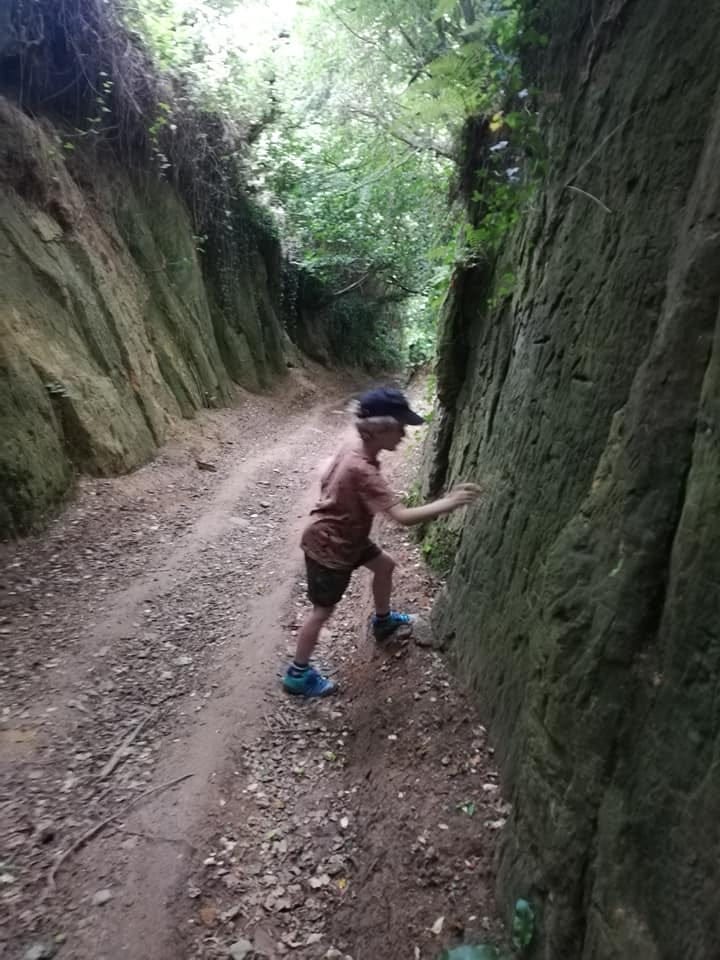
Holloways —Holloways are just as fascinating!I’d been keen to visit the infamous Hell Lane in Dorset for years and a couple of summers ago we took the kids there. I absolutely loved it and again I felt so close to the past and the earth there. Holloways are ancient paths criss-crossing the country, possibly markers of old trade routes. The paths themselves have become so deeply trodden by millions of feet, hooves and wagon wheels over centuries, that they are now almost tunnel-like, with the roots of trees visible on either side. At Hell Lane in particular you feel like you are about to descend underground as the trees shade you from above and the path leads you ever deeper. There are a fascinating array of carvings and faces on the clay walls too. I knew Black Hare Valley had to have its own Holloway!

Hell Lane, in Dorset. Photo is mine.

Fairy Circles — I only researched these recently when I decided that Black Hare Valley will be set in 1996 and that it definitely needs a prequel set in 1966, which will see my group of teens parents go through an equally strange and dangerous ordeal in the town. One of the 1966 kids is described as being ‘away with the fairies’ and I decided to play into this a bit more in the 1996 story, as this character as an adult has been missing for a long time. I simply added a fairy circle to a scene and had one character stomp through it while another declares it to be bad luck, and he retorts that his mother used to believe in such rubbish. Fairy circles are naturally occurring circles of mushrooms, often found in forests and grassy areas. Across the world, fairy circles or rings were often associated with folklore and myth and seen as dangerous places. It was said to evoke a curse or bad luck if you crossed one.

Ley lines — ley lines are also mentioned in Black Hare Valley, as I needed a central spot in one of my locations that would provide an intense amount of energy and a feeling of being held in place. I researched ley lines, which I only vaguely understood, and it turns out some people believe in them and some don’t. Essentially, they are believed to be straight lines between prominent landmarks, prehistoric sites and historic structures. Believers assert that ‘earth energies’ run along these lines but there is no scientific evidence to support this, and instead it is a matter of faith.

The May Queen — May Day, The May Queen and other spring celebrations and traditions will be more fully explored in my prequel set in 1966, but as I lay the clues for this in the 1996 book, I’ve had to research them now. One of my 1996 characters discovers that his troubled mother who ran away, had a sister who went missing in 1966, much in the same way a friend of his has gone missing in 1996. In scouring old photos from their parents, the group of friends discover that the missing girl was crowned the May Queen in the spring of 1966. I had great fun researching this and looking at old photos. The May Day celebrations marked the beginning of summer and small towns and villages across Britain, and indeed Europe, would celebrate by choosing a young girl to be the May Queen. She would be decked out in white with a crown of wild flowers and would be given a throne to sit upon. Villagers would also dance around a Maypole, weave floral baskets and ‘bring in the May’ by gathering wild flowers and branches. Going back even further, it is reported that wild hares were often part of the tradition and would be released from cages as part of the celebration. 

Researching books can be a lot of fun and Black Hare Valley is providing me with unique opportunities to google things and learn more. I have now started writing a rough draft of the book set in 1966 and have already had fun researching the clothes, music, and food popular at the time!