How I Write A Book

A few weeks ago I was chatting to someone and the subject of my writing came up. She asked what I had written and when I told her, she was politely impressed and asked me this question; ‘so, how do you even write a book anyway?’

It’s a great question, and one I have never really thought about before. To be honest I think I’ve always been a little bit scared to think about this question. In my head, my books just seem to happen, and yes, it feels a little bit like a lovely dose of magic. I like having magic in my life and I don’t want to ruin it. But seriously though, there must be a process, even if I am not always that aware of it. Recently I’ve also become more aware of how other people write books. This is fascinating! Spreadsheets and things! Now I have to admit, I am not really a spreadsheet kind of person. I exist in chaos and I quite like chaos. But this got me thinking about my process. How do I write a book? How does it compare to others? Do let me know in the comments at the bottom! But for now, here is how it works for me;

1) I never force anything. I never decide to write this, or that. I never decide to write Young Adult or Adult. I never decide anything. Which is good, because I don’t like making decisions. It all starts with a character. The ideas are there too floating about in the background, acting all shy. But the character is clearer. The sex and the age might come first. The character traits fade in and out. I don’t pay much attention to them to start with because I am always busy with other things. I’ll be writing or editing a book already. Or just living real life, and trying not to make too much of a mess of it all. So I try to ignore them at first. It’s not their turn yet, whoever they are. They will have to wait! Eventually they get braver though. They start chatting, they come out of the shadows and they become realer by the day. Soon I have a name for them, and a whole heap of issues.

2) At this point the notebook comes out. To start with it will be scraps of paper, or the back of a notebook I am using for something else. I will make note of their name and their character and some of their problems. Conversations will be quite frequent now, especially when I am out on dog walks. They all seem to start yakking then! I try to remember as much as I can, and when I get home I will jot things down. Before long, they need their own notebook.

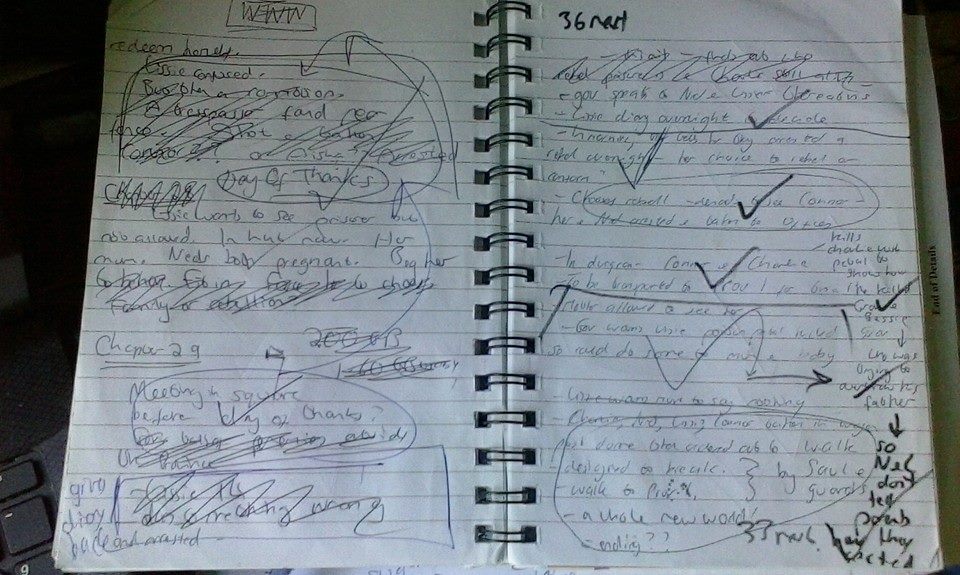
3) The notebook should be a neat and organised thing, but it never is. It’s starts scrappy and it stays that way. There is the occasional stab at organisation. A time line here, a character bio there. But no, mostly it is a crazy mess of what would look like scribbled nonsense to anyone else. Luckily, it always makes sense to me. I will start writing the book when I have time and when the voices have become too loud to ignore. By this time the notebook will be quite full, with possibly the entire plot outlined somewhere amidst the scrawls and scribbles! Every now and again an idea will hit me, a character will suddenly develop, a dilemma will spring up, things will link up and a story with a beginning middle and end will weave itself together. Normally it’s pretty much all there before I start writing, but not always.

4) I start writing. With my notebook by my side I will dive into this story that has been niggling me for some months now. Maybe even longer. I can practically hear the main characters clapping their hands in glee. The notebook will now develop with the book as I write it. So if there is not a timeline, or character bio’s for everyone, then I add them to the notebook as I go. The first draft is always horrible but exciting. It feels like a massive relief to finally be writing it, and I can only hope that other voices remain quite while I try to concentrate on this one. If I haven’t got the whole plot figured out, I never worry. With two of my books, The Mess Of Me and The Tree Of Rebels I really had no clue how they would end, or what exactly would happen. I had the main gist of the story and I had the characters, and that was enough to get going. The complexities of the plots revealed themselves to be on the journey, and I never panic about this. I just wait for it to happen. With some of the other books I know before I start writing what is going to happen. This sort of makes it easier, I suppose! I can write a loose plot in the notebook and use this as a framework.

5) I never worry how good or bad the first draft is. It’s just for me. It’s just to shut them up. It’s just to get it all out of my head. It’s like pulling a plug, or picking a scab, or squeezing a spot! Relief. I don’t worry about how long it takes. I don’t worry about word count or page numbers. With every single book except for The Tree Of Rebels (which is aimed at my 11 and 12 year old daughters) I don’t even worry about who the audience is. I know this will shock some people. Surely I need to know who my target audience is before I start writing? Surely I need to research this group of people and find out what makes them tick? What to they look for? What do they expect? Then I will be half way there with the whole monstrous marketing and promotional thing, right? Well no, sorry, it doesn’t work that way for me. And to tell you the truth, knowing who the target audience was for The Tree Of Rebels made it the hardest book I have ever tried to write! It took away the fun. I’m not sure why. Maybe because writing has always been such a personal and private thing for me. I guess I’m doing it for me first, to quieten those voices, to reveal those characters and help them with their load. I’ll have so much fun doing this that I sometimes have to remind myself that I do want people to read the book as well!

6) Finish the first draft and send it to a friend. I am lucky I have someone I really trust who reads my work and helps me with editing and proofreading. She is not the only person I use, but she is the first to get her hands on anything. The draft comes back to me with comments and we’ll have a few conversations about the themes of the book, what works and what doesn’t. By now I will be more than ready to get my teeth into the second draft. I can’t tell you exactly how many drafts there will be. It really varies from book to book. I will tell you that The Boy With The Thorn In His Side has had the most, by far! So that’s kind of how it works for me. I use a notebook and a pen, and only use the laptop when it all gets to much to contain. I’ve never used a spreadsheet in my life. There is nothing organised or properly planned. My head just doesn’t work that way. But somehow, I hope, it all seems to come out ok!

So over to you, how do you write your books? 11124930_964965450189387_1781543778663520427_n11127478_964965093522756_6604301044566462222_n
Top Tips Tuesday; Dialogue!!

DISCLAIMER!! I am not an expert or a professional. I am sadly not a bestseller either. These tips are written from my own personal experience as a writer and as a reader. I hope you find them helpful if you are struggling with how to write convincing dialogue.

You see, dialogue is my thing. I love reading it and I love writing it. I am guilty of slightly cringing when I come across dialogue that does not convince. The prose might be beautiful, the descriptions breathtaking, the plot gripping and so on, but if the dialogue is stilted, stiff or unconvincing, it will annoy the hell out of me and make me want to stop reading…

Show not tell? As writers we hear this mantra all the time and it is an important one to understand. You do not want your narrator, whether first or third person, ‘telling’ the reader everything. There are many ways to avoid too much telling, and using dialogue is one of them. Let the characters do the talking. In short, let them speak! You don’t need to keep telling the reader that Brian said this and Lucy said that; let the people talk! If the characters are talking, they can do some of the ‘showing’ for you. Instead of using the narrative voice to tell the reader what is going on, allow the characters to talk and have conversations that put this information across. Conversation is fascinating if you think about it. Think about what people mean, but do not say. Think about whether they are lying or exaggerating for effect. Think about what their body language can convey to the other characters. Does Brian scratch his beard when he is thinking? Does Lucy tug at her lip when she is nervous? Don’t rely on reams and reams of pretty narrative to get your story told, or to move your plot along. What is a story without its characters? Use them and let them speak, let them do the telling for you, in their own way.

Visualize your characters. Every time you write dialogue, you should be able to see your characters in your head. Obviously you will know, or you should know, what they look like. Write down their general descriptions such as age, sex, hair colour and build so that you don’t forget. But more importantly than that, build them in your mind. See them completely. Know their face as you would know the face of someone in real life. Learn their mannerisms. Do they stammer or stutter? Do they bite their lip? Do they brush their hair behind their ears when they talk? When your characters start to speak, when you start to fill their mouths with words, see them in your mind. Know every little detail about their physical presentation, so as you start to write the words, it is like having a little movie playing inside your head.

Read dialogue out loud. As you write it, as you start to make the characters speak, read the words out loud. Become them. Become their mouthpiece. Don’t worry about accent, just say the words as they would say them. Let your face become their face, along with any nervous twitches, throat clearing or wiping of noses. Read it out loud as you write it down and it should become obvious if it sounds wrong. Personally I read it out as I am writing it, and then read it out loud again when I am going back over it. This usually points me in the right direction and helps me pick out any words or phrases that do not feel real.

Pay attention to people when they speak. Sounds obvious, but sadly not all of us are terribly good at listening these days. We are often good at talking, good at voicing our opinions, but how well do we stand back and really listen? Practice this craft and you will be rewarded with a deeper understanding of the way that people speak. People do not speak in long, flat, monotones of dialogue. They break their speech up with pauses….their voices go up and down, their body reacts as they speak, releasing sighs, laughs, coughs and eye rolling. All sorts of things go on when people speak. They frown, they make faces that convey their opinions on things they are hearing or seeing. They interrupt and talk over each other, they trail off, or get distracted and change the subject. Watch and listen and where possible take note. When people are talking around you, become a silent observer. Listen in on conversations on the train or the tube or the bus, or while in the shops, in the Doctor’s waiting room, in the school playground. People are everywhere and they are never quiet! You can learn so much about speech and will find it easier to apply all these quirks to your own characters.

Don’t force things on them. Okay, you want them to help you ‘show’ not ‘tell’ too much. But don’t use them like puppets either. Don’t force your opinions into their mouths and be careful that you are not making them say something that is not realistic, just because it helps you push the story forward. Know your characters inside out and know what they would say and what they would not say. Dialogue is all about personality. Yes you need to drive your plot forward, so you need to move the characters about and you need to be in control, but just not too much. Be subtle. Think about how your characters will react. Imagine they are real and exist in your life. They come to the shops with you, they eat meals with you, they go on walks with you. Now ask yourself, would they really say that? And in that way? Or are you just wanting them to?

Be realistic. Think about your characters before, during and after you make them speak. If they are a teenager and it’s been a long old time since you were one, are you really getting it right? Are you sure you know how young people speak now? What about regional aspects? Not just accent but regional phrases and cultures. Would they really say it the way you have written it? Think about gender. Think about every aspect of your character’s personality and life. Does their background effect the way they speak? Are they quiet and withdrawn? Do they mutter? Be consistent or it will come across as unconvincing. Use dialogue well and it will really help bring your characters to life and encourage the readers to fall in love with them. Make your characters individuals who speak differently to each other. One will speak one way, and one another. Some people say ‘um’ a lot, some people start sentences with ‘so’ or ‘like’. Some people have a favourite swear word…

Avoid cliches/predictable dialogue. Hard to avoid unless you are aware of what they are, or can be, but my advice would be to read, read, read. Only when you have read really bad, contrived and cliched dialogue will you know what it is! If you’re not sure, just think about things people would never say in real life, and imagine that. Over dramatic, over the top, overly wordy or descriptive, that kind of thing. Who talks like that in real life? Well I suppose some people do, and if you are writing about them, then fair enough. However, bear in mind that if things get too predictable every time your characters speak, then something is lost. Remember that one of the main reasons characters fall flat or fail to convince the reader, is poorly written dialogue. You want your readers to believe in your characters, fall in love with them or loathe them, want to be friends with them or wish they could take them to the pub for a drink. This is not going to happen if your characters to not speak like real people.

I think that is all! For now…!


Top Tips Tuesday ; Find The Time To Write!

‘I don’t have the time,’ is the number one thing people tell me when they say they would like to write. I can understand this and have been there myself. Or at least I thought I didn’t have the time. In reality, I just wasn’t organising my time that wisely. When I was a kid, writing was my number one priority. If I could have chosen one thing to do, above any other, it was writing. It meant more to me than just about anything else. When I was a kid, I imagined that when I grew up I would have all the time in the world to write to my heart’s content, but this is not what happened. It fizzled out when I went to University. At the time I told myself this was because I now had to study. But of course I wasn’t just studying! I was going out most nights, drinking and having fun, and then laying in the next day sleeping. There was plenty of time to write, I just didn’t look at it that way. The same thing applied when I had my first three children and worked from home as a childminder. Of course there was no time for writing! There wasn’t even enough time for reading! But if I look back now, I can see that there was time. I just chose to use that time sprawled out in front of the TV. When my third child went to school the itch to write again came back with a vengeance, and three years on from then, despite another baby, I have managed to hang onto it and have published three novels through an independent publisher. Here are my top tips on finding the time to write!!

1) Ditch the TV. I’m serious. You don’t need it! If there is a choice between reading and watching TV then choose reading for your leisure time. Reading helps you become a better writer. TV does not. I don’t watch hardly any TV any more. There are usually two or three programmes a week that I will watch, and that is it. No soaps, no reality TV, no wasting my time. If I still watched all the junk I used to watch, I would have zero time for my writing.

2) Get up early and go to bed late. Okay, within reason! Obviously if you have a family and/or another job, then you need a decent night’s sleep. But why lie in when you could be writing? Sneak down and get some done before everyone wakes up! Get up earlier than you have to and write before you go to work. No doubt the stories will buzz through you all day at work and by the time you come home you will be desperate to get back at it. As soon as the kids are in bed, or you are home from work, then write.

3) Stop making excuses. I used to do this all the time. I don’t have the time. I’m too tired. I can’t concentrate. There is no point. Believe me, I used to say all these things and I believed them too. Not any more. I do have the time if I use my time wisely and prioritize the writing. Don’t put it off and think tomorrow will give you more time, or more energy because it won’t. Tomorrow will be the same as today and you will use the same excuses if you let yourself. Break out of this mindset and accept that although you don’t have much time, you do have time.

4) Sneak writing into all parts of your life. Tap notes into your phone or your tablet when you are waiting, walking, or on a journey. Any time you are alone and can get away with writing, then write. Even if it is short notes, or lists of things you want to tackle, or brief disjointed ideas, or loose lost words. It doesn’t matter. It’s still writing, and you will be surprised how many sneaky bits you can do throughout the day if the mood takes you. These snatched moments will spur you on. They will feed the passion. They will lead you back to that story when there is more time later! You will become hooked again.

5) Remember how it used to make you feel. Remember when writing was who you are and what you did. Remember when the stories filled your head all of the time, especially when you should have been concentrating on other things. The trouble is, adult life came along and convinced you that time is short and should be spent on more productive things. Not so. Don’t let it. Life is short and before you know it weeks, months and years have dragged you away from the last sentence you wrote. Go back to that sentence. Go back to that time. Go back to that you. Remember how it felt and what it meant to you and how exciting and breathtaking it really was. Find your inner child again and let them show you the way. I did, and I have not looked back since.

Eyes On Friday

business-people-rushing-front-city-skyline-18813894

I said the same thing last week. Thank God it’s Friday. Can’t wait til it’s Friday. I said it last week; it’s been one of those weeks! That was because everything was broken. The oven, the washing machine, the dog. I wanted Friday and a glass of wine.

I’ve been saying it again this week. It’s been one of those weeks I am glad to see the back of. I will be glad when this week is over. Roll on Friday!

Poorly baby, poorly dog, doctor’s appointments, vets appointments. Falling behind in everything I try to do. Scrabbling for time. Existing in exhaustion. Forgotten bills. Forgotten P.E kits. Not enough time for anything.

But it will all be all right once Friday comes. We all do it don’t we? Keep our eyes on Friday, keep it in our sights. We veer around the obstacles, we duck and dive and dodge the shit, we frown, we squint, we don’t want to lose sight of it. Oh Friday, there you are.

When it’s Friday, then you’ve made it. You’ve survived. You’re still alive for one thing. You’re in one piece for another. You didn’t kill anyone. Or yourself. You didn’t lose the plot, not completely. You didn’t lose a child or your mind. Not quite. You close your eyes and the relief is all yours.

Just like everyone else around you, with their shitty jobs and traffic jams. From Monday morning to Friday afternoon, hamsters on the treadmill, spinning, never winning. Running to keep the wheel going. Running to pay the bills, buy the food, pay the rent, buy the shoes, drink the wine.

All grim faced on a Monday morning. Clear the frost from the windscreen. CD player won’t work so you’re forced to listen to Radio 4, and all that disaster and human misery, one nightmare after the other. And look at all the other pale faces hunched up over steering wheels. They are all thinking about Friday.

Why do we do it? Wish the week away…When we know we shouldn’t? When we know there isn’t really much time? That sometimes life feels incredibly long, when you are crawling behind the line of cars, when your calf muscles clench and spasm in second gear and you look in the mirror and see you haven’t even found the time to wipe the crust from your eyes.

It feels long, but we know it isn’t. Just shit things like traffic jams make you think it is. You long for Friday because it means you can breathe again. All week it is like holding your breath while you tread water. You are drowning. Almost. Come Friday you can finally take that breath. Gasp for air. Because you don’t need to make the lunch boxes and you don’t need to set the alarm, and you don’t need to think about tomorrow.

Oh the lovely glory of  Friday night…in or out…it doesn’t matter. Everyone is happy. It’s arrived, it’s here, we did it, now breathe!

That’s what you see on everyone’s faces. That’s how they all feel. And how sad, really. To always be wishing the days away. To hate Monday and feel impatient with Tuesday, to feel excited on Wednesday and curse Thursday for dragging. How silly really. Friday. Just a day like any other. Wish the week away and then try to hold on too tight to one day, one night. Before it all starts again.