Did Choosing An Audience Ruin My Book?

I don’t know for sure, but it feels like it.

Let me explain. I am, of course, talking about The Tree Of Rebels, a book that once seemed so simple in its concept and execution. I tend to write quite hard hitting, gritty stuff, and I decided (rightly or wrongly) that I wanted to write a book my children could read. Specifically, I was aiming it at my daughters, who were at the time 11 and 12 and devouring books like The Hunger Games and The Maze Runner.

It wasn’t like I invented an idea to try to fit this genre and audience. I already had the idea for a dystopian future (one I am genuinely scared of). But I have to admit, this was the first time I ever sat down and tried to write a book knowing who the audience would potentially be.

Now, don’t get me wrong, there is absolutely nothing wrong with knowing your audience. Knowing your audience is key! How else will you know how to describe your book to potential readers? How will you know what categories to choose on Amazon etc? How will you know what cover and font to go for? All these things matter!

In fact, not knowing exactly who my audience were caused me no end of problems in the early days. You see, I didn’t know what kind of writer I was, because I had never really had to think about it before. The first two books I released, The Boy With The Thorn In His Side and The Mess Of Me featured young adults as the main characters, but this was purely incidental. In fact, if anything, I didn’t consider myself a YA writer at all and even kind of rejected the idea. I didn’t want to pigeon hole myself, I guess. I wanted adults to like my books too. It wasn’t deliberate that my characters were all young; that’s just the way it worked out. Or so I thought.

Truth is, I didn’t really understand the YA market at that time. I hadn’t looked into, or researched it as a phenomena. Since then, I’m glad to say I have learnt a lot and come to terms with the fact, that although not exclusively a YA author, YA is what I do best, YA is in my heart and soul, and YA is undoubtedly what I tend to seek out for reading material. I just didn’t really connect the dots in the beginning.

Anyway, the point I am trying to make is this. It can be good to know your audience before, during and after you write a book. It would have made things a lot easier for me when releasing The Mess Of Me if I had got on board with this and fully embraced and accepted the YA market I was aiming at.

BUT I do feel that knowing who to aim The Tree Of Rebels at has had a negative impact on writing the book. It felt like there was someone looking over my shoulder the whole time, saying no, don’t do it like that, that’s not how you write this sort of book! Looking back, knowing which audience I was aiming at definitely changed the way I approached it, making it one of the most challenging books I’ve ever written. I mean, none of the others ever felt that difficult, you know? They just kind of, happened. It’s not the only thing I can blame it on, and anyone who reads this blog regularly will know how many issues I have had with the book including the ones talked about in  Getting To Know Your Characters  and Final Draft? Patience is the key…

I’ve done so many drafts now that I have lost count. I have sent it out to beta readers three times and received very, very detailed edits and critique. I originally wrote the damned thing on Wattpad, so I had feedback on the very first version as it happened, and then posted later versions on there too. Lots of people have been involved and all of them have been incredibly helpful. Before I started this latest draft my intention was to fill it in more, add some detail and meat about how these people exist, but then towards the end I realised there was still something major missing.

Me.
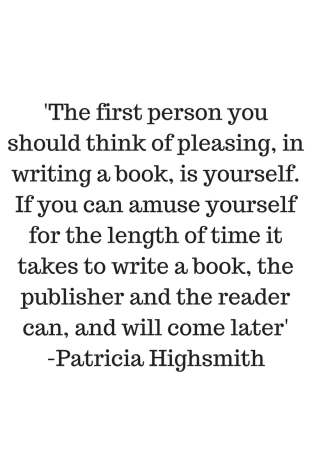
'The first person you should think of pleasing, in writing a book, is yourself. If you can amuse yourself for the length of time it takes to write a book, the publisher and the reader can, and will come later'-Patricia


It hit me one day while talking to my daughter.

I wrote this book to please them, and to please a certain type of reader who likes a certain type of book. I have never ever done that before. All of my other books were written to please me. They were written to scratch an itch. They were written to get the noisy people out of my head and onto the page. They were written out of passion and necessity. There was no other reason to write them other than that I simply had to. I’ve never known at the time of writing, who would like this book. Even with my current work-in-progress Elliot Pie’s Guide To Human Nature, I have absolutely no idea who this book would be aimed at or how I should even describe it! That for me, is familiar territory!

Of course, with my other books, on further drafts and edits I did begin to write and rewrite with my reader in mind. You have to! But they were not there in the beginning. It was just me.

So, how has this revelation helped me with The Tree Of rebels, you might ask? Is it totally ruined?

No, of course not. I still believe in the story and the characters. I have even started a sequel! But for now, I  have decided to leave this book alone. Put it to one side and focus on something else. I have decided to forget who it was aimed at, and essentially write it again. I have decided to write it the way I write all my books. I have decided to let it be whatever it needs to be and to stop trying to sculpt it into something I think it should be. In other words, forget about the perceived audience…For now.

I have a feeling it is now going to become an altogether darker book. But this is good. And would you believe it, while walking the dogs the other day, I had further revelations. Extra characters and another storyline, an important one, to feed into the others. It might make it a longer book. There might be more cutting. I’ve written the ideas down and that’s it for now. I am still not going back there yet!

But when I do I will be rewriting it entirely and writing it for me.

What do you think? How do you write a book? With the audience already decided or with just yourself to please?  Is anyone in your head when you write that first draft or do you really have no idea what sort of reader would enjoy it? Please feel free to comment! 


Guest Post: Shalaena Medford on why your blog is not about YOU!

Last Friday I introduced you to my new look blog and explained why I had renamed it and focused it on a theme that connects my writing and reading habits. I promised you a guest post from the indie author Shalaena Medford who inspired and helped me with these changes, so here it is! Over to you, Shalaena…

Hello readers and fans of Chantelle Atkins! Thank you so much for taking the time out of your day to read my guest post to this very lovely author’s blog.

You read in her previous blog post about changes she has been making to her website. I also have been making changes to mine according to the things I’ve learned in my New Media course at Southern New Hampshire University. (Yep, you read that right, I’m a darned Yank from the States! Don’t worry, I will not be tossing any tea. I love tea.)

Right off the bat we learned one major thing, which is that this is not about us. Yes, our selfish little scribbler’s hearts, with its ego-centric blinders focused on arguing “But it’s MY book, and MY website about ME!!” Yes, this is true. But when we treat it that way it’s like sitting down with that one friend we all have that somehow makes everything about them.

“Oh, I just bought this lovely book and—”

“Well I saw the movie twice and I don’t think the book is worth picking up.”

I don’t know about you, but I’d like to hit speaker number two for three reasons. One: don’t interrupt, you egocentric prat! Two: Who cares that you’ve seen it twice? No one asked for your opinion, anyway. Now sit down and let the other person finish telling you about this book! Three: You’re not going to read the book because you saw the movie? That’s the point where I (in the words of Ryan Reynolds) “have trouble listening to the rest of our relationship.” Seriously, you’re going to judge the book by what you saw in the movie? Excuse me. I have to go do…something else.

So reading that MY website isn’t about me was jarring. Then I realized, it’s not that it isn’t about the author, it’s that it isn’t FOR the author. My website isn’t for me. It’s for my fans. It’s for you guys! You fabulous readers who pick up bound sheaves of tree skin with tattoos on them (most wonderfully colorful description of a book I’ve ever had the pleasure of reading) and get lost in the worlds that we, the authors, have created for you. So why wouldn’t our sites be for you? A place where you can sit down and explore all the nooks and crannies and feel right at home.

So then I had to stop and think about not just my steampunk series, but all of my works. What they’re about, who the main characters are and who they speak to. Who are my readers? Chantelle writes about outsiders. I realized my main characters, and my readers, are misfits, or what I call the “socially abstract.” But my characters are at that point where they’re looking for the place where they fit in, or at least still trying to accept that they will always be on the outskirts of most social circles. My characters, like my readers, are still growing and learning to become comfortable in their own skin.

Once the reader type had been established, it was only a matter of finding out what they would like to see and what would engage them. I’ve set up a “share your story” page for those who have triumphed in their own small way (i.e. coming out, standing up to a bully, etc.), and I share their stories in my blog. In their own words. Because we all deserve a voice, no matter how insignificant we feel.

When I had a good grasp on what I was doing for my website, I decided to pass along the information to Chantelle. I’d been reading her articles for ages, which led me to follow her on Facebook, and eventually message her (mostly to ask who does her fantastic covers! I’ve since hired the same artist for one of my upcoming novels) and try to connect. It’s only recently we began talking more, and I am so glad we have. Chantelle is a genuinely wonderful person. While I haven’t had the pleasure of reading more than a page of her works, I think her writing is absolutely wonderful. But I’m sure you already know that!

So, here’s to Chantelle, for gracing us with her words.

And here’s to you, the readers of the world, who give authors like us a purpose. Enjoy Chantelle’s page (or mine if you really want to pop in and see what sort of crazy is going on in there). Because it was made for you.

Thank you for reading!

Remember to always stay abstract!

~Shalaena Medford: Author, Editor, Designer, Weirdo~

(Blushing! Thank you so much to Shalaena for writing this guest post for my blog and for helping me so much lately! I know she would love to connect with you also on her blog Socially Abstract. You can also follow her page on Facebook and link up on Twitter. And if you’d like to check out her work, here is her page on Pronoun.

This is the first guest post I’ve published to my blog and thanks to the wonderful writers I have connected with over the years, there will be many more to come! If you would like to submit something to post on my blog then do get in touch. If writing related, then any topic is fine. If it’s fiction or non fiction then something along the outsiders theme would be brilliantly received. See you on Friday!) Please feel free to comment below! 

Have You Got What It Takes To Go Indie?

Life as an indie writer is not easy. It is a hard slog, full of ups and downs. It is a journey often plagued by a gnawing self-doubt as well as the added burden of feeling like you constantly have to prove yourself. Not only do you have to make all the key decisions about your book, with regards to editing, front cover, and how to market and promote it, you also sometimes feel like you have a shadow hanging over you. You have to fight harder to be seen, try every trick in the book to prove yourself, and all with the nagging question that just won’t seem to go away. Are you really good enough?

Sadly, since I started my own journey in 2013, I’ve seen indie author’s announce they are quitting on a regular basis, stating that they just can’t do it anymore. There are just so many of us out there now, all searching for the same thing. The Holy Grail. How to succeed as an indie writer.  It often feels like a step forward, followed by two steps back. Many give up when their books refuse to sell. Many become disenchanted when they fail to find an audience. Many become exhausted by the endless choice and costs involved in promoting their books.

So what does an indie need to survive? What sort of person to they need to be to get through the inevitable highs and lows? I believe survival comes down to four main things, four personality traits you are going to need in bucket loads, if you are going to stick with the indie life and not give up when the going gets tough.

You need to have an immense passion.You must believe in your stories. You might be good at writing, but you are going to need more than talent to survive the bumpy road ahead. Never mind your writing abilities or creative talents right now. Ask yourself this; do you truly have a passion, a deep and possessive passion for the stories? Do these stories keep you up at night? Are these stories begging to be told? Do they plague your daydreams and interrupt your ordinary life? Do you have something you desperately want to say and share? Is this idea driving you crazy? If yes, then you‘ve got the passion. But that is only half the battle. You have to keep that passion, especially when times get tough, as they inevitably will. It helps to have a lot of unwritten material sloshing around inside of you. A host of characters chattering away, urging you to get on and give them their turn. A desire to get it all out,whatever it takes, to keep writing and writing, no matter what.  The passion to write is perhaps the most important thing you will need. It will ensure you keep writing, because you have to write, because absolutely nothing is going to stop you.

Self-belief. In truth, for any writer, self-belief comes and goes. There are times you have lots of it and feel genuinely proud of your last paragraph or your final, finished product. But there are equally as many times when a first draft is anything but perfect. In fact it is ugly and clumsy and utterly different to how you envisioned it in your head. Quite simply you think you should give up and never write another word. This is quite normal, and I’m sure even the most successful and well known writers are regularly plagued with bouts of crippling self-doubt. There are days you just can’t write properly, nothing comes out the way you want it to, you compare yourself to others and feel you fall woefully short. This is all fine. But in order to succeed as an indie writer you need to have a rather solid foundation of genuine self-belief.You may not want to brag about it or declare it to the world, but deep down inside you must believe that you are good. You must believe that you can write. You can tell a story and make it work. You can make people care. You deserve this and can hold your head up with the best of them. Otherwise, the hurdles to come are going to knock you off course pretty quickly.

Hope. I think this applies to the indie more than any other writer. The indie needs passion and self-belief, in order to get that idea down on paper. They need talent and determination to edit, rewrite and perfect that work until it is ready to publish. They need to become an expert at marketing, promotion, an entrepreneur even, and in many respects a businessperson. But they also need to be an optimistic and hopeful kind of person in order to survive. Why? Because hope keeps you going through all the hard times, through the low sales and no sales, through bad reviews and no reviews, through feeling totally alone and out of depth and not to mention being penniless! You have hope that you‘ll become a better writer, that you will get better with every new thing you write. You have hope that your small following will continue to grow,and that fans will spread the word for you. You have hope that you‘ll one day land a nice big, traditional publishing deal, (if that’s what you want, and let’s face it, most indies would love to hand at least some of the control over to an enthusiastic professional!) You have hope that you‘ll make it. You‘ll succeed and realise your dreams, and achieve whatever level of success you are aiming for.

And finally, I believe you need to be a realistic dreamer. By that I mean, you need to dream big and aim high, but at the same time, you need to keep your feet on the ground and be realistic. I think perhaps too many writers jump into the indie game with their expectations too high. I know I was guilty of just this at the start of my journey. I sort of expected things to just take off. I thought all my friends and family would buy and love my book, would leave plentiful glowing reviews, and would then encourage all of their family and friends to do just the same, and my book would somehow just tumble forward, picking up speed until I made it! Oh how that makes me laugh now! No, I’m sorry, it’s just not going to happen like that. In my experience, people mean well, but when they say they will read or review your book, it does not always happen. People are busy. They have their own lives and interests, and they may not want to read your book for fear of offending you if it’s not their kind of thing. in truth, many of them are just not going to be interested at all. The indie journey can therefore be a lonely one at times, not to mention frustrating. Expect too much, and you are going to get disappointed. Be realistic. Recognise that it is not a race, but more a journey of development and discovery. The fact is, you will get better at all of it. You will get better at writing, and at marketing, and you will realise you don’t need your family and friends to push you forward. You need to find your own audience, and finding them, is quite simply part of the package you sign up to. Getting reviews and exposure, gaining readers and fans, winning awards and so on; all of these things are down to you.

I believe that if you have enough passion, self-belief and hope, you will be able to maintain longevity as an indie writer. Keep your feet on the ground and your expectations realistic, while not ever giving up on the dream. They may all get dented and bashed about from time to time, but as long as the reserves are deep, you should be able to keep going. Who knows what is around the corner as long as you don’t give up your dream?

Indie Survival Kit

Indie Survival Kit

When I first started out as an independently published author in 2013, I had no idea what was going to happen. I had no idea what I was doing, and it took me a long time to figure out what I needed to know. There is a lot of help and support out there for indies, if you know where to look, but it’s very difficult to find the time to research, when you are already spending a lot of time writing. With this in mind, here is an Indie Survival Kit. A list of things you will need! Imagine you are about to pack a bag and start a long, unknown journey. These are the things you might need to pack.

The Right Attitude.

You need grit, determination and self-belief. You need to believe your story is worth telling, and that you have the skills to tell it. You will need to grow a thick skin, and become good at self-promotion. You might wish you could just sit at home writing and not have to bother with the rest of it, but you can’t. Not if you want to succeed. So roll up your sleeves, open up your mind and get working.

Community.

Surround yourself with like-minded people. Become part of the author community. Read other authors and reach out to them, connect, support and join forces, as together you are stronger. It’s not all about you, and if you think it is, you won’t get very far. It’s amazing how supportive and helpful other author’s can be, so make sure you are involved. Invite authors to post on your social media pages, or on your blog or website, and offer to do the same for you. Interviews are always very popular and interesting to both writers and readers!

Social Media Checklist

Have you signed up to at least three social media sites? One of these should be your blog/website. Do you blog regularly? At least twice a month, although ideally more? Are you visible on social media? Do people know who you are, or have they forgotten about you because you haven’t posted anything interesting lately? Has Facebook assumed your fans are bored, and has unliked the page on their behalf? Keep things fresh and fun, start debates, run contests, let people know about your struggles and successes, link up your sites to save time, share articles of interest and so on! Do this daily, as much as you can and don’t neglect it.

Reviews

Seek them out. Go after them. Don’t just rely on friends and family, or on the assumption that readers will remember to review. They rarely do. Go to review sites, and be prepared to pay for some and to be put on waiting lists for the ones that are free. The same applies for bloggers. Research them, make lists and do this weekly to build up those reviews. Remember that reviews help your book move forward; they encourage readers to buy and they convince Amazon to take your book more seriously.

Courses

Keep your skills up to date. Join writing groups online and in real life. Take courses. Udemy and FutureLearn are great sites that often have deals and freebies, so grab the offers when you can. Keep your skills sharpened and work to constantly improve your craft.

Audience

Be patient, but work on growing your fanbase at all times. Use your blog, Wattpad, Street Teams and social media sites to interact and connect with readers. Ask their opinions, share sneak peeks, freebies and competitions, share your ups and downs, your decision making processes and so on. Stay positive and upbeat. They will feel like they are on the journey with you. Offer free samples and short stories at the back of your books, or on your blog.

Resources

Look for free or cheap to help keep costs down. Canva.com is a great site for graphics and posters. You can create social media graphics, memes, posters, leaflets and even ebook covers on there. iAuthor is free, and is a great way to find the readers who are looking for your type of book. You simply add your books to the extremely diverse ‘themes’, or even make up your own. Wattpad is free, and is a great way to find readers and get feedback. Fiverr is a site where you can pay people as little as $5 for file conversions, artwork and more.

Follow the right people

There are so many great sites and pages out there for writers, it’s hard to know where to start. But do start. Follow organisations that will provide you with the information you need, so that you do’t have to go looking for it. The Alliance of Independent Authors, Author Unlimited, Writer’s Digest, The Writer’s Circle and Positive Writer are just some of the many pages/groups I follow to pick up tips and up to date information on the writing world.

Income streams

Find other ways to make money out of writing. Ads on your blog, sending articles to sites who pay, short story submissions and competitions are all great options. You can also get paid work as a book reviewer. There are so many sites  popping up now to provide reviews for indies and these sites also need reviewers! Offer editing and/or formatting to other indies, or even front cover design, graphics and art work if you are up to it. Many writers also make additional money by going into schools to run workshops, or by offering workshops to other writers. You can also do this online and sell the content. Copy writing, ghost writing, ad writing, all are other ways to pick up income through writing.

Promotion

As an indie, you will more than likely have a love/hate relationship with the promotion of your books. You know you need to do it, but you don’t know how. You know you must figure it out in order for readers to know you exist, but all you really want to do is write. I think the sooner you get to grips with promotion and accept it as part of the deal, the better. It can even become fun. Your blog for instance, should be fun. After all, it should be your little stage, your platform to talk about anything you want to talk about. Again, social media should be fun, and it can be if you engage with it and make time for it. Set aside one day a week when you concentrate on promoting your books. I advise setting up a website/blog early on and making sure it is as professional as possible, after all it may be the main landing point for readers interested in your books. Everything else can come from here; your links to social media, links to your books and your style of writing itself. Set up a subscribe by email button, and another button that collects emails for a fan newsletter. Do this as soon as possible so that you can start building an email list of people who are genuinely interested in your writing. You can then treat them to freebies, sneak peeks and special events and you are on the way to building an audience.

These suggestions are all simple and relatively cheap, and they are all things I wish I had known before I started.