Take What Tortures You And Write About It

I’ve got a confession to make. Just lately I’ve been suffering from a strange, and as far as I know, nameless, affliction. The only way I can describe it to you is by asking you to recall the feeling you get in your stomach just before you sit an important exam. You know, that lurch, that turnover, that horrible tightness that takes your breath away for a moment? Yeah, that.

I first noticed it happening whenever I thought about my writing. The things I had planned to do once my littlest child was in bed. I put it down to a sort of nervous excitement, and a borderline panic about how little time there is to write all the things I have in my head.

Then I noticed it happened at other times too. Just randomly. My stomach dropping, lurching and rolling over.

So, then I blamed it on something else. I’ve always been interested and engaged in political thought and debate, but even more so in recent years. This is not a bad thing, but then it gets to the point where you are feeling angry and helpless all of the time. Post Brexit was pretty bad. It’s all pretty bad. Climate change. Inequality. Housing crisis. A rise in racism and hate crime. Endless war. The fact we’re being organised and dictated to by massive corporations hellbent on destroying the world. The fact you cannot trust the media to tell you the truth.

sadlaptop

So, I made the decision to delete Facebook from my phone. Something I never thought I would do! I was getting seriously addicted. Picking it up to check my newsfeed first thing in the morning, and pretty much every chance I got throughout the day after that.

I did feel an immediate sense of relief. That first morning stomach lurch dissipated. I picked up a book instead. I no longer check my phone throughout the day because there is nothing to check. I have a quick scroll through Facebook in the evening, once I have done enough work to deserve a little break, and I’m sad to say it’s still the same. The violence rages  on, the world gets hotter and there seem to be angry and ignorant people everywhere.

I did feel a sense of relief and freedom for a while. But that feeling in my stomach has not gone away. In fact, I am getting it more often. Maybe it is because I’ve become aware of it, nervous of it even? Confused by it, and as a consequence, fixated on it? I don’t know, but it is strange, and  very annoying. Sometimes it takes my breath away. I have to stop, hold onto something and take a very deep and deliberate breath. And then I am okay again.

I can’t blame anything in my personal life. Everything is as it should be. Everyone is in perfect health. Money is tight, but it’s never been any different at any time in my life. We have a lovely home and a huge garden. We grow our own fruit and vegetables and raise chickens and ducks. We’re outside, a lot! I’ve got my four beautiful, intelligent children, and yes they come with their own issues, and yes being a parent is sometimes stressful and exhausting. But I’m a placid, easy going sort of person. I roll with the punches. I look back on the past fondly, I focus on the now, and I don’t look too far ahead,(unless it’s my saving up for a VW Campervan.)

So why the bad feeling? What does it mean? What is it trying to tell me? I just can’t work it out. It takes me by surprise at random times of the day, creeping up and sucking the air out of me, crunching up my guts and making me think I have forgotten something important. Am I about to sit an exam? Am I about to confront some scary, aggressive person? What is it??

I don’t know, and maybe I will never know. Maybe it built up over time and my stomach got so used to being tied up in knots, it just doesn’t know how not to be. All I can do right now is try to make use of it. I wrote a short story you can find in Bird People And Other Stories called She Is… I wrote this story to keep a novel at bay, and I’ve started writing a second short story with the same characters. Basically the story is about teenage girls, bullying and revenge, but the narrator describes this constant heavy feeling in her belly. She wakes up with it, and it comes and goes throughout the day. Of course, this came from me and my own experience, and I’ve carried it on into the next story. In her mind, it’s because something bad is going to happen, she just doesn’t know what or when. It’s a sense of foreboding for her, a warning from her body.

My fears for the way the world is heading, my fight to find hope, my questions about human nature, have all been rolled out and examined in Elliot Pie’s Guide To Human Nature. (On the third draft now) I didn’t even realise I was doing it at first, but I’ve poured so much of my current state of mind into this story-line. Elliot is the child in me, the hopeful innocent looking for the good in people. His mother Laura is the cynic in me, (exaggerated a fair bit! )Through her I get to rant and rave, I get to swear and scream at the cruelty and injustice in the world. I get to indulge myself in misery and cynicism, fearing the worst and totally giving in to it. I get to hide under a duvet and pretend it’s not happening.

In The Mess Of Me Lou is the voice for my own teenage angst and body issues. She is louder and brasher than me, able to say things I was not.

In recent short stories I have released endless frustrations and anxieties. From my utter dismay that people think it’s okay to dump rubbish in the river where I live, to my constant paranoia that one day soon the Earth is just going to snap, just going to cull us all in one bloody swoop, freeing itself at last. I honestly don’t know how I would cope with this world if I were not a writer!

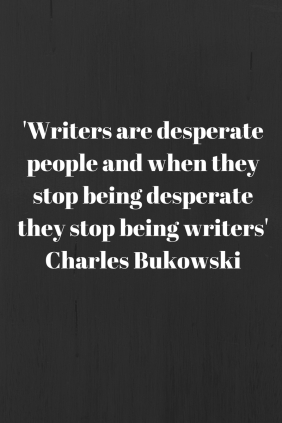
'Writers are desperate people and when they stop being desperate they stop being writers'Charles Bukowski.jpg

I think this is the best and sometimes the only thing we can do with something that tortures us. Use it, write about it, pass it on to a fictional character. Maybe this is one way to eventually rid yourself of it! Or at least gain a better understanding of it. I think writers do this all the time, often without even realising it. We project our fears and anxieties onto made up people, into made up worlds. So it’s not us with the problem, it’s someone else.

And then, we feel like we have some control. We can direct the proceedings, we can work out what the problem is, we can send the character on a journey and we can even create a happy ending 🙂 I truly think this ability is one of the greatest things about being a writer.

What about you? Please feel free to leave a comment!

Beta Readers; Handing Over Your Baby

Sometimes I try and work out what the toughest part of writing a book is. Is it the first draft where everything is at its freshest, but also most fragile? Is it the second draft when you realise how much work your first draft needs? Or is it when you are edging closer to the finish line? When you are swinging between self-doubt and elation? I’m not sure, but I think handing it over to someone else to read for the first time has got to be up there as well.

Last Friday I finished the second draft of Elliot Pie’s Guide To Human Nature. This second draft took less time than I had anticipated and went surprisingly well. To be honest, it was more of a read-through than a rewrite. I’d left the book for some time while I focused on other things, so I needed to familiarise myself with the story and the characters. I found myself smiling whilst reading it. I genuinely love these characters and it was enjoyable and comforting to be back in their company again. Obviously I cut out words here and there, picked up on some minor plot holes and corrected any glaring typos. But generally, I have to say, this time around it was a pleasant second draft. I like this book a lot. I feel good about it. I feel like I had a clear and concise goal before I started it, and I feel like I have so far achieved it.

Of course, I’m not naive enough to think there won’t be major rewrites and frustration further down the line. If my other books are anything to go by there will be! But right now it all sits nicely with me.

Only now I’ve got to let someone else in on the secret. I’ve got to hand it over to beta readers and see what they think. Now it’s obviously up to the writer to decide when their book needs to be picked apart by betas, and with a lot of my other books it has been much further down the line. But handing Elliot Pie over now feels right. The basic plot is all there. I just need to know if it works. If it is believable. If they see the ‘twist’ coming. If the characters ring true. I need to know if it makes them laugh or cry. The structure of the book is also rather different this time around, and I might be completely wrong about it. I can’t say too much at the moment, but I have been slightly experimental in terms of point of view and tense. For me, right now, it works, but I am bracing myself for my beta readers thinking otherwise!

They are so important in this process though, so vital as the first set of readers to dive into this fictional world I have created. Will they see it the same way I do, or will they see plot holes and inconsistencies I’ve been blind to? Now feels like the right time, because if the particular layout and structure of the book doesn’t work for them, then I will need to do some serious thinking.

Handing your novel over to your betas is a strange and disconcerting feeling. It’s a bit like handing over a piece of your soul. When you write that first draft, you are writing just for you. You have no idea if it’s going to work or not. You just start and see what happens. Sometimes it’s a flop, other times it’s spectacular, but no matter how good you feel about the finished product, you can’t just rely on your own opinion. Handing it over to betas is the first step in what Stephen King so wonderfully describes as ‘killing your darlings’. Hopefully, if they are doing their job correctly, the betas will send it back to you with a long list of thoughts, feelings, corrections and criticisms. Of course you want to hear positive things about the book, but it’s the negative things you really need right now. What doesn’t work needs to be changed or cut out. Subsequent drafts after the beta response ought to set the culling in motion. If it’s not adding anything to the story, it has to go. Cut out the fluff, tighten it up and be ruthless. I don’t think I could enter this phase comfortably without waiting for the response from my trusted betas. It’s like once I’ve heard the good the bad and the ugly from them, I can start swinging my axe with confidence.

Having said that, I already have a rather long list of things I made not of while going through it. Things I need to amend or add or pay more attention to on the next draft. It will be interesting to see what else my betas pick up on. I’m so curious to know what they think of the book in general. I feel a mix of emotions right now. Impatience and excitement; will they love the characters as much as I already do? I feel anxious and nervous at the thought of them casting their critical eye over something I am rather in love with. I know I will have to brace myself for anything scathing that may come my way, and remember how much better it makes a book to have early critiques like this before you unleash it on the public. I’m also sure there will be things we disagree on!

It’s exciting though because it is all part of the process of writing and finishing a book. That first draft. The elation and pride when it’s done, when it’s written, when this thing that was once just inside of you, is now out and in story form! That second draft. You’re moving on, starting to get critical, cutting bits out, polishing it up. Sending it to first betas is another significant stage in the life of a novel. They are the first readers to tentatively enter the world you have created. They are part of the process of making it all the best it can be.

It’s a bit like this book is my baby and I’m watching it grow before my eyes. It’s taking it’s first steps and changing! It’s got so many more stages to go through and I know from experience that the road ahead is nearly always a bumpy one. Some of my books have had major rewrites at later stages, leaving them almost unrecognisable to what went before! It’s satisfying to have set it on it’s path though. I’ve given birth to it and set it on its wobbly way towards maturity! I can’t wait to see what happens next.

Please add your comments below! When do you feel the time is right to hand your work over to beta readers? Does it feel a bit like giving your baby away? What do you think is the toughest part of writing a book?


What Comes First? The Characters or the Plot?


What comes first? The characters of the plot? I guess the answer is different for every writer, and often different for every book. I’ve been thinking about this since one of my daughters showed a rare interest in my writing and asked me what came first; my characters or my plots? My immediate answer was the characters, as this is how it so often feels. But as I went through the novels one by one, I had to admit that it’s different each time. For example, The Boy With The Thorn In His Side was an idea that grew into a character, followed by a more complex plot. The Tree of Rebels, which will be my next release, was undoubtedly plot before characters, more so than any other book I’ve written. I’ve blogged before about how difficult this made the process, and how it has taken longer for me to understand my characters and feel comfortable with them. With Elliot Pie (a book only in its first draft) it was the character first, but his character, in being someone who was intrinsically curious about strangers, was the plot. So they evolved simultaneously.

Having thought about it for some time I realised that my novels, This Is Nowhere and The Mess Of Me both have something in common. They were both written in the same way. I had the character first, and then had to create a plot to go with them.

I’m not sure this is the best way to write a book, but it’s just the way it worked with these two. With This Is Nowhere, I had the character in my head for some time, and with the character came the whole feel and tone of the book. Slightly sombre, dark around the edges, yet gentle, confused, struggling through mystery. I knew the character was a male in his late twenties or early thirties, and I knew he was rootless and aimless, a drifter. He had never grown up, but why was that? I knew he had a bad relationship with his father but the rest of that came much later. I knew he had a recurring stomach ailment, and had turned his back on the religion he had been brought up with. I had images in my head of a boy running across a sun baked field, though running from what I had no idea. The whole thing seemed to evolve in my head through feelings and images. I got the idea for the plot involving his missing mother when I was walking my dogs in the woods one day. I’m pretty sure, though it is hard to recall now, that my daughter had spoken to me about a missing persons case, and that had set something off in my head. What if this drifter was to return to his small home town in order to find out what happened to his mother, who vanished when he was a child?

With The Mess Of Me it was harder. In this case, I would probably not advise coming up with the character before the plot, although in all honesty I had absolutely no control over this!

Lou Carling started talking to me when I was about half way through writing The Boy With The Thorn In His Side. This was fantastic to me at the time. Having had a long break from writing, in tackling The Boy I was giving it all a go again, seeing if I still had the urge and the passion. When Lou started talking and grumbling, I was overjoyed because I had that feeling again. Of fireworks and ideas exploding in my head, of panic and excitement knotting in my belly, of wanting to hurry home to the laptop, of needing to scrawl notes onto scrap paper so I wouldn’t lose a thing. Essentially, Lou let me know that it was back. Writing was back.

I let her babble on for a while, mostly because she really amused me. She had just finished her GCSE’s and had a long summer before A-Levels ahead of her. She was deeply cynical about everything and everyone, and had a rather filthy mouth. Her best friend was a boy called Joe, a lanky, hazel eyed boy whose mother was her mother’s best friend. I could see Lou and hear her. In fact she barely left me alone. She would have constant conversations in my head, really interesting little nuggets of dialogue I just had to scribble down for later. But I had no plot. What was this book going to be about? What was going to happen to her? What did she want? What did she fear?

It took a while, but I got there in the end purely by listening to her, and being witness to the world that started to build around her. The claustrophobic council estate, growing up without money, feeling exasperated and embarrassed by her family. Hating everyone, especially herself.

I’m happy to admit that large parts of Lou are based on me, on my own experiences, on my own views and feelings growing up. In many ways, she is the character closest to me, at that age anyway. But I allowed her more freedom, letting her express herself when I was too shy to. Immensely liberating, I can tell you. The plot I ended up with actually came from a strange childhood memory.

When I was young, my mother had a friend who had five sons. She was a larger than life kind of woman, large in build and large in voice. She would sweep you in for a cuddle and nearly break your bones. She used to make jokes about swapping my mum’s daughters for her sons, and I used to think she was serious, and I was just a little bit afraid of her. I loved going to her house to play though. With her two youngest sons, me and my sister and brother used to trespass onto the grounds of their local school and play games with their pet dog. We would climb and hide in trees and bushes and behind walls and the dog would look for us. I can also remember playing with a huge mound of cardboard boxes in their back garden, making dens out of them, climbing up them and leaping off to crush the boxes below.

Her three older sons were teenagers when we were small. They flitted in and out of the background, and as I was so shy I probably never spoke to any of them. I watched them get the odd clip around the ear. One even had his mouth washed out with soap one day. But they were like mysteries to me. Part of my life, and yet totally unknown. They could have been anyone. They could have had any kind of life without me knowing. I had no idea who they were, where they went to, what they did, or what they dreamed about.

One day we were coming up the front path and one of the teenage boys was sat on the doorstep with his head in his hands looking absolutely miserable. In the cool dark of the kitchen, I overheard my mother’s friend telling my mum he was in so much trouble. They muttered and murmured in there for some time, while he remained on the doorstep. I never did find out what he’d done wrong.

So somehow, for some reason, this all crept into Lou’s world. The house full of boys. The mother on the warpath, driven to distraction by her unruly brood. Having these people you’ve grown up with, and yet never really know. Mysteries that unravel just out of reach and over the heads of young children who are told to go out and play.

The drug running storyline was of course utterly fabricated. It could have been anything really, the trouble the boys were in. Everything else from here on was pure imagination!

In many ways the drug running activities of Joe’s older brothers, and the way both Joe and Lou get pulled into it all, is a sub-plot to the main one, which is simply Lou’s journey over that summer. Her determination to lose weight and get skinny. Her finding herself, without it sounding too much of a cliche, was central to it all.

So that’s the story of The Mess Of Me. Where it came from and how it happened. It is probably my most character driven book, with the plot almost taking a back seat to the characters.

What about you? As a reader, do you ever wonder what came first, the plot or the characters? Can you ever tell?

What about you writers? Is it always the plot first, the characters later? Or the other way around? Which way does it happen for you, and does it make it harder to write if it happens in a way you are not used to?

Feel free to comment below!


Untold Stories

I’ve blogged recently about the amount of stories and characters I have in my head. I have also blogged about my struggles with the final draft of my YA novel The Tree Of Rebels, and how I have been constantly distracted by voices from untold stories. In order to keep some of these voices at bay, so that I can finish each project I am on, I have been writing the odd short story for these characters. Has this worked? Well, yes and no! On the one hand, it does feel good to get something out, to relieve a little of the pressure. But on the other hand, it seems that if I allow these people an inch, they will take a mile, and start shouting even louder.

Anyway, I am making great progress with the final draft of The Tree Of Rebels. I am probably only days away from finishing it. I might have mentioned before that I decided to try changing the tense, to see if that worked, and although I can’t be sure until I read through it all, I think it has! So, the plan is, I finish the draft then re-read the whole thing, checking a final time for errors, typos and so on. Then it will be done! What comes next? Well, I do feel I ought to finish my rough plot for the sequel, as it might be a good idea to not let there be too big a gap between the two books, but this won’t take me long. I will then jump into the second draft of my novel Elliot Pie’s Guide To Human Nature. As you might recall, Elliot Pie was a queue jumper! Jumping neatly ahead of the planned sequels to The Tree Of Rebels and The Mess Of Me! He was too insistent to ignore, so he finally got his story told. Once I have done the second draft I will send it to my wonderful beta readers, as I will need feedback on the structure of the novel, as it is a little bit different. What will I do whilst they are reading this?

Ooh, I’m glad you asked! Well, I recently wrote two short stories for a character that was getting impatient. Bill Robinson is one of the characters in a gritty teen drama I first wrote when I was sixteen years old. I never finished the book, and it had always been one I knew I would go back to at some point! Much in the same way I finally finished The Boy With The Thorn In His Side in 2013, after first writing it when I was twelve! Nightprowler and Bird People are both available to read on Wattpad if you are interested. Nightprowler is really a prequel to the novel, an event that happens before it all begins, and Bird People is really a snapshot into the mind and character of Bill.

Anyway, the point of this blog post is untold stories, and how exciting it is once you finally get the chance to tell them. Maya Angelou was quoted as saying that ‘there is no greater agony than bearing an untold story inside you,’ and I think most writers would agree that this is very true. It does become an agony. The desire to write and share, and the noise created by the characters and their lives, can reach unbearable levels if something is not at last released.

With this in mind I went hunting yesterday, and dragged the old suitcase out from under my bed. This suitcase is very important to me because it contains all my old stories, school work, essays and ideas. Luckily for me, I have never thrown anything away. And thank goodness too, because I found what I was looking for, and what a joyous moment that was. This great big hulking binder full of Bill’s story. It didn’t have a title back then, but the working title will now be A Song For Bill Robinson. Everything was right there. A plot (and how exciting to see that I used to plot at age sixteen, the same way I do no! ie a scruffy notepad filled with ideas with ticks on top of them!) character bios, and a whole load of notes and extra bits paper clipped together. More excitingly there is also a map! I used to draw maps of the fictional worlds I created to help me when moving the characters about. There is even a play list of songs, as one of the main plot lines involves Bill entering talent contests in his local community centre as a singer. He hooks up with some other people who play instruments, and the play list was a rough idea of some of the music they might play together.

How exciting! What a find…I knew I still had the unfinished handwritten manuscript, but I had completely forgotten about all the extra bits! I wanted to go back in time and pat my sixteen year old self on the back! Job well done! I can use all this! This is going to be brilliant! I was also impressed to find scraps of paper where I had written things like ‘by chapter 7 we know that Charlie is hiding something, and we know about some of it. We have suspicions of Laura’s private life, some from what she tells us and some from Bill’s own suspicions.’ Ha ha! Nice to know I had a good handle on the whole show not tell thing back then!

I can’t tell you how happy this discovery made me yesterday. This story still has to wait for me to get around to it, but in the meantime it is going to continue to grow and swell and evolve inside my head. I already know lots more about the characters than I did back then. There have been lots of nice, little details striking me lately.

So exciting!!