Of course, we knew it was coming. Of course we had seen her slow down. As she turned 14 in February, I celebrated the fact she was the oldest dog I’d ever had! My last two died at aged 10 due to heart failure, and aged 13 after a stroke. But at 14, she was still going, still clicking about on her increasingly weak and wobbly legs, still emitting her strange high-pitched woof every time she wanted something, still causing no trouble, still being the sweetest, gentlest girl ever…
In April I celebrated again. Fourteen years had passed since I agreed to squeeze in an extra foster dog, and had this tiny mucky little scrap of a thing handed over the garden gate to me. Already named Tinkerbelle, I stuck her in the sink for her first bath. She settled in like she owned the place; always calm, sweet, and optimistic, even as a tiny pup.
No one phoned up for her, there was no interest in this smooth coated brindle lurcher pup at all and then one day she managed to climb up onto the kitchen side to try and reach some food. She fell off and broke her back leg. This, of course, meant an extended foster stay with us, during which numerous other rescue dogs came and went to their new homes. On the day someone finally phoned up to ask about her, I knew I could not let her go. She was ours. She had been with us for too long and there was no way we could give her up now.
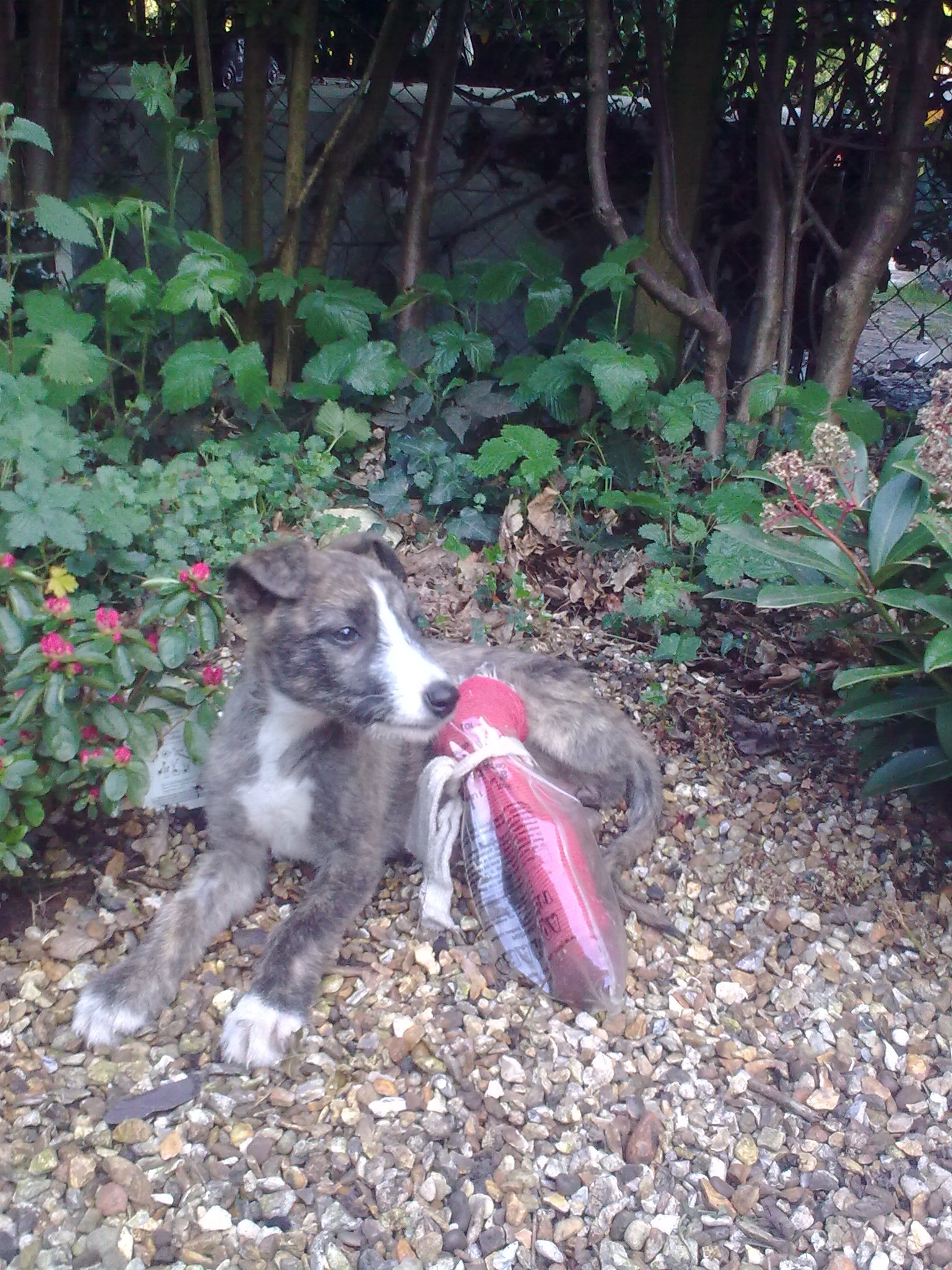
Tinks as a puppy with her broken leg in a cast – image is mine
Tinks was the perfect puppy. While still in a cast, she slept every night in a crate to keep her as still as possible and she never complained. Once her cast came off, she could start going for walks but was still happy to sleep downstairs every night. She rarely peed in the house, rarely nipped anyone as a small pup, and although not particularly interested in training or tricks, Tinkerbelle always had reliable recall and always greeted other dogs politely and sensibly. And as the months wore on, her smooth brindle coat grew long and fluffy!
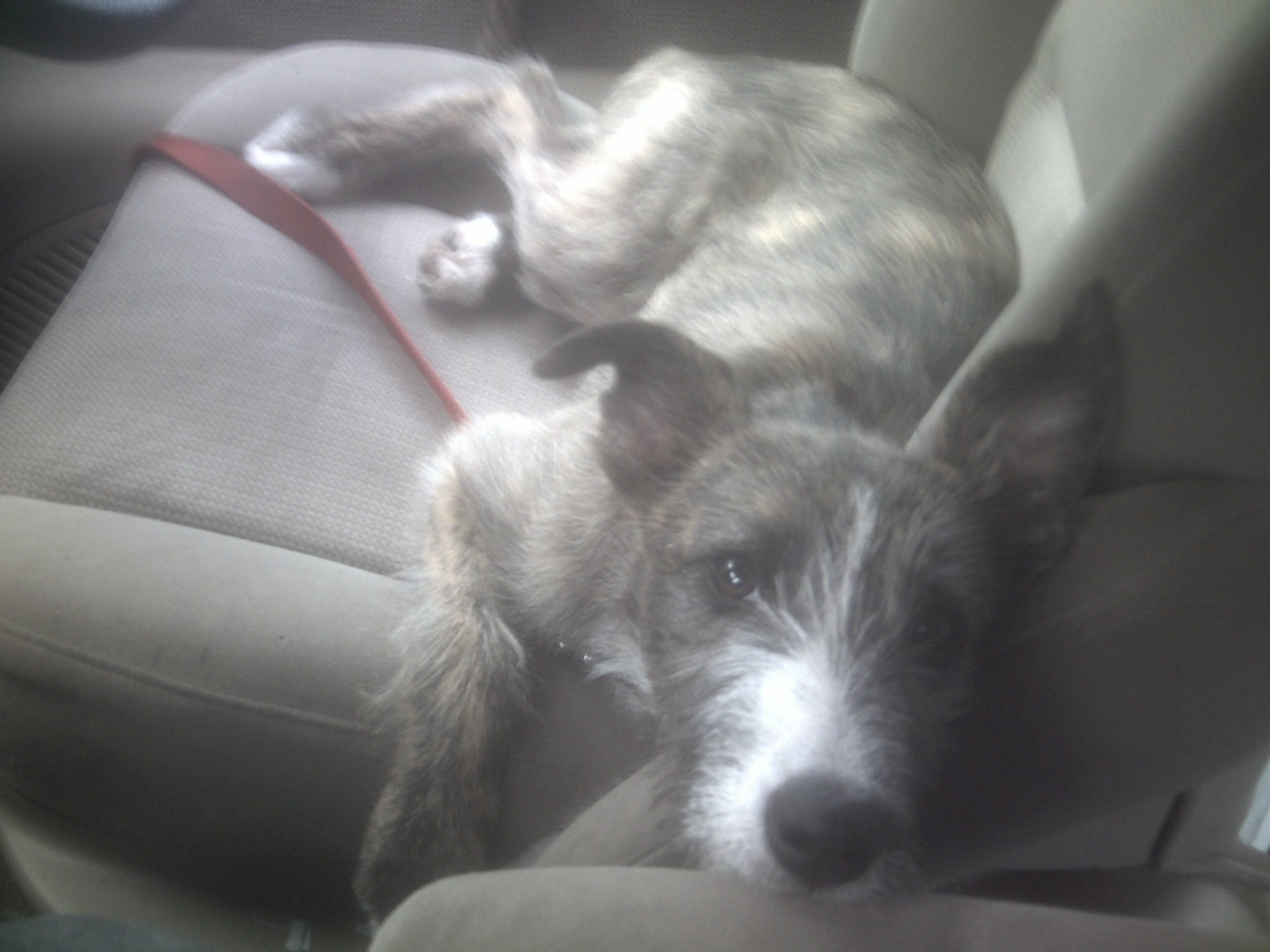
Tinks – first walk without her cast on! Image is mine
We were so, so lucky.
As the years went by, Tinks only got easier. I have never had such an easy dog. She was vocal when she wanted to be, but only ever out of excitement. She never jumped up at anyone, never stole food, never destroyed anything. She was so happy-go-lucky, so laidback. I always said it was like she lived in her own little world, and she did. A sweet, gentle happy little Tinks world.
Tinks as a puppy – image is mine
At the start of 2020, before the pandemic, we said goodbye to Skipper, another lurcher. He was ten and had suffered with heart failure for the last year of his life. He was a great companion for Tinks – they truly loved eachother and when he was put to sleep at home, she was there too. As I leaned over him, sobbing, she came over, pushed her head up under my arm and forced me to look at her. It was as if she was trying to say, hey, I’m still here!
Not long after Skipper left us, we got Jesse, who is now 5. He gave Tinks a new lease of life, as did Ada when she came along almost three years ago.
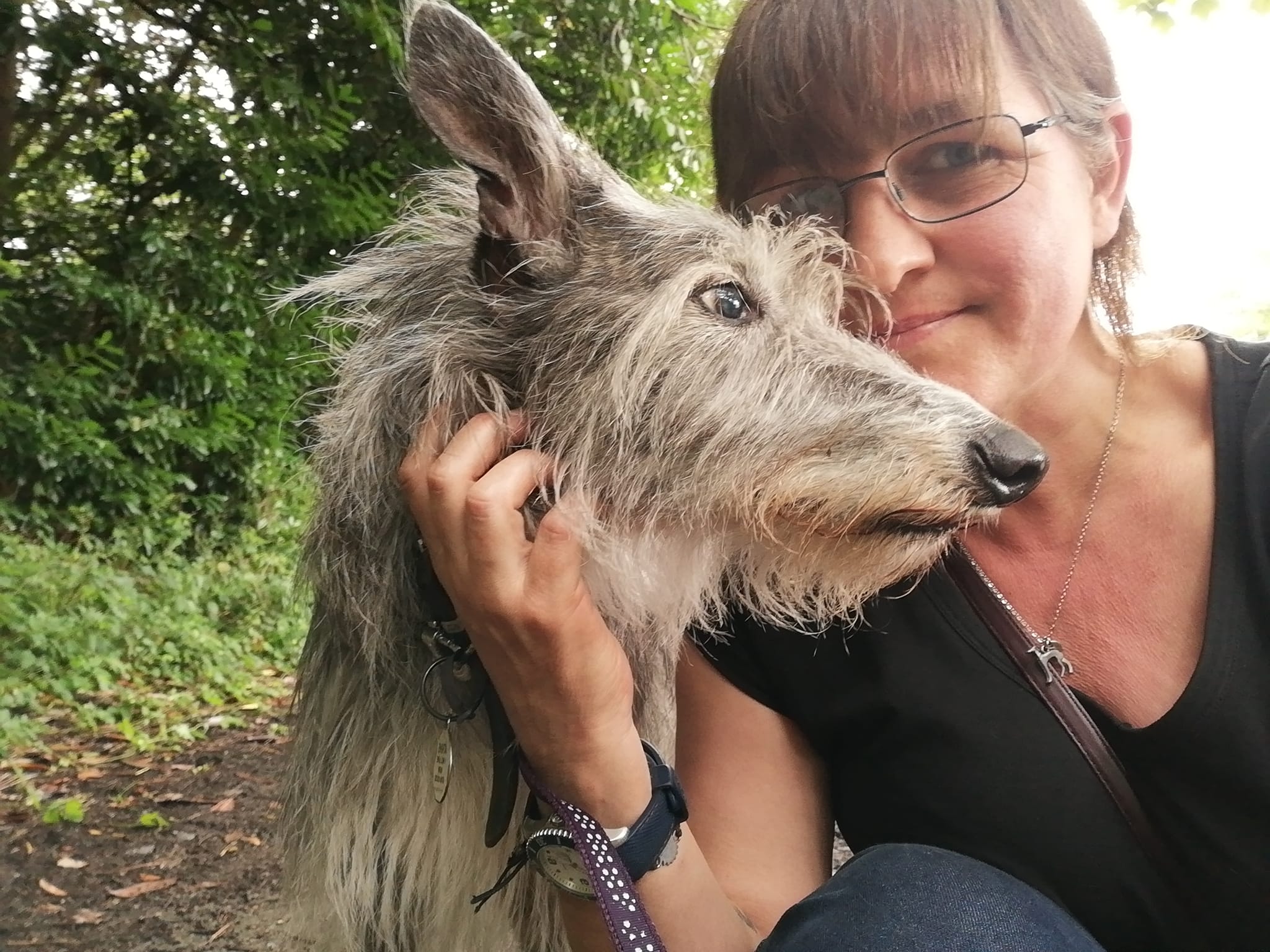
me and Tinks – image is mine
It’s really been the last year or so that Tinks started to slow down. Her back legs in particular were getting shakier and weaker, and she had trouble going up and down stairs. She stopped coming out for so many walks and was mostly happy pottering around the garden.
We knew the end was coming and I wanted the end that Skipper had. He was always afraid of the vets and became stressed getting into cars, so we had the vets come out to us. That way he could slip away in the comfort of his own home.
The Sunday before last, Tinks was fine one moment and then I noticed she was panting heavily. It was 6pm and we were watching TV together. She then got up and staggered about on her bed, so I went over to her, as something did not seem right. As I reached her, her legs gave way under her and she collapsed mostly into my arms, but hit her head on the floor. As she went down, her mouth stretched open and she cried out in pain. I thought I was losing her there and then.
We got her comfortable and all gathered around her, crying. She couldn’t seem to move her legs so we gently moved them for her so she was lying on her side. About an hour later she had another similar episode. She got up, staggered about, fell onto my lap and cried out. This time it was worse and she cried and grunted several times and again, I was certain she was going.
She settled down again and I called the emergency vets as I did not want her to suffer. They couldn’t send anyone out at that time but could see her if we drove her in. That would have been difficult, as she was a big dog who couldn’t move by herself at this point. We discussed it but by 9pm she seemed okay again. She had some water and even a few treats. We decided to leave her for the night and see how things were in the morning.
I slept downstairs with her that night. She slept peacefully through and in the morning surprised us all by going outside for a wee! She didn’t want any food though. Meanwhile, I made the appointment for the vets to come out on the Wednesday, as it was clear we couldn’t let this go on much longer. It gave us a few more days with her and I was thankful for that, but also anxious in case she had another episode. I just didn’t want her to suffer at all.
Thankfully she made it to Wednesday. She did not eat any dog food, just the odd treat and a tiny bit of cake I shared with her. She drank water but was otherwise uninterested in food. She slept peacefully most of the time and we all tried to spend as much time with her as we could.
Wednesday arrived. My busiest work day, but to be honest, I was glad of the distraction. I ran a few Zoom clubs in the morning then the vets arrived at 12.30pm. It was all over very quickly and very peacefully. She was so tired, so weak, so ready to go. My teenage son was here and he was wonderful. We buried her in the garden next to Skipper on the other side of the cherry tree.
Mostly, I feel relief. Life was getting harder for her, and I really wanted to avoid a stressful or painful death. She deserved the best end and I think that’s what she got. No more suffering, no more pain, no more feeling tired or weak.
And now, we miss her.
We realise how special she was, how sweet she was, how easy she was. She never demanded anything of anyone, that’s the thing I keep coming back to. She was the least demanding dog I’ve ever had. The simplest. The gentlest. The easiest.
Fourteen years is a long time for a dog to be part of your life and your family. Though we have the younger two to keep us busy, there is a Tink shaped hole in everything now.
But what I keep coming back to is how lucky we were to have her. From an extra foster dog I didn’t know I was getting, to the broken leg meaning her foster stay was prolonged, to having her as part of our lives for so very long, I feel lucky.
It’s been a few weeks now since I last blogged and that’s not for lack of things to write about! I just simply haven’t had time and other things have had to take priority. I also had two weeks of jury service to complete which was an amazing and fascinating experience! It’s back to normality this week though and now that my to-do list is somewhat under control, I have something I want to blog about, and it’s difficult dogs!
Followers of my Instagram and Facebook will know that I am a huge dog-lover, and that I currently own three lurchers. Tinks, is a 12 year-old scruffy-haired lurcher who I fostered as a puppy and ended up keeping. We don’t know exactly what mix she is but my guess would be deerhound/greyhound/whippet. She’s a lovely, easy-going simple soul, who, apart from being a bit vocal in her younger years, has never given me a bit of trouble. She came over on a van from Ireland with no history and just slotted right in.
Next we have Jesse, my almost three-year-old boy. He’s a greyhound/deerhound/whippet/collie/bedlington terrier mix who came to us as a puppy in between Covid lockdowns. He’s a smart, loving, laidback boy who I would describe as selectively reactive. If you’re not a dog owner, you might wonder what I mean by ‘reactive’. It’s what we call dogs who react to things we would really rather they just ignored. A prime example of this is barking and lunging on the lead when they see other dogs. This can be because they are excited and frustrated that the lead is stopping them from saying hi, or it can be because they are fearful of the other dog and they are barking at them to keep them away. And guess what, it tends to work, so reactivity then becomes a cycle you find you and your dog trapped in. Jesse can go weeks without barking at anything on the lead, then suddenly he will take a dislike to a dog and bark. Sometimes I can get his attention back on me, reward him for disengaging with the trigger and often, just saying hi to the unknown dog is enough to settle him down. In short, I don’t worry too much about his reactivity but we do work on it all the time.
And then there is Ada…
I wasn’t supposed to get a third dog! It wasn’t on the cards at all. However, I had been telling people that I was broody for a puppy and as Tinks is getting on a bit. I had started thinking about what I’d get in the future to go with Jesse. Jesse loves company and I know he wouldn’t enjoy being a single dog in the house. And of course, if you mention thinking about another dog, people who know you tend to mention it when they come across a dog that needs a home…
I received a message from a lovely lady who had taken a puppy from a breeder she wasn’t overly happy with. The puppy was not quite right for her and her dogs, but she was reluctant to send her back to the breeder. She sent me a picture and asked if I would consider her. I fell in love right away but was sure my husband would say no. After all, we already had two dogs! To my utter amazement he said yes, and the next day we drove to pick her up.
Ada’s mix is not dissimilar to Jesse’s. Her dad was a greyhound/deerhound and her mother was a merle collie/whippet/bedlington terrier/greyhound/bearded collie. However, it quickly became apparent that Ada’s mind and personality are 100% collie. That is a risk you take with lurcher pups because although they are predominantly sighthound crosses, they often have other breeds mixed in, usually collie or terrier. Ada is my fourth lurcher and I’ve fostered over 100 of them in the past and I have never come across one with so little sighthound traits.
Sighthounds are obviously bred to be extremely fast and athletic and they hunt by sight, hence the name. Once they have had a good run, they are usually known for being couch potatoes who like to laze around all day and I’ve always found this to be true. They can be very smart but they will decide what they want to do and often their favourite thing is just sleeping!
When Ada arrived she was very confident. She acted like she had always been with us and was instantly extremely affectionate with the whole family and made great friends with Jesse and Tinks. I was so pleased with how well she slotted in. I figured I’d train her as I had the others, work on recall and disengagement from a really early age, and before she was allowed out for walks, she had mastered all the basics and more. I’d carry her around as much as possible to help her socialisation and I signed her up to Life Skills classes with the wonderful trainer we know. I was so excited! But it soon became apparent that things were not going to go as planned or hoped…
The first time Ada met a strange dog, she was still not old enough for walks but I hoped they could say hello quickly. It was a small friendly dog but Ada’s reaction was to bark at it in fear. I didn’t have my other dogs with me at the time so she wasn’t copying them. She just didn’t want to say hi. Not long after that we started Life Skills and I could see right that she was not comfortable with the other dogs in the class, or the other dogs she could see in the distance of the field. She would focus on me and was amazing at her training but she would bark if she heard another dog bark and I felt my stomach sink. No, this couldn’t be happening. Not again. Not another reactive dog. And at such a young age? I was so upset and worried. I wondered what I had done wrong.
We continued with classes and she was amazing. She started coming out for walks, on lead and off with my other dogs and again I could see that she was not happy with other dogs, and worse than that, she was starting to bark and lunge and react to bikes, scooters, cars, joggers and children. Pretty much everything, to be honest! I tried not to panic. I told myself it was the puppy ‘fear stage’. She would get over it. I just had to keep taking her out, keep meeting other dogs, keep rewarding her when she didn’t bark and so on. But inside I felt sick with worry. She was only three/four months old. Where had these fears come from? Where would they lead?
For a while, it got worse. Ada off lead would run up to other dogs barking. She would never reach them – she would always turn back or circle around or go and hide. It was all fear, but it didn’t look good! On lead, she would lunge and bark and growl at cars, bikes, joggers, kids and dogs. It was so embarrassing because she still looked like a puppy. I almost died in the vets when she went in to get weighed. She was fine with a little dog sat next to us but when an excitable spaniel straining and panting on its lead came in, she lost her shit! After that, two big labs plodded in and she froze in terror and wouldn’t stop barking. I had to pick her up. I almost cried. It was awful. A trip to the pet shop was equally as embarrassing. I started wanting to hide away. I thought, I’ve made a big mistake here. What is going on?
Thankfully for me I know lots of lovely, well-informed and educated dog people, including my wonderful trainer Jodie. One Facebook friend pointed me in the direction of collie-based information and articles and everything began to click together. Off lead with my dogs, she acts like a border collie herding sheep. She runs to the left or right, she crouches, prowls, lies flat, stares, fixates, pounces, then runs ahead again. It was fascinating to watch but she seemed to have no bond with me when out. She was not paying attention to me at all – she was was all collie thinking independently and trying to herd the other dogs. Her reactivity to cars, bikes, joggers and dogs was movement based – it was the movement that was triggering her. Collies are notoriously sensitive dogs. Their senses quite literally go into overdrive – so a moving car, a flapping bird, a loud bang, a barking dog all at once or after the other, can be hugely hard for them to cope with. They tend to bark and lunge because they are on lead and cannot control the movement.
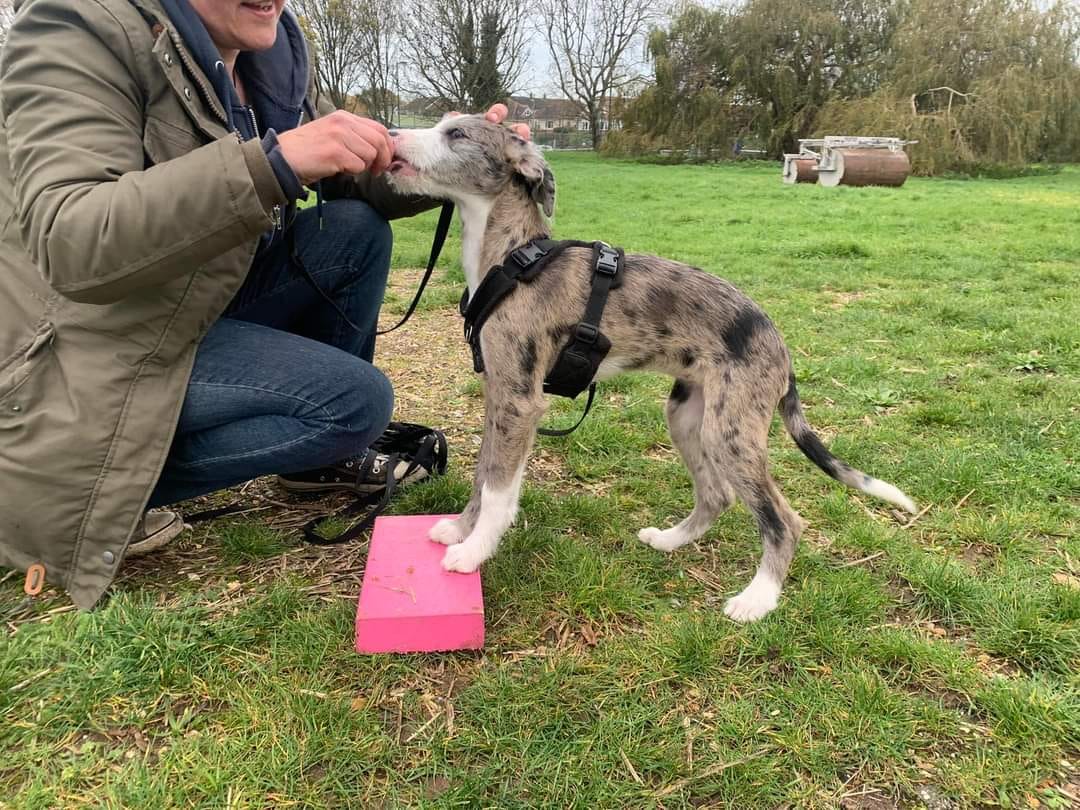
Once I read more and more about the collie brain and what it had been bred for, I began to understand this complex little girl all the more. She is insanely clever and extremely motivated to learn. Jesse will get bored of learning new things after a while and he will just wander off. She now attends trick training once a week and for that entire hour she focuses on me and learns at a fast pace I know my other lurchers would not cope with. I’m on the waiting list for Hoopers and I hope eventually to try agility and scentwork with her. We do little bits of these activities at home already and she loves them.
Her sensitivity at home was bewildering until I understood it too. If you get cross, raise your voice, say ‘no’ or just mutter a swear word to yourself about something that does not concern her, Ada will get very worried. She will run away and hide. If I tell off a child or another dog, if I say ‘no’, that’s it, she’s gone. So, I can’t use those words or that tone with her, not ever. If I do, if I lose my cool, or get frustrated or impatient with her, she shuts down, she won’t learn. It’s not worth it.
She responds to positivity. She absolutely loves being told she’s a good girl! We have been slowly working our way through fears and anxieties. I think I had to grieve a bit first, for the dog I thought I was getting and I had to accept the dog I have. Now that I understand her, life is getting easier for us both.
I take her out on her own as much as I can. I have to be very careful not to push her too fast though. But she does need to gain confidence on her own and I can work on her issues easier if it’s just her and me. This is time consuming, of course! We are slowly getting there. The other day I took her to a fairly busy area and she only barked at two dogs out of eight. I call that progress! She now has two local friends because some of my neighbours kindly agreed to help me with her reactivity by walking with us or down the lane in front of us until she learned to relax and disengage. She has friends at her trick training class and knows not to bark at them! Her confidence is slowly creeping up with all things. She still barks at dogs if they’re too close, too sudden, too scary and maybe she always will, but we will never stop working on it.
I don’t care what anyone else thinks of us. I’ve had to let the guilt and the embarrassment go because it was just getting in our way. We want to move forward. I want to get the best from this unique girl and I believe I already am. Most people don’t understand dog reactivity and a lot can be very judgemental. Some people get easy dogs and a lot of the time it is just luck. Try telling them that though! When you know you’ve put way more training, work, article reading and effort into your dog than they have with theirs, it can be hard to see the rolling eyes, and the judgement in people’s faces. But I don’t care because my dog is amazing.
Ada is the most affectionate dog I’ve ever owned. My other dogs have all been loving but she takes it to another level. The whole family adore her despite her quirky ways, because she is just so adorable. She will lounge over anyone’s laps, grunting softly like a sleep puppy, staring adoringly into your eyes. She follows me everywhere, has to be involved in everything. Her behaviour at home is exemplary!
Here is a list of positive things Ada does:
recalls, stays, gives paw, gives other paw, crosses her legs over when asked, retrieves and gives, middle, circle, orbit, backwards, around things, over things, standing tall, arch, beg, wave, pretending to cry, hugs on command, waits when told, doesn’t try to get our food, lies nicely and watches you eat, was easy to house train, never chewed anything she wasn’t allowed, doesn’t pull on lead (unless very nervous), behaves nicely in car, spins, doesn’t jump up.
Here is a list of negative things Ada does:
Sometimes barks at other dogs and things that scare her when on walks.
That’s it. Otherwise she is a perfect girl. She is an incredible girl. I have never experienced a dog like this before and I feel lucky and privileged to be on this journey with her. Yes, there will be hard times ahead. Yes, there will be days when all three of my dogs decide to react and bark when I really wish they wouldn’t. Yes, there will be days when other dog owners mutter at me or think the worst of me and my dogs. Yes, there will be days when I get tears in my eyes and want to hurry home to hide. Yes, there will be days when I get it wrong.
But I know we’re going to have good days too and I already know that Ada, this tricky, complex, difficult dog who was not at all what I was prepared for, is changing me and my life.
She is forcing me to learn new things, she is encouraging me to get over myself and my own selfish fears and doubts. She is making me go out there every day to help her, whether I want to or not. She is forcing me to be more patient, more calm, more positive and I feel like it’s spilling over into all areas of my life. This dog has changed me and my life and she is only seven months old.
I just hope I can do her justice. I hope I can be the owner she deserves. She tries so hard to get it right, she makes me want to be a better person, for her.
So, if you ever get a difficult dog, the kind of dog other people tend to judge, just hold your head up high and keep going. Keep doing what you need to do for that dog, the dog you have, the dog you ended up with. At the end of the day, all I care about is helping Ada feel more confident so that she can navigate the world with less stress. Other people won’t know that, they won’t know her, they won’t know what’s going on in her collie brain, but I can advocate for her and make sure I’m setting her up for success. She is so worth it!!
Welcome to the last post in my Pandemic Pets feature! I have been welcoming guests to the blog to tell us how the furry friends in their life have made getting through the Covid 19 pandemic that much easier. Today I’d like to extend a warm welcome to my very own big sister, Fran Hemsley. Fran is not a writer or a blogger, but I felt she had an interesting experience during lockdown, so I asked her if she would consider contributing to the blog.
When I found myself furloughed back in April I did what a lot of people in my position did – I started running! Every day I escaped home-schooling and the house full of people for about thirty minutes of ‘me time’; something I have never really indulged in before.
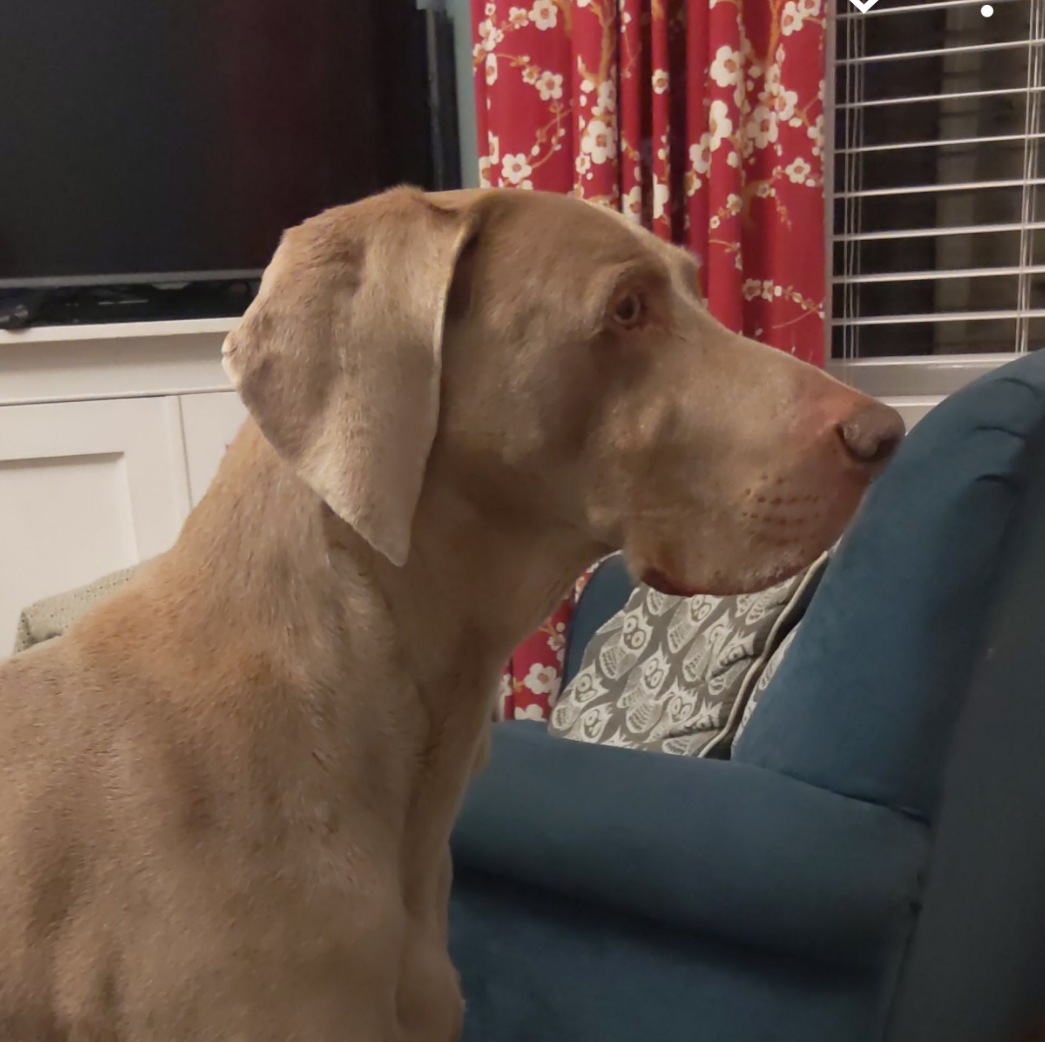
During lockdown I experienced the sudden death of my beloved Weimaraner Beau. I’m not ashamed to say he was the love of my life and my best friend. To cope with this unexpected bereavement I turned to running even more and found it even more beneficial as a means of ‘escape’.
Beau
It was during one such running session that I first came across Mr Fox. Well, I think he was a mister! He was sat as bold as brass in the middle of the road and when I paused to talk to him, he bounded on over and stopped at my feet.
And so an unlikely friendship developed in the midst of the global pandemic and the loss of my best friend.
After that initial hello, Mr Fox started appearing on my drive when I returned from my runs. He quite quickly started to follow me through the gate of our side lean-to. Even when the running stopped and I returned to work, if I left the gate open, he would appear like clockwork at the kitchen door.
After Beau died I was left with some very expensive dog food, so of course this went Mr Fox’s way. As did his wormer and flea treatment.
Mr Fox
Some people don’t like foxes being fed in urban areas, but their opinions don’t bother me. We have taken over their natural environment with the urban sprawl, turning them from hunters to scavengers and with the modern wheelie bins being so tall, it is hard for them to find our leftovers. Every single person I have spoken to about Mr Fox, bar one, does not have a problem with me feeding him. In fact, many neighbours confided in me and said; ‘Well, don’t tell anyone, but I feed the foxes too!’ It seems to be a very well kept secret where I live!
These days it’s too cold to sit in the lean-to and wait for Mr Fox to appear but I leave food for him out the front every night. Our property is kept clean and tidy and he must devour the food quickly, as we do not have a rodent problem in the area.
Brave Mr Fox
Making friends with Mr Fox was totally unexpected and magical and really helped me to get through the lockdown and the loss of my beloved Beau. I really hope to see Mr Fox again in the Spring.
Thank you so much to my sister Fran for sharing this with us and thank you too to the other bloggers and guests who shared their pandemic pet stories!








 The Glorious Outsiders