How I Write A Book – In Pictures

This is my tried and tested process

The fastest I have ever written a first draft is four weeks, which broke my previous record of six weeks. Now, these are the easy books – the ones that burst into your head fully formed and simply require some dedication and slightly unhinged addictive typing to get written. My average time to write a first draft is three months. It’s also important to point out that I am not one of those writers who edits as I go. I don’t. I rarely even read over what I wrote the day before. I just let it tumble out in a gloriously clumsy, scruffy, and undoubtedly ugly splurge. The real hard work, the editing and rewriting comes after and that can take me a few years!

But here’s how I get that first draft out of my head and into a book form.

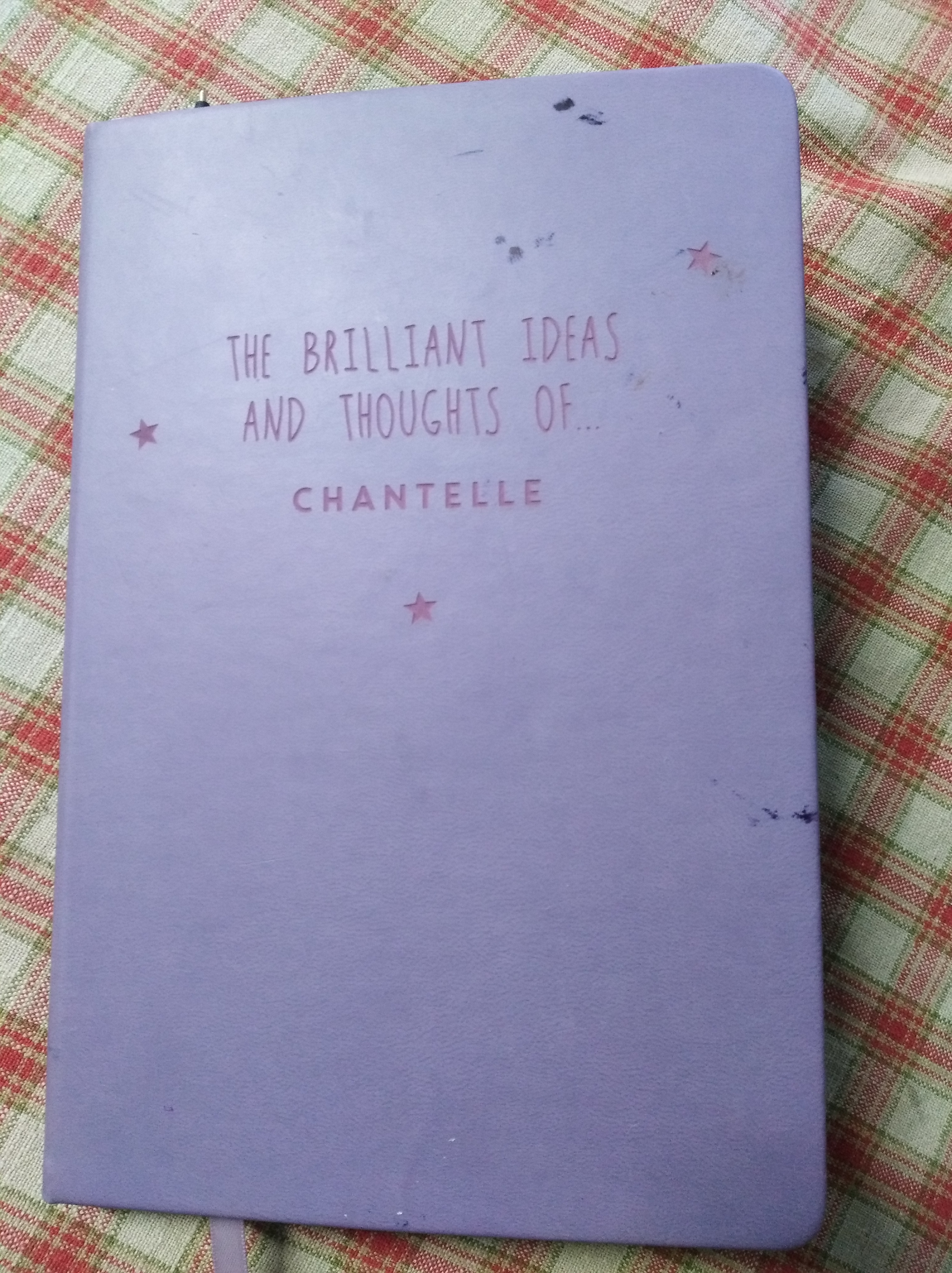
Step 1: you need a notebook! Image is mine

Step 1: Yep, it’s as simple and as old-fashioned as that. I get a notebook and allocate it to the book idea. The ideas are crowding my head now and need to be written down. It won’t be particularly organised. Other than pages for character bios and plot ideas, the initial writing will be an outpouring of what has been building in my head. I highly recommend the notebook approach. I know its tempting to do it all online or on Word, or whatever you use, but there is something scary and clinical about that crisp fresh new document blinking back at you and it can feel intimidating, even impossible to get started. A notebook is far friendlier and you can carry it about with you. No one has to see it. It’s private, just for you. It’s a way in. An open door. Now, anything can happen.

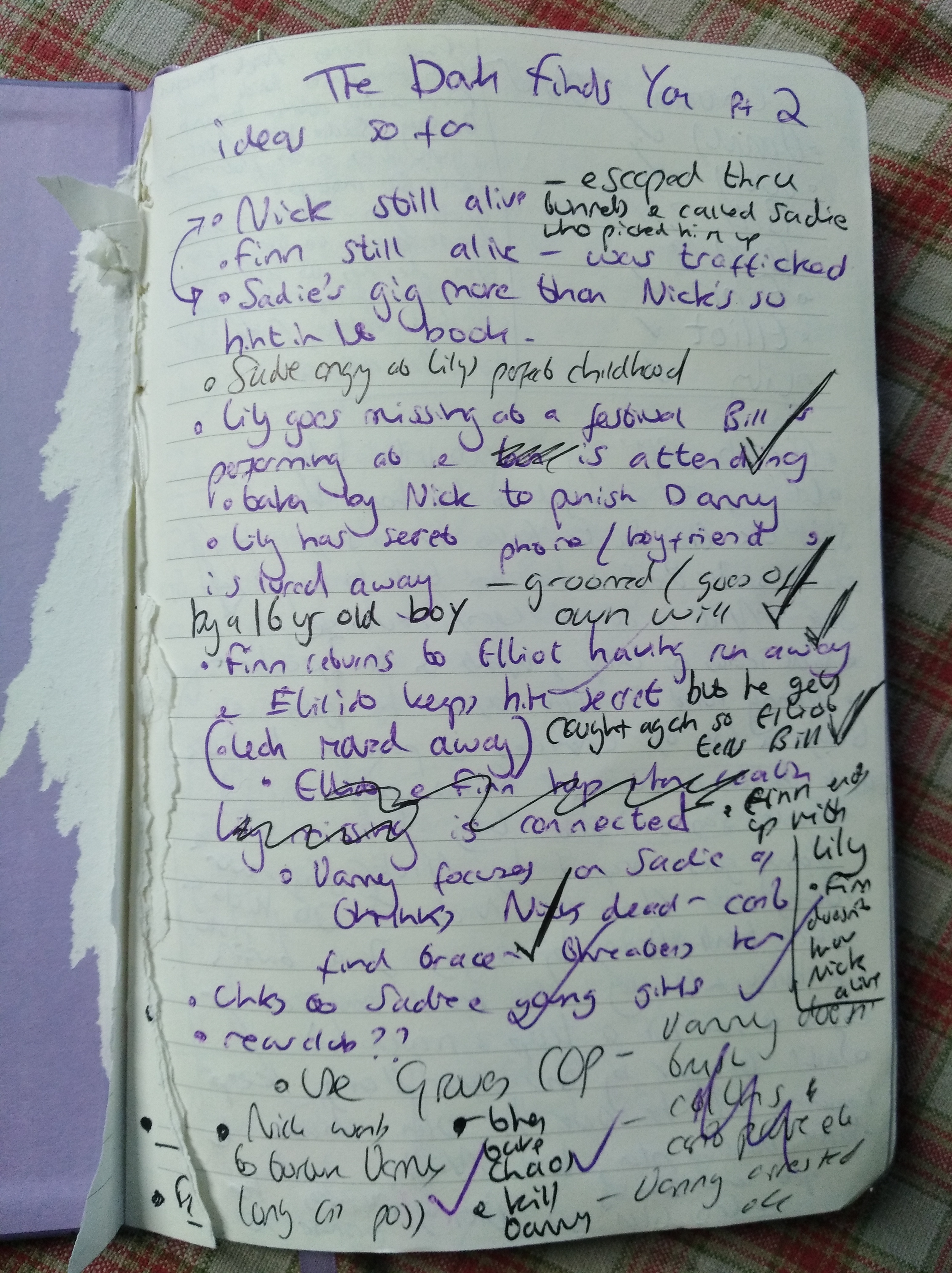
Step 2: First page of notebook: ideas explosion! Image is mine

Step 2: The next thing that happens is an ideas explosion. Mind-maps or brainstorms are good too, but I like to just list my ideas and then later when chapters are being written I have the satisfying job of going back and ticking off what I’ve done. These ideas won’t be in order, by the way. And a lot of them won’t make it into the book. New ideas and sub-plots will inevitably muscle their way in too.

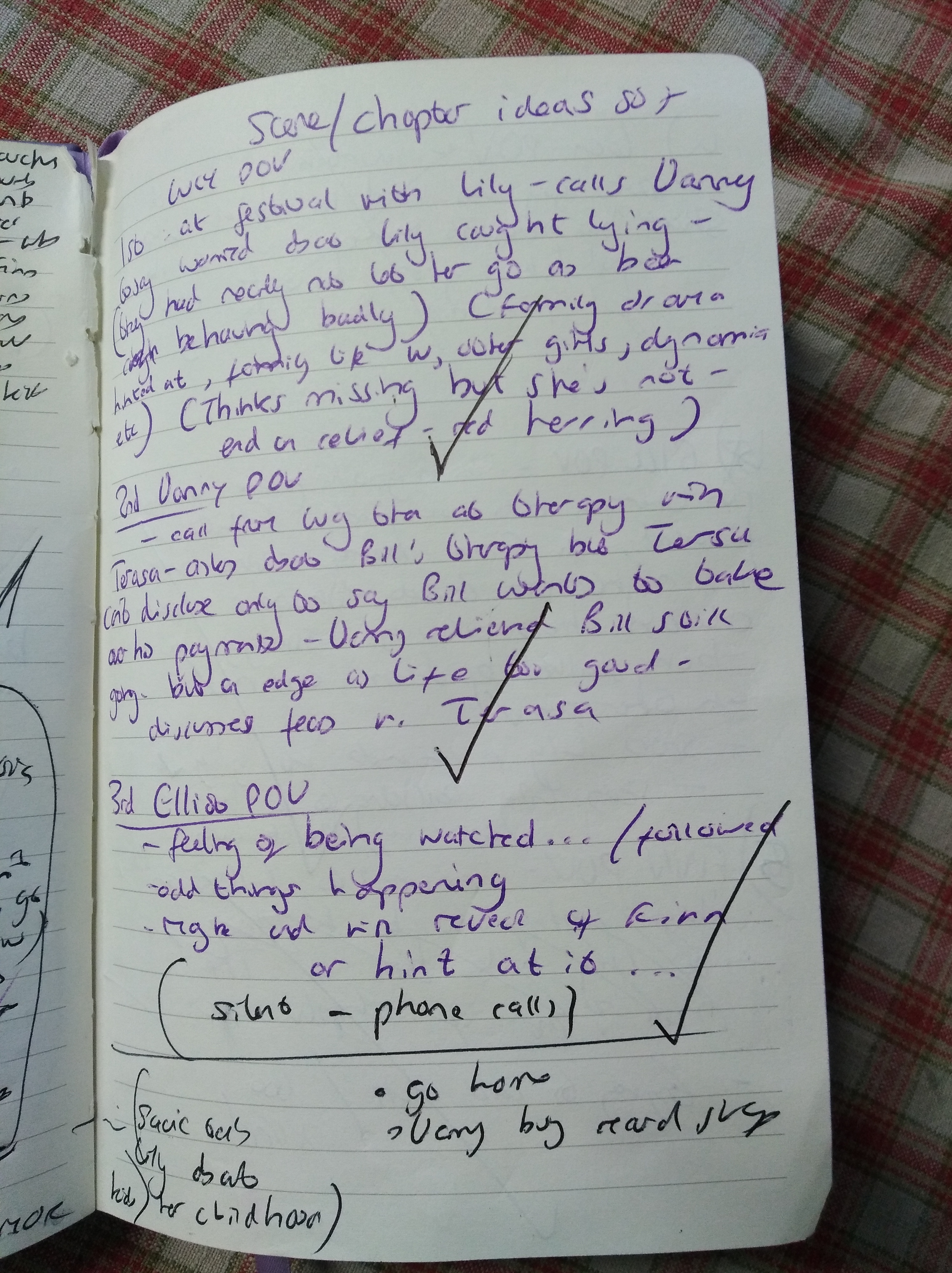
Step 3: chapter outlines! Image is mine

Step 3: The next step is chapter outlines. This is easier if the whole book has leapt into your head the way this one did in mine, but it can be achieved with less as well. I often find that starting chapter outlines gets me really far into the book, and often ends with me plotting the entire thing. Outlining one chapter, for example, very often leads you into the next.

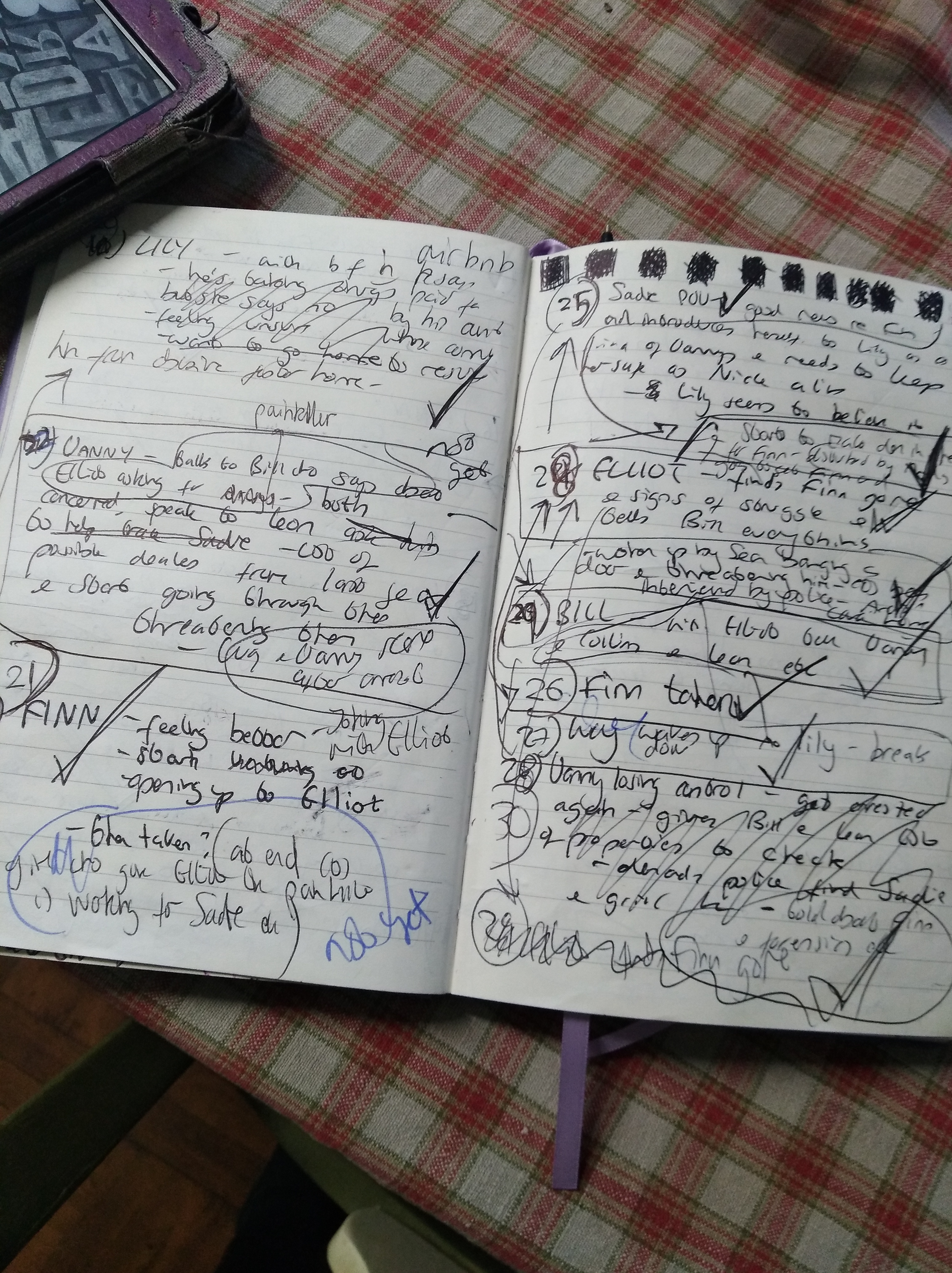
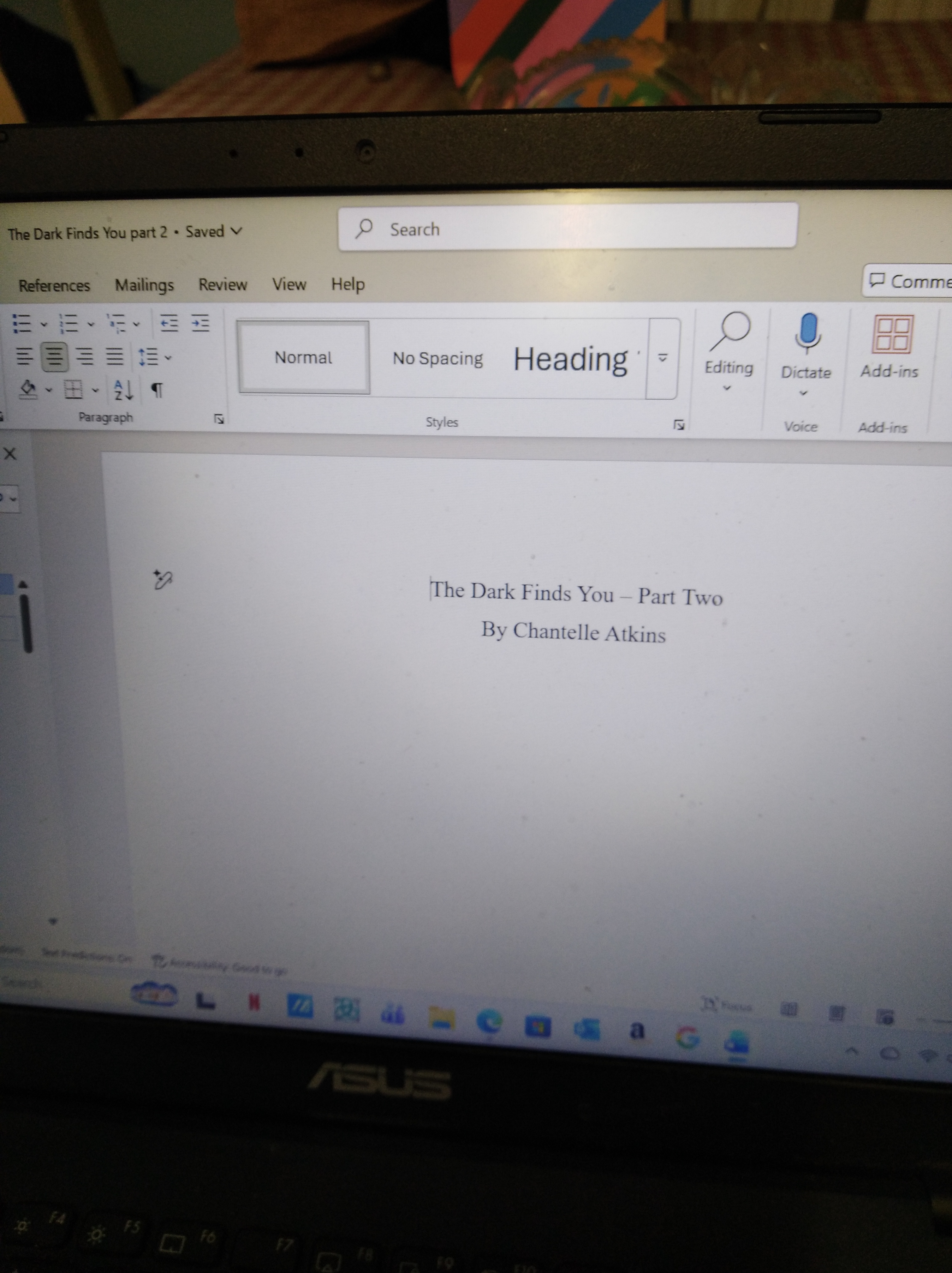
Step 4: Start writing the book on your laptop. I prefer Word for many reasons. The notebook of chaos runs alongside the writing. The notebook is indeed now very chaotic! New chapters have pushed themselves in between the original chapter outlines, and I end up with circles and crosses and arrows all over the place. No one else would be able to make sense of it, but I can, and that’s all that matters. Why still use the notebook? Why use one at all? I’ve already mentioned my own reasons for writing a book this way but there has also been a lot of research lately that concludes that all our brain is active when we handwrite, whereas only part of our brain is active when writing on screens. In other words, writing by hand makes us think more! I often wonder if my books would be different if I planned, plotted, outlined and wrote all of it on the screen.

Step 5: Using the notebook of chaos to guide you, ticking things off, circling ideas, crossing things out, now, you write the book! And how do you do this? It’s easy. YOU JUST DO IT. I can’t explain it any better. You just sit down at the keyboard and write. You make a habit and stick to it. Go for walks when you get stuck. Keep going. One word at a time until it is done. There is no secret formula, no magic spell. YOU JUST WRITE IT.

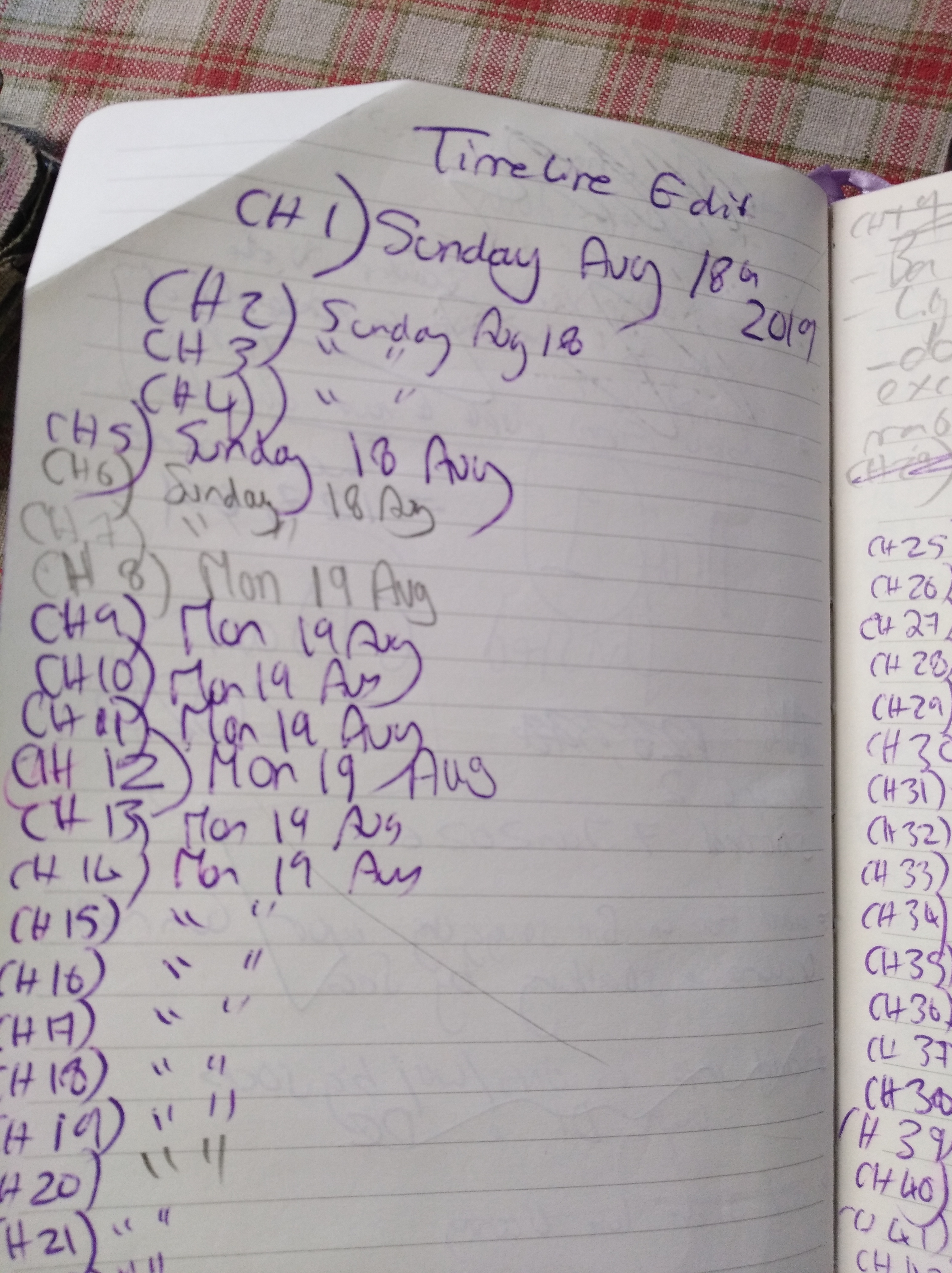
Step 6: 2nd draft is the timeline edit! Image is mine

Step 6. The book is now written in the first draft. I go back to the start and read through and at the same time I make note of a timeline in the notebook. I should do this when I am writing the first draft but I nearly always neglect to. For me, the purpose of a second draft is to read through what just happened, as I often don’t remember, and to apply the timeline so there are no date based plot holes or inconsistencies. I will also make changes and amend typos etc if I see them.

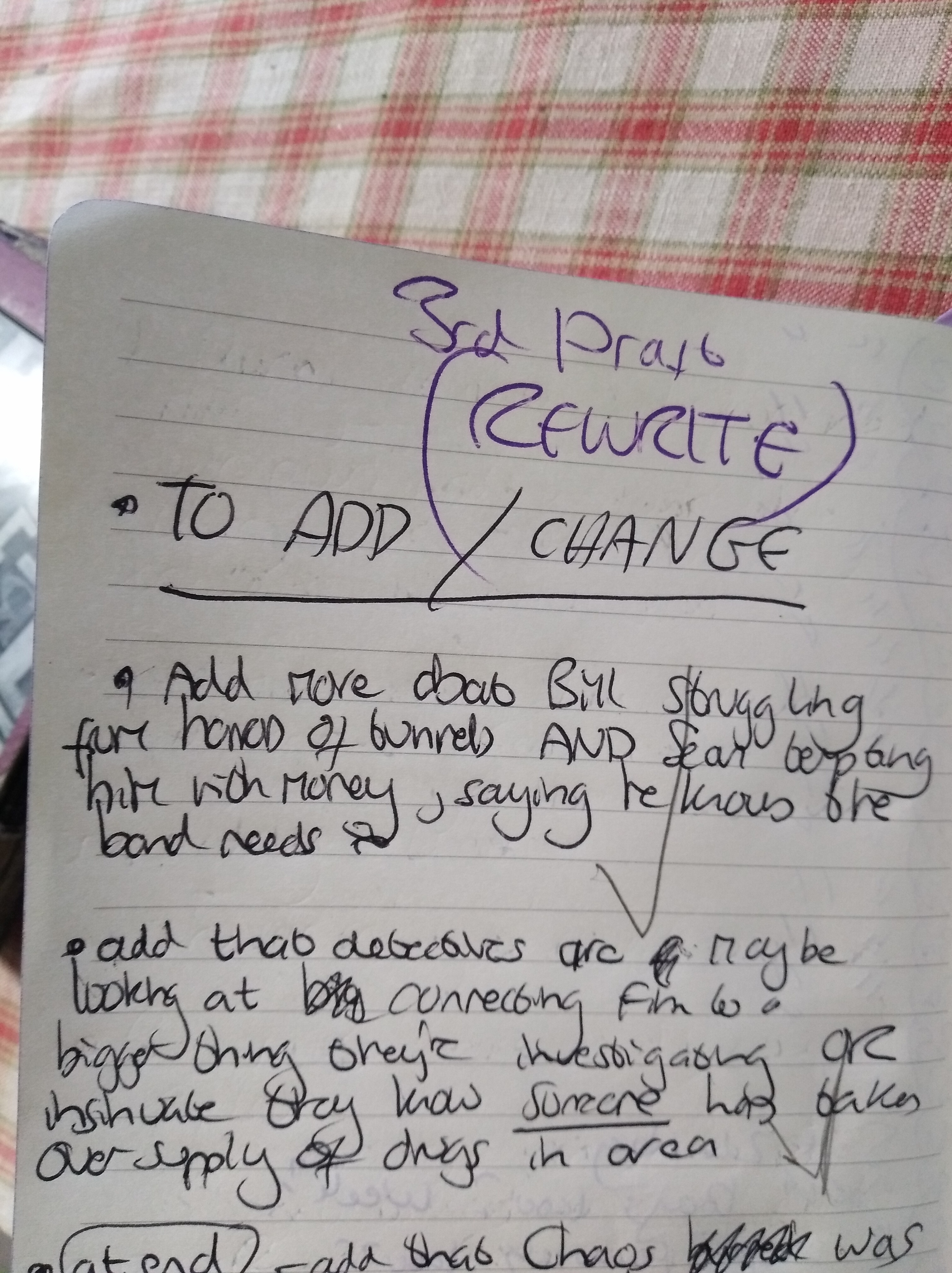
Step 7: the third draft is the first rewrite! Image is mine

Step 7. The third draft is the first rewrite! By rewrite I mean that I’ve found plot holes or changed my mind about sub-plots, or have decided to cut down some POVs, or change something fairly major. This involves more actual writing rather than editing typos. This is more time consuming than the second draft but much quicker than the first!

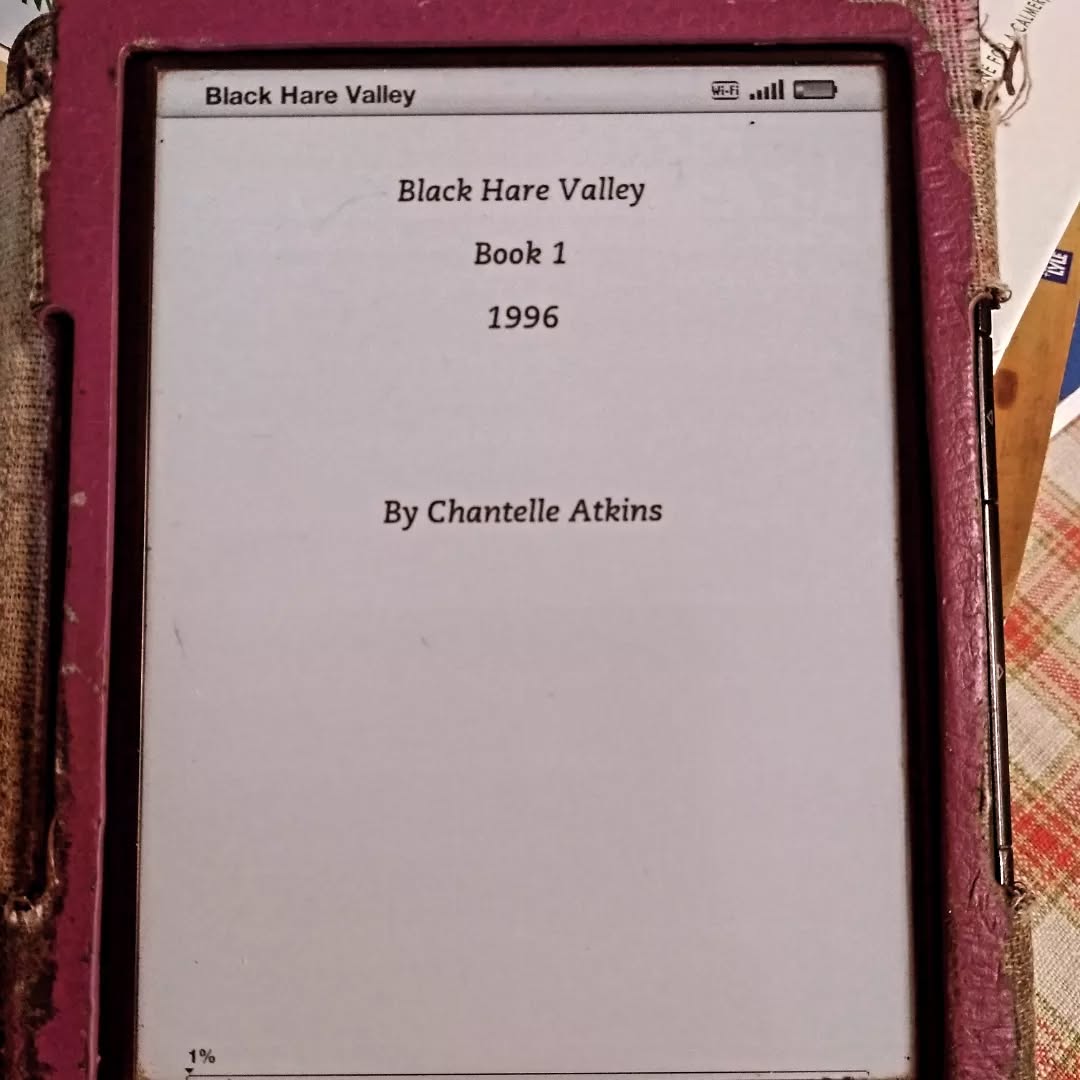
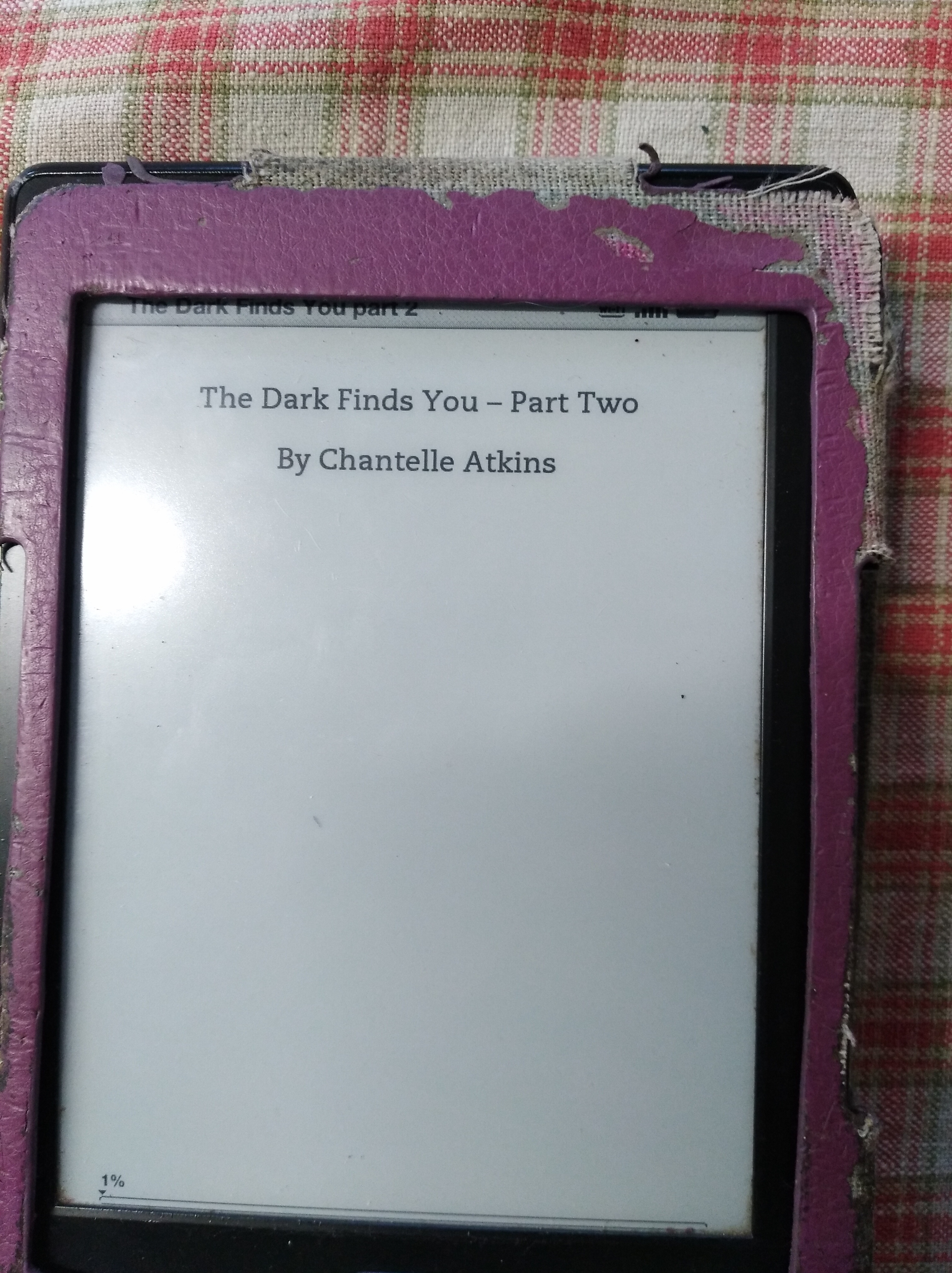
Step 8: The fourth draft is the Kindle edit! Image is mine

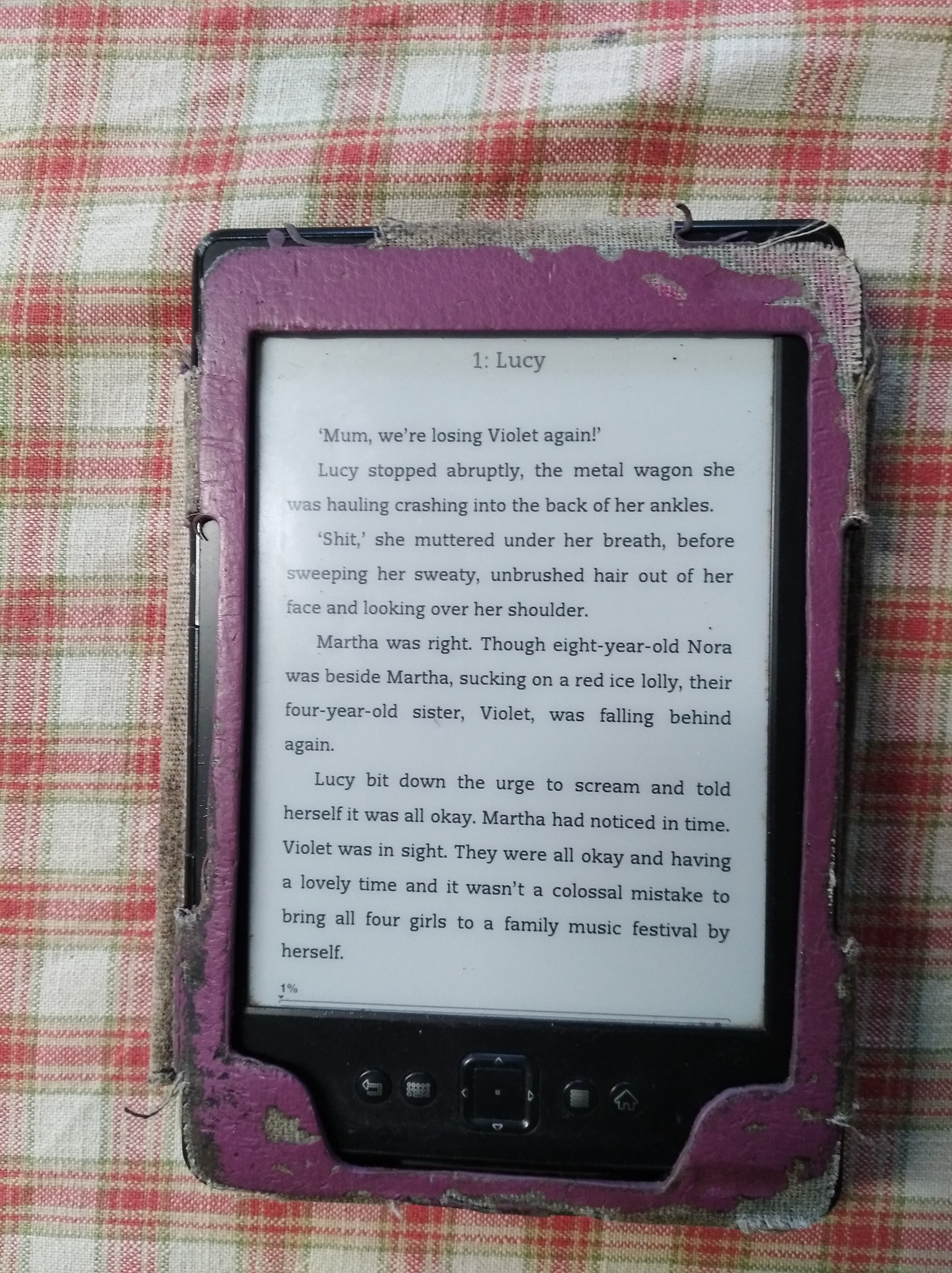
Step 8 is what I call the Kindle edit. I’ve written the book, applied the correct timeline and rewritten bits I didn’t think worked. Now I need to step back and read it as a reader. I send it to my Kindle and with a notebook on the go to pick up typos, repetitive words etc, I get going. I am mostly assessing how the book reads. Is it too fast or too slow? Are there parts that are in any way repetitive? Are my characters nodding or shrugging too much? (Yes, they always are.) Are my characters well written? Is the dialogue realistic? I am highly critical when doing this edit. Mostly I want to assess how much I enjoy reading the book!

my kindle edit – image is mine

Step 9: The fifth draft happens next. I go back to Word and fix anything the Kindle edit picked up. This might be quick if everything went well, or it might involve another rewrite if I wasn’t happy with the book!

Step 10: What happens next? The sixth draft. Another Kindle edit. Another draft. Then off to my editor. Do the editor’s edits. And so on….

So, there you have it. And to summarise, my top tips for writing a book?

  • a notebook
  • plan as much as possible before you start
  • THEN JUST WRITE THE BOOK

New Release! The Boy With The Thorn In His Side Part 3…

This week’s post is just a quick one letting you know that I have a brand new book coming out on 22nd February!

The Boy With The Thorn In His Side Part Three started life as a screenplay around a year ago. At that time, I had The Boy With The Thorn In His Side Parts One and Two merged into one large book, and the sequel which is set seven years later, This Is The Day also available. However, as I’ve said before, this story and these characters who have been with me since I was twelve, would just not leave me alone. I had this niggling idea for new material, which would move the ending of the original book,  slotting a brand new book between that one and the sequel.

It was a crazy idea, as the new material would mean making subtle changes to Parts One and Two, and the sequel, which would mean unpublishing them all, revising, revamping with new covers and then releasing again. I wasn’t sure it would be worth the risk so I decided to write the new material in screenplay form first.

I did this for a few reasons. First, I’ve always dreamt of these particular books being on the screen. I think they’d make an amazing gritty TV series with a killer soundtrack. I’ve been interested in screenwriting for some time and had Scrivener downloaded with a few screenplay ideas in motion. I also read some books and completed an online course. Also, this was a quick way to get the new material out of my head and onto paper. I used a notebook and carried it around with me, often writing into it while sitting in carparks waiting for school to finish. I’d scribble into it during brief moments of peace at home, writing alongside a coffee before I rushed back out the house. I sat with it in the evenings too, and it just kept growing.

It was so much fun and such an obsession! Of course, when it was done, I knew I had to turn the material into a novel, I just had to. There was no going back now. This was going to happen. I wrote the first draft quite quickly and after a few more sent it to my trusted beta readers. While waiting for feedback, I separated parts one and two and went over them both, cutting the word count, and rejigging a few scenes here and there so that Part Three would make sense.

Parts One and Two were originally published separately so I already had them on my Amazon dashboard, plus they already had reviews. I had to contact the cover designer to see if he could whip up new covers, or make changes to existing ones. A lot of work basically! I then had to redo This Is The Day, making more changes, adding scenes and changing the title to Part Four…

I thought I was crazy more than once but now that the brand new Part Three is ready for release, I’m really excited and certain that I made the right choice. By the time I got to the end of the Part Four edit, I already knew there was going to be a Part Five and Six.

This was very exciting! Part Five has already been written, in rough into a notebook, and Part Six is plotted. I’m not working on either of these just yet, due to other projects, but you would not believe how excited I am to get my teeth into them when the time comes!

If there is one thing I’ve learned from being an indie writer, it’s to leave things open. In fact, I’d say that ALL of my books have a potential sequel coming. Once I’ve created these character I never want it to be over, and it doesn’t have to be.


I Confess…I Write My Books For Me

I think it’s time to admit the truth. Who am I aiming to please when I write and publish a book? Well, mostly it’s me. I’ve been thinking about this a lot lately. 2018 was an endless round of editing and revising for me, as I prepared Elliot Pie’s Guide To Human Nature for release in October, and revamped and released The Boy With The Thorn In His Side Parts One and Two, and edited Parts Three and Four. Because of this amount of editing, and the fact I was taking part in a reading challenge, I didn’t get a hell of a lot of reading for pleasure done last year.

Which made me think about a few things. One, I really, really enjoy reading my own books, no matter how many times I’ve edited or read through them… Eek, I know, sounds big-headed, doesn’t it? But it’s true. I love my characters and my storylines have me hooked so much they keep me awake at night. Every single book I’ve ever published has a sequel bubbling away inside my head. I just can’t fully let any of them go. I’d miss them too much.

So, when I edit, revise, read through, proofread again and again and again, I enjoy it. I genuinely do. I become immersed in these characters lives. I enjoy the drama and the twists and the turns, even though I know how it ends! Weird, right?

Well, maybe not. After all, why do writers start writing in the first place? I’ve been thinking about this. Now, I’m sure for some it’s the dream of money and fame, of making it ‘big’, becoming an international, award-winning bestseller, who has all their books made into films. JK Rowling or Stephen King, in other words. I mean, it sounds amazing, so who wouldn’t want that?

And I’m sure for some, it’s the urge to entertain, to spin tales, to amuse, to awaken, to entice, to deliver a message.

But for others, I think it’s something different, something they’re not entirely in control of. And I think reading sparks it off. Reading a good book at a young age, then reading more. Becoming utterly drawn into a made-up world that holds your attention, keeps you amused, enthralled, or terrified. The kind of book you don’t want to end. The kind you want everyone else to read just so you can talk about it with them. The kind where you want the characters to be real, and almost believe that they are.

And then, because this is just so exciting, you start to wonder. I could do this myself. I could entertain myself. Then I’d be in control, and it need never end! I can create worlds and lives and people just how I want them, and I can make it funnier, or scarier, or sadder, whenever I want to. Forever!

'If there is a book that you want to read, but it hasn't been written yet, you must be the one to write it.'-Toni Morrison.jpg

And thus, a writer is born. A writer who originally set out to please only themselves.

That’s definitely how it was for me. Throughout my childhood and my teenage years, I was totally addicted to writing. I wrote early versions of some of the books I have since published or are working on. I wrote short stories, poems and endless, endless diaries and outpourings of words, thoughts, feelings, and dreams. My writing kept me sane, and it kept me entertained. I was never lonely or bored. I absolutely adored this game of make-believe, and I still do.

I write what I want to read, and I don’t think there is anything wrong with that. Maybe this is true of a lot of writers, I don’t know. It’s no coincidence that the kind of books I write are the kind of books I am always searching to read. I long to read books with amazing, complex characters, the type you never forget, the type you love and loathe in equal measures, the type you can empathise with and root for. I love realistic dialogue and prefer that to too much exposition. I like to read about characters I can relate to, which is difficult as so many books contain middle-class characters. I like to read gritty, hard-hitting storylines. I like realism.

So, there you have it. When I write a book I am mostly writing for myself. I want to write something for me to read. That’s not to say I don’t then spend years trimming it, honing it, revising it, proofreading and editing it until it becomes something I am proud to put out into the world. That goes without saying. I do want people to read my books. Desperately. I do want those reviews and those messages. Without a doubt, I would like better sales! And of course, my ultimate dream is to have all my books made into films or TV series! You got to have your dreams, right?

But in the beginning, it’s me I’m trying to please.

And I think that’s okay. At the very least, it means I will never stop writing!


Why I Love Writing # 5; Sometimes It’s Pure Magic

Actually, it’s pretty magical most of the time. Of course, there are days when it feels like anything but. When you’re revising the hundredth draft of something, when you feel like it’s a complete waste of time that no one will ever want to read. There are days when you don’t want to do it, days when you feel rejected and uninspired and full of self-doubt.

But the magical days for me, outweigh the negative ones. They can happen at any time during the creation of a finished novel. I often find the writing of a first draft a magical thing. That first line, first paragraph, first chapter is so daunting, so impossible, yet suddenly you’ve done it. It’s there. And then strange things start to happen. Magical things.

Characters you had a loose idea of start to come alive. They flesh out and invade your mind. They start talking to you and you talk back. That’s magic. The magic of make-believe. And then there’s the plot itself. I often have a good idea of what’s going to happen in a book before I start writing, and I would have made lots of notes before starting the first draft, but at some point, something else seems to take over. Unexpected things happen. The plot takes another direction, or parts of the story start to weave together in ways that are genius, but like something out of my control. Sometimes it feels like there is something else at play, controlling the whole thing.

take-532097_640

Often I know where I am going, but not how I will get there. I never worry too much about the finer points because I have learned to sit back and let the magic happen. And it always does. Out of the blue, never when I expect it to, it will all just come together. This happened to me recently with the six book series I am working on. Books 1-4 are written, and book 5 has had one very rough draft. I knew roughly what I wanted to happen in book 6, what storylines would be continued, but I didn’t know how I would end the book, or indeed, the whole series. I didn’t stress about it because I still had work to do editing books 3 and 4, and book 5 to write a second draft of.

But one day, out walking, it just suddenly came to me. My mind pieced it all together without me even trying, without me even consciously deciding to think about it. I suddenly just had it. How to end the book and the entire series, and it was perfect.

How does that work? How does that even happen? I have no idea, but like I’ve already said, sometimes I really feel like it’s not me in my head, working things out. Moments like that are so satisfying, and magical, they make all the blood, sweat and tears worthwhile.