Come with me, let me show you. Room to room. Window to window. Do you see? So close now, so close.
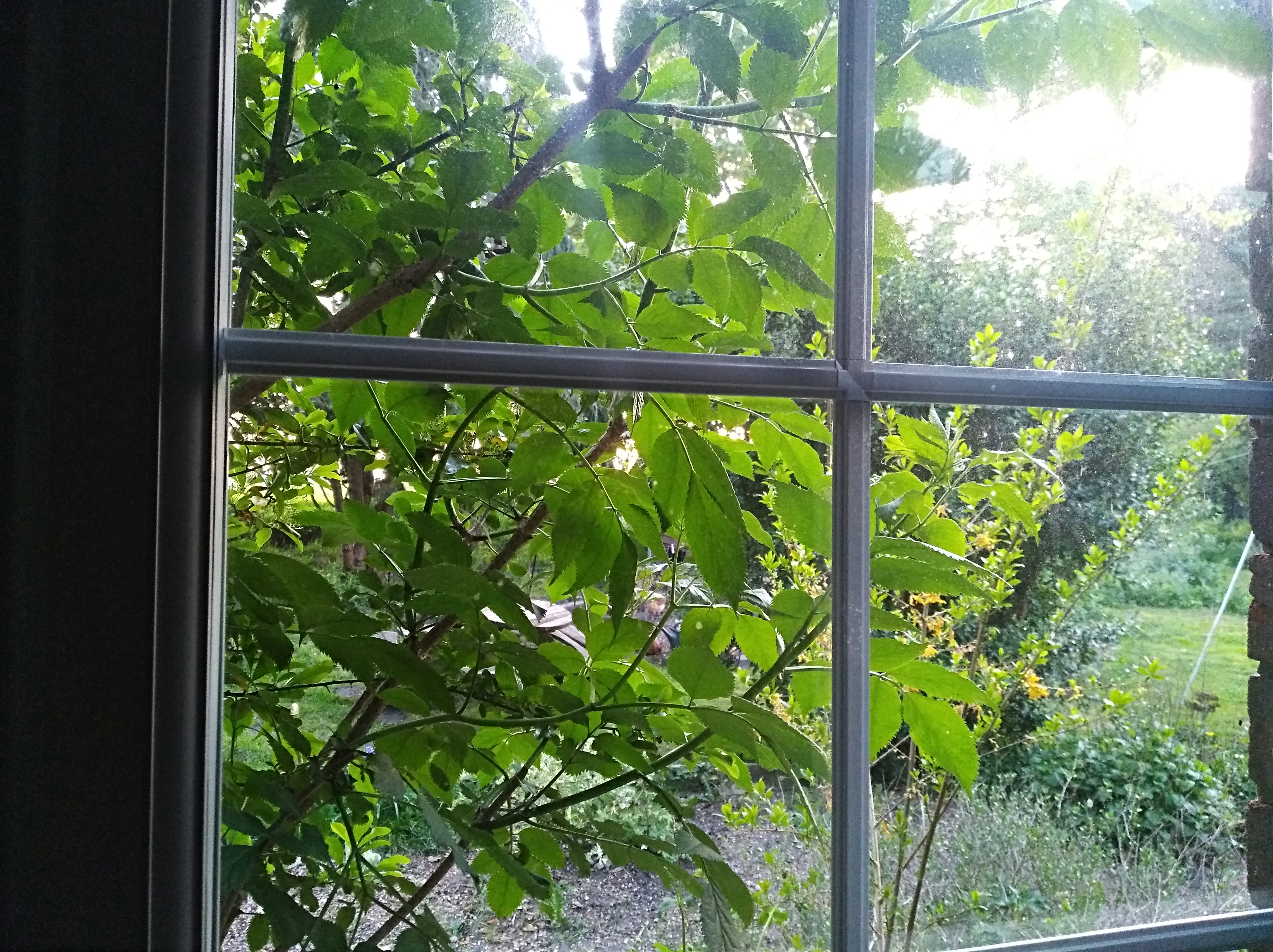
photo is mine
A long time ago I used to call it a wall of green. Back in the days when people were still a thing, and I’d do the gardening on sunny Sunday afternoons. Every now and then I’d stop and rest, rub the small of my back and grin at the trees.
‘Look at that wall of green,’ I’d say.
Because it was. Firs taller than the house, giant oaks, poplars, willows, sycamores and ash. So many trees. In the winter most of them shed their leaves and looked sorry for themselves. They looked barren and stark, nothing to offer but the impressive silhouettes they made against a silver moon.
But in the summer it was something… A wall of green I called it. From the huge trees lining the bridge across the road, to the endless rows of oaks, beech and hazel lined up along the lane, to the trees that edged our garden. Even the trees we added, the pear, and the apples, the plum, the cherry, the buddleia and the lilac, they grew so fast and were soon so tall they joined that great green wall.
And beyond that, sat us, surveying our huge green lawn, smiling smugly at the borders left to go wild, at the constant buzzing in the borage and the buddleia. Oh, we were smug, weren’t we? Thought we were doing our bit.
And oh, I did love those trees, that wall of green. We felt sheltered behind it, like nothing could ever touch us, like nothing could get through. And though a busy road ran past us, it didn’t feel like that in the garden, behind that ever growing wall of green.
We could hide there. Live there. Lie back on the grass and stare at the clouds. Listen to the robins and the blackbirds and the tits. Watch the crows see off the buzzards, and gasp in delight whenever a red kite hovered over us.
But things are different now. That life, that world, over. Only ourselves to blame, and all that. Of course. We always knew it was coming, always knew we were doomed. Why? Well, because people are mostly just awful that’s why.
Anyway. It doesn’t matter.
Things are different now, that’s all there is to say. That’s all I need to worry about. And the trees are closer. I know that. I feel it in my bones, in my blood. I suppose I could go out there with a tape measure, make an experiment out of it, prove myself wrong or right, but really, what would be the point?
I know.
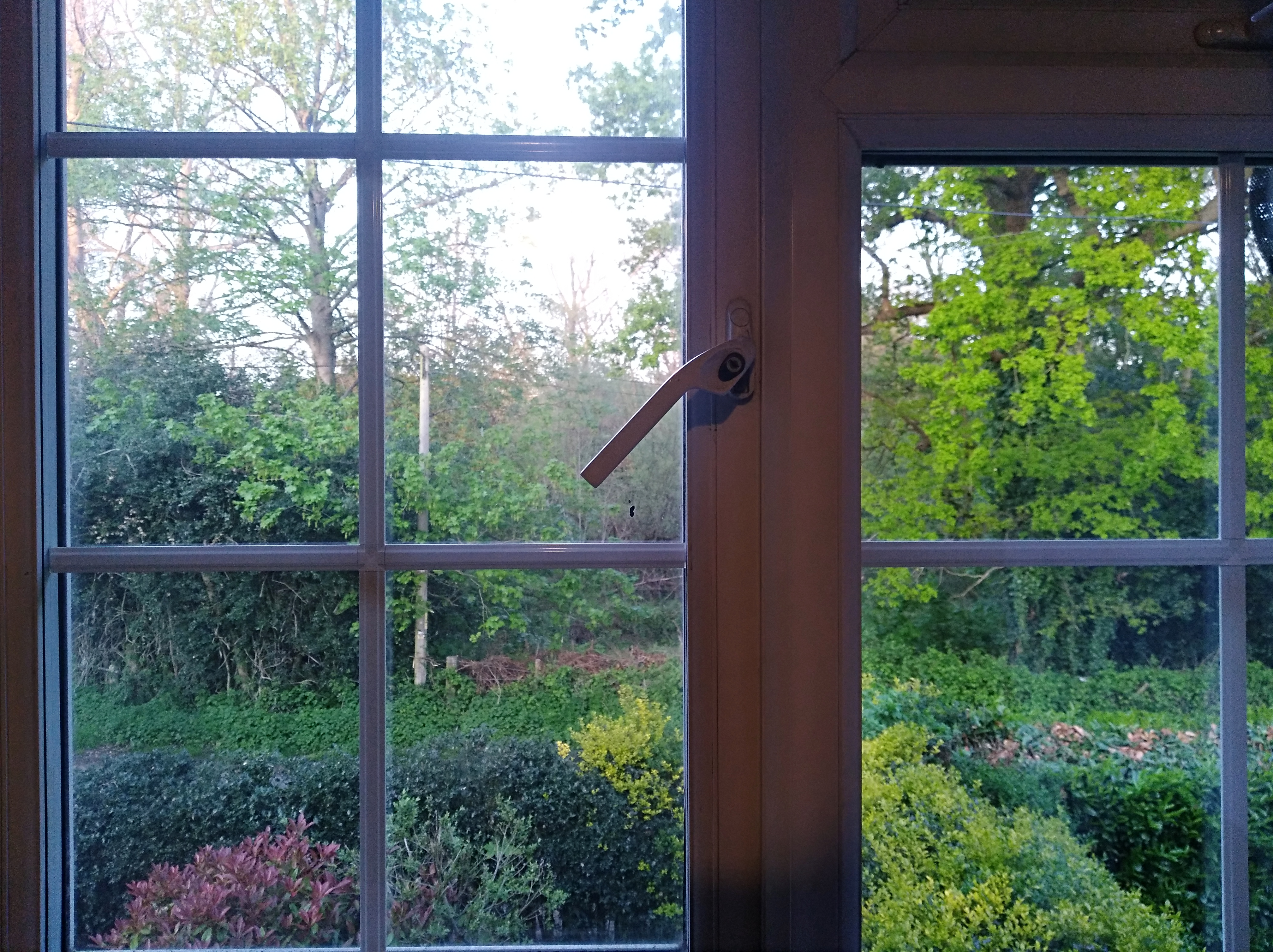
photo is mine
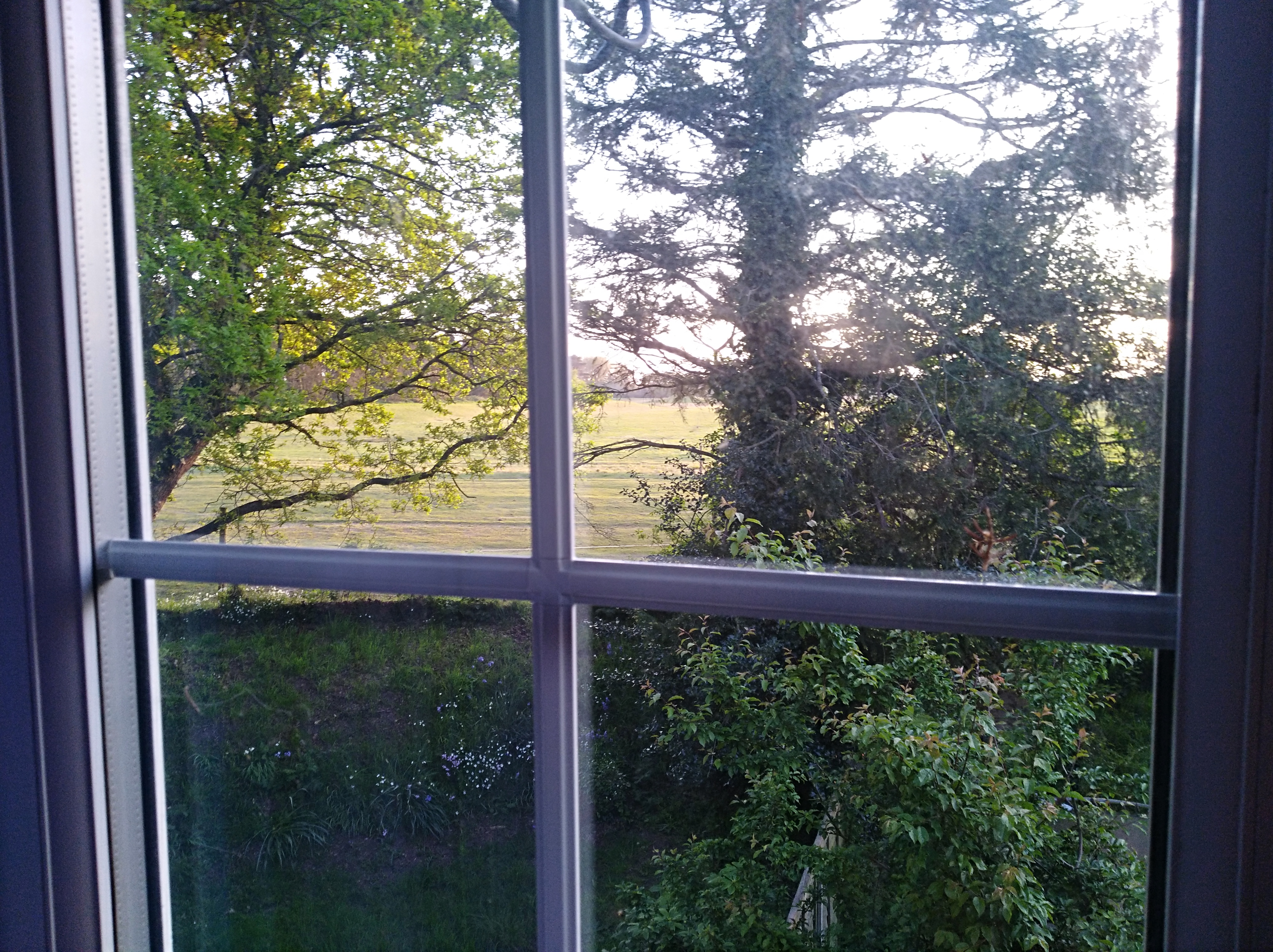
The trees are closer now. They’ve crept in. Bit by bit. They’ve grown, multiplied, reached higher, spread wider. The green is startling, I can tell you that. It hurts my eyes. It makes my vision blur if I stare too hard. I start to get lost in all that green. I think about opening the door and letting it in. Or wandering out to join them. I think I can see faces in the trees — maybe people who felt that same longing, people who opened their doors.
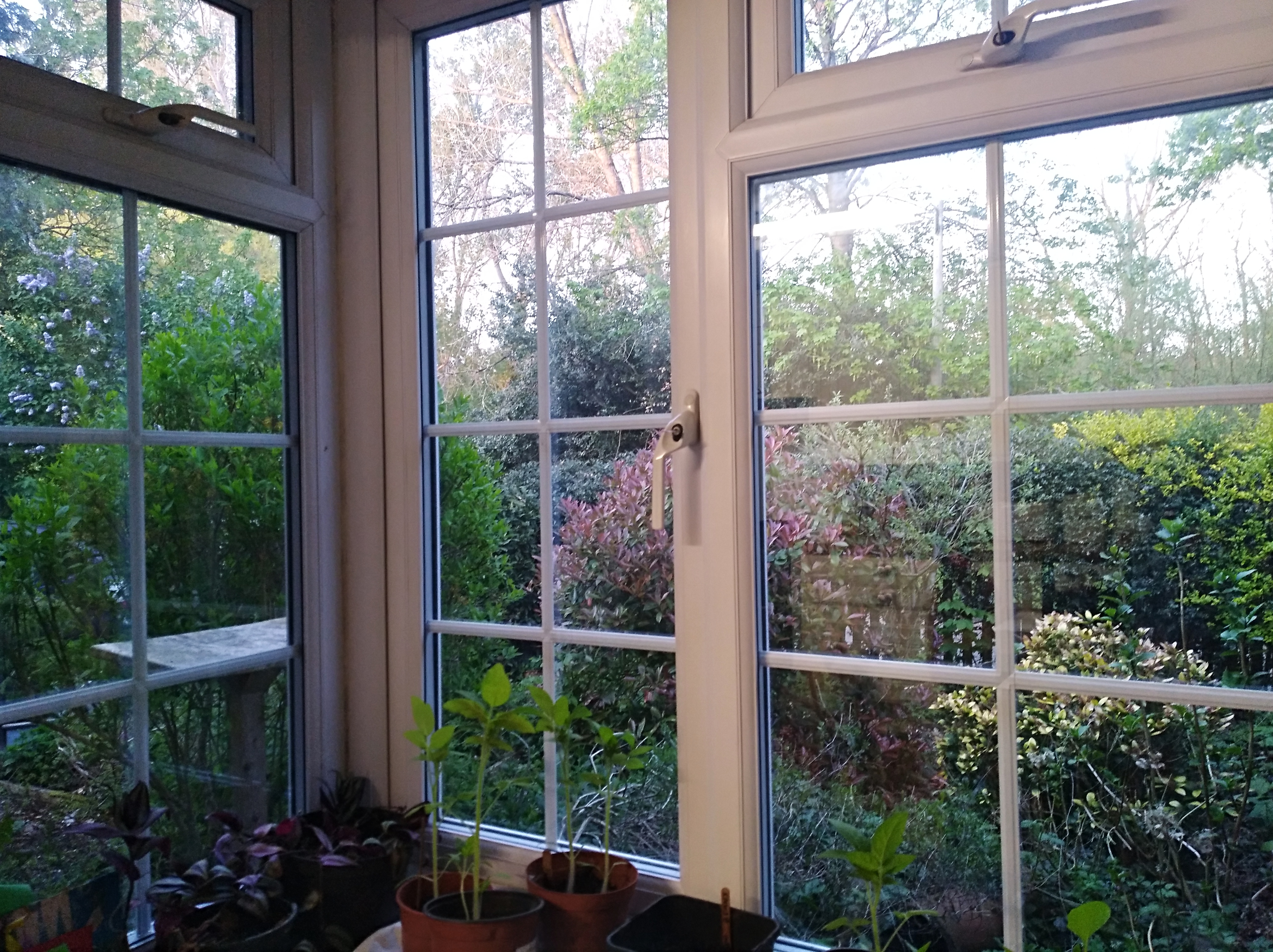
They didn’t use to be this close, filling every single window. I can’t escape them now. Every window is covered. They stand like sentries, turning my home into a prison. And I am not free. I cannot simply leave.
Every window, I tell you, every single window. The green fills the space and there is no room for anything else. The green taps its fingers against the windows, asking to come in. The green scratches and scrapes, prods and pokes. The green is only pretending to be shy.
The green is terrible and beautiful and it is only what we deserve, after all, we slaughtered them, hacked off their limbs, uprooted them, burnt them. The green just wants to say hello. And oh, I am tempted to open the doors, open the windows. Let it touch me. Wander barefoot and mad into it’s inevitable embrace.
photo is mine
I tell myself to hold on. To wait. To try to live. I might be the only one left…
I tell myself to be brave, to try to survive.
I tell myself the green is patient and wise, but maybe it doesn’t mean to hurt me.
But I also tell myself that perhaps the green is the better option, the kinder end, because something darker and uglier and thicker and gnarlier roars and rumbles to life under the very house I stand in.
The roots are awake.
The roots are closer now.
The roots want to come in.
Thanks for reading! This was written in response to the prompt ‘from a window’ on The Wild Writers Club. Initially I wanted to take a photo from every window in my house showing the close trees, bushes and greenery and writing a non-fic piece about how much I love it. However, I started to get an idea for a creepy story instead so that’s what I went with…
NO AI TRAINING: Without in any way limiting the author’s [and publisher’s] exclusive rights under copyright, any use of this publication to “train” generative artificial intelligence (AI) technologies to generate text is expressly prohibited. The author reserves all rights to license uses of this work for generative AI training and development of machine learning language models.
1
Jaime Perry’s first genuine introduction to Black Hare Valley is cold, wet and grey. The previous day a pleasant back-drop of blue skies and streaky white clouds had accompanied the cheery delivery of Jaime, her pregnant mother, Catherine, and her brand new step-father, Mark to the town.
Jaime, ever an optimist, is not discouraged to face different weather the next day. It’s one of the things Mark says he likes about her: her optimistic look-on-the-bright-side-of-life attitude. According to him, she will fit in well in Black Hare Valley. Having a father figure is still a novelty to Jaime, one she does not think she will ever tire of.
From the window of her bedroom above the Hare and Hound public house on the High Street, Jaime watches the heavy rain pummelling the thin glass of the window. She zips up her bright blue anorak, making sure her camera is lying snugly against her clothes where it won’t get wet. On her back she wears a slightly grubby pink backpack in which she has already stashed her reporter’s notebook, a packet of Wotsits, an apple, a handful of pens and a map of the town.
‘Oh, look at you!’ Mark comes into the room carrying yet another sagging cardboard box. She sees ‘Jaime’s bedroom’ written in black marker pen on the side and smiles at Mark gratefully.
‘Oh, thanks!’
Mark places it beside her bed and joins her at the window. ‘Not gonna let a bit of rain stop you then, eh?’
Jaime pulls up her hood. ‘Nope.’
‘Brilliant!’ He beams, as if she has made his day. ‘That’s the spirit. Just like me at your age; nothing could keep me indoors! I was always out there exploring in all weather.’
‘Do you think the rain will stop in time for the celebrations?’
Mark has already filled in her in on the town’s quaintly old-fashioned celebrations for May Day.
He tilts his head at the window. ‘Yeah, I think it will. It all kicks off at 3pm. You’ll be back by then, won’t you?’
‘Wouldn’t miss it for the world. So, where shall I start?’ Jaime asks, slipping her backpack from her arms. She unzips it and pulls out the map Mark gave her yesterday.
He frowns in concentration as he unfolds it and holds it out in front of him. Jaime runs her eyes over his kindly face and the way his brown curly hair lays in wiry waves against the collar of his blue and grey checked shirt. The shirt stretches over his slight beer belly, a gap between the shirt and his jeans revealing a white under t-shirt. He lifts one hand and strokes his curly beard – a thoughtful habit Jaime finds rather endearing. Her heart thuds with pride as she watches him.
In the year and a half that he and her mother have been together, Jaime has grown increasingly fond of Mark. She was there the day they met for the first time and she likes to think it will be a story she will retell in years to come. It’s certainly one she looks forward to telling her new brother or sister one day.
According to Mark it was instant love across the bar top. Catherine had gone into the popular high street bar to ask about a job they’d advertised. She had been nervous about it, Jaime remembers, clutching her daughter’s hand far too hard as she pushed open the door and strode up to the bar. Unfortunately, the position had already been filled and Jaime had watched her mother’s face fall in dismay. Since her father had left when she was a toddler it had always been just the two of them and times had often been tough.
Catherine hadn’t secured a job that day in their old town, but she had found herself an admirer, one who eventually managed to wrangle her telephone number out of her. The rest, as they say, was history, and now here they were, in Black Hare Valley. The beautiful, close-knit little town Mark grew up in.
‘Well, you’ll never do it all in one day but I’d say find the school so you’ll know your way in the morning.’ Mark jabs a fat thumb at the pub and then drags it along the High Street. ‘Past the library,’ he notes, giving her a wink. ‘We know you’ll want to check that out. Eugenie Spires has been running that place since I was a boy. She loves a bookworm! Then…’ He moves his thumb past a row of houses. ‘You see on your left here, you’ve got the nursery and the primary school, so cross over there and take the left onto School Lane. That’s how you get to the secondary.’
‘Oh okay, that’s simple enough. Is it a nice school? Nice teachers?’
‘You’ll love it,’ he enthuses. ‘You’re gonna fit right in, Jaime, I just know it. The headteacher, Mr Bishop, is tough but fair. And then, if you carry on up High Street, you’ve got the gift shop, café and post office. If you fancy getting a view of everything, you want to carry on past the vets and take the next right onto Walkers Road. See?’
Jaime leans over to watch Mark’s finger drag a route along a long stretch of road that loops around the back of the town.
‘Church,’ he points out. ‘Some flats. I’d avoid those people though. About the only ones that cause trouble around here. But keep going… and…’ His finger traces a route up into nowhere, ‘all that,’ he says, ‘is yours to roam. Fields for miles and miles. Pockets of woods to explore. Some old ruins. One of the hill forts is at the highest point but then eventually you’ll reach Rowan Farm. That’s private, obviously, which is a shame because the entrance to a Holloway is just below the hills there…’
‘What’s a Holloway?’ Jaime asks, already feeling the itch of curiosity, the desire to click her camera lens.
‘It’s just an old path trodden down over generations, but like I said, it’s Rowan’s property,’ Mark waves a hand to suggest it’s not worth pursuing, ‘but if you cut back down Rowan Lane here…’ His finger trails back towards town. ‘You’re back in town… a park there… The theatre there…. Then take Rowan Road back to the High Street via Lupin Lane and here we are.’ He jabs a triumphant thumb over her new home, the Hare and House Public House.
‘Thanks. I’ll do that then.’
Mark grins as he carefully refolds the map for her. ‘Well, that’ll be almost half the town explored anyway. This side. And up on those hills you’ll be able to see the whole place. Beautiful, it is.’
‘I can see why you wanted to come back,’ Jaime says as he packs the map back into her bag.
‘It’s even better in the sunshine,’ he says with a sigh, slipping his hands into his pockets. ‘You’ll settle in no bother. Lovely place for kids, this. The little lad’s gonna love it!’
‘Or the little lass!’ Jaime’s mum calls out from the stairs. Mark winks at Jaime and she winks back because they are both convinced the new baby will be a boy. ‘Mark, are you coming down? There’re some lads at the door wanting to know about opening times.’
‘Coming!’ he calls back. ‘No rest for the wicked. What, this place has been closed for all of two days? But these old-timers can‘t cope without it.’
He chuckles as he leaves the room and heads downstairs. Jaime follows, pausing on the stairs to lay a gentle, wondering hand on her mother’s swollen belly.
Catherine’s round open face provides a mirror to Jaime’s own. They have the same thin blonde hair, straight, neat and cut just above the shoulders to hang limply on either side of their inquisitive blue eyes. Like her daughter, Catherine is quick to smile and good at putting people at ease. Mark insists she will make a tremendous landlady.
She strokes Jaime’s hooded head. ‘Are you sure you don’t want to wait until the rain stops, sweetie?’
‘I’ll be okay.’ Jaime shrugs. ‘I’m in waterproofs, and school starts tomorrow so I won’t get another chance to explore.’
‘Okay, fair enough.’ Catherine sighs, smiling adoringly at her lovely daughter, so determined to put on a brave face and put the past behind her. ‘Well, don’t get lost.’
‘I’ve got the map Mark gave me.’
‘All right. But come back if the weather gets worse!’
‘I will.’
Her mum pinches her cheek. ‘Okay. Have fun.’
Jaime salutes – she intends to – and hurries downstairs. She peeks curiously into the bar area and can see Mark chatting to a cluster of old men who have stepped in out of the rain. They are all wearing dark macs and flat caps and the rain is dripping onto the maroon and gold carpet. One of them has what looks like a hairy whippet on a piece of old rope and it’s shivering between their legs, staring longingly at the fire.
‘If I let you in, they’ll all show up!’ Mark laughs. ‘And we’re not quite ready, that’s all it is, fellas. Deliveries will be arriving later and we can get all these barrels filled up for you!’
‘What about a tea or coffee?’ Jaime’s mother eases past her daughter to ask. ‘As neighbours, not customers? We can do that, can’t we Mark?’
There’s a cheer from the old men and a thankful grin from Mark. Jaime turns and goes out the back way. The pub kitchen is full of boxes to be unpacked and she’s not sure how many they can possibly open tomorrow with so much still to be done. She feels a twinge of guilt. Maybe she’s being selfish wanting to go off and explore. They could do with a hand here.
She pauses at the door, viewing the pub garden and trying to imagine it in better weather. It’s a long stretch of overgrown grass with faded picnic benches scattered haphazardly from one end to the other. At the far end is a swing set and plastic slide. A faint smile appears on her rain-splashed face as she pictures her baby brother (or sister) playing on them. She imagines herself pushing the swing or catching him (or her) as they come down the slide.
2
Jaime pulls the back door shut behind her and bumps straight into a fast-moving woman.
‘Oh!’ Jaime exclaims, stepping back and blinking up at the tall and imposing figure before her.
The woman is dressed in expensive looking Wellington boots of a rich red brown colour. Jodhpur trousers are tucked neatly inside the boots and a padded navy-blue jacket is buttoned up to her neck, where a blue and cream silk scarf is loosely wrapped. Jaime can see tiny pheasants on the material. Her eyes drift up to examine the long face with thin lips pulled into a blinding, white-toothed smile. The expression is one of instant curiosity – the surprisingly youthful grey eyes narrowed and intense. Her hair is silver, highlighted with ash blonde and worn in a severe twist at the back of her head. She holds a large black umbrella from which a steady cascade of rainwater is rolling off and onto Jaime.
She steps back again and the woman sticks out a hand inside a black leather glove.
‘You must be Jaime Perry,’ she states and her voice is loud, clear, calm and slow, giving the impression of someone who is used to being listened to and obeyed. She reminds Jaime a bit of her old headteacher – Mrs Bittern – the one who made so light of the bullying she had endured.
Jaime shakes the hand. ‘Yes. Hi.’
‘Margaret Sumner,’ the lady says, dropping her hand a little too quickly. Jaime frowns, knowing she has heard the name, panicking slightly that she should know who she is and ought to behave accordingly. ‘Mayor Margaret Sumner,’ the woman adds with a quick, small smile.
‘Nice to meet you,’ Jaime says with an audible sigh of relief. ‘Do you want to go in? I was just going out to explore.’
The mayor reaches for the door handle and places one boot on the step. Feeling crowded, Jaime moves around her and out into the rain.
‘Yes, dear,’ she replies. ‘You only arrived yesterday so you won’t have had a chance yet. I feel I ought to apologise for the weather.’
Jaime snorts a nervous laugh. There is something about this woman that makes her feel like she has done something wrong. ‘That’s okay, I don’t mind the rain.’
The mayor’s eyes track her up and down. ‘Yes, well, you’re certainly dressed for it. And it was absolutely glorious yesterday.’ She stares up at the dark clouds with a troubled expression. ‘It really can turn on a pin around here. You’ll get used to it, no doubt and don’t worry, May Day is going ahead as planned. I’ve just been overseeing the putting up of three very large marquees in the park!’
‘Oh, wow! That sounds great.’
‘Yes, I hope to see you all there later. There will be plenty of food and drink and I imagine it’ll be a good opportunity for you to meet people. Well, I’m going to go on in and introduce myself to your mother now. Of course, I’ve known Mark since he was a child.’
‘Did you grow up here too?’ Jaime asks out of politeness. Her mother has always told her that the best way to make conversation is to ask questions and encourage the other person to open up.
‘Oh yes, dear,’ Mayor Sumner says brightly. ‘My family have lived here for generations. In fact they founded Black Hare Valley, were the very first to settle here.’ She nods to the opposite side of town, to the towering stretch of green hillside Jaime can just see through the gathering mist. ‘I live up on Hill Fort Farm. That’s the highest point, you know.’
‘Oh.’ Jaime smiles.
Something flickers in the mayor’s eyes. They linger just a beat too long on Jaime’s – long enough for her cheeks to flush and her eyes to widen. Has she done, or said something wrong? The atmosphere feels icy…
‘Yes, I can see you all from up there. I can see everything. Now. Off you go. I’m going to tell your mother about our wonderful Neighbourhood Watch Committee.’
‘Okay. Nice to meet you, Mayor Sumner.’
Jaime watches, feeling a little unsettled, as the mayor opens the door without knocking and goes inside as if she owns the place.
Jaime spins away. ‘Okay then,’ she says to herself as she strides out of the gate and onto what must be the end of Lupin Lane. ‘Turn onto the High Street,’ she says and heads that way.
Jaime is smiling as she emerges but is forced to leap to the side as a huge brown truck powers down the High Street and through a puddle, spraying her with muddy water.
She shakes herself off. ‘Oh, damn.’
Jaime walks on, keeping close to the wall now, until she crosses the other end of Lupin Lane and finds the library. She stops at one of the windows and can’t resist peering inside. Mark was right about her being a bookworm. She feels excitement spreading through her at the size of the library, as she pictures how many books must reside behind its redbrick walls.
‘It’s huge…’ she says out loud, a bad habit born of years of loneliness. A passing man looks over his shoulder at her and her cheeks burn again.
3
Of course the library is closed for May Day. Jaime thinks it’s quite sweet, and just a tad old-fashioned how seriously they take the celebration. Her mother told her there would even be a procession along the high street – the May Queen sat on a throne and pulled along on a horse and cart, no less. Jaime thinks it’s adorable and wonders if the school would be interested in her writing about it. She’s hoping they have a school newspaper on the go and if they don’t, she hopes to suggest one.
She is grateful for May Day though. School being closed gives her a day to mentally prepare herself before she starts as the new girl tomorrow. My new life, she thinks and smiles again. A fresh start was what they all needed. Her mother had been right about that. A chance to start anew in a place where nobody knew her or the names she used to be known by.
Chubbs….Chubster…Chubba-wubba.
Sometimes Jaime can’t believe people have it in them to be so cruel. And now she hopes to put it all behind her. To start again. To have a second chance. She takes a deep breath and moves on. She’ll check out the library after school tomorrow. The thought excites her and she strolls on with a smile upon her face.
On the opposite side of the road she sees the nursery and primary school Mark mentioned. Walking on further reveals School Lane. No problem, she thinks, my school is down there. She stops for a moment and considers her options. She could cross over. The road doesn’t look too busy. It might be reassuring to wander past the school and suss out where the gates are, check out the size of it and so on. But, if she carries on, she can take the route that Mark advised.
She could have a peek at the gift shop and café and find Walkers Road. She stares up at the other ridge of the valley where the Rowan Farm must be. She feels the sudden urge to keep walking, to plough on up the hills, get that fantastic view Mark promised and maybe even keep going.
She turns in a circle and wonders how long it would take to walk around the entire town. She feels a pull – that thirst for knowledge her mum always jokes about – to see it all and know it all, to stand up there and spread her arms out as if wrapping them around her new home.
Decision made, Jaime continues to the gift shop. It’s an old-fashioned building with thick wooden beams and a thatched roof. It’s window curves outwards, small panes of glass divided up by green wooden frames. Windchimes tinkle. The window display reveals witches cauldrons, ornate candlesticks and leather bound books. The sign on the door says ‘open’. ‘Black Hare Gifts and Curios’ – Jaime mouths the words and thinks about going in. It looks dark, cosy, enticing. Candles flicker around a solitary till and she sees a face staring back at her.
Jaime pauses, unsure whether to wave or turn away, or go inside and say hi. She panics and does nothing, just stands and stares, all the time knowing how stupid and weird she must look. The face staring back is pale and almost hidden by two thick shafts of jet black hair and a heavy blunt fringe. The girl looks about her age and probably goes to the same school.
Oh God – why can’t she move? Smile? Wave? Do something?
4
Suddenly, a noise behind startles her. Snapped free from her trance, Jaime turns to see two teenage girls coming out of the café next door. Milly’s Café is a quaint white-washed building with a thatched roof identical to the gift shop’s. The windows are steamed up and a sea of chatter follows the girls outside as the door swings shut behind them.
Jaime experiences another awful panic-stricken moment where she is frozen to the spot. One of the girls is tall and rake thin. She has long blonde hair; the thick, luxurious type not the lank, dull kind like Jaime’s; she has almond shaped eyes a deep blue colour and her make-up is model flawless. She is wearing pink wellington boots and has a cream mackintosh tied at the waist. She looks Jaime up and down and giggles into her hand whilst turning slightly to address her shorter, more buxom friend.
‘Oh my god…’
Jaime follows their gaze and sees with dismay that her jeans and anorak are splattered with mud. Perhaps her face is too. It really was a huge puddle the truck roared through. The other girl has darker blonde hair and bright green eyes. Her complexion is clear, her skin like silk and her lips wide and full. She is several inches shorter than her friend with a curvy build contained under a black leather jacket she wears zipped up to her chin. She holds a huge black umbrella and stares at Jaime as if she has just landed from outer space. Her beautiful cherry red lips break into a wolfish, yet sultry smile.
Jaime acts without thinking, suddenly thrusting her wet hand at them as she straightens up like a solider on parade. The girls swap an incredulous look and burst into mutual laughter. Jaime’s nostrils flare and her lips tighten as she fights hard not to cry or panic. This isn’t the new start she had hoped for. This is all going wrong.
‘Jaime,’ she says, lowering her hand. ‘I just moved here.’
The girls swap another look. The tall one nudges the shorter one. ‘Ohhhh,’ she says. ‘That makes sense. Yeah, we heard about that. Don’t get too many new people about here. I’m Alexa.’ She nudges her friend again. ‘This is Bryony.’
Jaime feels a surge of hope. They’re talking to her. They’ve told her their names… She beams bravely.
‘Hi. So, do you go to…?’ She nods at the school across the road.
They both frown and Alexa says, ‘Yeah, obviously. It’s the only school in town.’
‘Your mum’s married Mark Aster,’ Bryony states, her green eyes narrowing.
Jaime nods, almost proudly. In truth, she is proud of Mark. He is a fantastic step-dad and she can’t wait to finally have a sibling.
‘Oh, yeah,’ says Alexa, turning to her friend with wide eyes. ‘God, yeah, he finally found someone to shack up with.’
‘Had to leave town for a few years to do it though!’ giggles Bryony.
‘Yeah well, he tried and failed with every woman here, right?’
‘Your mum?’
‘Yeah! Yours?’
‘Of course!’ Bryony makes a puking noise and quickly bores of Jaime. She rolls her eyes and flaps a dismissive hand in her direction. ‘I’m getting wet!’ she barks and quickly drags Alexa away.
Jaime turns, opening her mouth to say something, anything – but it’s already too late – they’re swishing past her and yet another umbrella shakes a cascade of rainwater onto her head.
A movement at the window catches her eyes and when she looks, the pale-faced girl stares back her, one eye visible through the curtain of hair. Jaime can’t deal with another rejection or more staring, giggling or eye-rolling at her expense, so she turns and hurries across the wet road, just knowing that she has to get away. Her planned route now forgotten, she finds herself plodding morosely along School Lane.
She can’t process the laughing or the belittling of Mark, not yet. It’s something that will come back to her tonight when she lies in bed, wide awake as her stomach churns with back-to-school dread.
For now, she splashes along, head down, cheeks burning. She tries to hold herself together. She tries to focus on the positives: the new baby; the new flat above the pub; her mum feeling happy and financially secure; Mark, being her friend and her father figure. She smiles. It’s okay. They were only two girls. She’s sure the rest of the children will be friendly. It will be okay.
And now she’s heading towards the school but she stops short when she spots a policeman crossing the school car park with a boy in handcuffs. It is the very last thing she expects to see but her instincts are cat-like, as she springs back and ducks behind the wall where she can peer out without being seen.
Her curiosity in overdrive, her eyes huge, her teeth biting at her lower lip, she does the first thing that comes into her head. She lifts her camera out from under her anorak and takes a snap.
The policeman is tall and broad, well-muscled and white-haired. He opens the door to a police car and pushes the boy into the passenger seat. Jaime holds her breath as her eyes devour the boy. He is perhaps a few years older than her, and tall. He’s wearing a rain spattered navy blue and black checked shirt and black jeans with rips at the knees. He has dark brown hair that is long and messy, curling in soft waves around his ears and neck, falling over his face when he leans forward. Jaime can’t see his face too clearly but still, she likes what she sees. She takes another photo before the policeman closes the door.
He gets in the other side and for a few minutes nothing happens. They must be talking. Jaime’s imagination and excitement are in overdrive. What did the boy do? Why is he in the school when it’s closed? Why has he been arrested? She wants to know. She needs to know.
Suddenly, the engine starts and the police car rolls slowly out of the school car park. Jaime starts walking fast, knowing that it will soon be out of sight and also knowing that she needs to keep it in her line of vision for as long as possible.
The car turns left. Jaime breaks into a run and tries to catch up. She finds herself on a road narrower than the High Street. Black Hare Road. She wonders if there is really such a thing as a black hare. She asked Mark about it when he first met her mother and he said it was a local legend, just a bit of fun.
At first she thinks the car is long gone but then she spots it parked outside a bookshop.
The Magic Of Books – Second Hand and Rare Books Bought and Sold. Maybe the boy lives there…
Jaime hovers at the roadside. She hides behind a parked white van and peers out. She looks through the lens of her camera and zooms in. All of a sudden she is right in the car with them – although they don’t know it and she can see the policeman taking off the boy’s handcuffs. Next, the boy digs into his pockets and hands over some small items she can’t quite make out.
What is going on here? Does the boy seem scared? His position is hunched, defensive, his expression tense. The policeman looks satisfied and amused as he receives the items and then something even stranger happens. The policeman gives something to the boy and the boy slips it inside his pocket.
What… the?
The boy gets quickly out of the car, moving as if he can’t get away soon enough, and the policeman drives away, still smiling to himself. Jaime snaps another shot, still unseen behind the van, as the rain-soaked dark-eyed boy walks stiffly and somewhat reluctantly into the bookshop.
Jaime cannot believe what she has just witnessed, but she zips the camera quickly back under the anorak and before she realises what she is doing, she’s crossing the road – the chase of a story burning her throat.
Thanks for reading!
Please feel free to leave a comment letting me know what you thought of Chapter One – May Day. Please also let me know if you would prefer shorter chapters. They are quite long and I could split each in half.What do you think of the characters introduced so far??
NOTE: Please remember this is NOT the finished version of Black Hare Valley Book 1. This book has not been to my editor yet or even my beta readers. There will be typos, grammatical mistakes, and sentences that need rewriting.
COMING NEXT THURSDAY: Chapter Three – Paddy’s Treehouse
NO AI TRAINING: Without in any way limiting the author’s [and publisher’s] exclusive rights under copyright, any use of this publication to “train” generative artificial intelligence (AI) technologies to generate text is expressly prohibited. The author reserves all rights to license uses of this work for generative AI training and development of machine learning language models.
Chapter One – May Day 1
Wednesday 1st May 1996
Jesse Archer checks his watch again
Ten minutes late now. Jesus fucking Christ. He growls at the back of his throat and jams his hands into the pockets of his black jeans. It’s starting to rain, the wind driving a miserable drizzle up the alley towards him. He turns his head, lowering his face and tucking his dark hair behind his ears.
‘Come on,’ he mutters to the wall. ‘God’s sake…’
The alley suddenly fills with leaves ripped violently from the trees in the park. Jesse looks up to see a great gust of them sailing over the roofs of the shops. They spiral and twist and dance around him and it feels like they, like the whole goddamn town, are laughing at him: Jesse Archer, youngest of the renowned Archer boys, waiting in an alley for his so-called friends; Jesse Archer, who didn’t bring a coat because it was sunny half an hour ago, but of course, the weather had to turn on a pin (as Mayor Sumner was so fond of saying) because this town hates his guts and always has done; Jesse Archer, whose mother went full psycho five years ago and hasn’t been seen since.
Jesse kicks the wall. It’s the only way to dispel some of the hot anger filling up his chest. He tries to imagine why Steven and Dominic might be late. Unfortunately, there could be endless reasons. With Steven – short, skinny, acne-faced and sneering – it could be anything. He might have had to help his dad with a cleaning job. Steven Davies doesn’t have a mum either – she ran off when he was only six when she, according to him, also went full psycho. In Steven’s opinion, that’s what this town does to you. There is no evidence to support this, however, and Jesse thinks it’s just classic Steven bullshit. If you’ve got a problem, Steven always has one ten times bigger.
Jesse also has to consider that it might be deliberate. That Steven might just be sitting at home in his flat above Jesse’s, feet up on the coffee table, with a big fat smile on his face. Steven is a wind-up merchant. In all honesty, he’s a bit of a prick, and Jesse wonders on a daily basis why he bothers with him.
Habit and history, he thinks now, turning from the red brick wall and skulking down to the end of the alley. Dominic – chubby, shaven-headed, pasty-faced – could be late for any reason too. He’s forgotten entirely, or he can’t tell the time. Not the sharpest knife in the drawer, Dominic Robeson is the chunky greasy bone Steven and Jesse fight over. A trio is never even. Three is always a crowd when both boys want to be the leader. The rivalry between Jesse and Steven is an undercurrent that thrums beneath them at all times, threatening to explode and driving almost every bad decision, stupid prank and minor crime they commit.
This was Jesse’s idea, so of course Steven would want to sabotage it.
Bored, Jesse peers out of the alley and looks up and down Town Road. To his immediate right are the school playing fields and car park, and beyond them, the target for today, Black Hare Valley Secondary School.
Shivering in his ripped jeans, Green Day t-shirt and checked flannel shirt, Jesse leaves the safety of the alley and turns left. He rounds the corner, whistling casually as he strides past the newsagents. It’s okay, he thinks, I’ll give them five more minutes, then I’ll do it myself. Fuck those losers. Another bloom of anger tightens his chest when he pictures Steven again, probably sitting at home laughing like a bastard. Jesse decides there and then that if they don’t show up, he’s done with them for good.
That’s it, he tells himself, move on. Fuck them. He’s been feeling restless in the trio for so long – he just needs one decent excuse to bin their useless arses. For a long time Jesse didn’t think he had any other options when it came to friends. His family’s reputation has stained him since birth; he’s the type of boy parents warn their children not to hang out with. But that’s changed lately, he remembers with a secret smile.
2
Jesse pushes through the door to the chemist out of habit. He’s not really thinking as he shoulders his way inside the shop, where one of the three strip lights is always flickering. It’s too easy in here, not much of a challenge. The intermittent expanding and retracting of light from one strip gives the place a disjointed, out of sync feeling, like anything could happen, but nothing ever will. The narrow aisles and dusty shelves and Mr Martin with his thick lenses and slight hunchback, leaning forward with his poor eyesight fixed perpetually on the floor; it all feels as stale and awful as the rest of the town does to Jesse.
And Nathan Cotton; at seventeen he is two years older than Jesse, but still has the nervous need to be accepted by anyone and everyone. He’s sitting at the till in shadows, blond head lowered, lips moving slowly as he gazes into his lap.
Unseen, Jesse reaches out for anything. Throat sweets, why not? They taste good. Ibuprofen? Maybe he can sell them. An electric toothbrush. The items vanish one by one up his sleeve, into pockets, like magic they vanish into thin air.
He smiles at his own skills as he approaches the till. He tips his head, about to say hi to Nathan, but Nathan is too fixated on whatever he has spread out on his lap, and still hasn’t noticed him. Jesse inches closer, his eyes scanning the shelves below the till, then lifting to focus on the items behind. The decent painkillers: co-codamol, Sudafed, Nyquil. Maybe he can distract Nathan, lure him out, slip around and nab some of the decent stuff, the stuff Nathan has to hold up for Mr Martin to nod at from the back. Stuff Nathan cannot legally hand over himself.
Curiosity distracts him – what the hell is Nathan staring at? Jesse slams his hands down on the counter and leans over whip fast, making Nathan jerk back in fear, sending the magazine skittering to the floor, but not before Jesse catches sight of bare backsides, oiled torsos and erect penises.
So, it is true, he thinks and stores the information away for later. Nathan, red-faced, forces a sick smile, jumps up, and smooths down the white apron he has to wear.
‘Hi, Jesse!’
‘There’s a rat back there,’ Jesse tells him, jerking a thumb over one shoulder. ‘In the corner by the door. Just saw it go under the shelves. Thought I better let you know.’
‘Oh no! Oh my goodness! Thanks!’ Nathan kicks his magazine under the counter and rushes out to look for the fictional rat.
‘No problem.’ Jesse leans over and swipes three packs of co-codamol. He stuffs them in his pockets and heads for the door. ‘Seeya later!’
Outside, the rain is worse. Jesse swears, drops his head and pulls his shirt across his chest. It has a hole in one elbow and too many buttons are missing to do it up. A hand-me-down from his brothers, it was too big for him six months ago, but a sudden growth spurt is sending Jesse towards the skies.
He scuttles back to the mouth of the alley, all good cheer from his successful theft now evaporates in the rain and he returns to his ever present conviction that Black Hare Valley hates him.
He stops for a moment, bereft. They’re still not here. Fuck those clowns. He’ll do it better without them. He’s not abandoning this plan, not for anything. It’s because Steven knows how much he wants to do it, that’s why he’s not turned up. He knows how much this means to Jesse.
His shoulders drop, he exhales his disappointment and heads right towards the playing fields, finding an odd type of comfort in the knowledge that he was right all along: the only person he can ever rely on is himself.
3
The school gates are locked. There is no school today because of the May Day celebrations. Jesse is sure that most other places on earth celebrate May Day on the first Monday in May, but not this town. May Day is huge in Black Hare Valley, and he’s not exactly sure why. The mayor and her cronies insist on celebrating it on the first of May, whatever day that falls on. It’s tradition, the old folks all say, as if that means anything. It means nothing to Jesse.
A day off school is a gift though, and he intends to make the most of it, as the wind and rain pick up force to batter him harder. He feels like the weather knows his plan, his intention. But it always feels like that in this town, he reflects bitterly, it always feels like whatever you do and wherever you go, you are watched.
The school sits on the horizon, on the other side of the damp green fields – grey, squat, ugly and listlessly waiting to devour him again. Although maybe it feeds on him more than it devours him. Jesse shudders just looking at it. He feels the fear tighten his muscles, even his skin. His scalp seems to clench under his hair as he follows the fence along until he reaches the hedging that surrounds the car park.
The town knows, he thinks, the town watches.
He thinks of Mayor Sumner up on Hill Fort Farm – the highest point of the valley – her inscrutable gaze cast relentlessly down on her town; the one she likes to remind everyone has been connected to her family for endless generations.
Thinking about Mayor Sumner makes his stomach feel weak, like a gurgling washing machine full of milky water and a sputtering, dying engine. Jesse shakes himself like a dog and finds the gap in the fence, the one he made himself with pliers at the end of last week when his final altercation with the headmaster, Mr Bishop, forced him to make the promise he now must keep.
Jesse squeezes through, his breath now clogged and thick in his throat. A stray cut wire snatches at his neck and gouges his skin just for fun. He hisses in pain and swats it away. Putting two fingers to his neck, he feels the tacky blood and curses. If Steven and Dominic were here, one of them would have held the wire back for him, but no, he has to do everything by himself. Well that’s it, he thinks viciously, never again, I don’t need them anymore anyway.
Jesse creeps around the edge of the car park, wondering why he didn’t plan to do this after dark. Still, there is no CCTV, he knows this for a fact. He doesn’t need a mask or a hood. He just needs not to be seen. Although, in truth, the reckless side of him laughs at this because what does it even matter? If he’s caught, if they know it was him, what can he lose? He has nothing in this town. And he hates them all.
Jesse reaches the school and scuttles over to the boys’ toilets on the ground floor. One window, one smash and he’ll be in. The science block is next door. Game on.
He flattens himself against the wall and scans the area, just in case. Nothing. No one. The cluster of silver birch trees that surround the car park and the ginormous horse chestnut that stands adjacent to the building prevent him from being overlooked. Without the green leafy trees, he would be visible to the houses on School Lane and possibly even the top windows of the bookshop and home improvement shop on Black Hare Road.
Remembering the bookshop, he thinks of Paddy Finnis and his resolve solidifies. It wasn’t just Jesse Mr Bishop humiliated last Friday, it was Paddy Finnis too. Short, frail, bespectacled Paddy, whose gentle father owns the only bookshop in Black Hare Valley.
The Magic Of Books: Second hand and rare books, bought and sold. Jesse feels shame when he recalls the books he has stolen from Paddy’s father over the years. He still has them all stashed in an old suitcase under his bed and he’d feel a different kind of shame if his older brothers or so-called friends ever came across them.
Jesse faces the window, pulls his cuff over his fist and punches the glass hard and fast, just the way his brothers taught him. He feels watched, he feels hated and hateful but he won’t stop now and he’ll tell himself he’s doing it for Paddy.
He’ll go there after to tell him, and just imagining this brings the flicker of a smile to Jesse’s normally hostile face. He will sneak around to the back and hide under the gnarled old apple tree. He’ll whistle up to Paddy who’ll be in his treehouse reading about stars and planets. They’ll sit together and smell the smoke of a burning school. We’ll never have to go there again, he’ll say. His mind wanders for a moment longer… What will Paddy think? Will he be happy? Proud?
Jesse reaches in and unlatches the window. He throws it open and hoists himself quickly inside. Five minutes and it’ll be done. School will be over. Mr Bishop will be out of a job. He smiles and wishes he could give himself a high-five.
Jesse leaves the toilets and enters the corridor. The school reeks of floor cleaner, old furniture and humiliation. The building holds the ghosts of shrunken souls, damaged and flayed, belittled and berated, never set free, forever clogging up the corridors with memories.
His family have stained this school like they’ve stained everything else, he thinks with satisfaction. His brothers names are still scratched and scrawled across doors in the toilets and on wooden desks in the classrooms. In rare moments of sobriety his father Nick has regaled him with wild tales from his own schooldays. Being expelled at aged fourteen is something he is supposedly still proud of.
Jesse opens the door to the first science lab and scans the room quickly. Wooden desks and stools, Bunsen burners and test tubes, goggles and vials. Smeared windows, creaking floors. He creeps in and closes the door behind him.
He turns to the water and gas valves on the wall beside the door. He flicks the gas lever down to open then hurries over to the nearest desk and leans over to the smaller valves used for the Bunsen burners. Jesse turns one on then moves on to the next. A loud hissing begins to follow his progress so he pulls his shirt across his mouth and nose and once they are all on, he dashes back to the door and tugs the box of matches out of his pocket.
It’s happening, it’s really happening! Excitement floods him and his face breaks into a huge smile. Breathing hard, his eyes watering, Jesse backs out of the lab and prepares to strike the match.
It’s then that the heavy hand lands on his shoulder and Jesse lets out the loudest scream of his life.
‘Don’t even think about it.’
Shit.
4
Jesse freezes.
The match falls to the floor unlit. The stench from the lab is now overpowering but not as overpowering as Sergeant Aaron Mayfield. The fifty-four-year-old is as fit as a man twenty years younger. The hand on Jesse’s shoulder becomes a claw. The claw digs into his flesh while the other one yanks his left arm up behind his back.
Jesse gasps. He’s suddenly spinning towards the opposite wall and he turns his face just in time to avoid a broken nose. His other arm is wrenched back and a pair of cold metal cuffs are snapped efficiently over his wrists.
A black boot shoots between his feet to kick them apart, spreading his legs in a dramatic fashion that makes Jesse suspect Mayfield has watched far too many American cop movies in his spare time.
A bristly cheek scrapes against his own and a voice laced with delight hisses into his ear.
‘Do. Not. Move.’
Jesse holds his breath and waits.
Sergeant Mayfield backs off briskly and Jesse hears him stomping into the science lab and flinging open windows. The hissing noise stops. Sergeant Mayfield comes back out into the corridor and presses his police baton into the small of Jesse’s back. Jesse inhales.
‘Vindictive little scrote,’ Sergeant Mayfield says, adding pressure to the baton. There is mirth in his voice. Sergeant Mayfield enjoys a joke and a tease and despite the insults, Jesse knows he enjoys his company. He turns the baton in a slow circle and then moves it up a little higher to prod a knob on Jesse’s spine.
Jesse keeps quiet. There is no point saying a word. He knows exactly what will happen next and in a strange kind of way he is almost relieved. A part of him pictures the explosion he’d hoped for, the flames and the smoke and the destruction of the school and a heavy layer of shame settles in his belly like sludge.
He should have known. Sergeant Mayfield has saved the school and probably him too. Maybe he had known – he had felt the eyes of the town watching him and Mayfield is even more of a voyeur than Mayor Sumner is.
Jesse hisses when the baton prods another bump in his spine.
‘I’ve been watching you all day, filthy little bugger. Nasty little stain. Why do you hate this town so much, eh? Why do you just want to destroy? And on today, of all days? This day means something to the people of this town, but you wouldn’t understand that, would you?’
Jesse doesn’t answer. The baton jabs at the next bump in the ladder of his spine. Sergeant Mayfield growls a little. He reminds Jesse of a bored cat playing with an injured mouse. He knows he has to give him something.
‘Just bored.’
Sergeant Mayfield likes and appreciates that answer. He turns Jesse around and beams at him as if he has pleased him somehow. His hair is short, neat and as white as snow. His moustache is thick, drooping down either side of his mouth. His eyes are bright, startlingly blue and surrounded by deep laughter lines. He laughs at Jesse now. His broad, muscular chest pushes forward as his head drops back a little. Then he places the baton under Jesse’s chin and forces his head up.
‘Ahh, bored were you? Well, now. Let’s see if we can do something about that.’
Keeping the baton under Jesse’s chin, Mayfield leans towards him, his fierce blue eyes drilling into Jesse’s. Jesse wants to hide from the dancing malice in those restless eyes but he cannot even breathe.
‘Come on then,’ he says softly. ‘Let’s be having you. Me and you have got work to do.’
Sergeant Mayfield lowers the baton, takes Jesse by the elbow and marches him out of the school. He carefully locks the doors behind him and leads Jesse over to his police car which is parked in the car park. Jesse feels a stab of anger towards Steven and Dominic. If they’d come like they were supposed to, one of them would have acted as lookout… He makes a silent promise to himself to ditch them for good, to never trust them again. He thinks about Paddy and wonders if there is any chance…
‘Bored,’ Mayfield sighs to himself, shaking his head as he opens the passenger door and shoves Jesse inside. ‘I’ll give you bored.’
Jesse stays silent as the door slams on him and Sergeant Mayfield strolls casually around to the other side. He feels fear and a sense of defeat mixed with relief. It’s out of his hands now and sometimes he appreciates that about Mayfield. Game over. In a sense, he’s lost as usual and everything is as it should be.
The other door slams and the car rocks as Mayfield’s substantial girth weighs the right side down. He chuckles and drums the palms of his hands against the steering wheel.
‘Well, now,’ he says, not looking at Jesse. ‘Did you really think you’d get away with it?’
The anger at his friends seeps out of him. He just feels tired and defeated. ‘No,’ he says and it’s the truth. Somehow he had known.
‘Nothing gets past me, you know,’ says Mayfield. ‘I’m the eyes and ears of this town, you know.’
Jesse does know.
‘And Mayor Sumner up on the hill, she’s the brain, isn’t she, eh?’
Jesse finds his gaze drawn that way, up and to the left of town, to Hill Fort Farm and to generations of watching and guarding.
‘And the Vicar Roberts, he’s the heart, isn’t he?’
And again, Jesse feels the pull. To the left this time, beyond the row of shops where he stole from Martin’s Chemist, beyond the park to Saint Marks church on the other side. He breathes in. And out.
‘And everyone else,’ says Mayfield in his cheery tone. ‘They’re the bones, aren’t they? The support system. The lungs and the blood and the oxygen and the rest. But you.’ His tone hardens. His eyes flick to the left and narrow to icy slits. He uses the baton to poke Jesse’s shoulder. ‘You. You’re the arsehole of the town, Jesse Archer. You’re the hole through which steaming shit flows and stinks. You’re the diseased bowels and cancerous colon. You’re the prolapsed anus and the itchy burning piles. You’re bowel cancer. That’s you and your contribution. Right?’
Jesse has no option but to nod. ‘Sure,’ he says. ‘Why not?’
‘Just like your brothers, and your father. Family of criminals and swines. It’s never been any different.’
‘Okay.’
Sergeant Mayfield ignites the engine. ‘Well. We better keep you busy and out of trouble. We better find you a job to do, eh?’
‘Okay.’
The car rolls out of the car park and Jesse holds his breath, wondering who the target will be.
5
Who else is on Mayfield’s radar?
They turn left onto School Lane, then left again onto Black Hare Road. The rain patters against the windscreen, gentler now, like Mayfield’s liver spotted hands and their loose, drowsy hold on the wheel.
To Jesse’s horror they pull up outside the bookshop. His mouth opens and then closes silently. Does Mayfield know? About him and Paddy? No, he can’t do. No one knows.
Mayfield reaches for him, shifts him to access the cuffs and unlocks them with the key. Jesse brings his hands in front of him and rubs his wrists. His heart is beating frantically inside his chest as he prays to god it’s the shop next door Mayfield wants to target.
‘Hand it all over, Jesse.’
Jesse digs into his pockets and one by one places the stolen goods on the dashboard.
‘Good for nothing, lying, cheating, vandalising cancerous stain…’
Jesse waits.
Mayfield opens the glove compartment and takes out a small device. A camera. Jesse sometimes wonders where he gets them from. He’s never seen cameras like them in the home improvement shop or the garage or anywhere else in town. Maybe Mayfield leaves the town and purchases them somewhere more sophisticated than stuck-in-the-dark-ages Black Hare Valley.
But the thought seems preposterous. No one ever leaves Black Hare Valley. Not least of all Sergeant Aaron Mayfield. His roots go far too deep.
He passes the camera to Jesse who reluctantly slips it into jeans pocket. His face feels tight, his jaw clenched painfully, his forehead frozen in a deep, troubled frown as he stares ahead and asks, ‘Where?’
‘Bookshop,’ Mayfield replies with a smile and a twinkle in his eyes. ‘Somewhere discreet. Maybe upstairs. Or the staff room. And not a word, remember.’ He jostles Jesse until he looks at him. Mayfield puts a thick finger to his lips. ‘Shh. Our little secret.’
Jesse’s stomach nosedives. He looks at the bookshop and thinks, why? Why them? He is close to asking, what did they do to get on your radar? Does Sumner know about this? Of course she does, she must…
Maybe Mayfield can sense the questions building because he clamps a hand down on Jesse’s arm and holds it tight.
‘Trying to blow up the school…’ He shakes his head sadly, his tone dripping with disappointment. ‘That’s got to be the lowest of the low, even for you. That’s a one way ticket to juvenile jail. The end of the line. Unless I do you a favour and you do one for me.’
Jesse nods quickly and opens the car door. He has no choice and they both know it.
‘I’m always watching, Jesse,’ Sergeant Mayfield reminds him as he climbs out of the car. ‘Remember that.’
Thanks for reading! Please feel free to leave a comment letting me know what you thought of Chapter One – May Day. Please also let me know if you would prefer shorter chapters. They are quite long and I could split each in half.What do you think of the characters introduced so far??
NOTE: Please remember this is NOT the finished version of Black Hare Valley Book 1. This book has not been to my editor yet or even my beta readers. There will be typos, grammatical mistakes, and sentences that need rewriting.
COMING NEXT THURSDAY: Chapter Two – The New Kid In Town
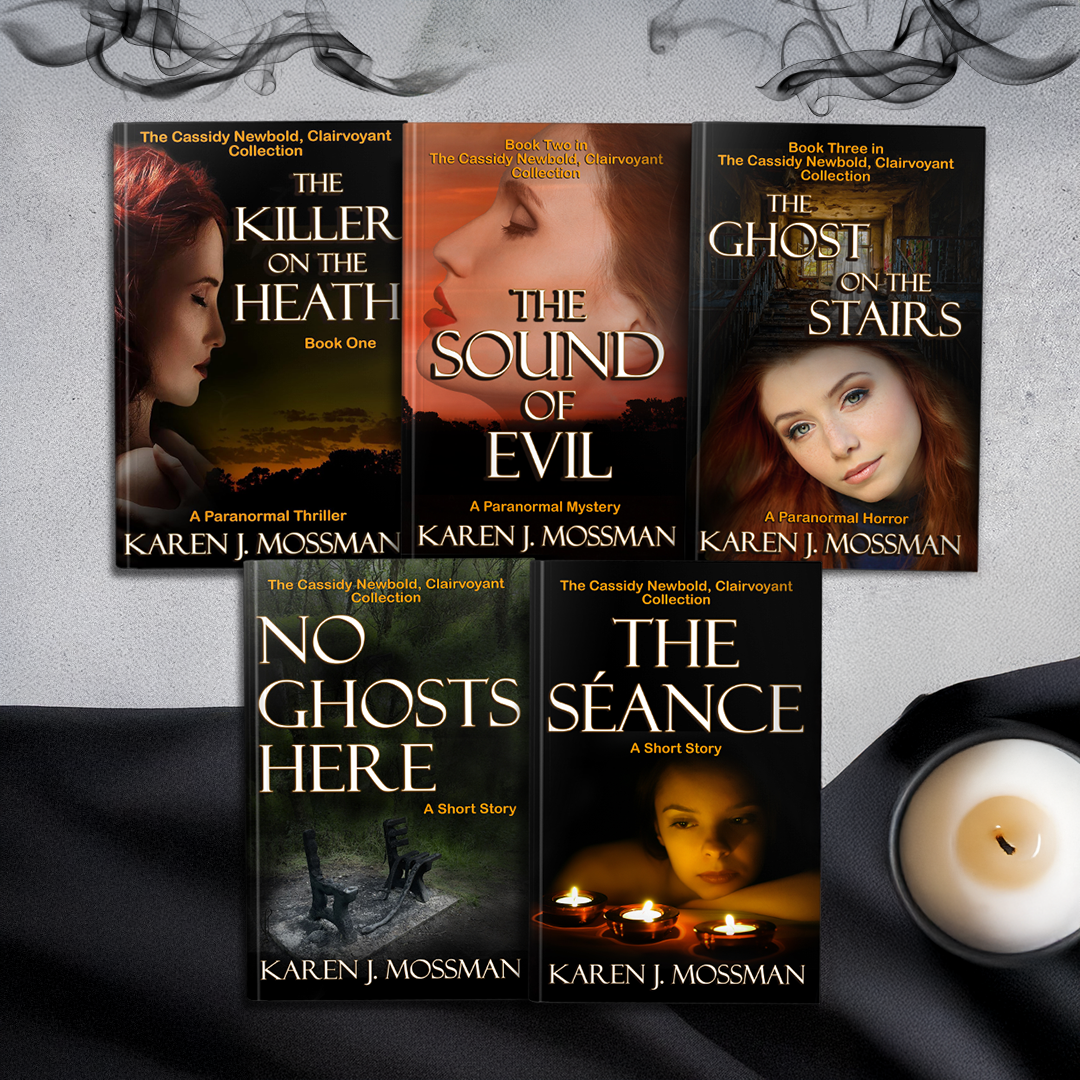
Today I’m delighted to be part of the book tour and giveaway for The Cassie Newbold, Clairvoyant series by Karen J. Mossman (https://karenjmossman.com/) Karen is a prolific author and is hugely supportive of other indies like me, so it’s fantastic to be able to repay a favour or two and be part of this tour. I have read a few of the books in the series and will link to a review further down.
Here is a bit more about the first book in the series, The Killer on The Heath, followed by my review.
Cassie uses her clairvoyant powers to help her detective brother solve crime… but will she find the answers in time?
The blurb:
A woman is dead, and another is missing. The only person who can save her is Cassie.
With no clues and time running out, her brother, Detective Newbold, desperately needs her help. He is counting on Cassie’s clairvoyant and empathic abilities to locate Chantelle.
When Chantelle’s brother, Pedro, seeks out a psychic for help, he meets and falls for Cassie. Though he wants answers, neither Cassie nor Detective Newbold can give any, which complicates their relationship. To make matters worse, his overbearing mother adds further damage with her meddling.
Meanwhile, the killer has been caught, but he refuses to talk. Now, it’s up to Cassie to read the signs and rescue her lover’s sister.
My review: I really enjoyed this story about Cassie, a clairvoyant who gets roped into solving a crime by her twin brother, Seb, a detective. Two women have gone missing locally and one body has been found. It was interesting to have both sides of the investigation: what Cassie senses or ‘sees’ vs what Seb discovers as a detective. I enjoyed the relationship between them -it had an interesting dynamic. The story focuses on Seb’s efforts to find missing Chantelle, and Cassie being distracted by an attraction to the missing woman’s brother. I was gripped until the end and my only complaint is how short the book is because I wanted more! But as it is part of a collection, I am looking forward to reading more about Cassie and Seb!
The Killer On The Heath is a fantastic introduction to the spooky world of clairvoyant, Cassie, and there are 5 books in the collection in total.
Don’t forget to leave a comment to enter the giveaway!


 The Glorious Outsiders