The May Queen, Hill Forts, Fairy Circles, Leylines, Holloways and the Moongazing Hare

Research for my latest novel has sent me down some divine British folklore rabbit holes.

(This article was originally published on Medium.)

I’m not normally a huge fan of research. Most of my novels have been set in times and locations that don’t require me to do a lot, and even then, if I do need to research something, I tend to leave a question mark there to remind me to do it later, while I get on with writing the thing.

However, my attitude towards novel research has changed for the better with my current work-in-progress, a folk horror story set in 1996, which will have companion books set in 1966 and 2026. On the very first draft (where I didn’t really know what I was doing), I ended up with the bare bones of a story, and possibilities for more in-depth plot-lines and character development. I didn’t do any research for the first draft, but I knew for the subsequent drafts I’d have to. And it’s been so much fun! I’ve had to look up a real range of interesting things, from which telescopes and cameras were popular in 1996, to 90s fashions and music (not too much of a problem, as I was a teenager in the 90s) to what sort of CCTV systems existed back then.

 This was just the start. As my folk horror story developed, I found myself going down some delightful British rabbit holes as I researched things I wanted to include in my story. It’s essentially a story about a strange little town with an ancient evil under the surface, and the plot is kicked off when a local boy goes missing.

These are some of the things I’ve had the pleasure of researching so far:

The Hare — I’ve always been fascinated by hares. I’m quite literally obsessed with them. For years and years I dreamed of seeing a wild one and in my youth had to be satisfied with keeping rabbits as pets, which was almost as good. In recent years I’ve seen hares in the wild and every single time it is a breathless magical experience for me. My son’s school is rural and on the journey there and back, down twisty country lanes, we often stop to watch hares running in the fields. Recently we spotted one lying low, and we stopped the car to watch. It knew we were watching and eventually got slowly up and loped away. I savoured every second of watching that huge, strong, almost deer-like body hop away. Another time we had to stop the car as another huge one was plodding casually up the lane in front of us. My son rolled his eyes at my over-enthusiastic reaction, ‘Oh my God, it’s a hare! It’s a hare! It’s a bloody hare right there!’ The hares in that area are giants, I swear. One time I thought it was a dog I’d spotted in a field but when I slowed down to check if it was all right or lost, I realised it was lupine in nature and had the pure joy of watching it dash away.

When I first created my current WIP, Black Hare Valley, it was just a vague idea about a folk horror story, an ancient evil, a plucky group of misfit teens and a strange little town I wanted to be old-fashioned in the most British of ways. Me and my son created it together, rolling out a huge piece of paper to create the map of the town. A few years later I started writing the story and always knew the town would be called Black Hare Valley.

Image by Artur Pawlak from Pixabay

But back to hares. There is so much folklore surrounding them, it only adds to their beauty and mystique. The moongazing hare has been symbol of growth, rebirth and fertility, as well as being associated with madness and witchcraft. In many cultures seeing a hare is meant to be good luck and in just as many, it is seen to be bad luck. There was an old superstition that witches could shape shift into hares, as often hares were seen running from flames. In truth, they often waited until the very last minute to break free from the traditional burning of stubble in fields. In many cultures the hare is considered a sacred animal who symbolises our relationship with the land.

Iron Age Hill Forts — Badbury Rings and Maiden Castle in Dorset are two favourites of mine but there are many of these ancient monuments across the British Isles. What were once defended settlements set into sweeping hills and reinforced with earthworks, stone ramparts, defensive walls and external ditches, are now intriguing and mysterious places to visit. I always feel strangely connected to both the past and the earth itself in these places. I was inspired by a trip to Badbury Rings to make Black Hare Valley a town built out of an iron age hill fort. Hill fort settlements could see their enemies from a great distance and this is a theme weaved into my story, especially concerning the history and founding of the town.

Holloways —Holloways are just as fascinating!I’d been keen to visit the infamous Hell Lane in Dorset for years and a couple of summers ago we took the kids there. I absolutely loved it and again I felt so close to the past and the earth there. Holloways are ancient paths criss-crossing the country, possibly markers of old trade routes. The paths themselves have become so deeply trodden by millions of feet, hooves and wagon wheels over centuries, that they are now almost tunnel-like, with the roots of trees visible on either side. At Hell Lane in particular you feel like you are about to descend underground as the trees shade you from above and the path leads you ever deeper. There are a fascinating array of carvings and faces on the clay walls too. I knew Black Hare Valley had to have its own Holloway!
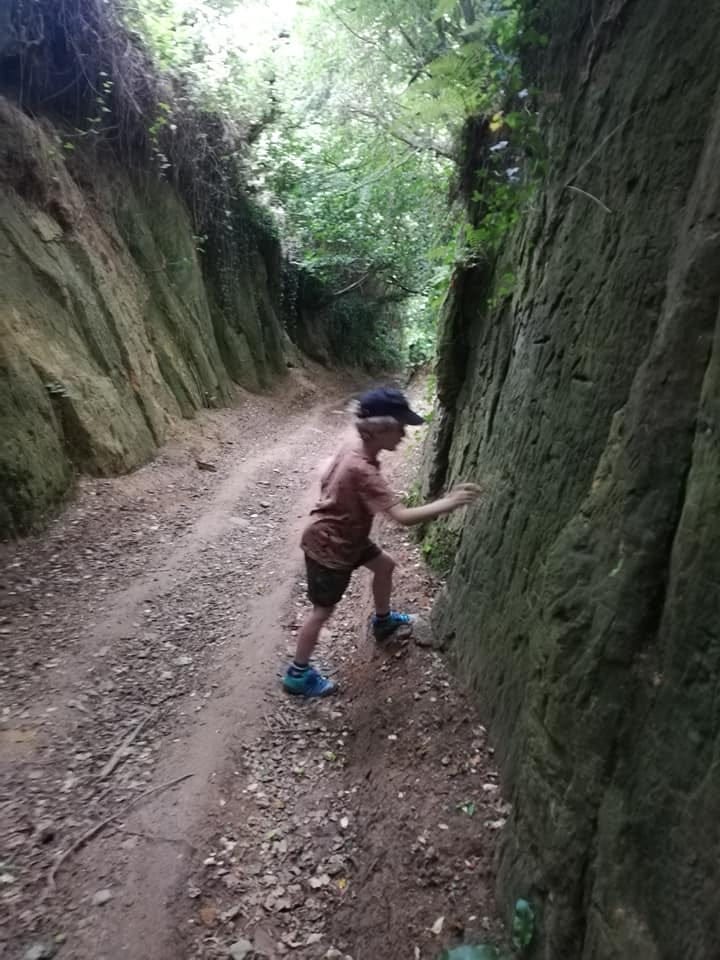
Hell Lane, in Dorset. Photo is mine.

Fairy Circles — I only researched these recently when I decided that Black Hare Valley will be set in 1996 and that it definitely needs a prequel set in 1966, which will see my group of teens parents go through an equally strange and dangerous ordeal in the town. One of the 1966 kids is described as being ‘away with the fairies’ and I decided to play into this a bit more in the 1996 story, as this character as an adult has been missing for a long time. I simply added a fairy circle to a scene and had one character stomp through it while another declares it to be bad luck, and he retorts that his mother used to believe in such rubbish. Fairy circles are naturally occurring circles of mushrooms, often found in forests and grassy areas. Across the world, fairy circles or rings were often associated with folklore and myth and seen as dangerous places. It was said to evoke a curse or bad luck if you crossed one.

Ley lines — ley lines are also mentioned in Black Hare Valley, as I needed a central spot in one of my locations that would provide an intense amount of energy and a feeling of being held in place. I researched ley lines, which I only vaguely understood, and it turns out some people believe in them and some don’t. Essentially, they are believed to be straight lines between prominent landmarks, prehistoric sites and historic structures. Believers assert that ‘earth energies’ run along these lines but there is no scientific evidence to support this, and instead it is a matter of faith.

The May Queen — May Day, The May Queen and other spring celebrations and traditions will be more fully explored in my prequel set in 1966, but as I lay the clues for this in the 1996 book, I’ve had to research them now. One of my 1996 characters discovers that his troubled mother who ran away, had a sister who went missing in 1966, much in the same way a friend of his has gone missing in 1996. In scouring old photos from their parents, the group of friends discover that the missing girl was crowned the May Queen in the spring of 1966. I had great fun researching this and looking at old photos. The May Day celebrations marked the beginning of summer and small towns and villages across Britain, and indeed Europe, would celebrate by choosing a young girl to be the May Queen. She would be decked out in white with a crown of wild flowers and would be given a throne to sit upon. Villagers would also dance around a Maypole, weave floral baskets and ‘bring in the May’ by gathering wild flowers and branches. Going back even further, it is reported that wild hares were often part of the tradition and would be released from cages as part of the celebration. 

Researching books can be a lot of fun and Black Hare Valley is providing me with unique opportunities to google things and learn more. I have now started writing a rough draft of the book set in 1966 and have already had fun researching the clothes, music, and food popular at the time!

Would It Be Okay To Watch The Last Sunset Alone? – poem

Hi folks! I have got so much content now on Medium – a lovely mix of essays, articles, poems and stories, so I thought for this week on the blog I would share a poem that recently did quite well for me there. I still can’t get my head around getting paid to write my poems!!

Image by Giani Pralea from Pixabay

Would it be okay
to not do anything
to leave today
and maybe tomorrow too
whatever, however long it takes
for the feeling to pass
of the world ending
of disaster
and death
and my decay
and the transition into bones
and dust
would it be okay
if I said not today?
I can’t do it today
my mind is a trap
a battlefield I can’t escape from
and your silence was too loud
when I tried to talk
if the world lets me
I’ll cancel today
bury myself in bed
find comfort in words instead
get lost and sad inside my own head
feel myself dissipate in the dark
embrace my bones
knowing it’s okay
to watch the last sunset alone

Thank you for reading! I am in the process of compiling all my Medium poems and pieces of fiction into a new book I’ll publish at some point. I’ll keep you posted on that but I already know it will be called Dirty Little Feet and Other Tales and Poems.

See you next week!

Interview With Chantelle Atkins On Her Latest Release: At Night We Played In The Road

Last week I was interviewed by author Sim Alec Sansford for the author news blog on the Chasing Driftwood Books website. Chasing Driftwood Books is an indie collective some like-minded indie authors have set up to help support and promote each other and I’m thrilled to be a part of it!

Here is the interview:

When Tom Lane was born, he accidentally killed his mother and in the process, his father’s love.

Determined to protect Tom from their father’s criminal business, older brother Alfie must become Tom’s father, mother and protector. It’s the two of them against the world until the day Tom chooses a life of crime over Alfie’s dream of a normal life.
Ten years later the estranged brothers are reunited when a violent gang bring Tom to Alfie’s door with a gun to his head.

Tom’s partners in crime have turned on him and he needs his brother to save him one more time…

A darkly brooding story of brotherly love, belonging and the beginnings that shape who we become.

Buy here: https://books2read.com/u/mBy7DZ

Your latest release is connected to your five-book series, The Boy With The Thorn In His Side. Can you tell us more about that?

Yes! The Boy With The Thorn In His Side Part 5 introduced two characters, Tom and Alfie Lane. They become unwittingly involved in Danny’s (the main character in The Boy…series) struggle to escape his crime ridden past. He helps them and they help him. As I wrote these scenes, I fell so in love with the characters I knew they had to have a story of their own. I was curious about their past, specifically their childhood and wondered what had happened to them to lead them to this point. For example, when Danny first meets Tom Lane, he is tied to a chair, about to be tortured by a violent thug Danny has tangled with before. But what led Tom to that chair? I saw a very troubled and co-dependent sibling relationship between Tom and Alfie and really wanted to explore that.

What is it about Tom and Alfie in particular that made you want to write their story, opposed to other side characters?

Good question! I have to be careful because I think all my side characters would like their own book one day! But these two did really catch my imagination. I think I was interested in the brotherly relationship and how Alfie had to be a father and brother to Tom. I was interested in that very specific dynamic too, one of co-dependency and how damaging that can be to both individuals. I wanted to examine it from both of their points of view, so I did. They love each other deeply and fiercely, which is incredibly beautiful, but they also hurt each other a lot over the years. Their family background was really interesting to me too. How sometimes you cannot escape your family, even if you don’t want to be like them. How some children hero worship abusive parents, while others see them for what they are and try to break free. Tom also has Tourette’s Syndrome which was something I was researching a lot at the time as my youngest child displays many of the symptoms. Tom is based on him, just a tiny bit. His energy, his optimism, his intelligence!

This book explores many dark themes as do your other stories. What is it about the genre that you particularly enjoy?

I think I am just drawn to the dark side of life and everything that means and entails. There are so many layers to humanity and being alive and it’s fun to pick them apart and see what flows out. I like gritty stories, topics you can get your teeth into. I like writing about outsiders and rebels, people who don’t fit in and don’t want to. I think there is so much to be explored there! I suppose it comes back to writing what I want to read. I want to read books with relatable flawed characters and dark themes, so that’s what I enjoy writing too.

You’re well known for your passion and dedication to writing, but what keeps you so inspired?

I suppose life itself and all it’s mysteries, all it’s ugliness and beauty, everything! I love the quote that reading is breathing in, and writing is breathing out. It feels like that for me. Writing is me exhaling everything I have learnt, felt, seen, observed and wondered about life and people and society and families… Writing to me is pure magic. It feels incredibly exciting, like a natural high. People inspire me, families inspire me, the endless possibilities for stories inspire me! I don’t know how to live and not write.

Are there more books coming for The Boy With The Thorn In His Side universe? What can we expect?

It certainly is a universe, full of inter-connected books. Characters pop up in each-others stories and the locations used are familiar. I have two more books to release in this universe and then that will be it. Those two books should tie up everyone’s stories. I am releasing the sequel to my debut novel, The Mess Of Me in January 2025. The Mess Of Us is set two years after the dramatic events of the first book and see the characters Lou and Joe trying to come to terms with what Joe’s criminal brother Leon did to them, as well as dealing with an unexpected pregnancy, among other things. In The Mess Of Us we get to explore Leon a bit more. He was very much the mysterious boogey man in The Mess Of Me, and the main character and narrator, Lou, absolutely despised him, and quite rightly. But she sees another side to him in the sequel, and then he reappears as a main character with his own storyline in the final book in this universe, The Dark Finds You. I aim to release this summer 2025. This will unite many of my characters from other books! Lots of them already know each other so it was not hard at all to draw them all together for one storyline, which also helps conclude their own personal ones. It involves Leon from The Mess Of Me and The Mess Of Us, as already mentioned, Joe also appears from those books. Elliot from Elliot Pie’s Guide To Human Nature, plus his mother Laura and friend Leah are also main characters in The Dark Finds You. Danny from The Boy With The Thorn In His Side is now in his 40s, so fans of that series might like to see how he’s doing now! And Bill Robinson from The Holds End trilogy is another main character. I wrote the first draft in six weeks – it was that addictive and exciting and I can’t wait to share it!

You tease a lot of your work on your social media. What can you tell us about Black Hare Valley?

Well, mainly that it’s another universe that has totally sucked me in and is currently holding me captive! I am seriously addicted to this at the moment! Black Hare Valley was first created during lockdown, 2020. I had just re-read my favourite Stephen King book, ‘IT’ and wanted to write something similar as a sort of homage, I guess. I envisioned a close-knit town with a dark secret and a band of misfit kids drawn together to solve a mystery. That was all I had. However, me and my son, who was 12 at the time, designed a huge map of the town just for fun. We created a valley town set between two Iron Age Hill Forts, with farmland, forests and rolling hills, rivers and streams. We added everything they would need from schools and theatres, to pet shops and garages! I also created some character bios. It was a lot of fun. I left it alone for a few years while I was working on other books. Two years ago we had a prolonged power cut and no WiFi so I ended up writing Black Hare Valley in long-hand into five notebooks. I didn’t really know what I was doing. It just happened. I just let it flow. As I wrote it, I had to ask myself more and more questions and the story slowly unraveled. I then typed it up and left it alone again. When I’d finished The Boy… universe books, I could finally turn my attention back to Black Hare Valley and it sucked me in and wouldn’t let go. Essentially it’s going to be a three book series with the first book set in 1996, the second in 1966 and the third in 2026. It’s a very dark folk horror story about this very strange town tightly controlled by a well-meaning Neighbourhood Watch Committee. They are not what they seem however, and children, in particular, have a habit of going missing, never to be seen again… That’s all I want to say but if you love folk horror, creepy towns, misfit kids, and quirky traditions such as May Day celebrations, fairy rings, leylines, hill forts and more, you might just want to visit!

Who are some writers that influence you and what books do you enjoy reading?

I’m a huge fan of Stephen King, Charles Bukowski and Chris Whittaker, to name a few quickly. But generally I love reading anything dark and gritty with wonderful memorable characters. It’s all about the characters for me. As a teenager I was very influenced by Stephen King, and SE Hinton.

What made you decide to create Chasing Driftwood Books?

I’ve been writing and independently publishing since 2013. I’ve published with indie collectives three times before, but each one eventually folded. They were all different, but essentially they were all allowing authors to self-publish for free and keep their royalties, but belong to a bigger community of authors who can support each other and help promote each other. I wanted to take all I had learnt from those platforms and create our own. We are very small at the moment but will open for submissions in due course! What I have realised since I started publishing was that it’s very, very difficult to land an agent and get a traditional deal these days, and also that the traditional deals are not always what they are cracked up to be. I’ve learnt that indie authors who do well are in the most enviable position of all. They have full creative control, retain full royalties and can very often earn enough to give up their day jobs. But to achieve that, they often have to pump a lot of money into their books. Paying for editing, proofreading and professional covers, goes without saying, but to really succeed they also need to be paying for advertising. Low income authors, disabled authors and other under-represented groups, are simply not in a position to do this. I’ve been an avid reader of indie books for some time and have read some truly extraordinary books by incredibly talented authors who should be selling far more and getting far more success and visibility. Money is so often the problem. What we are hoping to do here is draw quality authors together into a community that can help support and promote each other. That is just the start but the long-term aim is increased visibility for all our authors!

You have a prominent cast of male protagonists throughout your books. What is it about writing through their eyes that inspires you to do so?

I think I once sat down and worked out that by the time I have written and released all my works-in-progress plus all my vague ideas for books, I will have an equal amount of male and female protagonists! But I get what you are saying. With my published books at the moment, there are more male protagonists than female. I think partly this is pure accident, in as much as the characters just come to me and I can’t often control their gender. But also I think in the past at least I have been more curious about the male view and experience, simply because I am not one! So, that made it just a bit more interesting to explore.

Finally, what more can we expect from the world of Chantelle Atkins?

Two more books in the interconnected The Boy With The Thorn In His Side universe, as already mentioned, followed I expect a year later by the full Black Hare Valley trilogy. I have also started a fifth book in The Day The Earth Turned series, though that is taking a back seat at the moment! Works-in-progress involve a half-finished YA zombie apocalypse story told in a diary format, a family mystery called The 7th Child, and a story about two dysfunctional young adults who get bored of waiting for the apocalypse so decide to try and start one themselves… I am also planning to write a crime book with my oldest child, Daisy! She is about to start her Masters in creative writing and we have come up with an excellent serial killer plot set on a university campus! I have another YA post-apocalyptic story that has been planned with character bios done…. I think that’s it!

If you’d like to follow me and keep up to date with my books news, here are the links:

Website/blog: https://chantelleatkins.com/

Facebook page: https://www.facebook.com/chantelleatkinswriter

Instagram: https://www.instagram.com/chantelleatkinswriter/

Medium: https://medium.com/@chantelleatkins_17828

Medium Tips – Again!

I recently encouraged a few more friends and fellow authors to join Medium and I’ve been guiding them through the process and answering any questions they have on getting set up. I thought it might make sense to write another blog post listing the process from start to finish. So, here goes.

Image by Firmbee from Pixabay
  1. Join Medium as a subscriber if you want to earn money! You can join for free and you can submit writing and read other people’s work for free, but if you want to get paid you need to be a subscribed member. It’s just $5 a month and that gives you endless interesting content to read, plus it means you can start getting paid yourself once you have been accepted onto the Partner Programme.
  2. Set up your profile page. You’ll probably find the process familiar if you are on any other social media sites. You need a profile photo and a short bio. Both of these will appear when you follow people. I don’t tend to follow people who don’t have bios or photos, so make sure it is a good clear picture and a nice concise bio. Here is mine as an example: Author and owner of Chasing Driftwood Writing Group and Chasing Driftwood Books. Owner of The Wild Writers Club publication. https://chantelleatkins.com/ As you can see, mine is short and to the point. They don’t allow many characters.
  3. Set up Stripe payments. Once you apply to the Partner Programme you can start getting paid, so make sure you have set yourself up for payments via Stripe. I found it very straightforward. You just follow the cues and enter the information required.
  4. Write an About Me story. To do this, you first need to find the About Me publication on Medium and comment under their pinned submission post to join as a writer. Once accepted, write your About Me page and once that has been submitted and accepted by the publication, pin it to the top of your profile page. Now you have a short bio plus a longer introduction to who you are and what you write. Here is mine as an example: https://medium.com/about-me-stories/about-me-chantelle-atkins-91d0bc990187
  5. Look for publications that would suit you. What do you want to write on Medium? If you only want to write stories and poems, then search for fiction accepting publications. If you only want to write about parenting, then search for those. If you have lots of ideas then reach out to a few publications to get you started. I recommend Promptly Written for the sheer reason they provide monthly themes and weekly prompts to respond to on a wide array of topics. This could be the boost you need to get writing. The Honest Perspective also covers most topics and formats of writing. I also like Modern Women, Rainbow Salad, Read or Die, The Parenting Portal, Know Thyself, Heal Thyself, The Poetry Publication, and of course my own recently set up publication, The Wild Writers Club!
  6. Ask to be a writer for the publications you like. Usually the process is simple. Most pubs ask you to comment on their submission guidelines (to show you have read and understood them) asking to be added as a writer. Some pubs are fussier and require forms to be filled in and some prefer to be emailed directly. Smaller pubs are easier to get into but ask to write for any you think you could contribute to.
  7. Make sure you read their submission guidelines, rules and their work! This is very important. I recently set up my own publication, added some writers and some then submitted work that had nothing to do with my publications topics! So I had to decline them. The best way to make sure you are a good fit for a pub is to read their work. Spend some time on their page reading work by other writers. Don’t forget to engage by clapping, commenting and highlighting! It’s also really good practice to follow at least some of the other writers on that publication and support their work by reading, clapping and commenting. This shows loyalty to the publication and encourages growth and visibility, which is mutually beneficial for everyone!
  8. How to format your written pieces. Some publications may have clear rules on how they want work to be formatted before submitting. If you don’t read and adhere to this, then they won’t publish your piece, and why should they? After all, it is their publication and they may have a certain look or feel they are trying to maintain. Personally I prefer and advise the following check list: Use both a TITLE and a SUB-TITLE. You might as well use both. The sub-title allows you to fit more keywords into your title, which may attract more readers, so in my opinion, you’d be silly not to utilise that extra tool. To correctly format the main TITLE, you write it into the title space, highlight the first T in the word TITLE and then choose the TITLE option when it comes up. It is set out as a capital ‘T’. To format the sub-title, you do the same underneath. Highlight the first letter in your sub-title and choose the smaller ‘t’ when it comes up. This gives it all a nice universal look. You can also add a KICKER above your title. Again, you might as well! A KICKER just gives the reader a bit more information on what type of writing this is. For example you might put: ESSAY/FAMILIES/MEMOIR if you have written a piece about childhood memories. To add a KICKER you merely write it above your TITLE and again, highlight the first letter and choose the small ‘t’ again. This will format your KICKER.
  9. Images. It is wise to add a suitable image to your piece. I usually only add one at the start of my piece, but again, some publications will prefer you to add more and some really don’t like more than one. Check those submission guidelines! To add an image you click on the + symbol and a menu of options appears. You can upload an image from your device, or choose one from the Unsplash site. You must then add a credit under the image stating where it came from. You can also use other free sites like Pixabay. If the photo is your own, just state that. Then add Alt-Text. If you click the image, you will see a box saying ‘Alt-text’ come up above it. Click on this and it will ask you to describe the image for visually impaired readers. This is good practice and some publications are now insisting on this, so you might as well get in the habit of doing it.
  10. End of your piece. You can use the + symbol again to add paragraph breaks or new blocks. I like to add a ‘…’ to separate my main piece from my explanation or links at the end. Some people add these throughout their piece. It’s up to you. It’s a style choice. At the end of mine, after the separator, I use italics and thank people for reading. You can ask for claps, comments and follows if you want, but I prefer not to. Most pubs will allow you to add links or ‘calls to action’ at the end of your piece. If it has been written in response to a prompt, for example, the publication will want you to add a link to that piece. Some ask for their submission guidelines to be added at the end of each piece. Again, read those guidelines! I tend to add a link to the prompt and then one or two more pieces I have written for that publication. This gives the reader the option to read more from me on a similar topic in the same publication and I like to think it shows some loyalty and appreciation to that pub for having me as a writer! You can also add links to your books, if you are a published author, links to websites or other sites such as X or Substack etc. But again, check. Some publications only allow a certain amount of links at the bottom. To add a link, again click on the + symbol and move along the menu bar until you find the option for adding a link. It’s sensible to add links if the publication allows it. If people enjoyed your piece, you are giving them more to click on.
  11. Getting boosted. Writers on Medium can have their work boosted by boost nominators. Some pubs have boost nominators and some don’t. It’s probably a good idea to write for a mix of both. But writing for a pub without a boost nominator is not a problem, as boost nominators don’t just nominate within their own publications. They can nominate anything they come across on Medium. They have 20 nominations a month to use up and the Medium curation team then decide if the piece is indeed boost-worthy. You might get lots of nominations for boosts but not have them actually boosted, or you might win on both fronts. If your work is boosted you will receive an email from Medium. Your piece will then be pushed in front of more readers and you will see more views, reads, claps and comments as a result. This generally means your piece will earn you more money, but it does vary. My biggest earner from a boost has made me $405 so far. It’s still getting reads so it will continue to make me money. But some of my boosted articles have only earned around $15. As for non-boosted, you can earn as little as a few cents or as much as $50 or more! It really can vary a lot. What gets boosted? That would take a while to delve into but for me, it’s been pieces that are raw, honest, heartfelt and authentic, usually on topics that are fairly universal and relatable.
  12. Medium etiquette. Medium is overwhelmingly a lovely, warm, supportive place. It’s a very co-operative place and that’s why it works. It’s reciprocal. It has to be. If you use Medium selfishly, you will not do well. Follow people you are genuinely interested in. Subscribe to get email alerts from them if you really want to support them. Read the Daily Digest email every day. It will load up stories from writers who follow you, writers you follow, and topics it has noticed you are interested in. Read whatever catches your interest, clap and comment to increase engagement for that writer. Every time you read AND engage, you are helping that writer earn money. Support the publications that have accepted you to write for them. Answer comments when you get them. It’s polite to thank people for reading and commenting, and your comment to them also counts as more engagement. Don’t beg people to follow you. I hate that. Don’t comment on people’s work asking them to read your piece on a similar topic. That’s so rude. Don’t be needy. Don’t spam people, don’t try to sell them anything. You can get reported and thrown out, quite rightly. Medium etiquette really needs a longer post, so I might come back to this another day! But it’s really quite simple. Read the rules, learn the rules, pay attention to the etiquette and support others if you hope to be supported yourself.

Okay, that’s everything for now on the basics. If you want to know more about Medium and what a wonderful platform it is for new and established writers, let me know what else I can talk about! Thanks for reading!

format title, sub title and kicker

add image and give credit plus alt text

use title and sub title – alluring, thought provoking

edit edit edit proofread, edit and again

be real