So, What Do You Write?

So, what do you write? An innocent enough question, yet one that tends to fill most writers with instant fear and panic. Unless, of course, you’re one of the sensible ones who only writes in one easy to categorise genre. Oh, how nice that must be; to be able to answer quickly and succinctly, ‘I write romance,’ or ‘I write crime thrillers.’

For those of us who write in multiple genres, this is the question we dread people asking. Imagine the scene. You’re getting to know someone, or chatting to a stranger to pass the time at a bus stop or in the doctor’s waiting area. They ask politely what you do for a living and you say you’re a writer. (You probably wave a dismissive hand almost immediately and tell them that you also have a day job…) Or maybe they already know you’re a writer, maybe someone told them and they’re asking out of curiosity. They like to read, you see, so of course they want to know what you write. And you freeze. You look for an easy, quick answer, as neither of you want to drag this out too long, but there isn’t one. So, you start mumbling incoherent sentences about, ‘a bit of this and a bit of that…’ Before you know it, their eyes have glazed over and they no longer take you seriously, if they ever did.

I have always dreaded this question. When I first started publishing my work, I had no idea what genre my books were or how to categorise them. Amazon and other platforms force you to think about this if you haven’t already. You need to allocate your book a category and you need to choose keywords, for example. My first novel was YA but I didn’t actually realise it at the time – I had just written the story that was in my head, and at that time, I had no plan to market it towards a certain audience. Obviously, since then I’ve learned a lot and I now realise how important genre is in marketing your book, from the cover, to the title and the blurb.

My next books were The Boy With The Thorn In His Side series and I still struggle to explain what genre this is! The main character is thirteen in the first book, but twenty-four in the fifth, so I can’t really call it YA. It has a lot of crime and drama, but I would say the psychological elements are stronger. Having said that I wouldn’t really want to call is a psychological thriller. It has elements of suspense and horror, plus coming-of-age. Heaven help anyone who asks me what it’s about…. They’ll be stuck there a while.

Not being sure of genre or category is one problem, but what if you also continue to release books in different genres? It makes it hard to build a loyal audience, that’s for sure.

After that series, I released This Is Nowhere. At heart it’s a family mystery – the main character returns home to try and discover what happened to his mother who vanished when he was a boy – but it’s also an examination of mental health and in our ability to find meaning in life. Tricky. After that I wrote The Tree Of Rebels, probably the one and only time I decided to write a book to fit the market. At the time YA dystopian books were becoming very popular and as I had an idea for one, I decided to write it and market it as such. It ended up being the hardest book to write for that reason. Like someone was watching over my shoulder the entire time.

Since then I have released Elliot Pie’s Guide To Human Nature, a book I still find hard to categorise. Its literary fiction; character driven with a young narrator, yet its not YA. My YA trilogy Holds End was easier to classify as YA, but it’s also a mix of things; coming-of-age, crime, drama, thriller, murder mystery…

I’ve released two short story and poetry collections, and two books so far in a co-written YA supernatural/paranormal series. I’m currently editing The Day The Earth Turned series which is YA post-apocalyptic, and I’ve written first drafts for more crime/drama/thrillers and a YA horror/fantasy… That’s not to mention the zombie apocalypse story I started a while back, and the family mystery/psychological thriller I’m making notes for…

It would be great to write in one genre. It would make life far easier for me. I would be able to call myself a horror writer or a crime writer and I would be able to market my blog and social media pages with this in mind. I would be able to work on building a loyal following of readers who know what to expect from me. Instead, the small amount of readers I do attract, never know what to expect next. YA supernatural, followed by YA post-apocalyptic, followed by gritty, crime drama?

There’s no doubt writing in multiple genres makes it harder to market and sell books. It’s almost as if people don’t take you as seriously as the writer that always writes to one genre… I’m not sure why.

I have come to the conclusion that I shouldn’t waste too much time worrying about it. Sales and reviews are hard to come by, but ideas certainly aren’t. My head is full of them. And whether the next idea is a murder mystery, a post-apocalyptic horror, or a story about shape shifters, I don’t think I’ll be ignoring it. How could I?

In many ways, writing in multiple genres keeps things fresh and new. I’m having fun so hopefully my readers are too. And there are a few things that all my books do have in common and I’m not too shy to mention them here. They are all a little on the dark side, often examining the worst elements of human nature, and they are all very character driven. My aim is to make you fall in love with my characters as much as I have. So, if you like things a bit dark and you want to make some new friends you will wish were real, you’ve come to the right place.

And the next time I get asked what I write, do you know what? I am going to hold my head up high and tell them the truth. That I write in many genres, and therefore, have something for everyone, no matter your tastes!

How My Writing Habits Have Changed

I’ve never understood the type of people who refuse to change the way they do things. You know the type. Even if what they’re doing is not going so well, they’ll hang onto the adamant belief that it is the best way to do it, simply because it is the way they have always done it. It’s even worse when it comes to opinions and beliefs. I have strong beliefs and opinions, but I like to keep my mind open and accept that knowledge and understanding are open to interpretation and change. If some new piece of knowledge comes along, I am always happy to admit I was wrong and change my way of thinking. I think the refusal to ever change your mind or admit you were wrong, is actually very dangerous. Anyway, in that spirit, I’ve been thinking lately about how I write now, and how I used to write. You see, over the last few novels, things have changed. And with the WIP I am on right now, and the book I have planned after that, I feel they are changing even more. Here’s how, and why…

  • I edit as I go…Not word for word, not every paragraph, but I do now go back over what I wrote at the start of the session. And I always read what I wrote last before I start writing again. I used to do things quite differently. I would rush out this clunky, crazy first draft. It would be this desperate measure, this way of getting this thing out of my head once and for all. I’m not saying that’s wrong, and I think with some books it’s totally the right way to do it! But I have noticed lately that I’m slowing the process down. I’m going back over what I last wrote and editing out mistakes and typos. Previously I would not care about these in a first draft. I just wanted it done. Now I think I am probably saving myself some time later on, and it is also helping me get to know this story and its characters, to feel and breathe with them as they develop and take form. Reading over and checking what I just wrote is helping me to make sure everything stays on course.
  • I plan more…I used to plan as I wrote the book…so as ideas came to me, I would jot them down and the novel would often change course and follow twists and turns as I wrote it. I would start, not really knowing how to finish. Now, I try to plan the whole novel before I start writing, chapter by chapter if possible. Not in too much detail, and always allowing for change and development and the surprises which will inevitably pop up. But now I like to be able to see where I am going…I like to know the general destination of my journey.
  • I’m aware of my potential audience…This is not to say I am writing anything and aiming it at a certain audience. Doing this with The Tree Of Rebels caused me untold problems (see Did Choosing An Audience Ruin My Book?) so I won’t be making that mistake again. But I do have a better idea of the genre I am writing in before I start writing, an idea of the type of person who would pick this book up and want to read it. I never used to consider this at all, and had a very hard job picking genres and categories for my finished books because of it.
  • I write the log line and synopsis first…Now, to be honest I am only just getting to grip with loglines! They are actually quite hard to do. The idea is you should be able to write a one to two sentence paragraph which explains your book, and if you can’t, you may have a problem. The logline can then help you to shape your synopsis. With early novels, I always left the synopsis to last and found them nothing short of utter hell and torture. How to condense a massive novel down to a paragraph or two? What to cut out, what to leave in? How to lure people in without spoilers? How to pick the right key words? Hard, hard work. With the last two books I penned (The Tree Of Rebels and Elliot Pie’s Guide To Human Nature, both still not quite finished) I wrote the synopsis first. I’m not sure why. It just seemed like a good idea, and I had a general idea of what to say, so I went for it. Neither is perfect and both will need tinkering, but overall, I think they both say what they need to say. Lesson learned. From now on, I work on the synopsis first!
  • I research as I go…This is another thing I used to be quite lazy about. I was in a hurry. I just wanted to get the book written. So I would make up stuff as I went along, noting down that I needed to properly research it later.  Now if something comes up that needs looking into, I do it there and then before I write another word. Again, this saves me time and stress later, and if what I research ends up changing the story in some way, it’s much better to know this early on! Plus it’s fun. I used to put off research of any story because I thought it was boring. Just detail that needed throwing in to make it all sound better. But now I look at it differently. It’s important to the story and I’m also learning new things all the time!

So, over to you followers! Have you always done things the same or have your writing habits changed through trial and error? Does it all depend on the book you’re writing? Let me know!


Did Choosing An Audience Ruin My Book?

I don’t know for sure, but it feels like it.

Let me explain. I am, of course, talking about The Tree Of Rebels, a book that once seemed so simple in its concept and execution. I tend to write quite hard hitting, gritty stuff, and I decided (rightly or wrongly) that I wanted to write a book my children could read. Specifically, I was aiming it at my daughters, who were at the time 11 and 12 and devouring books like The Hunger Games and The Maze Runner.

It wasn’t like I invented an idea to try to fit this genre and audience. I already had the idea for a dystopian future (one I am genuinely scared of). But I have to admit, this was the first time I ever sat down and tried to write a book knowing who the audience would potentially be.

Now, don’t get me wrong, there is absolutely nothing wrong with knowing your audience. Knowing your audience is key! How else will you know how to describe your book to potential readers? How will you know what categories to choose on Amazon etc? How will you know what cover and font to go for? All these things matter!

In fact, not knowing exactly who my audience were caused me no end of problems in the early days. You see, I didn’t know what kind of writer I was, because I had never really had to think about it before. The first two books I released, The Boy With The Thorn In His Side and The Mess Of Me featured young adults as the main characters, but this was purely incidental. In fact, if anything, I didn’t consider myself a YA writer at all and even kind of rejected the idea. I didn’t want to pigeon hole myself, I guess. I wanted adults to like my books too. It wasn’t deliberate that my characters were all young; that’s just the way it worked out. Or so I thought.

Truth is, I didn’t really understand the YA market at that time. I hadn’t looked into, or researched it as a phenomena. Since then, I’m glad to say I have learnt a lot and come to terms with the fact, that although not exclusively a YA author, YA is what I do best, YA is in my heart and soul, and YA is undoubtedly what I tend to seek out for reading material. I just didn’t really connect the dots in the beginning.

Anyway, the point I am trying to make is this. It can be good to know your audience before, during and after you write a book. It would have made things a lot easier for me when releasing The Mess Of Me if I had got on board with this and fully embraced and accepted the YA market I was aiming at.

BUT I do feel that knowing who to aim The Tree Of Rebels at has had a negative impact on writing the book. It felt like there was someone looking over my shoulder the whole time, saying no, don’t do it like that, that’s not how you write this sort of book! Looking back, knowing which audience I was aiming at definitely changed the way I approached it, making it one of the most challenging books I’ve ever written. I mean, none of the others ever felt that difficult, you know? They just kind of, happened. It’s not the only thing I can blame it on, and anyone who reads this blog regularly will know how many issues I have had with the book including the ones talked about in  Getting To Know Your Characters  and Final Draft? Patience is the key…

I’ve done so many drafts now that I have lost count. I have sent it out to beta readers three times and received very, very detailed edits and critique. I originally wrote the damned thing on Wattpad, so I had feedback on the very first version as it happened, and then posted later versions on there too. Lots of people have been involved and all of them have been incredibly helpful. Before I started this latest draft my intention was to fill it in more, add some detail and meat about how these people exist, but then towards the end I realised there was still something major missing.

Me.

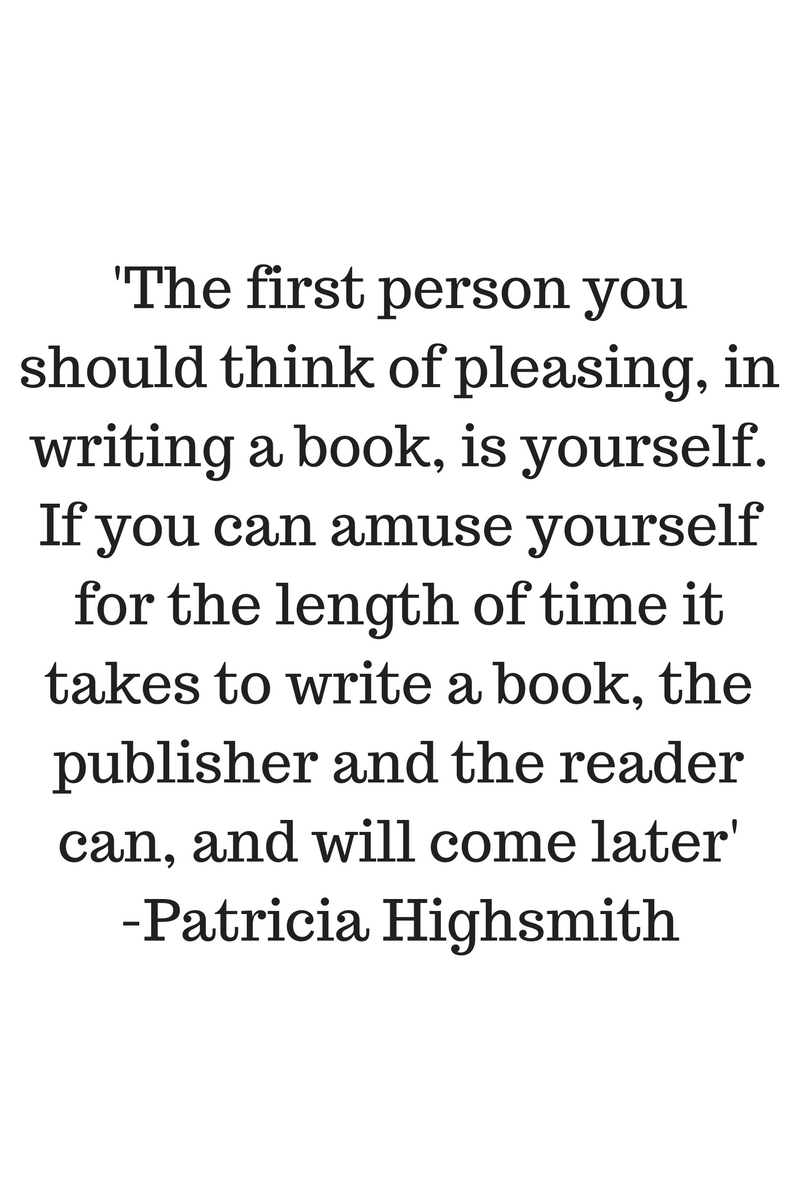
'The first person you should think of pleasing, in writing a book, is yourself. If you can amuse yourself for the length of time it takes to write a book, the publisher and the reader can, and will come later'-Patricia


It hit me one day while talking to my daughter.

I wrote this book to please them, and to please a certain type of reader who likes a certain type of book. I have never ever done that before. All of my other books were written to please me. They were written to scratch an itch. They were written to get the noisy people out of my head and onto the page. They were written out of passion and necessity. There was no other reason to write them other than that I simply had to. I’ve never known at the time of writing, who would like this book. Even with my current work-in-progress Elliot Pie’s Guide To Human Nature, I have absolutely no idea who this book would be aimed at or how I should even describe it! That for me, is familiar territory!

Of course, with my other books, on further drafts and edits I did begin to write and rewrite with my reader in mind. You have to! But they were not there in the beginning. It was just me.

So, how has this revelation helped me with The Tree Of rebels, you might ask? Is it totally ruined?

No, of course not. I still believe in the story and the characters. I have even started a sequel! But for now, I  have decided to leave this book alone. Put it to one side and focus on something else. I have decided to forget who it was aimed at, and essentially write it again. I have decided to write it the way I write all my books. I have decided to let it be whatever it needs to be and to stop trying to sculpt it into something I think it should be. In other words, forget about the perceived audience…For now.

I have a feeling it is now going to become an altogether darker book. But this is good. And would you believe it, while walking the dogs the other day, I had further revelations. Extra characters and another storyline, an important one, to feed into the others. It might make it a longer book. There might be more cutting. I’ve written the ideas down and that’s it for now. I am still not going back there yet!

But when I do I will be rewriting it entirely and writing it for me.

What do you think? How do you write a book? With the audience already decided or with just yourself to please?  Is anyone in your head when you write that first draft or do you really have no idea what sort of reader would enjoy it? Please feel free to comment!