What Happened To Pip Collins?

A short story

local graffiti – artist unknown – photo is mine

Hey everyone,

I hadn’t quite finished the post I had in mind for today so I’m going to share this short story with you instead. And yes, that does mean the writing is flowing again! More on that next week. I wrote this piece in response to a prompt on Medium, which instructed you to go outside and take a random photo then write a story inspired by it. This graffiti was added recently to one of the poles on the bridge down the lane from us. I thought it made a cool photo and a cool short story prompt so here we go. (This is only a second draft story and I do intend to polish it up a bit more in the future.)

What Happened To Pip Collins? (Working title)

The ghost hunt starts at the little stone bridge, just a ten minute walk down the lane. My older brother Ed photographs the graffiti and starts scribbling in his school notebook while I pluck catkins from the young ash trees and toss them into the shallows.

For a long time, this little note, this graffiti from another time, was the only clue in a missing person’s investigation but three weeks ago, another note was found on the wall of an abandoned mill. The mill is on the other side of the Stour, what we call the ‘big river’ and it was my brother who made the connection to this one. He immediately knew what he was going to do his local history project on: the disappearance of ten-year-old Philip Collins in 1978.

He had a hard time convincing his history teacher but he didn’t give up, arguing that everything that happened in the past is now history and if the boy vanished locally then that makes it local history. For the record, I think he is right about this. Plus, I really want to see a ghost.

Bored of tossing catkins, I indulge in a quick game of pooh sticks, snatching up twigs and throwing them over the mossy bridge, before darting to the opposite side. Ed rolls his eyes and I sense his impatience, but I see no urgency in the putting away of childish things. My first twig gets stuck on the large fallen tree that cuts the shallows in two. My second bobs up and over it, and the third never emerges from under the bridge.

Meanwhile, Ed consults his notes, reading from a newspaper clipping he found online, printed out and stuck into his project book:

‘Ten-year-old Philip Collins, known by his family as ‘Pip’ was last seen leaning over the railings of the small stone bridge on Hurn Court Lane, Hurn Village, Christchurch.’

I drift towards Ed and peer over his shoulder. He has the photograph of Pip in his project book too. We both stare at the black and white shot of a beaming, dark-haired boy who looks like the cheekiest kid who ever lived. His huge grin, his lips pressed together as if swallowing laughter, and his shining eyes all suggest a little rascal. He’s wearing dark coloured shorts and wellington boots, and a dark zip up cardigan which looks too small for him. He’s clutching one of those tiddler catchers, you know, a colourful net on a bamboo stick. Ed reads on:

‘A couple walking their dog across the bridge reported the sighting the following day after the alarm had been raised. Mr Weathers told the police that the boy was leaning over the railings and appeared to be alone. They said hello and walked on. They walked their dog in Ramsdown Forest on the opposite side of Christchurch Road, and when they later walked back the same way over the bridge on Hurn Court Lane, the boy was gone. He had however left a note on the railings of the bridge.’

Ed runs his finger over the next photo in his book, one taken back in 1978 of the graffiti left behind. He brings up his phone and compares pictures. It is amazing how the writing has been preserved over time. It’s even more amazing that a second note was hiding on the side of the mill all these years.

‘What next?’ I ask my brother. 

He scrambles to his feet, swipes his messy brown curls out of his eyes and gestures to the landscape around us. ‘I’ll take some more photos.’ He points to the muddy banks below and the barbed wire fence beyond. ‘Go up there a bit and explore, take more photos. He might have done that, don’t you think?’

I shrug. ‘My guess is he fell in at the weir, at Throop. Left this note, walked all that way, left the other note on the mill and decided he’d had enough and he’d go home.’

Ed nods, his brow knitted in serious thought. ‘I think so too. The bridge over the weir was wooden back then.’ He opens his book, shows me another photo, this time from the 80s. ‘See? Dangerous. They never found a body though.’

‘Isn’t his mother still alive?’

Ed nods again. ‘Yep, and most of his siblings.’

That’s right — Pip came from a large family who lived in Christchurch. He had two older brothers, one older sister, one younger sister and another baby brother. I bet his poor mother was run ragged. 

‘But this is a ghost investigation,’ I remind Ed. ‘Not a missing person’s investigation.’

Ed ignores me, stuffs his book in his backpack and goes down to the water. In order to keep his project classed as local history, his teacher suggested interviewing people about the ghost sightings over the years. My guess is the teacher didn’t want Ed harassing the family or the police about the cold case of the missing Pip Collins. Better to let him scratch around after ghosts, then they can all have a laugh in the staff room after.

I walk across the fallen log in my sandals, wincing when the cold water laps over my toes, holding my arms out to either side for balance. Electric blue damselflies hover above the water in pairs, and every now and then the drone of a huge dragonfly makes me squeal and duck. I don’t fall off though and when I get back to the bank, Ed is climbing back over the barbed wire with only one scratch on his ankle to show for it.

‘What now?’ I ask, following him back up to the bridge.

‘Interviews,’ he says, flicking through the photos on his phone. ‘I’ll have everything in place then. Original newspaper reports, interviews with his family at the time, the photos, the timeline, oh, and the route he took to the mill which no one knew about until recently.’

‘Think they’ll open up the case again?’ I ask him.

He shrugs. ‘They should. No one ever saw him at the mill or on the way there or back. They should at least put it in the news, see if they can jog any memories.’

Our mission for today is the two people locally who have claimed to see a ghost that resembles poor Pip Collins. 

The first is Mr Coleman; a retired gamekeeper who lives in one of the cottages on Hurn Court Lane. He’s a bit stern, always used to scare the shit out of us when we were little kids, stomping about with all his camo gear on, well trained Labradors at his heels. He’d ask if we’d seen any suspicious characters about, his dark eyes narrowed on ours. 

We find him in his back garden, smoking a cigarette while he waters his runner beans. A grey-faced black Lab lies in the sun behind him. He’s still wearing his camo gear.

‘I never saw the lad,’ he relays to us once Ed has his phone recorder running. ‘Not when he was alive, anyway. They didn’t come up this way, the family. This was all unfamiliar territory to the lad, see.’

‘His mum said he ran away to teach her a lesson,’ Ed pipes up.

‘That’s what I heard too,’ nods Mr Coleman. ‘Was feeling left out when his latest sibling arrived, something like that. Decided to teach them all a lesson and ran away.’ He chuckles a little at the thought then gives us a pained look. ‘Kids were always doing things like that back then. They ran free and had fun without adult supervision. Not like you lot glued to your screens inside your houses.’

We don’t take the bait. Ed smiles politely. ‘He had run away before,’ he says and Mr Coleman nods. ‘But he had never come up to Hurn from Christchurch.’

‘So, he didn’t know the area,’ Mr Coleman goes on. ‘Expect he walked up from Fairmile Road, kept going straight across Blackwater. Traffic was lighter back then, of course. And it wasn’t unusual to see kids out on their own at that age.’ He throws us another dirty look. ‘No doubt he spotted the lane all shady and curious, and decided to cross over and wander down to the bridge. Lovely place to play. Private. Sheltered by all those trees. Kids were always playing out alone back then. Plenty of tiddlers to catch.’

‘He didn’t take his net that day,’ Ed points out. ‘Nothing was found at all. Not sweet wrappers, or even footprints.’

Mr Coleman looks sad. ‘That’s right, I remember. No sign. No trace. Apart from that note on the railings but who can be sure it was him that did it?’

‘His mother said it was his handwriting,’ I shrug.

He shrugs back. ‘No one knows for sure, but I can see why everyone thought so. Cheeky little sod thought running away was funny.’

‘What do you make of the second note that’s been found on the mill?’ asks Ed.

The old man scratches his nose. ‘I’m not sure it’s connected. The writing looks different to me. They’re having it analysed or something, aren’t they?’

‘Yes, so we might know more soon, but that would make sense wouldn’t it? That he carried on down the lane, turned left at Pig Shoot and followed the river to the weir bridge?’ Ed brings out the old photo. ‘It was dangerous back then. He could have fallen in there after writing on the mill.’

‘What did the second note say again?’

Ed shows him and reads it out at the same time. ‘It says, no one can see me.’

‘Little sod,’ sighs the old man. ‘I don’t know. S’pose we’ll have to wait to see what the experts say, but that’s not where I saw the ghost, so I’m sceptical myself.’

‘Tell us about the ghost, Mr Coleman.’

He nods and settles back on the wicker garden chair. ‘It was just the once,’ he relays, his voice low and soft. ‘Early morning. I was taking the dogs over the forest and I came up towards the bridge. There was mist on the water, I remember that, and the sun was shining through the trees. Spring time, it was. Everything in bloom.

‘And that’s when I saw this little figure standing on the bridge. He looked real to me. So real, the dogs barked and I called out to him. The railings were old and they needed replacing. I thought he might fall in. Mind you, it’s so shallow there, he’d have been all right, but still… He looked back at me, you know. I saw his little face. Pale, but he was smiling. Laughing, I think.’

Ed and I sit frozen on either side of Mr Coleman. We know the bridge and the shallows so well, we can see it perfectly inside our own heads. Though I don’t believe a word of it. Everyone knows Mr Coleman is fond of the drink.

Mr Coleman goes on to describe how he approached the boy and the boy vanished into thin air. He snaps his fingers at us. ‘Poof! Like that!’ 

That’s when me and Ed swap a look. I can feel the giggles rumbling to life in my guts and I know we have to get out of there soon.

‘And you have never seen the ghost again?’ Ed checks.

Mr Coleman shakes his head sadly. ‘Nope, never. But I know what I saw and I know it was a long time ago but it’s always stayed with me. The way he laughed and grinned then just vanished.’ His eyes cloud with memory as me and Ed swap another look. ‘I’ll never forget it.’

We leave him to his memories and seek out our second interviewee, Mrs Doreen Goldsmith, who lives in a retirement flat in Christchurch. It’s a long hot walk into town for Ed and me, but my brother looks ever more determined, and walks silently, refusing to be drawn into my childish musings and games.

‘I know what I saw,’ the old lady asserts as soon as we are seated beside her. She’s been wheeled outside to enjoy the sunshine, but has a knitted blanket tucked over her frail knees. She’s smiling at us, her old eyes twinkling. ‘And it wasn’t just the once. It was all the time, usually at dusk, when I was heading home. I worked in town you see, biked there and back every day. It was usually nearly dark by the time I cycled down that hill and over the bridge.’

‘That’s where you would see him?’ Ed checks.

‘Oh yes, always on the bridge, where he left the note. Always holding onto the railings and leaning over. And he would always look up when I drew near, and he would always smile and laugh.’

‘Did he ever speak to you?’

‘No.’ She looks momentarily sad about this. ‘He would only laugh. It frightened me at first, of course. I was just a girl myself. But I recognised him from the newspapers and I tried to tell the police. Everyone thought I was crazy, of course.’

‘Other people claim to have seen a ghost there too,’ I remind her.

She smiles graciously. ‘Have you seen him?’ We both shake our heads. She leans a little closer. ‘You have to be there at the right time. It was always dusk for me, when the light was fading. The low sun would be reflecting off the water and he’d appear there in the beams, you see.’

Her story is strikingly similar to Mr Coleman’s, apart from the time of the day, but after we leave Ed makes a note in his book:

Coleman — a drinker

Goldsmith — has dementia

My brother seems sad and deflated when he leave the retirement home. We are exhausted but he says he can’t go home yet, not until he has followed Pip’s route to the mill and back.

So, that’s what we do, crossing over the old mossy bridge once again, then following the lane down to Pig Shoot, across the forde, and on towards the weir and the mill. We find the new note guarded by metal railings and police tape. With his phone zoomed in to maximum, Ed snaps a picture and we stare at the words side by side, comparing it to the one at our bridge.

No one can see me.

‘Coleman might be right about one thing,’ my brother murmurs, his expression troubled. ‘There are no random capitals in this one. Other than that it looks the same though, right?’

‘Right.’ I’m tired and I want to call it quits, but a sort of fire takes over Ed’s eyes and he sets off suddenly, muttering to himself. ‘What is it?’ 

I struggle to keep up but Ed hurries over the weir and heads back to the forde, where another old stone bridge takes us over the water. He’s possessed, I think, watching as he clambers over the railings and drops himself into the water. It’s shallow, but cold, and he gasps as his hands curl around the railings, and his eyes skim up and down as if searching for something.

Then, my brother starts shouting. He looks insane. Stood in the water, his lower half soaked through, pointing and shouting and laughing and crying all at once.

He helps me over to see what all the fuss is about and there it is. The source of Ed’s explosive reaction. Another note.

A man is following me with a gun.

I tremble, what does this mean? Ed takes a photo, then climbs out, dragging me with him. He starts comparing the three notes while I shiver on the bridge beside him.

‘How did you know?’

‘I saw it years ago! Remember when you were about four and you had that rainbow coloured bouncy ball? And it went in the water right here?’

I shake my head. ‘No. I don’t know. Maybe.’

‘Mum and dad were on their bikes further back. I was nine. I climbed and got the ball back for you and that’s when I saw the note. Pip must have been in the water when he wrote it! I only saw it because I’d climbed in too. Mum and dad were furious with me, said it was dangerous.’

I stare at him and it slowly sinks in. ‘Bloody hell, Ed!’

‘I know, I know! It’s been bugging me since the note on the mill was found. I knew I knew something, you know? You know when there is a memory or a thought or a feeling and you just can’t grab onto it?’

‘We need to tell the police,’ I say, my arms folded over my damp clothes. 

‘Man with a gun,’ Ed muses, putting his phone away. ‘Man with a gun.’

We have the same thought at the same time and turn towards each other suddenly.

Around here, the gamekeeper would have been the only person with a gun.

The Shallows – a creepy short story

This is a story originally posted in my Medium publication, The Wild Writers Club!

The Shallows

July tipped into August.

It did so lazily, like the slow sticky drips from a forgotten ice cream.

The hot weather had dulled and bloated us. Like fat lazy flies we could not move. And the days all had that endless quality, like every hour was twice the length and we had stopped being ruled by clocks, and time.

We existed in our own timeless purposeless bubble. The sun had moved and taken our shade from it. The trampoline where we had lounged all afternoon was now a sun trap.

It was the heat and the boredom that drove us to the river. Not the big river, where there would be chaos and kayaks and fishermen and teenagers dunking each other under the water. We headed to the little river, to the shallows.

We strolled down the hot lane, shaded intermittently by oaks and limes and sycamores. They provided blessed shadows as our bare feet burned on the road.

No cars. No noise save the drone of a gigantic dragonfly.

We dragged sticks behind us and thought about how hot it was. It was always too hot to speak, so Pippa and I had almost given it up. Sometimes all we could think to say was how hot it was. Sometimes summer seemed to go on forever and you started to forget how to live in the normal world.

We took the left at Twisty Corners and it was still too hot to talk, despite the darkness that suddenly enveloped us from the trees above and around. They created a tunnel and we ambled down it sluggishly. Pippa was a year younger than me but we were both on the brink of something else.

‘You’re like a pair of foals,’ our dad always said, ‘all legs.’

We were caught in that no man’s land between childhood and adolescence. Everything the adults said and did suddenly annoyed us, yet we still tucked a soft toy under our arms when we went to bed at night.

We traipsed over the stone bridge, pausing lethargically to throw a stick in and watch it float out on the other side. There was nothing to say. Nothing to think. We plodded down the muddy bank, wincing as the overgrown nettles swiped our skin. And there it was. The shallows.

The water flowed slowly from under the bridge, then veered left channeling through a narrow stretch, the banks too high to climb. That way lay madness, I thought, but didn’t know why.

In front of us a great expanse of shining water undulated with the gentle current and we stood and marveled at it, at the way the light came through the canopy of hazel trees and lit up the shallows like a sprinkling of fairy lights.

The shallows had its own light; a unique blend of red and gold as the dappled sunlight broke through the leaves and filtered through water to the red earth below. We stood side by side, our toes curling into the mud, staring at it as if in a trance. Time slowed and we breathed in unison. I was about to tell Pippa I was bored when she gripped my arm and pointed.

‘What’s that under the tree?’

I looked to the right where a fallen tree stretched from one bank to the other. It came down a few years back and was slowly rotting away as the river washed over it in the winter and under it in the summer. Sometimes we’d sit there with our feet in the water, watching the tiny fish swim by as the electric blue damselflies flitted under the bridge.

view of a river shaded by trees with a fallen log across it and a stone bridge just visible beyond
my own photo

Pippa’s grip tightened. I pulled away and started to wade through the water. There was something lodged under the tree. It looked like a pile of clothes, inflated by the water; dark blue material ballooning against the gentle tide.

‘Someone’s thrown rubbish in again,’ I muttered, reaching the fallen tree.

It was then that I got the prickling sensation on the back of my neck. I put a hand there, self-soothing, but the feeling persisted until I lifted my gaze and saw the man standing on the bridge. I looked back at Pippa and shrugged. She splashed towards me and we stood side by side again, a united force.

I still held a stick and poked at the bundle of clothes with it. I felt self-conscious doing it, as the man on the bridge looked on, but when I gazed up again to see if he was still watching us, he wasn’t there. I nudged my sister.

‘Where’d he go?’

She shrugged and used her own stick to help me with the bundle of clothes. We used the sticks like hooks, trying to free the bundle which had become wedged under the log. We did it lazily, carelessly, poking and jabbing at this thing that had jarred our peaceful vision of the shallows.

That was when we realised it was not just a bundle of clothes.

It suddenly sprung free and floated by. Pippa and I turned slowly to watch it go. We were weary from the heat, as if all our senses and brain functions had been slowed down by sticky sweat. We saw the blue material followed by dark legs. We saw bare feet. We didn’t see a head.

We stood in the shallows, frozen. Our arms hung by our sides, our knuckles skimming the cold water, our fingers still curled loosely around our poking sticks. We didn’t say a word as we watched it go.

It passed the deep spot, the bit that always fooled our terrier Binx when he was alive. He’d paddle out brashly before suddenly finding no land beneath his paws as it dipped away brutally, trying to drown him. He’d sputter and panic and swim back and then he’d make the same mistake again next time.

It moved faster there, the current stronger, but ultimately driving it to the left, towards the narrow channel that we knew eventually met with the huge monster of the river Stour. It was sinking too; the water and the debris were filling the materials, dragging it down.

Still, we watched, Pippa and I, not saying a word, barely breathing as if we were not really there, and I could almost believe that to be true if it weren’t for the tiny sticklebacks circling my toes. I could almost believe if I closed my eyes and then opened them again slowly, I would find myself spreadeagled on my bed with the sun slanting down on me, or face down on the trampoline, exhausted by the endless heat.

The body moved on with some speed, spinning just once as it knocked against the end of another fallen tree. That was the moment I told myself I should have moved. I should have splashed my way over to the other tree, climbed on and made my way to the end. I could have hooked it again then. I could have snagged it and stopped it and Pippa could have called the police.

But it was like I knew I never would.

None of it felt real.

It looked less like a body now, just some blue material still visible as the current drove it towards the narrow stretch. I knew if it went down there we would not be able to follow. The water was unknowable, dark depths promising no foot holds or forgiveness. The banks were steep and slippy and we could never see where it ended. There was a darkness to that place, where the shallows became the deep. We never ventured there.

I also knew if it went down there it would more than likely sink or get snagged on something again, and I knew that no one would ever find it. No one would ever know. And there was something dark and delicious about that knowing.

I thought Pippa might say something. I thought she might cry out, pull my hand or say something. But she didn’t. When I turned my head to look at her, her expression was slack and dull. There was no wonder in her eyes, only a blunted acceptance. Her forehead shone with sweat and I watched a bead of moisture form on her top lip.

When I looked back for the body, it had gone.

I heard a noise escape Pippa. A long, low exhalation of breath.

Then another noise behind us.

I looked over my shoulder and the man was there again. He was wearing a blue shirt and dark trousers. He was staring right at us, some kind of intent in his expression that told me he was about to open his mouth and speak to us, and for some inexplicable reason, this possibility filled me with dread.

I gripped my sister’s hand and yanked her until she moved. Together we splashed back to the flat sandy bank, still holding our sticks. We didn’t look at the man as we crept away, skirting the large clutch of nettles that surrounded the ash tree. On the other side, I peeked out like a rabbit checking the land from its burrow. The bridge was clear. The man was gone.

We started running, our bare wet feet slapping across the old stony bridge where the man had stood just moments before.

Still, we didn’t speak. To speak would be to give it a reality I knew instinctively to avoid. As I rushed us home, as Pippa and I ran hand in hand up the sun-baked lane, the sun punishing us every time there was a gap in the shade from the oaks, I felt a roaring dread that Pippa would open her mouth and speak. I thought perhaps I would punch her in the mouth if she tried to.

By the time we reached home and shoved open the wooden gate, we were drenched in sweat and feeling giddy. We closed it behind us and felt the dread drop away from us. We threw down our sticks and didn’t look at each other as we made our way around to the back garden.

The trampoline was still in full sun so we plodded over to the far right corner of the garden without speaking. There was always this unsaid thing between me and Pippa. We could go hours without talking and still be completely in tune with each other. She was the one who dragged a blanket from the washing line, bone dry and starched stiff from the sun. She threw it on the grass under the sycamore tree and we dropped down on our bellies, our feet kicking at the sky as we buried our faces in our sticky arms.

‘Everything all right?’ we heard a voice call from the house.

We raised our heads long enough to see that it was our father, home early from work, his glasses pushed up on his head as he squinted across the garden at us.

I met Pippa’s eye and knew just what she was thinking. It was so tempting not to answer him. It would be so easy just to smirk at each other, lie back down and ignore him. And we knew he would just accept it. Just shrug his shoulders as if it must be his own fault. Or worse, he would wander over, hands in pockets, hopeful expression on his face.

I decided to end it before it began. I didn’t know why he seemed scared of us lately but it was tiring to say the least. I didn’t want him to amble over to us and try to evoke conversation. It was always too hot and there was nothing to say.

I waved at him. ‘Fine, Dad! We’re just tired!’

‘Been out all day gallivanting, eh?’ he yelled back.

Pippa shot me a scowl. ‘Gallivanting?’ she hissed under her breath.

‘Yeah, something like that!’

Satisfied, he waved again then ducked back inside the house. We both knew he would reappear at some point, perhaps carrying cold drinks on a tray in an attempt to bribe us into words.

We dropped our heads, closed our eyes and breathed. I felt the relentless sun beating down on everything and knew it was too hot to talk of it, too hot to even think of it.

And more than anything, it was simply too late.

Dirty Little Feet: What Followed Us Back From The Holloway (a short story)

This short story was recently posted on Medium where it sadly didn’t get a lot of reads. I thought it was a better story than a similar one I posted called Into The Green. That one got boosted and has earned me nearly £30, but I prefer this one. See what you think!

Dirty Little Feet

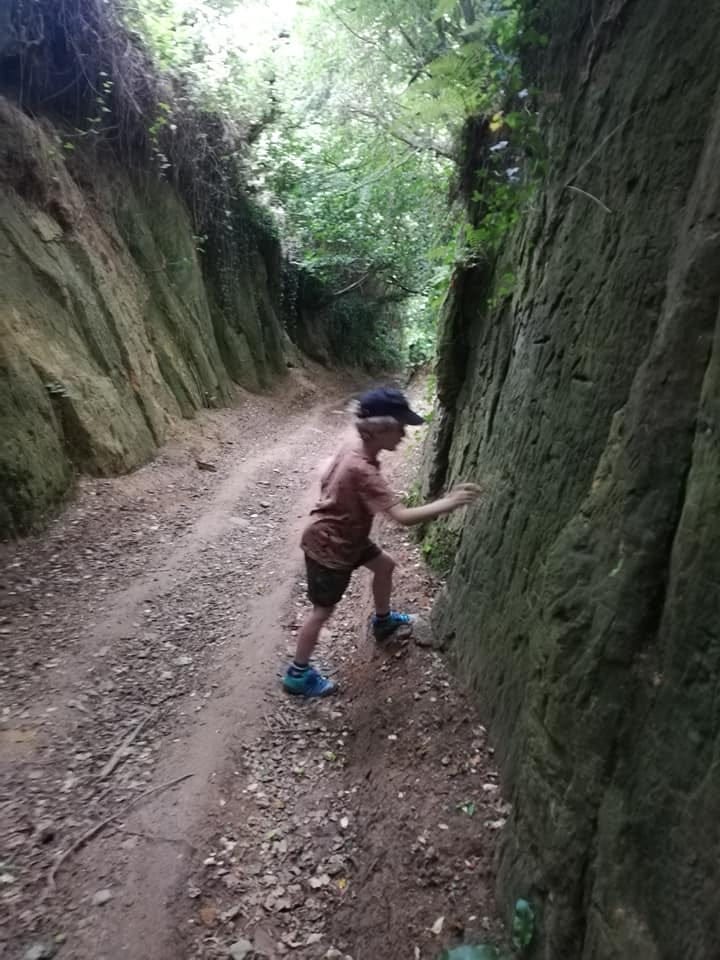
It was cool and dark in the Holloway – our impatient bare feet slipped effortlessly into the tracks laid down by our ancestors. Their faces were etched into the earth and the clay – their long-dead eyes followed our movements from the walls as we darted along the ancient track.

Our feet thundered upon theirs, our laughter mingled with echoes of their own as we sprang down the tunnel, splashing through cool streams, our toes curling into claggy mud. The walls of the Holloway sheltered us as we ran. This space was our fortress, our underground lair, our tunnel system, our playground. It was our link to the past.

Above us the trees linked hands; their vibrant green canopy a roof above our heads, bursts of late evening sunlight fragmented by trembling leaves. All around us, the stillness of time. We laughed and played as if time did not exist for us and down there, it didn’t. We wouldn’t grow old, we wouldn’t age or decay or die. Much like everything else that lived in the Holloway, we were eternal.

Photo is mine

But as dusk fell, we knew we were breaking a rule passed down by our parents and grandparents: don’t linger in the Holloway after sundown or you risk inviting one of the old back home with you.

To us, rules were made to be broken and returning home after sundown offered a delicious risk we could not resist. That evening, my siblings — twins, George and Arthur, Grace, the oldest and I, the youngest — stayed longer than we should.

Still, it was not quite dark by the time the old warnings infiltrated our consciences and prickled the hairs on the back of our necks. We scuttled out, hand in hand, giggling as our muddy feet raced back up the centuries old track, reaching for gnarled roots and boughs to lead us home and leaving the faces of our ancestors on the walls behind us.

Photo is mine

We tore across the sheep field — their eyes glittering back at us in the semi-darkness, and we returned home, leaving tell-tale muddy footprints across the kitchen tiles.

Grace washed away the evidence of our childish rebellion and come morning, we all thought our indiscretion had gone unnoticed by Mother.

Not so.

She was raging as she swept her old mop across the tiles where small brown footprints could be seen trailing in from the back door and stopping in the middle of the kitchen. We denied they were ours (ours had been a criss-cross pattern made by four sets of feet…) but it did no good. We were banned from the Holloway and given arduous chores to complete to make it up to her.

Later that day we heard her scream in rage once again; the noise drawing us out of our sulking to witness yet another trail of muddied prints on her floor. Who had defied her? It was my George who pointed out that the prints were far smaller than ours. He made me, the youngest, stand next to them to prove his point. My feet were small but not that small.

Mother’s face paled.

We watched as she sank into the nearest chair and stared dully at nothing. Then;

‘You stupid, stupid children. Why didn’t you listen to us? Why can’t you ever just listen?’

We swapped guilty glances, then released a collective gasp when a childish giggle echoed gleefully around us. We all froze. I reached for Grace and gripped her hand in mine. Tears shone in our mother’s eyes.

We all heard the sudden drumming — at first like a steady heartbeat, then louder, boom, boom, boom, until it faded out into something that was closer to a soft pattering.

Footsteps.

‘You’ll never get rid of it. We’ll have to move!’ Our mother wept again, dropping her head into her hands.

We were silent as we watched her get up and solemnly slosh the mop over the footprints. Still, we didn’t fully realise what we had done, even then. The dirty little footprints came back again and again. As fast as Mother washed them away, they would reappear. Sometimes they came in from the door and just stopped. Sometimes they made circles, as if the culprit was spinning around and around. Sometimes they ran up the walls and across the kitchen surfaces.

Next came the smell.

It started in the kitchen — a musty, earthy, swampy sort of smell. Mother was in despair. She claimed the house would never be clean again. She punished us with more chores and often we would hear her on the phone begging to be rehoused. We would fall into bed exhausted every night.

And that’s when the drumming would begin.

Footsteps at first, light and gleeful, teasing, dancing. Then they would build up. Harder, faster, angrier. Tearing up and down the stairs while we huddled in our beds, our breath frozen in our chests. Our eyes met in the darkness. We had done this. This was all our fault.

The dirty little feet stomped and thumped. Up and down the stairs, across the landing, into our rooms and around our beds while we quivered under the covers, clutching hands. Cold laughter echoed through the house as it kept us awake night after night.

Then one night, I woke up, muddled and sweating from a dream where the thing that followed us from the Holloway was smiling at me from the shadows. It had black holes for eyes and a wide sneering mouth and its skin was as white as bone.

I heard something new.

A frantic pounding. The panicked drumming of tiny angry heels. I ran to my window and there it was — I saw it for the first time. I saw its feet. Small, dirty, they beat as if in a great tantrum against my window pane from the outside. Had it somehow found itself shut out again? There was a great sadness emanating from it, a lonely desperation in its incessant thudding.

‘What do you want?’ I asked it, but the feet continued to kick. I pressed my hands to the glass. I wanted to see it properly. I wanted to see what had followed us home. I wanted to know why. It refused to show its face. Only two dirty little feet were visible and when I finally flung open the window, they were gone too.

In the morning, my mother looked disheveled as she started packing up our things. We had led a simple life there in the little stone cottage and it only took a few hours to pack up our lives and move out. Us children were bereft to be leaving the place we loved.

We trooped down to the Holloway to say our goodbyes but we did not go in. Instead, we held hands at the entrance, our heads lowered in sorrow. We stared at the ancient path, created by the constant tread of endless feet and rolling cartwheels, pushed into the earth deeper and deeper over centuries of old. Our own feet had pressed into it. Our own blood had flowed into the earth and the mud. Our laughter had echoed down the track and up into the giant trees and now we had to say goodbye.

The new home was nice. Small and neat, on the outskirts of the nearest town. Our walk to school was quicker, at least. We were happy there for a year until one morning we awoke to the sound of our mother screaming.

The screams were followed by wails, which soon dissolved into hopeless sobs.

When we ran down to comfort her, we all stopped just outside the kitchen, too afraid to step in.

The kitchen floor was covered in the gleeful dancing footprints of two dirty little feet.

Thank you for reading! I’ve wanted to write a story set in a Holloway since I visited the fascinating Hell Lane in Symondsbury, Dorset, UK. West Dorset is predominantly sandstone so has several Holloways. The name comes from the anglo-saxon word ‘sunken road’ and they are believed to be at least 300 years old with some traced back to the iron age. At one point they would have been trails to drive cattle along, popular highways if you like, to move people, goods and livestock from one place to another. They would have been ground level tracks back then but eventually centuries of human and animal feet and the wheels of carts would have eroded the soft earth and widened it, with help from the water running off the surrounding land. These days many Holloways are 20 or 30 feet deep. They are mysterious and magical places, eerily silent and still and you can’t help feel a real connection to the past as you follow the ancient paths so many centuries of feet have trodden.