Giving Myself Permission to Draw Reminds Me Of When I Gave Myself Permission To Write

Reclaiming my love of drawing

When I was a child I’d lose hours alone with a notebook, writing stories about lost and neglected animals and illustrating them myself. If you’d asked me back then I would have told you I longed to be an author and I’d also have told you how much I loved drawing. I did go on to study GCSE Art but that was where my attempts to draw came to an end. I stuck with writing for longer – though it fizzled out when I became a mother and I lost an entire decade where I did not write at all.

As a teenager, I used to sketch the characters in the stories I was working on, including The Boy With The Thorn In His Side, but post aged sixteen, I barely drew again. That’s as far as I allowed my skills to develop.

It’s sad when we grow up and lose our creativity and it happens all the time and to most people. Children are naturally creative in everything they do. They are curious about materials, they like to dance, move around, play make believe, sing, make noise, scribble and paint and make up stories. They don’t worry about being ‘good’ at it and they certainly don’t entertain the idea of making a ‘career’ out of it.

Yet as adults it is those two concerns that inevitably lead to us distancing ourselves from the creative pursuits we used to enjoy.

I remember going through a phase as a teenager where I would write little poems onto notepaper then illustrate the edges and paint over with water colours. I remember being thrilled with the results! Years later, when I finally got back into writing, I told myself it was just novel writing and that poetry was not my thing. Even when reclaiming writing, I was still putting up barriers to my creativity.

My journey with writing will never be over and I’m happy to say that as the years passed I naturally found myself progressing to embrace all forms of writing. Novels, short stories, flash fiction, essays, articles and yes, poetry! I love them all and practice them all every week.

What stopped me writing for a decade was not thinking I was good enough and not believing I could earn money from it. I’m so relieved that the urge continued to persist inside of me and that eventually it grew too big to ignore. I finally gave in and the dam burst in spectacular fashion. I recently published my twenty-third book, and earn monthly from writing in various forms on Medium. I’ve also had essays and articles published by various magazines over the years.

I have confidence in my writing now, but I still embrace progression and experimentation with it.

Back to drawing. Recently I started to get a very strong urge to draw. It reminded me very much of those urges to write I eventually gave into. It’s like a little bit of the old you poking relentlessly at your brain demanding to be let in, remembered and nurtured.

I started feeling like I wanted to create a graphic novel version of Black Hare Valley for crying out loud, that’s how strong the urge was. I gave in, to some extent. I didn’t plan to. But I was buying some supplies for my kids writing clubs in The Range and spotted some nice sketchbooks and before I knew it I had tucked one under my arm. It felt like giving myself a treat. Giving myself permission.

I’ve started playing around with ideas of sketches for Black Hare Valley. I’ve had fun with a few art tutorials and workbooks and had some helpful tips from my son who is studying A-Level Art. I’ve been pleased with my efforts but do you know what instantly occurred to me when I examined them?

one of the hares I’ve drawn for Black Hare Valley – just practicing!

They are the same level as the character drawings I did as a teenager. I haven’t gotten any better or matured my skills because I did not keep it up. Imagine how much better I would be at drawing now if I had not pushed that side of me away for so long!

Now every time I feel a bit embarrassed about my artistic efforts, and every time I feel like I am wasting my time or shouldn’t be doing it, I remind myself of how and why writing came back to me. It came back to me by itself. It hammered at my mind until I let it back in and once it had me in its grip again it refused to ever let go.
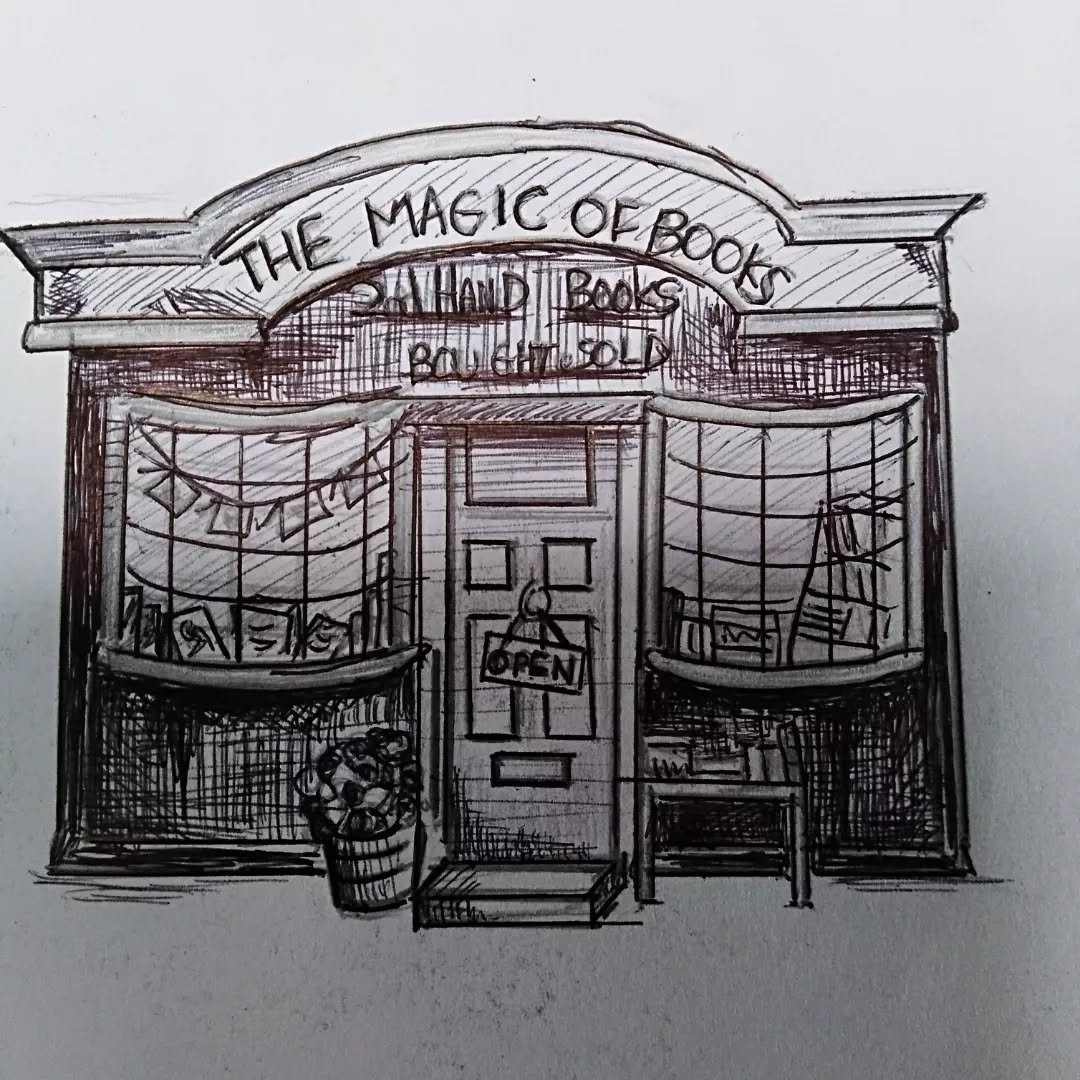
the bookshop in Black Hare Valley – a major location!

And because I stuck with it and practiced it, and tried new things, and studied it, and learnt from others, and got feedback, and kept going…. I got better!

I need to remind myself that the same thing applies to art.

the white hare – a character in Black Hare Valley – needs work!

My challenge is this: I want to illustrate the entire Black Hare Valley series myself. To do this I need to discover, embrace and improve my own style, much like writers do with their voice. I feel excited. I feel motivated. Whatever happens, it is good to have a challenge and a new hobby!

the ruins in Black Hare Valley – a major location
The raven in Black Hare Valley – another character – just pencil so far, will be going over with pen.

The May Queen, Hill Forts, Fairy Circles, Leylines, Holloways and the Moongazing Hare

Research for my latest novel has sent me down some divine British folklore rabbit holes.

(This article was originally published on Medium.)

I’m not normally a huge fan of research. Most of my novels have been set in times and locations that don’t require me to do a lot, and even then, if I do need to research something, I tend to leave a question mark there to remind me to do it later, while I get on with writing the thing.

However, my attitude towards novel research has changed for the better with my current work-in-progress, a folk horror story set in 1996, which will have companion books set in 1966 and 2026. On the very first draft (where I didn’t really know what I was doing), I ended up with the bare bones of a story, and possibilities for more in-depth plot-lines and character development. I didn’t do any research for the first draft, but I knew for the subsequent drafts I’d have to. And it’s been so much fun! I’ve had to look up a real range of interesting things, from which telescopes and cameras were popular in 1996, to 90s fashions and music (not too much of a problem, as I was a teenager in the 90s) to what sort of CCTV systems existed back then.

 This was just the start. As my folk horror story developed, I found myself going down some delightful British rabbit holes as I researched things I wanted to include in my story. It’s essentially a story about a strange little town with an ancient evil under the surface, and the plot is kicked off when a local boy goes missing.

These are some of the things I’ve had the pleasure of researching so far:

The Hare — I’ve always been fascinated by hares. I’m quite literally obsessed with them. For years and years I dreamed of seeing a wild one and in my youth had to be satisfied with keeping rabbits as pets, which was almost as good. In recent years I’ve seen hares in the wild and every single time it is a breathless magical experience for me. My son’s school is rural and on the journey there and back, down twisty country lanes, we often stop to watch hares running in the fields. Recently we spotted one lying low, and we stopped the car to watch. It knew we were watching and eventually got slowly up and loped away. I savoured every second of watching that huge, strong, almost deer-like body hop away. Another time we had to stop the car as another huge one was plodding casually up the lane in front of us. My son rolled his eyes at my over-enthusiastic reaction, ‘Oh my God, it’s a hare! It’s a hare! It’s a bloody hare right there!’ The hares in that area are giants, I swear. One time I thought it was a dog I’d spotted in a field but when I slowed down to check if it was all right or lost, I realised it was lupine in nature and had the pure joy of watching it dash away.

When I first created my current WIP, Black Hare Valley, it was just a vague idea about a folk horror story, an ancient evil, a plucky group of misfit teens and a strange little town I wanted to be old-fashioned in the most British of ways. Me and my son created it together, rolling out a huge piece of paper to create the map of the town. A few years later I started writing the story and always knew the town would be called Black Hare Valley.

Image by Artur Pawlak from Pixabay

But back to hares. There is so much folklore surrounding them, it only adds to their beauty and mystique. The moongazing hare has been symbol of growth, rebirth and fertility, as well as being associated with madness and witchcraft. In many cultures seeing a hare is meant to be good luck and in just as many, it is seen to be bad luck. There was an old superstition that witches could shape shift into hares, as often hares were seen running from flames. In truth, they often waited until the very last minute to break free from the traditional burning of stubble in fields. In many cultures the hare is considered a sacred animal who symbolises our relationship with the land.

Iron Age Hill Forts — Badbury Rings and Maiden Castle in Dorset are two favourites of mine but there are many of these ancient monuments across the British Isles. What were once defended settlements set into sweeping hills and reinforced with earthworks, stone ramparts, defensive walls and external ditches, are now intriguing and mysterious places to visit. I always feel strangely connected to both the past and the earth itself in these places. I was inspired by a trip to Badbury Rings to make Black Hare Valley a town built out of an iron age hill fort. Hill fort settlements could see their enemies from a great distance and this is a theme weaved into my story, especially concerning the history and founding of the town.

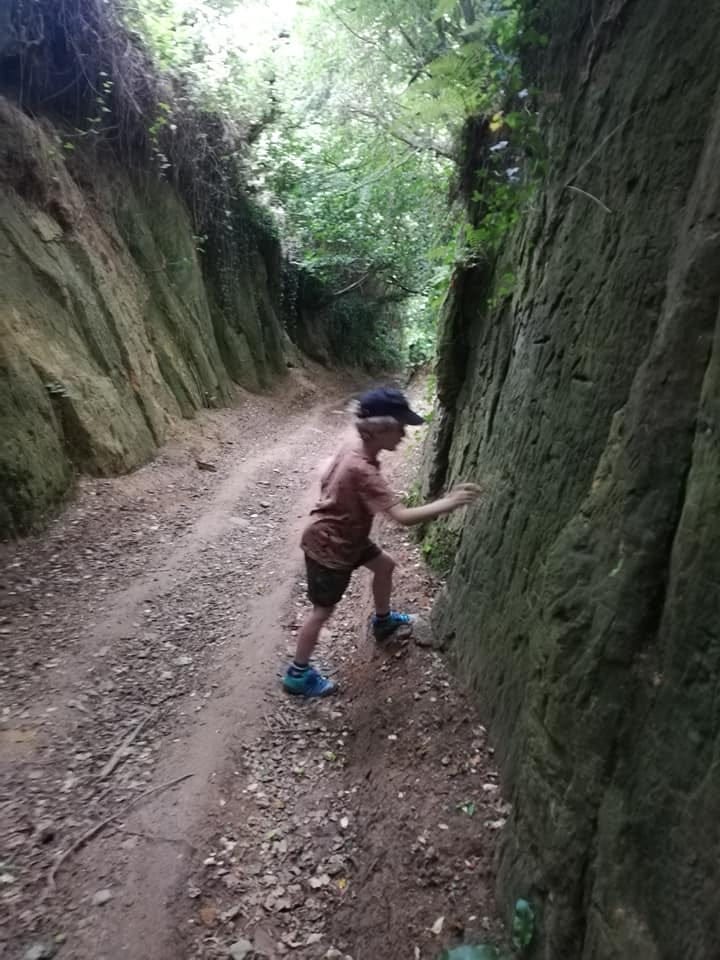
Holloways —Holloways are just as fascinating!I’d been keen to visit the infamous Hell Lane in Dorset for years and a couple of summers ago we took the kids there. I absolutely loved it and again I felt so close to the past and the earth there. Holloways are ancient paths criss-crossing the country, possibly markers of old trade routes. The paths themselves have become so deeply trodden by millions of feet, hooves and wagon wheels over centuries, that they are now almost tunnel-like, with the roots of trees visible on either side. At Hell Lane in particular you feel like you are about to descend underground as the trees shade you from above and the path leads you ever deeper. There are a fascinating array of carvings and faces on the clay walls too. I knew Black Hare Valley had to have its own Holloway!

Hell Lane, in Dorset. Photo is mine.

Fairy Circles — I only researched these recently when I decided that Black Hare Valley will be set in 1996 and that it definitely needs a prequel set in 1966, which will see my group of teens parents go through an equally strange and dangerous ordeal in the town. One of the 1966 kids is described as being ‘away with the fairies’ and I decided to play into this a bit more in the 1996 story, as this character as an adult has been missing for a long time. I simply added a fairy circle to a scene and had one character stomp through it while another declares it to be bad luck, and he retorts that his mother used to believe in such rubbish. Fairy circles are naturally occurring circles of mushrooms, often found in forests and grassy areas. Across the world, fairy circles or rings were often associated with folklore and myth and seen as dangerous places. It was said to evoke a curse or bad luck if you crossed one.

Ley lines — ley lines are also mentioned in Black Hare Valley, as I needed a central spot in one of my locations that would provide an intense amount of energy and a feeling of being held in place. I researched ley lines, which I only vaguely understood, and it turns out some people believe in them and some don’t. Essentially, they are believed to be straight lines between prominent landmarks, prehistoric sites and historic structures. Believers assert that ‘earth energies’ run along these lines but there is no scientific evidence to support this, and instead it is a matter of faith.

The May Queen — May Day, The May Queen and other spring celebrations and traditions will be more fully explored in my prequel set in 1966, but as I lay the clues for this in the 1996 book, I’ve had to research them now. One of my 1996 characters discovers that his troubled mother who ran away, had a sister who went missing in 1966, much in the same way a friend of his has gone missing in 1996. In scouring old photos from their parents, the group of friends discover that the missing girl was crowned the May Queen in the spring of 1966. I had great fun researching this and looking at old photos. The May Day celebrations marked the beginning of summer and small towns and villages across Britain, and indeed Europe, would celebrate by choosing a young girl to be the May Queen. She would be decked out in white with a crown of wild flowers and would be given a throne to sit upon. Villagers would also dance around a Maypole, weave floral baskets and ‘bring in the May’ by gathering wild flowers and branches. Going back even further, it is reported that wild hares were often part of the tradition and would be released from cages as part of the celebration. 

Researching books can be a lot of fun and Black Hare Valley is providing me with unique opportunities to google things and learn more. I have now started writing a rough draft of the book set in 1966 and have already had fun researching the clothes, music, and food popular at the time!