Space To Write

A couple of weeks ago I was trying to write while my family bustled around me, and I ended up jotting down the following words about how my writing works in a house as busy and noisy as this one ;

in the middle of chaos and noise and warmth and murmuring and wee wee on the potty and dogs barking to be let out and then in again, and kettle’s boiling as tea is made, as wine is poured, as pudding is grabbed, as music is played, as conversations rise and fall in the kitchen, and CD’s are changed, as days are yawned and trouble’s forgotten, as grievances are voiced, as ideas are expressed, as pictures are drawn and presented…

I wrote this on a typical Friday evening, when father-in-law is over for his dinner, and all the kids get to stay up late because it’s not a school night, and there is music on in the kitchen, and the TV is on in the lounge, and the little one is wandering to and fro and I am stupidly trying to write.

It made me smile and wonder how on earth I ever get anything done.

But things have changed! We just recently swapped everyone’s bedrooms around, which means the husband and I have gained a bigger room. My immediate thought was that I could set my writing table up in the bedroom and move the whole operation upstairs away from all the chaos. After all, I only really try to write in the evening once the littlest one is in bed. I dismissed the thought, thinking it selfish and worrying that I would feel too cut off from the family.

But my husband seemed to have other ideas, and during one of his days off last week, he went on a mad cleaning/sorting spree, which involved my writing table being moved up to our bedroom. Voila!

ptdc0153
ViviLnk

I now have what I need. Space to write. Silence. (Well not exactly, I can’t write in silence so YouTube will be on in the background and I can still hear the noise of the house, just reduced!) I’m still not sure if my husband was trying to be nice and supportive of my writing, or if he just got fed up of the mess my writing corner was creating in the lounge!

Anyway, it’s been a week now and I have to confess, I have been a hell of a lot more productive. I suppose I never realised how fragmented my time and thought processes were when in the middle of all that noise and movement. I would sometimes ask them to turn the TV down, or to be a bit quieter, but inevitably the TV would also distract me and put me off my writing anyway.

Now there are no excuses. Occasionally a child wanders in for a brief chat, and I don’t mind this, after all I don’t want them to feel abandoned! But on the whole I am left alone, which gives me roughly four hours of writing time, give or take, depending on when the little man is in bed.

It’s like when I was a kid! I used to hurry homefrom school to bury myself in my room, tapping away at my electronic word processor, creating worlds and inventing friends to share them with. I was always in my room, with the music on as I typed away. My mum used to worry about it, and say I should get out more and join in with the family but I was addicted, pure and simple. I had to write. And back then, I had the space and the time to write as much as I wished.

I think the only thing missing from my new writing space is a window view, but this can be easily arranged with a bit of a move around.

How about you? How do you write? On the go? At a desk? Do you need as much silence and peace as possible, or can you get surprising amounts of work done while surrounded with chaos? Feel free to comment below, and post pictures of your writing spaces!

How My Writing Habits Have Changed

I’ve never understood the type of people who refuse to change the way they do things. You know the type. Even if what they’re doing is not going so well, they’ll hang onto the adamant belief that it is the best way to do it, simply because it is the way they have always done it. It’s even worse when it comes to opinions and beliefs. I have strong beliefs and opinions, but I like to keep my mind open and accept that knowledge and understanding are open to interpretation and change. If some new piece of knowledge comes along, I am always happy to admit I was wrong and change my way of thinking. I think the refusal to ever change your mind or admit you were wrong, is actually very dangerous. Anyway, in that spirit, I’ve been thinking lately about how I write now, and how I used to write. You see, over the last few novels, things have changed. And with the WIP I am on right now, and the book I have planned after that, I feel they are changing even more. Here’s how, and why…

  • I edit as I go…Not word for word, not every paragraph, but I do now go back over what I wrote at the start of the session. And I always read what I wrote last before I start writing again. I used to do things quite differently. I would rush out this clunky, crazy first draft. It would be this desperate measure, this way of getting this thing out of my head once and for all. I’m not saying that’s wrong, and I think with some books it’s totally the right way to do it! But I have noticed lately that I’m slowing the process down. I’m going back over what I last wrote and editing out mistakes and typos. Previously I would not care about these in a first draft. I just wanted it done. Now I think I am probably saving myself some time later on, and it is also helping me get to know this story and its characters, to feel and breathe with them as they develop and take form. Reading over and checking what I just wrote is helping me to make sure everything stays on course.
  • I plan more…I used to plan as I wrote the book…so as ideas came to me, I would jot them down and the novel would often change course and follow twists and turns as I wrote it. I would start, not really knowing how to finish. Now, I try to plan the whole novel before I start writing, chapter by chapter if possible. Not in too much detail, and always allowing for change and development and the surprises which will inevitably pop up. But now I like to be able to see where I am going…I like to know the general destination of my journey.
  • I’m aware of my potential audience…This is not to say I am writing anything and aiming it at a certain audience. Doing this with The Tree Of Rebels caused me untold problems (see Did Choosing An Audience Ruin My Book?) so I won’t be making that mistake again. But I do have a better idea of the genre I am writing in before I start writing, an idea of the type of person who would pick this book up and want to read it. I never used to consider this at all, and had a very hard job picking genres and categories for my finished books because of it.
  • I write the log line and synopsis first…Now, to be honest I am only just getting to grip with loglines! They are actually quite hard to do. The idea is you should be able to write a one to two sentence paragraph which explains your book, and if you can’t, you may have a problem. The logline can then help you to shape your synopsis. With early novels, I always left the synopsis to last and found them nothing short of utter hell and torture. How to condense a massive novel down to a paragraph or two? What to cut out, what to leave in? How to lure people in without spoilers? How to pick the right key words? Hard, hard work. With the last two books I penned (The Tree Of Rebels and Elliot Pie’s Guide To Human Nature, both still not quite finished) I wrote the synopsis first. I’m not sure why. It just seemed like a good idea, and I had a general idea of what to say, so I went for it. Neither is perfect and both will need tinkering, but overall, I think they both say what they need to say. Lesson learned. From now on, I work on the synopsis first!
  • I research as I go…This is another thing I used to be quite lazy about. I was in a hurry. I just wanted to get the book written. So I would make up stuff as I went along, noting down that I needed to properly research it later.  Now if something comes up that needs looking into, I do it there and then before I write another word. Again, this saves me time and stress later, and if what I research ends up changing the story in some way, it’s much better to know this early on! Plus it’s fun. I used to put off research of any story because I thought it was boring. Just detail that needed throwing in to make it all sound better. But now I look at it differently. It’s important to the story and I’m also learning new things all the time!

So, over to you followers! Have you always done things the same or have your writing habits changed through trial and error? Does it all depend on the book you’re writing? Let me know!


Welcome To My Mind!! (Via my notebooks…)

I have a strange addiction to notebooks. I just can’t have enough of them. I have far too many floating around my writing space, but they all serve a purpose, and if any of them were to go missing, I think the wheels would fall off this operation. My notebooks are the physical version of what goes on in my mind. So, I thought I might share them with you. I would be really interested to know if anyone else writes and lives like this!

PTDC0087.JPG

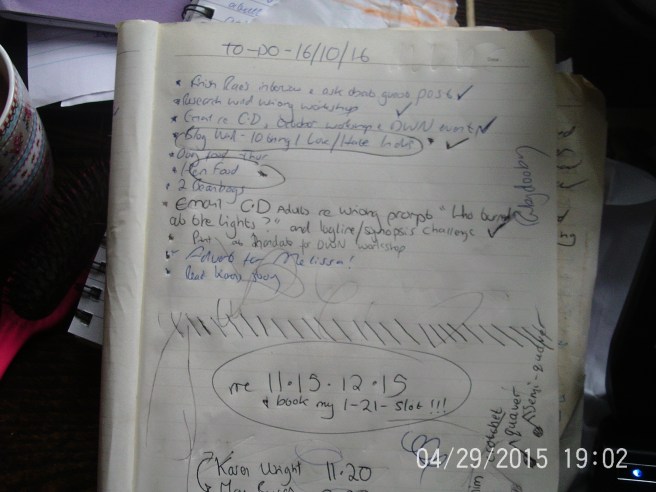
My To-Do List Notebook!

Introducing the backbone of notebooks. The one that holds everything else together! My to-do book. I always have one of these on the go and when it’s used up, I buy another A4 sized notebook to replace it. Every Sunday night I write my to-do list for the week ahead. It usually starts off pretty short and gets added to as the week goes by. It will include things like posting my author interview or guest post blogs, my usual Wednesday blog post, making sure my newsletter is drafted, finishing a short story or article, printing stuff out for workshops and so on. It also reminds me to order dog food on Thursdays, and pay for school trips online and so on! I don’t think I could function without a to-do list book. There is something so satisfying about ticking things off as the week goes on! I feel like I am keeping on top of things in all areas of my life, and I’m sure a lot of stuff just wouldn’t get done if I didn’t write them down!

PTDC0089.JPG

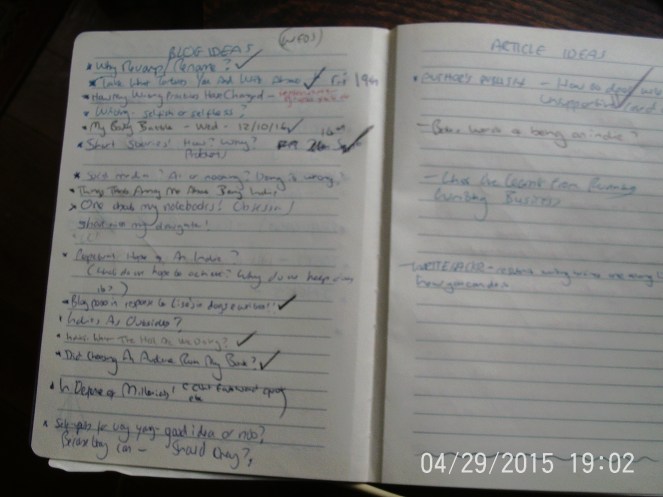
My Non-Fiction Notebook!

This A5 notebook keeps me on track with all things non-fiction in my life. I list possible blog post ideas in here and tick them off when I have written and published them. I also write down ideas for articles. I use this book to note down ideas, research, and plans for any workshops I might be running for Dorset Writers Network, or for my own venture Chasing Driftwood Writing Group Anything I read that inspires me, any plans I have for the future, I note down in here!

ptdc0088

Current Work-In-Progress Notebook!

All my books have a notebook. The notebook comes into action once the voices get too loud in my head. This notebook is for my current WIP A Song For Bill Robinson. As Elliot Pie is having another round with beta readers, and I am just not ready to revisit the tricky Tree Of Rebels yet, I am having a stab at a YA novel I first attempted when I was sixteen. There are two stories related to this in Bird People and Other Stories. The book is basically written, I am just having to make it better than it is! (Oh the cringe of reading your own teenage writing..!)

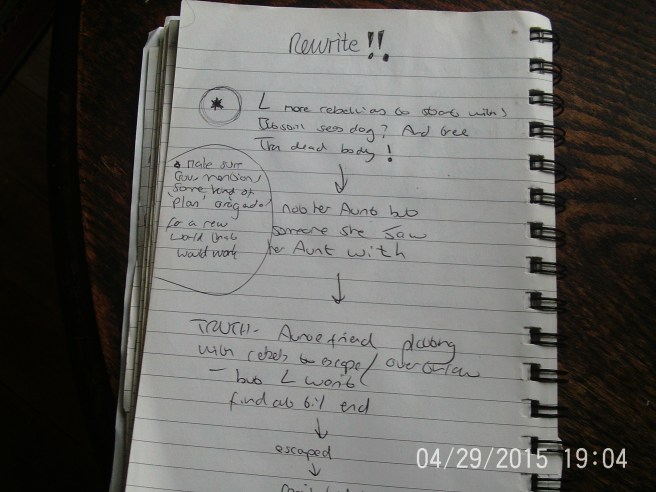
PTDC0094.JPGThe Tree Of Rebels Notebook!

Self-explanatory. This is the long and complex story of a novel still not finished, all wrapped up in one now very tatty A5 notebook! We will get there one day with this one!PTDC0096.JPG

Elliot Pie’s Notebook!

Here it is, Elliot Pie’s notebook. As with all my books, this notebook contains character bios, themes, ideas, plotting, and the many, many lists I make when rewriting, which I then go through and tick off. 

PTDC0092.JPG

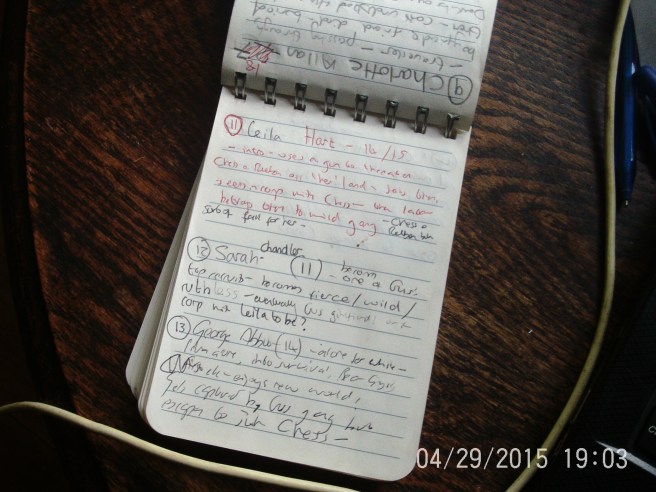
Plans For Unwritten Novel!

Recently a short story I wrote to include in the newsletter, morphed into something far, far bigger. Something quite epic. Something four books long epic. Something I would love to see on TV as a drama series for kids epic. So far I have written mini bios for lots of characters, several short stories which basically serve as sample chapters, and have loosely plotted the book, or books. It is definitely going to be a four book series, and I need to have Elliot Pie, Tree of Rebels and Song For Bill Robinson all done and dusted before I can bury myself in this little beauty for a very, very long time…

There are actually two more notebooks I couldn’t be bothered to photograph. One I take with me to my writing group and workshops so I can note down thoughts on people’s readings, or make plans, or tick people off etc. And the other is my very secret and special Christmas planning notebook! But obviously, I don’t want anyone to see that one!

So how about you? Are you a list person? Do you need to write things down in order to remember them? Maybe you use your phone, or a calendar? Am I the only one who makes use of copious amounts of notebooks at the same time?? Please comment! I love hearing from you!

Author Interview; Rae Stoltenkamp

Welcome to my latest indie author interview, this time with author Rae Stoltenkamp. I first came across Rae when we were both authors on the now defunct indie publishing platform Autharium. I read her excellent  crime thriller  Six Dead Men and will soon be diving into her new venture, the first in a young adult series, Where Rainbows Hide. In this interview Rae talks about her writing and publishing journey so far, tells us about her writing process and offers her advice to writers about to embark on the indie route!

Q1 Tell us about your writing and publishing journey so far;

In 2006 I made the firm decision to leave teaching and write on a more full time basis. When I told my dad of my decision he didn’t blink an eye and supported me without a moment’s hesitation. In 2012 my dad died and my rebellious streak asserted itself in a desire to do something to honour his passing. I had a completed novel (Six Dead Men) which I was editing whilst sending letters and emails to agents and publishers – getting the usual rejection mail as expected. His death prompted me to do SOMETHING more concrete with my novel. Unbelievably, an opportunity arose to publish in e-book format without any expenditure on my part at all (Autharium). At that time e-publishing was a much debated topic and people were convinced it would have no place in the world. I thought, “Well, what the heck – it’s not costing me a penny.” Tons of no risk no gain sayings crossed my mind: Nothing ventured nothing gained If you’re not willing to risk the unusual you’ll have to settle for ordinary For who that dare not undertake, by right he shall no profit take So I forged ahead. I didn’t have the slightest clue what I was doing but the e-book went into the world and I told my friends and family all about it. I made the sum total of £12 in royalties and could not have been prouder.

Q2 When did the writing bug first grip hold of you?
I first got the writing bug around age 12 but started with incredibly soppy poetry that always rhymed. From 13 onwards wrote angst ridden teenage poetry which is so embarrassing I probably shouldn’t even mention the existence of it. Then ventured into short stories around age 14 and started on my first novel called Panthra.
Q3 Tell is a bit about Six Dead Men. Where did the idea for the story come from?
It’s quite sad really. I’d been to a neighbour’s party and met a rather nice guy. We ended up snogging for quite some time. Afterwards he asked for my number and I was certain he’d call but then he didn’t. I just put it down to the way things go sometimes. But a few weeks later my neighbour called me in, sat me down, made me a cup of tea and was generally acting very anxious. He then told me that the lovely man had been killed in a tragic accident. It may have been the shock but I found myself thinking it was probably my kisses which cursed him. And so was born the premise for Six Dead Men.
Q4 How would you describe your genre and your style?
My preferred genre is Magic Realism. I’m intrigued by how much in life can seem totally inexplicable. This genre allows me to explore this and helps me to delve into characters’ minds to look at how they may think or behave or be affected by circumstances and influences. My style is influenced by writers like Toni Morrison and the poet Maya Angelou. I love how these writers use the rhythm, feel and sound of words to get a message across in a dramatic way. I also equally love the element of melodrama you get in work by Austen and the Brontes. My YA books are all Science Fiction as they have a strong eco message which lends itself to this genre. It was also one of my mother’s favourite genres so I have a great soft spot for it. I guess my YA books are mostly a tribute to her.
Q5 You write in adult and YA genres, can you explain to us how this works? Does the character come first, or it is usually the plot?
As I’ve already said, Six Dead Men was born out of a personal experience so the character was built around this. I thought long and hard about the names as I wanted them to be significant. With my WIP; the prequel to Six Dead Men, the character came first. In fact I woke one morning with her words in my mind. Her voice was strong and clear and I had to race to scribble them all down. My YA novels always seem to be story led but I’ve recently found that characters are beginning to demand I tell their story in greater detail. As this is a series of books on the same topic I don’t have to think about the plot so much – it is almost a foregone conclusion. So it seems natural that I can now focus more on characters and what they feel, think and ultimately do.
Q6 Can you tell us about your writing process? What is an average writing day like for you?
I teach at a local charity 3 days a week so only have 2 dedicated writing days a week. I also volunteer one evening a week and tutor in the evenings the rest of the week. So I usually get up around 6:30am. After a coffee I get stuck right in. I have to set the timer on my phone as I often forget to have breakfast. After breakfast I get straight back into it and work until about 2pm. The afternoons are reserved for meetings or any marketing which needs doing. If I have no meetings scheduled I write until about 3 or 4pm then call it quits for the day. I’m currently thinking of moving all my marketing activities to a Saturday as this will free up more writing time as I want to crack on with several projects.
Q7 What are you working on at the moment?
My current WIPs are: 1. The prequel to Six Dead Men 2. A series of short stories based around characters in Six Dead Men and its prequel 3. The sequel to Where Rainbows Hide 4. The sequel to The Lonely Dragon.
Q8 What would you say have been the best and the worst parts of being an indie author?
The best part is writing about things that matter to me and seeing them in print. There is no worst part as it allows me to do something which makes me feel incredibly fulfilled. Sometimes the precariousness of the financial side can cause sleepless nights but when I’m deep into a project and the words are flowing on the page, I get such a sense of rightness that the worry simply falls away.
Q9 What advice would you give to anyone about to embark on the indie publishing route?
Only go down this route if you have great support from friends or family or both. Trying to do it all alone is a very hard road. Be prepared to put the hours in. No-one will be standing over you to make it happen – you’ll have to do that all on your own. Join a body like the Alliance of Independent Authors as they have a wealth of information which is invaluable. And finally – know your product and your audience then market accordingly.
Q10 What are your hopes and dreams for the future with regards to your writing? What would you like to achieve?
My hope is that within 5 years I will be able to earn a living from my writing and give up tutoring in the evenings so I can spend more time with friends and family. I would then wish to publish any writing for children for free.
Q11 Who are your favourite authors and why?
My favourite authors make up a very long list so I’ll just do my top 10: Jane Austen, The Brontes, George Eliot, Toni Morrison, Louis de Bernieres, John Steinbeck, Terry Pratchett, Joanne Harris, Neil Gaiman and Jacqueline Wilson The Brontes, Austen and Eliot because of the element of melodrama they bring to a cracking good story. de Bernieres because he opens up unexpected worlds in my mind. Pratchett and Gaiman because they tackle serious topics but also make me laugh out loud. Morrison, Harris and Steinbeck for their beautiful use of language. Finally, Wilson as she tackles issues so very relevant to children in this day and age and does it with great sensitivity.
Q12 Tell us three interesting facts about yourself
Not sure these are particularly interesting but here goes: 1. I absolutely loath white trainers – don’t know why, just do 2. I don’t like being given cut flowers as a present as they only serve to remind me that they are already dead and only good for the compost heap now. 3. I love watching garden make-over programmes even though I am the worst gardener on the planet and never even go into my own.
Thanks so much Rae!

Rae Stoltenkamp was born in South Africa and came to England in 1987 to visit family. She liked the weather so much she stayed. After a writing holiday in Greece she had an epiphany and realised she should be writing on a more full time basis. It was probably heat stroke since she hadn’t had sun in a while. She then studied writing at City Lit with the poet Caroline Natzler and is now a writer, blogger and former English teacher living in South London.

Currently Rae also works with www.inkhead.co.uk , teaching creative writing courses to children. This has inspired her to work on a children’s book called The Lonely Dragon. She is writing and editing several projects simultaneously, including a series of YA Science Fiction novels and the sequel to The Lonely Dragon.

Rae has a passion for Argentine Tango and when she is not chained to her desk and laptop, can often be seen tripping the light fantastic with her tango friends. She has also recently discovered the delights of Lindy Hop and is laughing her way through this style of dance.

https://www.facebook.com/raestoltenkamp.author

http://raestoltenkamp.blogspot.co.uk/

https://twitter.com/Raedenewrites