Character Interview; Flora from ‘Letters To Eloise’

Welcome to another character interview! Today I’m chatting to the lovely Flora, from Letter To Eloise by Emily Williams.

Enjoy!

1) Do you have any negative character traits, and if so what would you say they are?

I have many! I’m an over-thinker and this makes me a daydreamer and over emotional. You’ll read this in Letters to Eloise and understand! I get irritable and short-tempered when I know I’m in the wrong and I struggle to find the words sometimes to apologise. I turn to food (not a bad thing!) when I need comfort, especially biscuits and cheeses!

2) What are your most positive traits?

Hopefully, others will think that I’m a kind and loyal friend. I am fun loving and up for trying most things, which is a useful trait when starting university as there is many social activities and events to participate in. I am hardworking and dedicated to my studies and always down the library, but for those who have read Letters to Eloise, you’ll know that sometimes studying wasn’t on the agenda when I was there! Tut tut!

3) What are your current ambitions or dreams?

I’m hoping to finish university and take up a teaching place after my maternity leave. My ambitions have been slightly put on hold, but fear not, I will get back there and complete my childhood ambition of teaching children. I do dream that one day I’ll make amends with River, but we’ll see…

4) What are you scared of?

Absolutely everything, but mainly of missing opportunities. You’ll see in Letters to Eloise why I was scared of the future and being pregnant and alone at University. I wasn’t afraid of the pregnancy and of little Eloise, the rest of the future terrified me!

5) Who is your best friend and why?

I’d have to say Brooke (otherwise she’d kill me!) but it’s a close toss up between Brian and Brooke. Brooke is loyal and there for me one hundred percent but her ways of going about things sometimes leave me stifled. Brian struggles with communicating his feelings, except in a jokey way, but he is a true friend and is always there for me.

6) What do you think true love feels like?

Like jumping between big puffy clouds. Light and effortless.

7) Do you have any secrets?

That would be telling! I’m not good at keeping secrets unless they are really important to me.

8) Do you have any regrets?

I regret the way things have been left between myself and River. I wish more than anything I’d worked harder to make it work. I’m not sure, even if I had of, whether it would have made much of a difference but I regret not trying.

9) Where would you like to be 5 years from now?

Settled, happy and with a healthy and beautiful daughter. Anything else fades into insignificance.

10) How would you like to be remembered?

For my strength and for never giving in


The Many Wonderful Worlds of a 3 year-old

I realised today that you don’t live in the same world as the rest of us. And why should you?

Yours are so much better.

It does me good to let go of my own adulthood, of the chains of washing up and preparing meals and sweeping up dust and driving from here to there and back again. It does me good to give in to you completely.

Sometimes I view being with you as a chore. Sometimes I think, how much easier it would be to get things done alone, without a little voice chattering at my side. But that’s the adult me. That’s the tired Mum me. That’s the 39-year-old woman who wonders when she will ever stop feeling tired. That’s the woman who has been up since half five this morning and craves the odd snatched five minutes of coffee drinking and Facebook scrolling in the kitchen, out of sight…

But I need to shrug her off. I need to push her away and free myself from those weighted thoughts of shopping, and finances, and to-do lists and never enough time in the world. I need to be in the moment, in the here and the now, existing purely with you. I need to be more like you and enter your magnificent worlds more often.

Days like today remind me. Days when I give in purely and completely to you. Days when I become as you are and see the world as you do. Because you don’t just live in this world because this world, do you? You live in so many others, and there is no strain or drudgery in any of yours. One moment you are a ‘little puppy’. The next you are a burger flipping character named ‘Cooker.’ We never know who or what you will be next. My mind is fascinated by yours. What goes on in there? You are so tiny yet stuffed tight with so many stories!

Today you wanted to use bricks to make car-parks for your cars. You say ‘please, you be this one. Please, you build more par-parks.’ And I’m thinking, with a sigh, but we’ve got to take the dogs out, because we’ve already been to toddler group and had lunch, and it’s not fair to make them wait any longer. You don’t want to go, but I tempt you with a biscuit and in seconds you have your coat and shoes on and we are off.

When we get there, you want to choose the ways. You want to go the ways I don’t want to go. I slip into the usual habits. Grumbling, muttering under my breath, pulling at the dogs, snapping at them to behave, and you just want to climb on the big boulders and jump in the puddles. You want to show me a tree and ask why it has a knobbly bit on it, and it’s there and then that I swallow the exasperation and the impatience and just give in. I feel the fight and the stress seep right out of me.

Because I realise that it doesn’t matter. It doesn’t matter if you choose ways that I wouldn’t or if you want to climb on rocks and through brambles. It doesn’t matter if the walk takes longer than I intended. None of it matters!

So I let you take charge. And you show me your world.

‘Don’t step on the black bits! They suck you under!’

‘This is my house. This is my fire.’

‘This is my hitting stick.’

‘This is my party.’

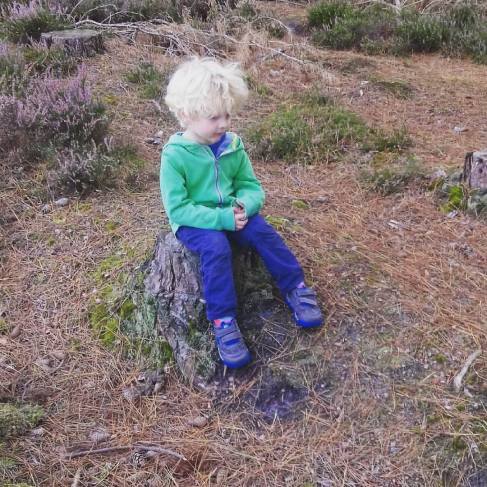
At this point, my heart melts entirely. Since you could string the words together, you have referred to a cluster of tree stumps as a ‘party.’ I have no idea where this comes from, but the sight of tree stumps makes you think of parties. So you show me your party, and jump from the tree stumps, then you say we have to go because everything is on fire.
21552023_1641955992490326_5856412386341430487_o

We run to the next one, further up the hill. A few weeks ago this place was a haze of purple, the heather in full bloom. Now everything is turning orange and brown. Leaves are falling and the earth is dark and wet. One of the dogs runs off and you yell;

‘That’s my dog! Where my dog going?’

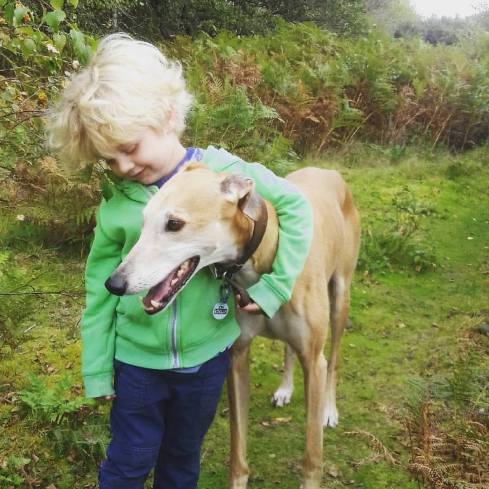
So we chase after her and find another party. You make another fire. You show me your bed on the lime green moss of the forest floor. You are totally and utterly inside this world. You slip between worlds so effortlessly, so naturally. You tell me to watch out for the tripping up steps (tree roots) and we abandon the party to march further up the hill.
21586946_1641951839157408_5282486645849501800_o.jpg

I let you choose the way, and we go left, out across the flat of the hill, walking along narrow flattened paths between burnt orange heather and ferns.

‘Don’t walk on that path! Walk on this one!’

‘That one a river!’

‘That boat with tiny people on it.’

‘That tree is my house.’

‘Here you have to do a dance like this…’

‘Here, you have to do a funny walk like this.’

‘I’m the Doctor. I’m Doctor Dad. You’re Amy.’

And just like that, you create another world and invite me inside with you. You’ve got the Tardis key around your neck and your sonic screwdriver in your hand. You stomp your tiny way through ferns taller than you are. You crouch down to bypass needle sharp gorse and tell me we have to find the Tardis because the aliens are coming.

We circle around and down the hill. You pretend to die by going all stiff and then tell me you are another Doctor.

Which one? A girl or a boy?

‘A boy Doctor.’

Are you old or young?

‘I’m an old man Doctor. But if I get hurt, I be another Doctor.’

We walk on, and you never stop talking, never stop imagining. There is no such thing to you as just a tree, or just a fir-cone, or just a stick. Everything has infinite possibilities. Everything becomes a story.

We walk home, we make it back to the Tardis and your key lets us in, and then you see your bricks and cars, and instantly you are back in that game. A small part of me longs a coffee in the kitchen, checking my phone, taking a breather. But I shove that small part away briskly and firmly.

You want me. You ask for me. You require me in your games and in your many, wonderful worlds. I am honoured to be asked, and needed. For I know you won’t always want me there. And when the places you take me are so magical, they make me forget I am a grown up, they make me forget about unpaid bills and unanswered emails, how, why would I ever say no?

It’s Ok To Ask For Help

I’ve never been very good at asking for help, and I blame my parents for this. With the best of intentions, they brought us kids up to be polite, and not ask for things. It was one of the most repeated mantras of my childhood. ‘Don’t ask for anything! Wait until you are offered!’ I can see why they drummed this into us. They didn’t want their children to be brattish or demanding. They thought children who marched into someone’s house and asked for an ice lolly were rude. I can clearly remember playing in the garden at my Nan and Grandad’s house on various hot summer days. We knew the ice creams were kept in the chest freezer in the cellar. We knew our doting Nan would give us one if we asked, but we didn’t dare. We kept egging each other on, urging one of us to go and ask for an ice cream. I expect we worked up the nerve eventually, but it definitely took some time!

Not asking for things in sweet shops and toy shops was the norm. My mum would have given us ‘the look’ if we had ever dared. She always said it was much nicer to give a child something they had not been expecting. But the trouble is, not asking for treats becomes translated by a child into not asking for anything, including help. Take me in the classroom, all the way through my education, too scared to put my hand up for any reason, including going to the toilet!

I’ve had a problem with asking for help my entire life. I hate asking anyone for anything. If I have any kind of problem, I will do everything I can to try to solve it on my own, before I give in and reach out for a helping hand. It really is quite ridiculous. I can’t help assuming that asking for help annoys the person you are asking, puts them out, or means they will begrudge you.

This has also made things harder as an indie writer. Indie writers cannot do it all alone. They just can’t. But in the beginning, this was how I approached things. I struggled with so many aspects of indie publishing, from formatting, to cover design, to marketing, to gaining reviews, and I was absolutely rubbish at asking for help! I truly didn’t want to bother people.

Fast forward four years and six books later and I am beginning to change my mindset. For my sixth book, The Tree Of Rebels, I actually had a book launch.  I wasn’t quite brave enough to do a real life one, so I opted for a Facebook one and thoroughly enjoyed it. I was amazed by the response and the positive results of sales, reviews and follows. I’ve also started asking for help more by sending out ARC’s for the first time ever. I would never have done this before, but now I am trying to live with the mantra; ‘if you don’t ask, you don’t get!’ Out of the 45 people I asked, 31 responded positively, and I have received 18 reviews on Amazon UK and 6 on Amazon US. This has without a doubt given this sixth book a far bigger kick into orbit than the others have, and I will learn from this and do an even bigger and better book launch next time!

friendship-2390279_640.jpg

Learning to ask for help is not easy when it has been indoctrinated into us to be polite. Last week was a really hectic one for me work-wise. I had all the normal bits to do and a rather big dog walking/sitting job as well. I love my day-job as a dog walker and sitter, but I’ve only gone back to it fairly recently as it was too tricky to combine with my youngest when he was first born. Last week I was so busy walking back and forth, that my blog post didn’t get written or posted and I only managed to scrape in an hour or two of editing Elliot Pie each day. There was one day in particular when I had a lot of walking to do, washing to hang out, a parcel to post that had been sitting there for weeks, washing up to do and God knows what else. Instead of trying to do everything myself and then getting grumpy, I reached out to the kids and got them to help. Two took the parcel to the post office and one hung out the washing, and wow, what a difference it made just having those two jobs crossed off the list! I felt I could breathe again and calm down and it made me realise how rubbish I am at asking for help at home too.

I do what my mum used to do. I do everything myself get worn out, feel unappreciated and then moan about it! I must stop doing this! I have four children and the oldest three are more than capable of helping out. If it involves the animals, they jump at the chance anyway, so why the hell am I trying to do it all by myself? Again, I think the reluctance to delegate chores goes back to being told not to ask for things as a child.

I don’t want my children to grow up unable to ask for help, so I am trying to set them a good example now. I’ve told them all about the amazing response I had when asking for help to launch the latest book. I want them to see that asking for help doesn’t make you weak, or needy, or annoying. Yes, you should strive to be independent and proactive, but when you genuinely need help from others, you should not feel ashamed to ask for it. And it makes such a huge difference!

Have you ever found it hard to ask for help? How did you overcome this? I would love to hear from you! Please feel free to comment and share.

10 Ways Writing A Book Is Like Raising A Child


This blog post is brought to you from the mind of a writer who has a three-year-old son who won’t go to sleep by himself. As frustrating as it is, his delightful refusal to fall asleep on his own, is entirely my fault. As my fourth and last baby, I have held onto him even tighter. This time, I ignored the advice I had struggled with in the past, I shunned the social norms and expectations and embraced what felt natural. So, he was breastfed to sleep until he was two and three months, and since then, I have cuddled up in bed with him and held him until he falls asleep. So of course, he has absolutely no clue how to drop off on his own. We tried working on it last week and it was horrible. There was crying and shouting and stomping about and general confusion for both of us. Inevitably, I gave in to him and to my heart and got back into bed with him. As I lay there, holding his half snoring, half sobbing body tightly to mine, I suddenly realised that a year from now he will be about to start school. I held him even tighter and as I gazed into his face I could have wept with the useless, torment of knowing this will all one day be over. And then I started thinking about writing books, preparing them and letting them go. I released my latest book The Tree Of Rebelson the 11th August after two years of work. The more I thought about it, the more I realised that writing books and raising kids have quite a few things in common…

  1. They occupy your mind constantly and completely. I sometimes say my mind is like a sieve these days. Utter mush. But in truth, it is just full of children and writing and there is not a lot of room for much else. If I am not thinking of,  worrying about or planning things for my children, then I am consumed with thoughts and fears and ideas of the fictional kind.
  2. You don’t want to let them go. Well, sometimes you do. When they drive you mad, when you’re at a complete loss as to what they need or want. When you’re tired, close to exhaustion, just want to escape, or have completely forgotten why you started this in the first place! But most of the time, letting go is hard. Almost impossible. I just spent two years making sure one book was good enough to meet the world. And as for the kids, I’m never going to be ready for that.
  3. You are always preparing to let go. Though you don’t want to, you know you have to. As a parent, bringing up your child to be a decent human being, is preparation for letting them go. From the moment you first hold them in your arms, you are making decisions that will affect how they turn out. You encourage them to walk and talk and run and climb. You send them to pre-school and teach them how to hold a knife and fork. You do all of these things because you know that one day they will be standing on their own two feet. It’s the same with writing a book. When you first start it feels impossible that it will ever be developed enough to share with anyone. It’s a mountain to climb. Followed by another one. But every draft, every edit, every rewrite, every proofread are all part of letting it go bit by bit.
  4. You know you must work hard for the end result to have a positive impact on the world. You don’t want to raise an arsehole. You don’t want to inflict a spoiled brat on the world. You don’t want to create a selfish, mean or ignorant human. There are already enough of those! Raising decent kids is a lot of hard work. You have to say no a lot, and you have to explain why you are saying no. You have to distract them from the thing you are saying no about. You have to be inventive, creative, spontaneous, organised and heroic. Writing a book is similar. You might not aim to change the world, but surely you don’t want to make the world a worse place?
  5. Inspiration works both ways. My children and our lives together inspire my writing. I write for them and because of them. Our journey takes me outside of myself and later allows me to fully wallow inside of myself. They have made me a better person and I want to be that better person for them. Being a writer also inspires me as a parent and a human. Because I love writing, I am interested in humanity and in the stories that make up a society. I hope this makes me more empathetic as a person, as I try, time after time, to get into the heads of other people.
  6. The work is never really over. You get to the top of the mountain, only to discover another one! The work is never over if you are a writer. There will always be another idea, another plot, another story to be told. The same applies to parenthood. They might fly the nest one day, but you are never going to stop worrying about them.
  7. But once it’s mostly done, you will have more time for the next project. When I go cold at the thought of my littlest one starting school, I remind myself how much more time I will have for other things, once he does. I can remember when my third child started school, I spent months dreading it and welling up at even the thought of it, and then, that summer, I started writing again. I had not written in years. But suddenly it was back and I needed it more than ever. I was suddenly excited. I had something just for me. I had a part of me back again! And the same thing applies to writing a book. You feel so many mixed emotions when you finally publish it, but what allows you to let go is the call of the next project, the next characters and so on. It keeps you excited.
  8. They will always be your baby. Kids grow up fast. They often move away from you before you are ready. Pulling their hand out of yours when they spot their friends. Saying they are too old for bedtime stories. It happens bit by bit. You watch them grow. You prepare to say goodbye. But even when they eventually leave home, just like the books you wrote, they will still be your babies. Forever. Nothing can change that.
  9. They came from inside of you. And I don’t just mean physically, although this is obviously true of both your children and your writing! I mean they were created and developed and matured with your thoughts, feelings, emotions and imagination. What is inside of you as a human, what makes you you, has had an influence on these offspring of yours.
  10. Creating them means you will live forever. Well, sort of. I like to think of it like this anyway. Passing your genes onto your children, as well as some of your experiences, stories, opinions, beliefs, means parts of you live on after you have died. The same could be said of writing books. Your words and therefore, parts of you and who you were, will continue to exist long after you do.

people-2572105_640