Dirty Little Feet: What Followed Us Back From The Holloway (a short story)

This short story was recently posted on Medium where it sadly didn’t get a lot of reads. I thought it was a better story than a similar one I posted called Into The Green. That one got boosted and has earned me nearly £30, but I prefer this one. See what you think!

Dirty Little Feet

It was cool and dark in the Holloway – our impatient bare feet slipped effortlessly into the tracks laid down by our ancestors. Their faces were etched into the earth and the clay – their long-dead eyes followed our movements from the walls as we darted along the ancient track.

Our feet thundered upon theirs, our laughter mingled with echoes of their own as we sprang down the tunnel, splashing through cool streams, our toes curling into claggy mud. The walls of the Holloway sheltered us as we ran. This space was our fortress, our underground lair, our tunnel system, our playground. It was our link to the past.

Above us the trees linked hands; their vibrant green canopy a roof above our heads, bursts of late evening sunlight fragmented by trembling leaves. All around us, the stillness of time. We laughed and played as if time did not exist for us and down there, it didn’t. We wouldn’t grow old, we wouldn’t age or decay or die. Much like everything else that lived in the Holloway, we were eternal.

Photo is mine

But as dusk fell, we knew we were breaking a rule passed down by our parents and grandparents: don’t linger in the Holloway after sundown or you risk inviting one of the old back home with you.

To us, rules were made to be broken and returning home after sundown offered a delicious risk we could not resist. That evening, my siblings — twins, George and Arthur, Grace, the oldest and I, the youngest — stayed longer than we should.

Still, it was not quite dark by the time the old warnings infiltrated our consciences and prickled the hairs on the back of our necks. We scuttled out, hand in hand, giggling as our muddy feet raced back up the centuries old track, reaching for gnarled roots and boughs to lead us home and leaving the faces of our ancestors on the walls behind us.
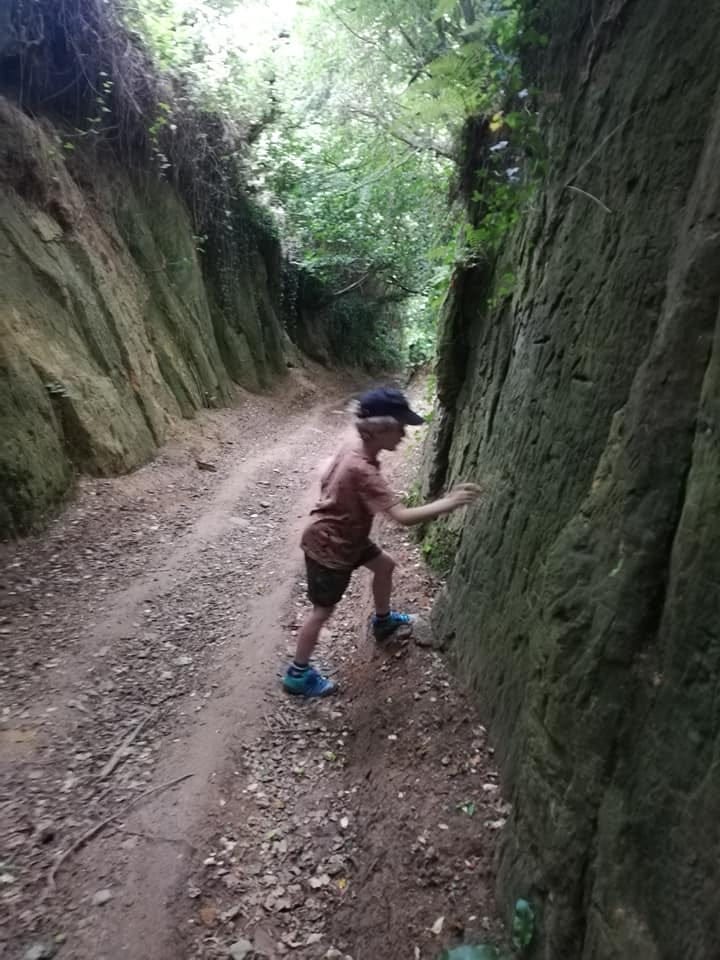
Photo is mine

We tore across the sheep field — their eyes glittering back at us in the semi-darkness, and we returned home, leaving tell-tale muddy footprints across the kitchen tiles.

Grace washed away the evidence of our childish rebellion and come morning, we all thought our indiscretion had gone unnoticed by Mother.

Not so.

She was raging as she swept her old mop across the tiles where small brown footprints could be seen trailing in from the back door and stopping in the middle of the kitchen. We denied they were ours (ours had been a criss-cross pattern made by four sets of feet…) but it did no good. We were banned from the Holloway and given arduous chores to complete to make it up to her.

Later that day we heard her scream in rage once again; the noise drawing us out of our sulking to witness yet another trail of muddied prints on her floor. Who had defied her? It was my George who pointed out that the prints were far smaller than ours. He made me, the youngest, stand next to them to prove his point. My feet were small but not that small.

Mother’s face paled.

We watched as she sank into the nearest chair and stared dully at nothing. Then;

‘You stupid, stupid children. Why didn’t you listen to us? Why can’t you ever just listen?’

We swapped guilty glances, then released a collective gasp when a childish giggle echoed gleefully around us. We all froze. I reached for Grace and gripped her hand in mine. Tears shone in our mother’s eyes.

We all heard the sudden drumming — at first like a steady heartbeat, then louder, boom, boom, boom, until it faded out into something that was closer to a soft pattering.

Footsteps.

‘You’ll never get rid of it. We’ll have to move!’ Our mother wept again, dropping her head into her hands.

We were silent as we watched her get up and solemnly slosh the mop over the footprints. Still, we didn’t fully realise what we had done, even then. The dirty little footprints came back again and again. As fast as Mother washed them away, they would reappear. Sometimes they came in from the door and just stopped. Sometimes they made circles, as if the culprit was spinning around and around. Sometimes they ran up the walls and across the kitchen surfaces.

Next came the smell.

It started in the kitchen — a musty, earthy, swampy sort of smell. Mother was in despair. She claimed the house would never be clean again. She punished us with more chores and often we would hear her on the phone begging to be rehoused. We would fall into bed exhausted every night.

And that’s when the drumming would begin.

Footsteps at first, light and gleeful, teasing, dancing. Then they would build up. Harder, faster, angrier. Tearing up and down the stairs while we huddled in our beds, our breath frozen in our chests. Our eyes met in the darkness. We had done this. This was all our fault.

The dirty little feet stomped and thumped. Up and down the stairs, across the landing, into our rooms and around our beds while we quivered under the covers, clutching hands. Cold laughter echoed through the house as it kept us awake night after night.

Then one night, I woke up, muddled and sweating from a dream where the thing that followed us from the Holloway was smiling at me from the shadows. It had black holes for eyes and a wide sneering mouth and its skin was as white as bone.

I heard something new.

A frantic pounding. The panicked drumming of tiny angry heels. I ran to my window and there it was — I saw it for the first time. I saw its feet. Small, dirty, they beat as if in a great tantrum against my window pane from the outside. Had it somehow found itself shut out again? There was a great sadness emanating from it, a lonely desperation in its incessant thudding.

‘What do you want?’ I asked it, but the feet continued to kick. I pressed my hands to the glass. I wanted to see it properly. I wanted to see what had followed us home. I wanted to know why. It refused to show its face. Only two dirty little feet were visible and when I finally flung open the window, they were gone too.

In the morning, my mother looked disheveled as she started packing up our things. We had led a simple life there in the little stone cottage and it only took a few hours to pack up our lives and move out. Us children were bereft to be leaving the place we loved.

We trooped down to the Holloway to say our goodbyes but we did not go in. Instead, we held hands at the entrance, our heads lowered in sorrow. We stared at the ancient path, created by the constant tread of endless feet and rolling cartwheels, pushed into the earth deeper and deeper over centuries of old. Our own feet had pressed into it. Our own blood had flowed into the earth and the mud. Our laughter had echoed down the track and up into the giant trees and now we had to say goodbye.

The new home was nice. Small and neat, on the outskirts of the nearest town. Our walk to school was quicker, at least. We were happy there for a year until one morning we awoke to the sound of our mother screaming.

The screams were followed by wails, which soon dissolved into hopeless sobs.

When we ran down to comfort her, we all stopped just outside the kitchen, too afraid to step in.

The kitchen floor was covered in the gleeful dancing footprints of two dirty little feet.

Thank you for reading! I’ve wanted to write a story set in a Holloway since I visited the fascinating Hell Lane in Symondsbury, Dorset, UK. West Dorset is predominantly sandstone so has several Holloways. The name comes from the anglo-saxon word ‘sunken road’ and they are believed to be at least 300 years old with some traced back to the iron age. At one point they would have been trails to drive cattle along, popular highways if you like, to move people, goods and livestock from one place to another. They would have been ground level tracks back then but eventually centuries of human and animal feet and the wheels of carts would have eroded the soft earth and widened it, with help from the water running off the surrounding land. These days many Holloways are 20 or 30 feet deep. They are mysterious and magical places, eerily silent and still and you can’t help feel a real connection to the past as you follow the ancient paths so many centuries of feet have trodden.

My Entire To-Write List Is In Action!

Image by Fathromi Ramdlon from Pixabay

In January 2022 I wrote a blog about how I handle having such a long to-write list. Part of coping with so many book ideas is allocating a notebook for each one, so that I can jot down title, blurb ideas, plots, character bios and so on. At that point I was putting the final touches to The Day The Earth Turned series, and the Fortune’s Well trilogy co-written with Sim Sansford. The trilogy is now out and the first book in The Day The Earth Turned series is also out! The other books in the series are also finished and waiting for their release dates.

In the meantime, I’ve been doing my usual crazy thing of writing/editing/jotting ideas and thinking about multiple writing projects at the same time! No change there then, but I don’t worry about it anymore. It’s just the way my mind works.

However, I did suddenly realise the other day that my entire to-write list is now in action. Every book is in some state of progress and even better than that – I have not had any new ideas!!!!

Awesome!

I feel like I can now relax and enjoy getting these books finished and released. They will certainly keep me busy over the next few years!

To keep you updated, here is a list of my to-write list and the stage each one is currently at (I’ve listed them in the order I expect to release them in):

At Night We Played In The Road – the spin-off book from The Boy With The Thorn In His Side series. Works as a standalone but does give spoilers for part 5 of The Boy series… It’s written, it’s had six drafts, its been to beta readers and I’ve responded to feedback. It’s currently with my editor and I’ve already worked on a few structural edits she suggested. I plan to release around May 2024.

The Mess Of Us – long awaited sequel to my debut novel The Mess Of Me. It’s had five drafts and I’m just about to start draft six before sending it to beta readers! Hope to release summer 2024.

The Dark Finds You – the unexpected crossover book that ends the stories in The Boy With The Thorn In His Side universe – brings characters from The Mess Of Me/Us, the Holds End trilogy and Elliot Pie’s Guide To Human Nature together in one storyline with Danny from The Boy series… It’s had five drafts and I absolutely love it. Probably the easiest most addictive book I’ve ever written. I hope to release end of autumn 2024.

Black Hare Valley – written in long-hand in five notebooks, wrote ‘The End’ about a year ago and haven’t touched it since, but I will be diving into the second draft of this once the books above are completely finished and ready for release.

Diary of the Undead – started in a notebook a few years ago then put aside, I recently picked it up again and decided to type up what I had. This led to a few more chapters but I then put it aside to concentrate on everything else!

We hate The Cool Kids – still awaiting a second draft and it’s been about five years now, but I’ll get to it when I can.

The 7th Child – in progress because I have the whole plot nailed down, plus the characters are evolving on a daily basis and I’m adding bits of plot etc too. I’ve also written the first chapter.

The Few – a series to cowrite with Sim Sansford – we recently kicked this off with the first few chapters done!

And that’s it. All the books waiting in notebooks and all the books in my head all in some state of action. I’m really pleased about this but do you know what I’m most pleased about??

Not having any new ideas!!!

Addicted To Writing Or A Maladaptive Daydreamer?

My name is Chantelle and I am addicted to writing.

Or at least it feels that way… like a drug, a high, like something I crave for and cannot live without…

It’s always like this but its worse when a new story has truly captured me. Last week I blogged about the reasons people stop writing, and I mentioned that as a child and teenager, I wrote constantly and endlessly, before having a 10-year gap where I barely wrote at all. The way I am now is exactly the way I was as a kid and I recently discovered that it may even be a clinical condition. Maladaptive daydreaming is where people daydream so intensely that they subconsciously leave this world for one of their own creation. Within these made-up worlds, they create characters and storylines that they replay and tweak in their heads for their entire life. One person in this article https://www.theguardian.com/science/2022/aug/28/i-just-go-into-my-head-and-enjoy-it-the-people-who-cant-stop-daydreaming described it as like putting Netflix on and I relate to that in a big way.

Image by Pheladi Shai from Pixabay

As a child, I was nicknamed cloth-ears by my parents because it appeared I was never listening. I was the daydreamer, the one never paying attention, the one in her own little world. At some point, around the age of eight, I realised I could write these daydreams or stories down and that’s what I’ve been doing ever since. I am at the mercy of the characters who live in my head and the drama that surrounds them. I identified so strongly with the people in the interview that the only difference between us was that I write my daydreams down and publish them as books! I kind of think these people are missing a trick if they don’t do the same!

I’ve blogged before about The Boy With The Thorn In His Side series, and how the characters grew in my head at the age of twelve. I’d lie in my bed at night and move them around, like watching a film that I was in control of. I still do this now, every night. As that series will soon have a spin-off and a crossover book, I think it’s safe to say that my daydreams truly have control of me. I’m not sure whether I am addicted to writing, or whether I am an intense maladaptive daydreamer, but just in case you are curious, this is what it feels like:

  1. I can’t stop thinking about my story from morning until night. I wake up with an urge to write and a head load of possible scenes and conversations and then I go to bed and lie awake, dreaming up more. Every night I fall asleep with my characters in my head.
  2. I can switch between worlds with ease. One moment I will be fully submerged in my created universe, hearing their voices, seeing their movements, picking up on every facial expression or nuanced gesture, and the next I’ll be back in reality, teaching a class, paying for shopping, filling the car up with petrol. My mind seems to know when to switch back without too much disorientation.
  3. Having said that, I do sometimes find it hard to concentrate on other things and this is especially tricky when I am writing a new story that is going well. Some stories take time and patience and lots of rewriting, whereas some of them just write themselves. Those are the best but they do make it harder to switch between worlds. At the moment, my WIP is completely taking me over to the point of obsession, and I find it is all I can think about. I find myself drifting off into noticeably thicker daydreams when it’s like this…
  4. I get a nervous feeling in tummy, because I am scared I’ll not do it justice. The story plays out like a film or a TV show in my head and it looks perfect. Perfect locations, settings, characters and dialogue. Fight scenes look flawless yet realistic, dialogue is spot-on, facial expressions are just right and if I could just encapsulate it as it is in my head, it would be perfect. Yet the tricky bit is writing it and trying to make it how it is in my head so that the reader can see what I see. I am never sure I am up to the job and this can make me feel quite anxious at times.
  5. It feels like having a movie on pause when I’m not writing. When I’m not writing, I feel quite torn away from it, quite lost. It’s like I’ve been forced to put a good book down when I am dying to find out what happens next,. It feels like leaving a movie on pause. They are all just frozen until I can think about it or write it again.
  6. I can’t wait to get back to it. The frustration I feel when I cannot think about my stories, or write them, is quite awful at times. I don’t really want to live in this world, but I have to. Because of this, I am constantly longing to get back to my world, constantly pining for it and missing it when I’m not there.

Whether I am addicted to writing or just an intense daydreamer who writes them down, I wouldn’t have it any other way. Writing has saved me time and time again and without it I know I would struggle. What about you? Were you nicknamed a daydreamer as a child? Do you still daydream? Do you write them down? Feel free to comment and share!

August Writing Challenge: Face In The Crowd

At the end of July I asked my Facebook page followers to give me some more random writing prompts to respond to and I had a great selection to choose from. I ended up blending two together for this weird little story. Author Paula Harmon suggested a story set within a crowd and author Sim Sansford posted a creepy picture of a faceless woman with faceless masks hanging on the wall behind her. I also played around with second person POV which was great fun! Please note, this is only a second draft and I will definitely be rewriting this story at some point, maybe even making it a bit longer.

Image by Keith Johnston from Pixabay

Face In The Crowd

You won’t see her coming.

Except maybe out of the corner of your eye…

And by then it will be too late anyway.

She seems to know who she wants; you see. She is a predator, stalking you, and you are the prey. Nothing more, nothing less.

Let me take you back to the last crowd you found yourself in. Heart already pounding faster than it should, prickles of cold sweat erupting on the back of your neck, while something tight and spiky curls into a hard ball inside your guts. You’ve felt it before. Bad things happen in crowded places. A human is never so alone as when lost in a crowd. You remember them all. Different types of crowds, none of them safe.

School assembly, remember that? Trapped on a hard varnished floor with your knees tucked up under your nose so that you don’t touch the people on either side of you. Not your friends. Never your friends. To the left, to the right, in front of you and close behind, surrounded, fenced in, unable to breathe. Always too hot. No way out. Panic beating its small wings inside your chest as your outward face insists that nothing is wrong here.

Supermarket queues… Not as hemmed in, but still, the heads bob too close before you and one glance over your shoulder reveals a horrifying snake of people behind you. You swallow fear and bite back the urge to run, because how weird would that be? Suddenly barging through, shoulders crashing into backs, pushing, shoving, running, running. You’d never be able to go back if you did that.

Christmas crowds: the hopeless horror of a shop wedged tight with angry, entitled bodies. You give up and go home and shop online. You don’t like crowds. Never have. Festival crowds. You gave those a go. Outside, fresh air, music thumping through your veins, alcohol and friendship spurring you on. You thought, I can do this! But then you made the mistake of looking behind you, seeing the impossible volume of human life, jumping, shoving, screaming, living, too fast, too hard, too close. You stumbled when they pushed and the pushing didn’t stop. You tried to pick yourself back up, breathless with fear, but they kept coming, trampling, not seeing you, because you had ceased to exist.

Remember, that was the first time you saw her?

Weaving her way through the herd with feline eyes, swivelling to take in every view; hunting someone down. She was tall, you remember that. Towering above the revellers yet hunched over to disguise it. Her neck swanlike, or snakelike. A small mouth, or no mouth. She pushed through them, not touching anyone, moving like oil, her pupils gliding eerily from side to side, until she reached out with a long hand, longer fingers, nails curled over and mottled grey. You saw her touch someone but you didn’t see what happened next because the crowd surged and you almost died.

That’s why I don’t like crowds, you tell anyone that will listen, I am not antisocial, just emotionally scarred from nearly dying. Broken ribs are nothing to laugh about you remind yourself when that chilly fear settles across your shoulders, telling you to turn around and go home.

Today the crowd bustle before you. They have taken over the entire square. It’s market day; you should have known. You shake your head at your own stupidity and lack of foresight. But you did the best you could – remember that – moving to a quiet seaside town, dead in the winter, smells faintly of salt and vinegar – humming with tourists in the summer but that’s when you stay home or go out on your boat. No risk of a crowd out on the water.

Today, market day, the crowd moves like a messy unified thing, a squirming mass of warm bodies and haircuts, small lives, red faces, sweat stains. You hate it. But you need to go to the post office, right on the other side. You sigh heavily, dramatically, your annoyance with these people’s existence out of proportion to their right to exist just like you. You’d fire a rocket launcher at them if you could. You still remember being trod into the mud. You shudder.

But you move. You have to. You can do this. They’re just people.

You step forward and before you are even ready, before you have taken the obligatory deep breath and shaken out your limbs, pulled your bag closer across your chest, the crowd sweep you up and take you.

This is what you resent.

This makes you wish you had a grenade in your coat pocket.

The inescapable claustrophobic nature of the crowd. Of people.

Just people, you tell yourself, but you know that’s not true. They’re not just people, not just this or that. Never underestimate them. Never expect the best. Instead, always prepare for the worst. For sickening body odour and hairstyles freeze dried into place, for sharp elbows and fat shoulders. For feet that trample your own. For bags that whack you out of your space. For bodies, thick and long and selfish and demanding, all moving, and moving you whether you want to be moved or not.

You grit your teeth put your head down and push through.

And then you see her.

Like you did when you were down in the mud.

Tall, hunched, otherworldly in her movements, she glides along, coming for something, someone. Lank pale hair hangs over her shoulders. She has her back to you, every bump in her elongated spine visible through the thin colourless dress she wears. Her arms are at her sides, the elbows jagged, the forearms raised and at the end of the wrists her long thin hands hang, fingers dripping, nails curled.

Your breath catches in your throat and you freeze, unable to breathe or move. Your scalp seems to contract and tighten under your hair and your entire body floods with ice cold fear. It feels like the world has stopped but it is just you, frozen while the crowd moves and circles around you. Unbelievably, they seem oblivious to the strange, hunched form who hunts among them. She doesn’t touch them as she glides between warm bodies and not one of them looks at her or senses her dark presence.

You want to scream out, do something. You open your mouth but nothing emerges except a cold puff of air. You stare in agony as the colours of ordinary life swirl around her and then slowly, you see her reaching out. For she has chosen someone, a woman. A small petite woman with bright red hair wearing a spotty blue and white raincoat.

The hunched woman reaches for her, claw like hand sinking into unwilling flesh and there is a small, awful moment when the woman with the red hair stops and turns and stares in haunting clarity up at the collector. But it is fleeting, a microsecond of agonizing helpless horror and then it is over.

The red-haired woman walks away unscathed, slouching through the crowd with her bag on her shoulder, none the worse. Until she passes you and you see that she no longer has a face.

But no, maybe you imagined it. You are seeing things. Panicking. It’s all this stupid claustrophobic fear that you have no control over. You find yourself moving, pushing through, determined to make it to the post office, determined to brush this off, brush it away.

But as you move through the crowd, you see her again. She is still hunting. Still collecting faces. She towers over the people, glassy eyes swivelling in hollow sockets until another catches her eye. Not you, not you, no, thank God. She does not look at you because if she did you know you would be helpless, unable to run.

This time she makes her way over to a young man chatting on his mobile phone. He is powering through the crowd in a hooded jacket and black jeans. He is smiling, laughing as he focuses only on his conversation. He is easy prey, too distracted to feel her sliding towards him. He freezes when she touches him and you see the same dull dawning horror explode behind his eyes before it’s over. His face is gone and he moves on, still talking.

You make it to the post office and shove your way, sweating, through the doors. You can’t get out of that crowd quick enough. You cower at the window, behind shelves of envelopes and pens. You peer out, determined to hide until the whole thing has dispersed. You won’t go out there again, not with that many people, not with her out there stealing faces.

‘Are you all right?’ a worried voice asks from your shoulder.

You glance at the little man who wears a tight expression on his weathered face. ‘Yes,’ you swallow hard and reply shakily. ‘I’m sorry but I’m not good with crowds. Do you mind if I wait in here for a bit until I feel a little better?’

He nods and smiles in sympathy and leaves you alone.

You peer back out at the ever moving, swirling, humming crowd of life. The shoulders and heads, the hats and coats, the faces and the faceless.

I will be needing more writing prompts for my September challenge so feel free to post any here!