Dealing with Self-Doubt

Writers are often plagued with crippling self-doubt and I am no exception. It’s always there, lurking, waiting for opportune moments to show up and throw me into a panic. I’m preparing a book for release, and I always find self-doubt shows up in a big way around about now, so it is something I am currently dealing with. But there are lots of other times I’ve experienced self-doubt about my writing, so I thought I would list them here as well as my tips for dealing with it.

  1. Childhood. When I was a child, I didn’t know what self-doubt was. Sure, I was shy and introverted, but I also had the child’s innocent optimism and I was utterly convinced that one day I would be a world famous author. Of course, life happens to children. Reality is dictated to them. You can’t do that, you can’t be that, you won’t make money, not many writers are successful, and so on. The worst thing you can do to a child is squash their creativity. If you were that child, be kind to yourself now. Remember that people probably had good intentions. Perhaps their ideals and aims in life differed greatly from yours. And if you know a child who wants to be a writer, for God’s sake don’t crush their dreams. Let them make mistakes. Don’t pick on their grammar, their spelling or their lack of plot. Just let them write! It can all too easily be discouraged in children these days.
  2. Adolescence. Writing helped me get through my teenage years. Without a doubt, it was my greatest friend and comfort. From the diaries I wrote daily, to the lyrics I scrawled onto my bedroom wall, I wrote endlessly. I was in a constant dream and my head was full of wonderful words. Self-doubt had found me though, and I now accepted I needed a realistic Plan B. I would have to decide on a day job to pay the bills. My advice to anyone at this stage would be this; keep writing. Keep dreaming. Don’t worry about structure or plot, or how many drafts it will take, or how similar your work is to your favourite films or books, or how pointless it seems putting down words that are unlikely to be read by anyone else. Perhaps right now they are only meant for you. Don’t let anyone tell you it’s not useful, worthwhile or beautiful. Keep going. In private, in your bedroom, in your head, in snatched moments. It will all take you somewhere one day.
  3. Writing Group. Self-doubt may lead you to attend a writers group and they can be a wonderful help. Just remember not to compare yourself to anyone else. No doubt you will all be of different ages, backgrounds and cultures. There will be people there with more and less experience than you. There will be people there with a better grasp of grammar. There will be people there who can write the most beautiful prose. Don’t be intimidated. You are not them. Only you can do what you do. Use writing groups as sound boards and listen to any advice that is helpful but don’t let exposure to other writers encourage self-doubt. You are there to get better and to move forward.
  4. Twenties. Real life. Graduation. Jobs, Careers. Marriage and babies. All these things get in the way when you are becoming an adult, leaving less and less time and energy for writing. This is the period of life when so many leave writing behind, viewing it as a childish, foolish habit they must move on from. After all, very few writers earn a living from it, and there are bills to pay and rent to find and debts to cover and there will just never be enough time to sit down and write like you used to. And then every now and then someone you used to know will ask if you still do the writing. And saying no, not anymore, will break your heart. So write anyway. Even if it’s just a diary. Or a blog. Or scribbles and rants into a notebook. Even if it’s five minutes or ten minutes a day. Even if you don’t think it will ever go anywhere. Get back in the habit. NOW.
  5. First draft, We all get there eventually. The first draft. Self-doubt will plague you more than ever before. Are you wasting your precious time? Is everyone laughing at you? Is everyone expecting you to fail? Can you even write? Is anyone ever going to care? Something keeps you going, but self-doubt is clawing at you every step of the way telling you to go back, to quit, to stop before you waste any more energy. Don’t listen. Keep going. The first draft is just the beginning of a long journey, but if you can get it done, if you can get over that hurdle, then all the rest will come. You’ll have fostered the stamina and grit needed to pursue this idea until the finish.
  6. Feedback. Getting feedback is hard. You need it, but you dread it. You sort of hope everyone is going to gush over your work and say it is the best thing they’ve ever heard. But being realistic, what you really need right now is the cold hard truth. You need to be able to take it. If your characters suck, if your dialogue is stiff, if your middle drags or your ending is unsatisfying, you need someone to tell you. Then you need to take the time to think about it, digest the information and decide what you agree with. Don’t let self-doubt hijack you now. Writers never stop getting better. That is part of the fun.
  7. Submissions. Submitting your work is a brave step. Maybe it’s competitions, or magazines, or articles. Maybe it’s your novel to agents or publishers. You’ve done all the hard work and now you are handing it over to the ‘experts’. If you are lucky you might get some feedback. It might sting, it might be encouraging. Or you may get the long cold silence. Whatever happens, self-doubt will creep in to remind you that you are a crap writer and nothing you write will ever be published by anyone. Just keep writing and remind yourself that the more you write, the better you get. That rejection is part of the process for ALL writers and that all you can do is learn from it, and refuse to let it make you quit.
  8. The Final Draft. Nearing the end of a project is exciting and thrilling. Seeing the end in sight after a bumpy road of stops and starts and endless highs and lows, can be a huge reward for a writer. You have finished the book. You have rewritten and edited and proofread and copyread the book and you have probably done all of this so many times you have lost count. In your head, at last, the book is ready. It’s done. It’s the best it can possibly be so it’s time to let it go. But hang on…suddenly the doubts are back in full force. A dark paranoia that you were wrong all along, that no matter what you do to it, no matter how many more times you rewrite or go over it, it still hasn’t worked. It’s not the book you had in your head. It’s failed. You’ve failed. I don’t know why this happens when the final draft is done, but it always seems to happen to me. One moment I will be basking in the relief and the joy of a completed, polished manuscript, ready to move onto the next project, and the next I will be doubting every single word I have written. I will want to change my mind entirely, consider scrapping the entire book even. The only way I get through this is by reminding myself that I felt exactly the same about the previous books. And would I change anything about them now they are out there? No. When it’s time to let go, I think you get a gut feeling, followed by a flood of doubt and fear. Try to accept this as natural and ease it gently to one side.

Feelings of self-doubt are part and parcel of being a writer. They follow you about, peering over your shoulder and niggling at you. They will never go away, and that is perfectly normal. If we were full to the brim with endless confidence, I suspect we might start turning out some pretty poor writing. Self-doubt forces you to aim for perfection, to question yourself and your work again and again, until one day you know you have done all that you can.

Diversity In Books

About a year ago I noticed something about my books. I realised that all of my characters were white and straight, with the exception of the head teacher in The Boy With The Thorn In His Side. Or at least they were white in my head; obviously readers may have imagined them differently. I have to admit I felt a bit ashamed by this. It was never intentional of course, not to write about more diverse characters, it’s just that I’ve always lived in a very white area, where everyone I grew up with was white and so on. As for writing characters that were gay, this had also never occurred to me, I guess, because I’m not gay.

After realising this, I decided to change the ethnicity of my main character Elliot in Elliot Pie’s Guide To Human nature. It wasn’t a huge change. I just mentioned that his absent father was Indonesian, making him mixed race, with dark skin and hair, unlike his mother who has blonde hair and fair skin. Not much is made of this in the book. It did, however, tie in nicely with the hatred his mother Laura feels for the people who live in her claustrophobic neighbourhood, such as Tony, who likes to knock on people’s doors to warn them there are immigrants living behind them.

At the time, I spoke to a lot of other people about the topic of diversity in books. My daughters thought I was right to change Elliot’s ethnicity, and were quite appalled that all my characters so far had been white and straight. Other people said to change his ethnicity seemed a bit like a token gesture, and if he was white in my head I should leave him like that. I’ve since thought about the decision in other ways too. For instance, does a white writer have any right to write about a character who has a different cultural background to them? I would argue that they do, as long as they have done their research if research is needed. In this case, it was not. Racism is not an issue for Elliot, only his mother, who cannot stand the Little England mentality of people like Tony. His mother is in a state of despair about the state of the world, and for example, cannot understand the callous attitude people are having towards the refugee crisis.

I decided to leave Elliot as mixed race and think about it again later. If he persisted as blonde-haired and blue-eyed in my head, then I would change him back. But for me now, after about a million drafts, he is darker skinned than his mother, with very dark hair. He’s become this Elliot in my head, so I’m pretty sure that’s the way he’s going to stay.

While Elliot Pie was with beta readers, I took a break from it and wrote a rough draft of a YA novel about an alcoholic teenage singer. I’ve blogged about this story idea in the post  Untold Stories , as the original story was one I penned aged 16 and then discovered in an old suitcase under my bed. In the original story, again, everyone was white, straight and working class. In this new version, as I was writing it, the characters changed. One of the secondary characters became gay, and the main character, Bill became bisexual. Well, I say bisexual, but this is not entirely confirmed by the end of the novel, and he certainly doesn’t waste any time feeling confused or upset about what he is or isn’t. He just has a lot of fun kissing his best friends, one of whom is female and one of whom is male.

Now, again, why did I do this? I think there are several reasons. I think because diversity in books has been on my mind. It’s been on my mind because I too have noticed how many of the books I read contain, straight white characters and this has started to annoy me. It’s been on my mind because of my children, who are, to my great pride, growing up to be the sort of people who are accepting of anyone of any culture, ethnicity or sexual preference. In many ways, my children educate me on the issues facing the LGBT community. Plus, I feel that with recent political events, and the horrific rise of hate crimes against ethnic minorities and LGBT  people, we all have a responsibility to stand up for equality and decency and kindness.

With all this on my mind in recent months, it’s no wonder it crept into this rough first draft. It was not intentional, but rather an organic and natural progression. It felt right for the characters and added to their storylines hugely.  Have I got it right? Who knows at this point? I will see how it all reads once I get around to the second draft.

And as for Elliot Pie’s ethnicity, this still feels like the right thing for the book. So, what do you think? As readers, do you feel the books you read have enough diverse characters? Is diversity in books important to you? Do you ever feel certain groups in society or ignored,

So, what do you think? As readers, do you feel the books you read have enough diverse characters? Is diversity in books important to you? Do you ever feel certain groups in society are ignored, sidelined or stereotyped in literature? What about you writers? Do you write about diverse characters, and if you do, is it intentional or natural? Do you tend to write about characters who are similar to yourself? Or do you feel writers have a responsibility to open people’s minds up to other lives, cultures and backgrounds? I would love to know your thoughts, so please feel free to join in the conversation!

Dear Untamed Human Of Mine

Look at you, so utterly absorbed in all you do, so completely within the moment, not thinking backwards or forwards. Sadly, you do now understand the concept of ‘in a minute’ ‘not now’, ‘just wait.’ It’s weird how it once seem unfathomable that you would be able to articulate speech or instigate questions, but now, approaching your third birthday, you are brimming over with why? And how? Every time you open your mouth we are shocked by the new things that spill out. You make us laugh out loud daily with the things you come out with. It only seems moments ago that you were lying wordlessly in my arms.

It’s funny to me how you know your own mind already. You have a preference for how things should be done and tell me ‘not like that, Mummy.’ And it’s always over the smallest of things, like me trying to put your shoes on, or give you a kiss. It’s like you have to have the last word, the ultimate control over everything. You’re stubborn too. There are days when you argue with me over everything. If it’s raining and I say it’s raining, you will adamantly insist that it is absolutely not raining.

Your funny walks and your funny talks, though in the wrong moment, you will hate for us to laugh at you, in the right ones, you play the clown and laugh your husky laugh along with us. Your funny faces, your spontaneity, your wildness, you have no real clue how to fit in anywhere or how to behave, but we are teaching you, and sometimes I regret this.

When I tell you to hurry up, when I insist the shoes do go on the right feet, when I take your out of your car seat on the ‘wrong’ side, when I make you sit on your chair at dinner time, when I say no to your impulsive demands for biscuits or juice, I am taming you. I am teaching you how to behave.

We are all doing it. We are all complicit in your taming, restraining you from running wild, telling you not to jump in the puddles too much or your socks will get wet, telling you have to hold hands, telling you to hurry up, come on, we have things to do…

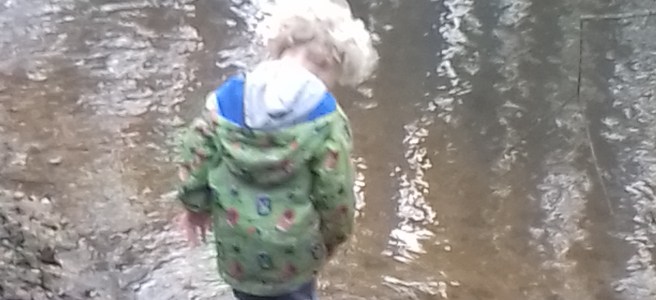
Sometimes I watch you. Sometimes I can’t stop staring at you when you’re in a puddle and set on staying there as long as possible because there is nothing more important to you in the world, and I am tired, I need coffee, and all the bribes of hot chocolate or CBeebies have not worked, because you just want to stay in that puddle. I stare at you, at how lost and absorbed and interested you are, swirling your stick around in the water, stamping your feet, walking up and down, repeating the same actions again and again, and it hurts my heart to imagine you in a shirt and tie and blazer, forced to sit still at school.

I can’t imagine you not like this. Wellies and mud, picking up sticks and stones, not listening to a word I say, with your crazy hair and your mucky face, because you hate for me to wipe it, and how you want to climb on absolutely everything, and how it drives me crazy sometimes when I am in a hurry, and want to get on, and don’t want you to hurt yourself and absolutely know that you will. Sometimes I hate myself for telling you to be careful, for warning you of pain you have no concept of. It’s even worse when I scold you because I simply want to get home, because I’ve had enough, because I’m bored, or tired, or grumpy, because I just want one moment to myself…

I wish there was always time in this life for climbing and balancing and puddles and crouching down to intently inspect your world, for wandering off, for taking the other path, for doing something unplanned and not in the schedule, for sitting down and refusing to move, for refusing to wear your hood up in the rain, for everything you love, for everything that holds your interest. My last child, my wild child, I long for you to be forever untamed, forever entranced by trees and tigers and muck and hose pipes.

I look at you sometimes,  and I think of all the things you need to learn to be. Patient, quiet, still, orderly. I think that we are preparing you for pre-school, which will prepare you for school, which will prepare you for employment, and I want to say no, no, no no! We’re teaching you how to behave. We’re teaching you how to fit in. We’re taming you and I’m sorry.

Interview with Author Harriet Springbett

Last week I read and reviewed a beautiful and unique YA book, called Tree Magic. I came across this book in a Facebook group I am lucky enough to be part of, and the front cover and title immediately caught my eye. It sounded just my sort of thing. (If you follow me on Instagram you might have an idea of how obsessed with trees I am!) You can read my review of Tree Magic here. Author Harriet Springbett kindly agreed to an interview, which you can enjoy below. Tree Magic comes out in paperback on the 1st of March, and is currently only 99p for the ebook on Amazon. Grab it!

Tree magic3

1) Can you tell us what inspired you to write Tree Magic?

I was sitting under a weeping willow tree in my garden, writing the start of a novel about Rainbow, a teenager who didn’t fit in. A recent storm had uprooted a nearby sumac tree and I found myself wishing I could stroke its branches back into shape to rebalance it: we hug trees to make ourselves feel better, but who ever makes trees feel better? I started to wonder what it would be like if someone could communicate with trees and help them in this way. As Rainbow was under my pen, she became the one to be blessed / cursed with this gift.

2) Did the plot come first, or the characters?

Definitely the main character. I’d already written a short story about Rainbow, and a member of Lumineuse, my writers’ group, said she was such a vivid character that she could almost see her beside me. The plot grew organically from Rainbow, her gift and her problems. This was a deliberate approach on my part, because the previous novel I’d written was plot-led and I’d found the writing experience too restrictive.

3) The story is told in both past and present tense – why did you choose this approach, and how difficult was it to pull off?

The tenses are intrinsically linked to the characters of the two protagonists: Mary wants to forget her past so the present tense represents her best, whereas Rainbow is like a tree, with roots into her past. It wasn’t a question of ‘pulling it off’, because it was natural rather than being a storytelling device. I was warned that publishers wouldn’t like the tense-mixing, but I believed it was too essential to change. In fact, my publisher (Impress Books) never questioned the tenses.

4) Are any of the characters based on people in real life?

No! Part of the fun of writing stories is creating characters. I’m a detail hoarder, and I jot down lots of rubbish that amuses or interests me, which may then produce a character (or not). For example, the other day I was running with a friend who’d bought a new pair of trainers. I noticed that the underside of her trainers happened to match the colour of her T-shirt, and found myself thinking about the kind of person who would do this deliberately.

5) Did you have to do much research into trees, or did you already have some knowledge in that area?

I love trees. I grew up on a Dorset farm that had 10 acres of woodland and a stream, and we were always playing in them, making tree houses or fixing rope ladders and swings to them. We had our own trees in the way other children have pets. Tree Magic doesn’t have technical details about trees, so I only needed an everyday knowledge, which my childhood and a tree guide provided. However, I did research details for the habitats and characteristics of certain trees, such as the symbolic silver maple.

6) This is your debut YA novel, can you tell us what is coming next?

I have already finished another YA novel called Red Lies, White Lies. It’s a thriller with a 17-year-old protagonist, set in France, and has no magic realism. A beta reader said she couldn’t put it down – but I really should make time to seriously hunt for an agent. I love the writing part of being an author, but I’m not very good at sending out my work. I must confess that I have begun to write another YA novel when I should really be trying to find a home for Red Lies, White Lies.

7) Do you read a lot of YA yourself? If so, what are your favourite YA books?

I didn’t intend Tree Magic to be a YA novel because I hadn’t read much YA fiction. When it was placed runner-up in a competition, the judge told me that with a little rewriting I could target the YA market. An agent who rejected it mentioned YA too – so I researched the YA market and rewrote it for younger readers. I only really started reading YA a short time ago – and I’m seriously seduced by what I’ve read. There’s a refreshing liberty in YA writing. I loved The Sun is Also a Star for its ‘science versus intuition’ approach (a little like in Tree Magic). I was shocked and impressed by Orangeboy. I adored the protagonist in Wing Jones and thought A Monster Calls was beautifully written. I could go on, but I’d better stop there.

8) Can you tell us about your writing and publishing journey so far? What have been the highs and lows?

The lows were the rejections. I originally sent Tree Magic to about 10 agents, was rejected by all of them and concluded that the story was rubbish. I left it in a drawer for years before learning that this rejection rate was normal, and that small publishers accepted unsolicited manuscripts. Long live small publishers! The highs were firstly getting my manuscript accepted by Impress Books (though I worried for ages that they’d change their minds) and then the whole editing process with them. They are wonderful. The weirdest moment was when I read the blurb my editor wrote. My immediate reaction was ‘that sounds like an exciting book’ and my second was ‘it’s your book, you idiot.’

9) What advice would you give to new writers just about to start the journey into publication?

Don’t be put off by rejections. You must keep searching for a home, but make sure you get readers and other writers to critique your story first. Writers’ groups are invaluable for this. Also, I wish I’d written more short stories before launching into a novel because the experimentation, feedback and rewriting loop takes less time than with novels. Short stories help you to find your voice.

10) What have you learned so far about promoting your book?

I didn’t realise that book promotion and publicity would be so time-consuming. Getting started can be scary, so it’s wonderful if you have a publicist to guide you. If you’re not careful, it will eat into your writing time, so you have to sum up your courage and push yourself to be proactive while still remembering that the writing is what’s most important.

11) Describe an average writing day for you

I exchanged my full time job for part time work in order to have writing time, so this motivates me to sit down every morning and write until lunchtime. Most evenings I run or cycle – this is my problem-solving time, when I run through scenes in my head and visualise characters’ reactions. Of course, my friends don’t believe me when I say I’m working as I run! I don’t write at weekends, because I want to live fully, spend time with my family, do sport, see friends etc. Inspiration comes from interacting with real life, from watching and listening to what’s going on in the world, so it’s important not to shut yourself away all the time. It also means I look forward to getting back to my computer on Monday mornings.

12) Finally, tell us three interesting facts about yourself

This is the most difficult question. OK: when I was 22 I did a Raleigh International expedition in Chile and then hitchhiked 5000km from the south to the north. My ideal holiday is an itinerant trip with a bike, a tent and good company. And I’m (distantly) related to Thomas Hardy.

More about Harriet Springbett…

Harriet Springbett lives in France with her French partner and teenage daughters. She grew up in West Dorset and qualified as a manufacturing engineer before realising she preferred people to machines, and words to numbers. She moved to France in 1995, where she studied French and then worked as a project manager, a freelance feature writer, a translator and an English teacher. She has always written in her free time.

Her debut YA novel, Tree Magic, was published by Impress Books in ebook format in January 2017. The paperback is due out on 1st March. Harriet writes every morning and blogs on writing and cultural events at Harriet Springbett’s Playground of Words and Thoughts. Several of her short stories (Quark Soup, Shingle & Sand, Ami Entends-tu?, Big Bones…) have been placed and shortlisted in competitions or published in magazines such as The French Literary Review.

Links;

Tree Magic page at Impress Books: http://www.impress-books.co.uk/impress/tree-magic/ Tree Magic on Amazon.uk: https://www.amazon.co.uk/Tree-Magic-Harriet-Springbett/dp/1911293001/ref=sr_1_1?ie=UTF8&qid=1485160742&sr=8-1&keywords=9781911293002 My Blog: https://harrietspringbett.wordpress.com Facebook author page: https://www.facebook.com/HarriSpringbett/ Twitter: https://twitter.com/HarriSpringbett