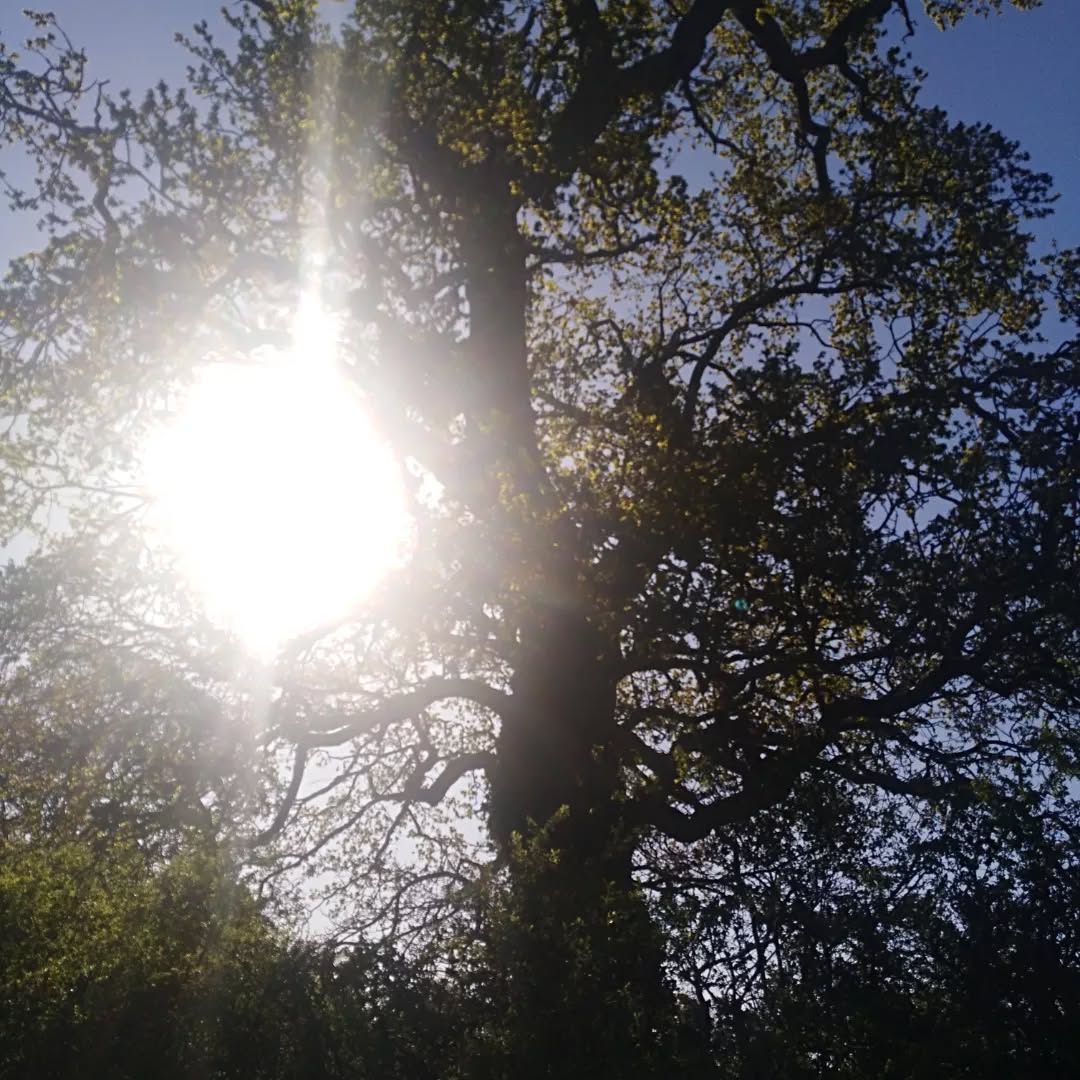
I only need to look up to see greenery, trees, shielding me. The view from here is my favourite oak, taller than the house and so grand it hurts. How many hundreds of years has it stood on this lane watching over this place? My place. Our place. The view from here is the sycamore and the poplar. I got worried when its leaves didn’t come back as fast as the others, but maybe poplars just take their time. The view from here is the bridge over the river, where the willows weep beside ash and elm and alder. The view from here reminds me how lucky I am, though none of this is truly mine, it is. It is.
I only need to wander to the back windows to look out on something close to glory. Something close to perfect. Something that feeds my soul in a way that nothing else can. The view from here is a garden full of trees and shrubs and flowers, where chickens peck and the dogs bury bones, and the old tire swings from the fir tree, still going strong after fifteen years. Where the horses in the field snort and graze, where the deer trot furtively from the woods as the sunlight fades. The view from here is sunsets and early morning mist. The view from here is lapwings and buzzards and red kites and badgers and foxes. The view from here is safe, for now.
The view from here makes me dizzy, when the memories rush in, one here, one there, a little boy with socks on his hands pulling a funny face, being rolled down the hill in a tire, being buried in a hole, little baby jabbing at a mud hole with a stick, little girl firing arrows to be like Katniss, little girl and her little chicks cupped in her little hands, and bbqs and trampolining and drinking cider while the sun goes down on us all, and firepits and marshmallows and games of football and tennis and tag and when it was lockdown we made the garden our outdoor gym, and jumped from log to log, twirled and spun and laughed at our own rules, and threw eggs out of the window in a parachute that didn’t work and looked out of the windows at the still silent world.
And that was then. And this is now. And we are still here.
The view from here grounds me. Reminds me: who I am, who we are, what we did, who we loved, how we lived. The view from here changes with the seasons, and in the autumn the garden is covered in leaves, and in the winter the ground is crunchy with frost, and in the spring the green is creeping back to shield us, and in the summer the grass dries out and the sun never seems to go to bed…
I hadn’t quite finished the post I had in mind for today so I’m going to share this short story with you instead. And yes, that does mean the writing is flowing again! More on that next week. I wrote this piece in response to a prompt on Medium, which instructed you to go outside and take a random photo then write a story inspired by it. This graffiti was added recently to one of the poles on the bridge down the lane from us. I thought it made a cool photo and a cool short story prompt so here we go. (This is only a second draft story and I do intend to polish it up a bit more in the future.)
What Happened To Pip Collins? (Working title)
The ghost hunt starts at the little stone bridge, just a ten minute walk down the lane. My older brother Ed photographs the graffiti and starts scribbling in his school notebook while I pluck catkins from the young ash trees and toss them into the shallows.
For a long time, this little note, this graffiti from another time, was the only clue in a missing person’s investigation but three weeks ago, another note was found on the wall of an abandoned mill. The mill is on the other side of the Stour, what we call the ‘big river’ and it was my brother who made the connection to this one. He immediately knew what he was going to do his local history project on: the disappearance of ten-year-old Philip Collins in 1978.
He had a hard time convincing his history teacher but he didn’t give up, arguing that everything that happened in the past is now history and if the boy vanished locally then that makes it local history. For the record, I think he is right about this. Plus, I really want to see a ghost.
Bored of tossing catkins, I indulge in a quick game of pooh sticks, snatching up twigs and throwing them over the mossy bridge, before darting to the opposite side. Ed rolls his eyes and I sense his impatience, but I see no urgency in the putting away of childish things. My first twig gets stuck on the large fallen tree that cuts the shallows in two. My second bobs up and over it, and the third never emerges from under the bridge.
Meanwhile, Ed consults his notes, reading from a newspaper clipping he found online, printed out and stuck into his project book:
‘Ten-year-old Philip Collins, known by his family as ‘Pip’ was last seen leaning over the railings of the small stone bridge on Hurn Court Lane, Hurn Village, Christchurch.’
I drift towards Ed and peer over his shoulder. He has the photograph of Pip in his project book too. We both stare at the black and white shot of a beaming, dark-haired boy who looks like the cheekiest kid who ever lived. His huge grin, his lips pressed together as if swallowing laughter, and his shining eyes all suggest a little rascal. He’s wearing dark coloured shorts and wellington boots, and a dark zip up cardigan which looks too small for him. He’s clutching one of those tiddler catchers, you know, a colourful net on a bamboo stick. Ed reads on:
‘A couple walking their dog across the bridge reported the sighting the following day after the alarm had been raised. Mr Weathers told the police that the boy was leaning over the railings and appeared to be alone. They said hello and walked on. They walked their dog in Ramsdown Forest on the opposite side of Christchurch Road, and when they later walked back the same way over the bridge on Hurn Court Lane, the boy was gone. He had however left a note on the railings of the bridge.’
Ed runs his finger over the next photo in his book, one taken back in 1978 of the graffiti left behind. He brings up his phone and compares pictures. It is amazing how the writing has been preserved over time. It’s even more amazing that a second note was hiding on the side of the mill all these years.
‘What next?’ I ask my brother.
He scrambles to his feet, swipes his messy brown curls out of his eyes and gestures to the landscape around us. ‘I’ll take some more photos.’ He points to the muddy banks below and the barbed wire fence beyond. ‘Go up there a bit and explore, take more photos. He might have done that, don’t you think?’
I shrug. ‘My guess is he fell in at the weir, at Throop. Left this note, walked all that way, left the other note on the mill and decided he’d had enough and he’d go home.’
Ed nods, his brow knitted in serious thought. ‘I think so too. The bridge over the weir was wooden back then.’ He opens his book, shows me another photo, this time from the 80s. ‘See? Dangerous. They never found a body though.’
‘Isn’t his mother still alive?’
Ed nods again. ‘Yep, and most of his siblings.’
That’s right — Pip came from a large family who lived in Christchurch. He had two older brothers, one older sister, one younger sister and another baby brother. I bet his poor mother was run ragged.
‘But this is a ghost investigation,’ I remind Ed. ‘Not a missing person’s investigation.’
Ed ignores me, stuffs his book in his backpack and goes down to the water. In order to keep his project classed as local history, his teacher suggested interviewing people about the ghost sightings over the years. My guess is the teacher didn’t want Ed harassing the family or the police about the cold case of the missing Pip Collins. Better to let him scratch around after ghosts, then they can all have a laugh in the staff room after.
I walk across the fallen log in my sandals, wincing when the cold water laps over my toes, holding my arms out to either side for balance. Electric blue damselflies hover above the water in pairs, and every now and then the drone of a huge dragonfly makes me squeal and duck. I don’t fall off though and when I get back to the bank, Ed is climbing back over the barbed wire with only one scratch on his ankle to show for it.
‘What now?’ I ask, following him back up to the bridge.
‘Interviews,’ he says, flicking through the photos on his phone. ‘I’ll have everything in place then. Original newspaper reports, interviews with his family at the time, the photos, the timeline, oh, and the route he took to the mill which no one knew about until recently.’
‘Think they’ll open up the case again?’ I ask him.
He shrugs. ‘They should. No one ever saw him at the mill or on the way there or back. They should at least put it in the news, see if they can jog any memories.’
Our mission for today is the two people locally who have claimed to see a ghost that resembles poor Pip Collins.
The first is Mr Coleman; a retired gamekeeper who lives in one of the cottages on Hurn Court Lane. He’s a bit stern, always used to scare the shit out of us when we were little kids, stomping about with all his camo gear on, well trained Labradors at his heels. He’d ask if we’d seen any suspicious characters about, his dark eyes narrowed on ours.
We find him in his back garden, smoking a cigarette while he waters his runner beans. A grey-faced black Lab lies in the sun behind him. He’s still wearing his camo gear.
‘I never saw the lad,’ he relays to us once Ed has his phone recorder running. ‘Not when he was alive, anyway. They didn’t come up this way, the family. This was all unfamiliar territory to the lad, see.’
‘His mum said he ran away to teach her a lesson,’ Ed pipes up.
‘That’s what I heard too,’ nods Mr Coleman. ‘Was feeling left out when his latest sibling arrived, something like that. Decided to teach them all a lesson and ran away.’ He chuckles a little at the thought then gives us a pained look. ‘Kids were always doing things like that back then. They ran free and had fun without adult supervision. Not like you lot glued to your screens inside your houses.’
We don’t take the bait. Ed smiles politely. ‘He had run away before,’ he says and Mr Coleman nods. ‘But he had never come up to Hurn from Christchurch.’
‘So, he didn’t know the area,’ Mr Coleman goes on. ‘Expect he walked up from Fairmile Road, kept going straight across Blackwater. Traffic was lighter back then, of course. And it wasn’t unusual to see kids out on their own at that age.’ He throws us another dirty look. ‘No doubt he spotted the lane all shady and curious, and decided to cross over and wander down to the bridge. Lovely place to play. Private. Sheltered by all those trees. Kids were always playing out alone back then. Plenty of tiddlers to catch.’
‘He didn’t take his net that day,’ Ed points out. ‘Nothing was found at all. Not sweet wrappers, or even footprints.’
Mr Coleman looks sad. ‘That’s right, I remember. No sign. No trace. Apart from that note on the railings but who can be sure it was him that did it?’
‘His mother said it was his handwriting,’ I shrug.
He shrugs back. ‘No one knows for sure, but I can see why everyone thought so. Cheeky little sod thought running away was funny.’
‘What do you make of the second note that’s been found on the mill?’ asks Ed.
The old man scratches his nose. ‘I’m not sure it’s connected. The writing looks different to me. They’re having it analysed or something, aren’t they?’
‘Yes, so we might know more soon, but that would make sense wouldn’t it? That he carried on down the lane, turned left at Pig Shoot and followed the river to the weir bridge?’ Ed brings out the old photo. ‘It was dangerous back then. He could have fallen in there after writing on the mill.’
‘What did the second note say again?’
Ed shows him and reads it out at the same time. ‘It says, no one can see me.’
‘Little sod,’ sighs the old man. ‘I don’t know. S’pose we’ll have to wait to see what the experts say, but that’s not where I saw the ghost, so I’m sceptical myself.’
‘Tell us about the ghost, Mr Coleman.’
He nods and settles back on the wicker garden chair. ‘It was just the once,’ he relays, his voice low and soft. ‘Early morning. I was taking the dogs over the forest and I came up towards the bridge. There was mist on the water, I remember that, and the sun was shining through the trees. Spring time, it was. Everything in bloom.
‘And that’s when I saw this little figure standing on the bridge. He looked real to me. So real, the dogs barked and I called out to him. The railings were old and they needed replacing. I thought he might fall in. Mind you, it’s so shallow there, he’d have been all right, but still… He looked back at me, you know. I saw his little face. Pale, but he was smiling. Laughing, I think.’
Ed and I sit frozen on either side of Mr Coleman. We know the bridge and the shallows so well, we can see it perfectly inside our own heads. Though I don’t believe a word of it. Everyone knows Mr Coleman is fond of the drink.
Mr Coleman goes on to describe how he approached the boy and the boy vanished into thin air. He snaps his fingers at us. ‘Poof! Like that!’
That’s when me and Ed swap a look. I can feel the giggles rumbling to life in my guts and I know we have to get out of there soon.
‘And you have never seen the ghost again?’ Ed checks.
Mr Coleman shakes his head sadly. ‘Nope, never. But I know what I saw and I know it was a long time ago but it’s always stayed with me. The way he laughed and grinned then just vanished.’ His eyes cloud with memory as me and Ed swap another look. ‘I’ll never forget it.’
We leave him to his memories and seek out our second interviewee, Mrs Doreen Goldsmith, who lives in a retirement flat in Christchurch. It’s a long hot walk into town for Ed and me, but my brother looks ever more determined, and walks silently, refusing to be drawn into my childish musings and games.
‘I know what I saw,’ the old lady asserts as soon as we are seated beside her. She’s been wheeled outside to enjoy the sunshine, but has a knitted blanket tucked over her frail knees. She’s smiling at us, her old eyes twinkling. ‘And it wasn’t just the once. It was all the time, usually at dusk, when I was heading home. I worked in town you see, biked there and back every day. It was usually nearly dark by the time I cycled down that hill and over the bridge.’
‘That’s where you would see him?’ Ed checks.
‘Oh yes, always on the bridge, where he left the note. Always holding onto the railings and leaning over. And he would always look up when I drew near, and he would always smile and laugh.’
‘Did he ever speak to you?’
‘No.’ She looks momentarily sad about this. ‘He would only laugh. It frightened me at first, of course. I was just a girl myself. But I recognised him from the newspapers and I tried to tell the police. Everyone thought I was crazy, of course.’
‘Other people claim to have seen a ghost there too,’ I remind her.
She smiles graciously. ‘Have you seen him?’ We both shake our heads. She leans a little closer. ‘You have to be there at the right time. It was always dusk for me, when the light was fading. The low sun would be reflecting off the water and he’d appear there in the beams, you see.’
Her story is strikingly similar to Mr Coleman’s, apart from the time of the day, but after we leave Ed makes a note in his book:
Coleman — a drinker
Goldsmith — has dementia
My brother seems sad and deflated when he leave the retirement home. We are exhausted but he says he can’t go home yet, not until he has followed Pip’s route to the mill and back.
So, that’s what we do, crossing over the old mossy bridge once again, then following the lane down to Pig Shoot, across the forde, and on towards the weir and the mill. We find the new note guarded by metal railings and police tape. With his phone zoomed in to maximum, Ed snaps a picture and we stare at the words side by side, comparing it to the one at our bridge.
No one can see me.
‘Coleman might be right about one thing,’ my brother murmurs, his expression troubled. ‘There are no random capitals in this one. Other than that it looks the same though, right?’
‘Right.’ I’m tired and I want to call it quits, but a sort of fire takes over Ed’s eyes and he sets off suddenly, muttering to himself. ‘What is it?’
I struggle to keep up but Ed hurries over the weir and heads back to the forde, where another old stone bridge takes us over the water. He’s possessed, I think, watching as he clambers over the railings and drops himself into the water. It’s shallow, but cold, and he gasps as his hands curl around the railings, and his eyes skim up and down as if searching for something.
Then, my brother starts shouting. He looks insane. Stood in the water, his lower half soaked through, pointing and shouting and laughing and crying all at once.
He helps me over to see what all the fuss is about and there it is. The source of Ed’s explosive reaction. Another note.
A man is following me with a gun.
I tremble, what does this mean? Ed takes a photo, then climbs out, dragging me with him. He starts comparing the three notes while I shiver on the bridge beside him.
‘How did you know?’
‘I saw it years ago! Remember when you were about four and you had that rainbow coloured bouncy ball? And it went in the water right here?’
I shake my head. ‘No. I don’t know. Maybe.’
‘Mum and dad were on their bikes further back. I was nine. I climbed and got the ball back for you and that’s when I saw the note. Pip must have been in the water when he wrote it! I only saw it because I’d climbed in too. Mum and dad were furious with me, said it was dangerous.’
I stare at him and it slowly sinks in. ‘Bloody hell, Ed!’
‘I know, I know! It’s been bugging me since the note on the mill was found. I knew I knew something, you know? You know when there is a memory or a thought or a feeling and you just can’t grab onto it?’
‘We need to tell the police,’ I say, my arms folded over my damp clothes.
‘Man with a gun,’ Ed muses, putting his phone away. ‘Man with a gun.’
We have the same thought at the same time and turn towards each other suddenly.
Around here, the gamekeeper would have been the only person with a gun.
I still can’t believe it. Getting boosted on Medium is a huge deal because it brings far more readers to your work which translates nicely to more earnings. I have been extremely lucky to have been boosted many times since I joined Medium over eighteen months ago, but I never, ever expected to get boosted for a poem! Poems and short form writing don’t do so well on Medium because they are so short, but it’s still a lot of fun to write them and in particular, I love responding to writing prompts.
I was thrilled to bits to have this poem boosted as it is my favourite one at the moment. It was written in response to a prompt from the Promptly Written publication which suggested keeping a gratitude journal and writing a poem a day from it.
I’ve been thinking about gratitude a lot lately so this was really timely for me and immediately caught my interest.
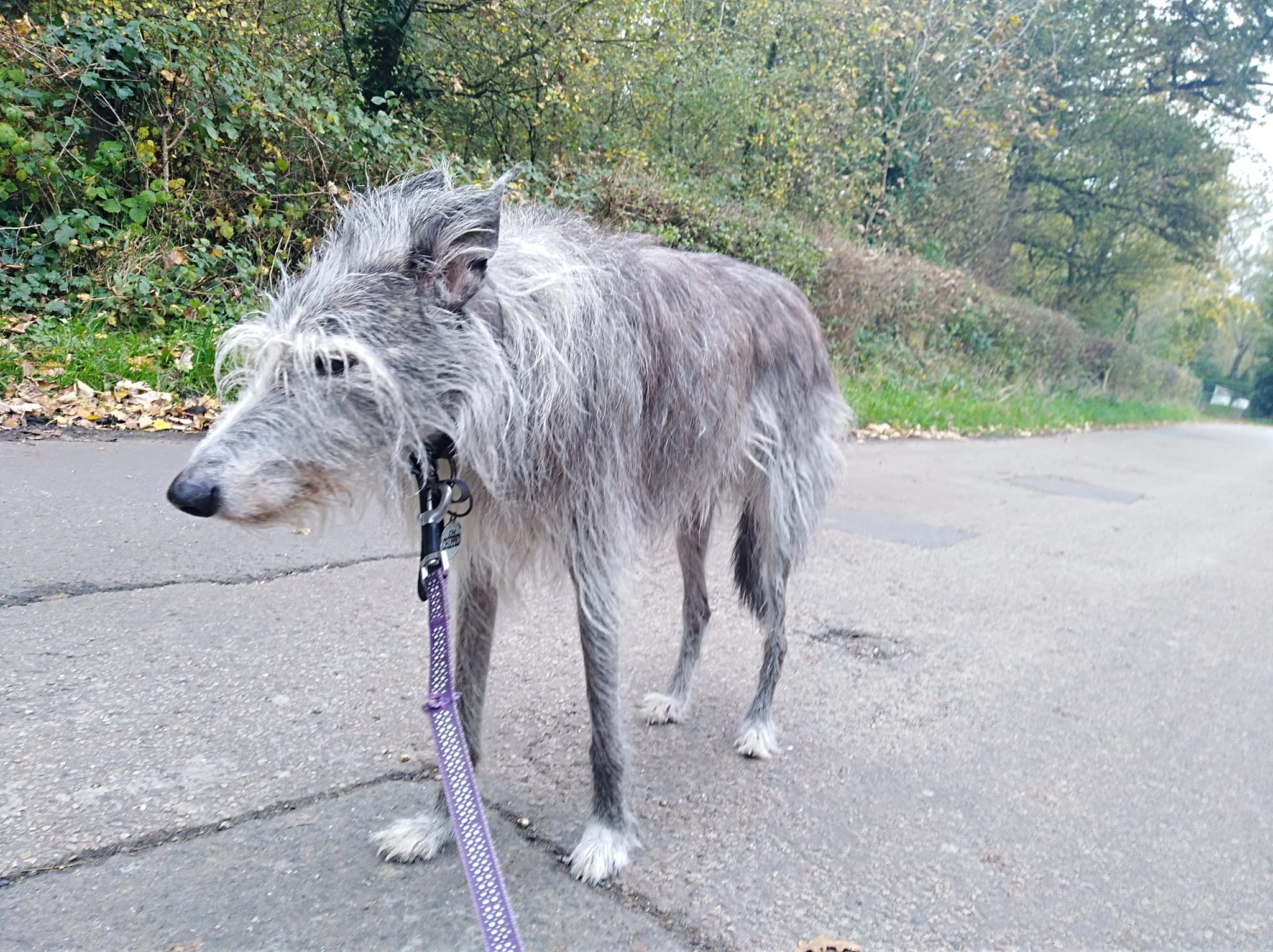
I wrote a poem for Monday which got a few reads and earned me a few pence, then posted the following poem for Tuesday, which was about walking my elderly dog Tinks down the lane. Getting boosted for this really means a lot as we all know she is on her last doddery legs and every moment with her is precious. For her poem to get boosted and seen by more people is just lovely.
Anyway, here it is, alongside a photo I took of her on the day in question.
image is mine
Just for while we had the world to ourselves in a moody silence just the buzzard on the oak tree looking over its shoulder to follow our slow progress just the fast flit of tiny birds from one hedgerow to another just the crows taking off lazily and the pheasant on the fence post just wandering alongside you matching your feeble pace and the age it takes to get from here to there and back again is the time it takes for everything to fall silent for this beauty to breathe so slowly that I can breathe with it in, out, in, out with the time to see, hear, taste and smell the lonely land falling asleep as winter creeps into your old bones
Last week I responded to a prompt on Medium and wrote this short story using two characters I had already created for a potential future novel. The prompt was musical; you had to choose a song title and/or lyrics to respond to and I picked Dancing In The Dark by Bruce Springsteen. For some reason the characters of Cody and Anya popped into my head as I feel like their entire story is very much a dance through the dark… This is a very rough and shortened version of how I think they will first meet and put their dark plans into action. See what you think!
When the newsflash ended our eyes met across the cafe table. The coffee he had offered in apology for kicking my bag across the floor had been barely touched, and suddenly I had no appetite for it.
I didn’t know his name yet, but the great scrawny scarecrow of a man raised his eyebrows at me. ‘Don’t tell me that surprises you.’
I glanced back at the TV, which had moved onto commentary and coverage of the protests already building up outside parliament. I scanned the cafe and saw the other customers frozen in shock, their foreheads furrowed, their lips moving without speaking.
‘He really said that?’ the waitress behind the counter questioned, before dismay and anger filled her face. ‘Jesus Christ, I voted for that lot! He really bloody said that, didn’t he?’ She looked our way, shaking her head in fury.
I smiled and nodded. ‘He really did say that.’
The scarecrow cleared his throat, his eyes on me. ‘Cody,’ he said, with a wink. ‘And you are?’
‘Anya,’ I told him, ‘and no, it doesn’t surprise me. Nothing surprises me anymore. The better question is, what are we going to do about it?’
A huge grin lit up his face. ‘Now you’re talking. I knew you were my kind of girl.’
Maybe he was flirting, who knows? It was one of those moments for sure. Life-changing — and everyone in that cafe felt it. There was something heavy in the air, yet it was crackling with electricity and Cody was staring at me in pure hunger. It felt like we were standing on the edge of the universe and somehow, though I knew we wouldn’t survive, I was ready for it. Ready for something.
‘What did he say?’ one of the old women by the window asked, her voice cracked and trembling. ‘What did he say about us?’
‘Why are they surprised?’ Cody lowered his voice, leaning in closer. ‘It’s hardly a shock, is it? Extremely rich and powerful person doesn’t give a shit about the rest of us? Jesus, where the hell have these people been living?’
I nodded, still grinning. He was right. I was right. Suddenly, we were right. Everything was happening. There was a crash out the back and a frustrated scream from the waitress.
‘What’s the point in anything then?’ one of the other old women asked.
‘It’s all kicking off now,’ someone else commented.
Cody and I looked back at the TV. Sure enough there were violent protests breaking out all over the country. We saw police leaping out of vans, batons raised. We saw crowds charging down the streets of London. We saw windows being smashed.
‘I need to close up!’ the waitress yelled from somewhere. ‘We all need to go home!’
Cody held out his hand. ‘Care to dance?’
‘Dance?’ I took his hand. It was weathered and warm. He was a walking talking scarecrow with his straw-like blond hair sticking out from under his grey beanie. Under his black duffel coat I glimpsed a white t-shirt with The Clash emblazoned across it.
‘This could be the end,’ he said with another wink. He scooped up my bag and handed it to me and we left the cafe arm in arm, staring into each other’s eyes. ‘And if it is, I’d love to dance with you, Anya.’
‘Everyone always thinks it’s the end,’ I quipped, as we pushed through the doors and out into the rain. It soaked us in seconds but neither of us cared. We pulled our coats around us, linked arms again and started to walk along the side of the harbour.
‘True. There will be outrage and protests for a few days, then everyone will go back home and back to work like the good little sheep they are.’
‘Indeed they will. They’ll probably even vote for him again next time.’
‘His career won’t be over,’ Cody agreed. ‘He’ll find a way to milk it and monetize it. They always do. He’ll be on Celebrity Big Brother before you know it, winning the viewers over.’
‘You can almost predict it. Still,’ I caught his eye, ‘it was a hell of a thing to get caught saying.’
‘Yeah, but at the same time any reasonably intelligent person knew already, right? Yet somehow it’s a genuine shock to some people that the establishment don’t give a damn about them.’ Cody laughed and shrugged skinny shoulders under his heavy coat.
‘So, a dance?’ I reminded him.
‘Somewhere chaotic,’ he mused, looking around. ‘Somewhere we can watch the world end.’
‘Or plot its downfall?’
He flashed another dazzling smile. ‘Now you’re talking.’
‘Hilsborough Hill?’ I suggested, nodding to the rolling green hills that looked down on us and out to sea. ‘It’ll be beautiful up there this time of night.’
‘And just us, dancing in the rain.’
We set off, hand in hand, two perfectly dysfunctional strangers. While the small seaside town exploded in outrage behind us, we followed the harbour-side until we started to climb the majestic hills that looked down on it all. As we walked we heard glass shattering as windows were smashed in, cars screeching and crashing, people shouting, sirens blaring.
I agreed with Cody. It wouldn’t last long.
The Deputy Prime Minister’s cruel, cold words would be washed over in the days that followed. The media would brush them off and rewrite them. The truth would be painted over with another more digestible one. The tabloids would turn on the protesters and paint them as the true aggressors. Others would watch the violence from home and feel frightened and isolated. The excuses would begin.
He didn’t mean it. It was taken out of context. He’s only saying what we’re all thinking! I mean, come on, he’s not wrong, is he? He was only joking! No one can take a joke these days! He’s getting cancelled, that’s what it is. And anyway, he was right, wasn’t he?
The media would find a new story. They would wash it all away but I knew the truth wasn’t going anywhere. We knew. We had always known. He had confirmed our worst fears and he had, for the first time in a politician’s life, spoken the truth.
At the top of the hill the wind and rain swirled around us and Cody and I embraced.
‘It’s nice to meet you, Anya.’
‘You too. Feels like fate.’
‘It really does. What a day! And life is so short.’
‘It is. Just look at them.’
We looked. We saw the little town glittering back at us, small untidy lives and unfilled ambitions and dreams only glimpsed at night. We wouldn’t be like them, like slaves to the system. We would be free.
‘I’ve never felt so free,’ he said to me then. ‘I’m thankful to that twisted bastard for finally saying it.’
‘We were right all along,’ I replied and he nodded, pulling me into his chest. I could feel the bumps of his ribs and I watched the wind pulling at his hair, trying to free it from the woolen hat.
We held onto each other and danced. The darkness consumed us and the hill we stood on felt like nothing, like it wasn’t even there. The rain soaked us, the wind battered us and still we danced, out eyes closed, our bodies pressed together.
‘I’ve got an idea,’ he said then.
‘What is it?’
‘I’m getting sick of waiting,’ he said with a yawn. ‘Sick of waiting for the goddamn apocalypse. Even this won’t bring it you know. Not fast anyway, not fast enough for me. There will still be jobs and money and bills, right to the bitter end.’
‘You’re right,’ I said, looking up into his face. ‘Tomorrow they’ll all get in their cars and drive to work to make the money to pay the bills and then they’ll get old and die and never realise they were a slave to bastards like that. That he laughed at them all along.’
‘They’ll deny it,’ nodded Cody, ‘even to themselves. But I say, how about we wake them up?’
‘How do you mean?’
‘I’ve been thinking about starting a movement. Anya, you and me, and a few others. There’s nothing left to lose, you know? He said it himself. We heard him say it in his own words.’
‘Yes, we caused climate change and we knew it all along and we didn’t care, and we still don’t care!’ I repeated the words Giles Forbes-Roberts had been caught on camera exclaiming with such arrogance, such gleeful light in his eyes.
‘They’re all going to die anyway,’ Cody continued, repeating the MP’s words and mocking his Eton bred accent. ‘That’s just the way it is. Jesus Christ, up here we all just wish it would hurry up, you know? Less of them would be better for us, that’s what we always say.’
‘Let them die,’ I grinned, ‘we’re quite happy to just let them die.’
Cody threw back his head and copied the raucous drunken laughter of the MP as he lounged against the bar with champagne in hand and no idea the young lady he was talking to was recording his every word.
‘Let them die!’ I shouted, spinning with Cody, dancing in the dark as if nothing could touch us. ‘Why don’t they just hurry up and die?’
‘Do you want to hear about my movement then?’ Cody asked, holding me close as we rocked and swayed to the music of the waves smashing the rugged cliffs below.
‘If it involves violence towards people like Giles, I’d love to.’

 The Glorious Outsiders