Life Is Story and Stories Are Everywhere

Just recently I penned a guest post for another blog, the topic of which was the reason I write. I know people write for many, many complex reasons, and I think there is more than one reason that compels me to make up stories, but certainly one of the biggest reasons is simply to live more lives. To become other people, to step into their shoes, to create them and control them, to live with them and die with them. It’s the same reason I read, I guess. So that I’m not just me, living this one life.

What I also notice, as I go through my one, short life, punctuated by the lives of the people and worlds I have lovingly created, is how stories are everywhere. How they make up our lives and our worlds, and our day to day existence. Maybe you don’t always notice them, but if you look, stories are everywhere. Everything is, in fact, a story. Or at least, the potential for one. The inspiration for one.

When you get an idea for a story, it’s because you asked a question. You asked, what if? You asked, why? You asked, what is going on here? And you wanted to know the answers to those questions, so you made some up.

Children are wonderful at doing this. Natural play in childhood is nothing but stories and make-believe. I find this utterly enchanting. How they lose themselves completely in made-up worlds. These worlds and stories might make no sense at all to us, the adults, but to them they do. They set them up and let them roll. They start them out of nothing, out of the thin blue air. And they carry them on, for weeks, sometimes years.
20170704_182940.jpg

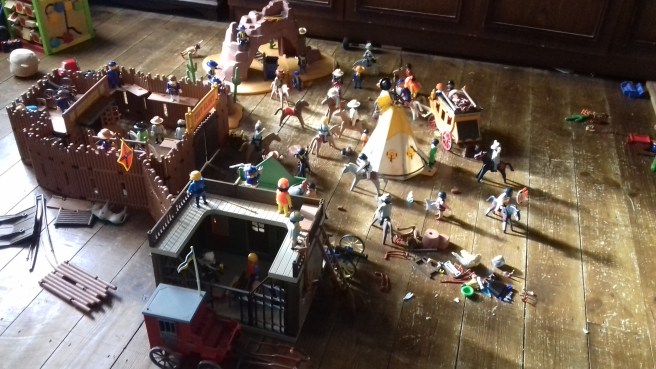
Look at this Playmobil set up. My 3-year-old got given a box of the stuff this week but it was his 10-year-old brother and 13-year-old sister who set it all up like this. I walked past it while tidying up and found myself wondering what was going on. There is one fellow, an outlaw, tied to the roof of a wagon, for instance, and I wanted to know why. There are a lot of rifles placed on a table in the sheriff’s office, and this was also obviously part of the story. The kids had dinner and went back to the Playmobil. I had to do other things, but I would have loved to know what happened next to all these people! This might look like play, and it is, but it’s also a story in action, one that I am sure will develop over the next few days.

A few days ago my youngest sat down to do some drawings on his chalkboard. I wasn’t allowed to join in, I was only allowed to watch. He started drawing big circles and little circles with lines joining them, up. He chatted to himself and when I asked about it, he gave the circles all names like Hop and Plop and Poop and said they were all holding hands because they were friends. They didn’t have faces, but some did have bananas! He then drew a square around them all and said they had gone into a house. This went on for a while, with my son adding further layers to the story. It was a lovely moment, art and storytelling interlinked quite naturally!

Children are just natural storytellers, and we should notice and cherish and encourage this as much as possible. Tonight, one of my older sons early creations, came back to visit us, and I was once again reminded how naturally children construct stories and carry them on through their lives.

When he was almost three, my older son used to get scared at night and get into our bed. We would ask him about this and he would talk about odd little creatures he called the Muckoos. In the day, his sisters would question him, and he would describe them in ever greater detail. (They were small and spiky and multi-coloured and liked to steal biscuits) They also kept him awake at night with their noise and they did lots of naughty things around the house. As the story grew among us all, my son started blaming the Muckoos when things went wrong. I wrote a story about it at the time, which I still have, and may one day do something with!

I’ve never forgotten the Muckoos, and I quite often call my littlest son a Muckoo, as in my mind it sums up a small child, mucky and messy and troublesome and cheeky! I sometimes call him Muckoo Madness, and he will retort; I am not Muckoo Madness!

Anyway, sometimes we have trouble getting the littlest one to bed, and my older son has been helping out the last few nights, by pretending to be a creature called Gavin, who loves stories. This in itself, is just gorgeous. He insists on sitting on a pillow on one side of me, while his little brother sits on the other side. They both get toys to cuddle and we all choose one book to read. Then ‘Gavin’ has to go back to his cave, and my little son happily goes to bed. What a way to use storytelling to encourage a young child to sit still and listen to stories! Tonight, my older son remembered the Muckoos, and ‘Gavin’ told us he was a Muckoo, in fact, the last of his kind. Quite a poignant moment, I felt! It was magical to witness this ‘story’ resurfacing after so many years and I am quite convinced it will continue to develop further layers and complexities…

And for anyone wondering what the last Muckoo looks like, my oldest son agreed to draw one for you!

muckoo


Dear Newbie Indie Author…

pranam-gurung-116984.jpg

Dear Newbie Indie Author at the start of your journey….Panic not. Though everywhere you turn there are rules, and experts, and advice, and do’s and don’ts. Remember that all those who are further along than you, were once where you are now. If I could give any advice to me when I was a newbie indie author, it would go something like this;

  • Attend a course, workshop or conference. Something that fills you with wisdom and ambition. Something that makes you dream and hope and long to get your words out into the world. Something where dreams are balanced with a hefty dose of reality and an honest account of how hard it is likely to be.
  • Remember that Rome was not built in a day, so neither will your author platform. Be aware of it, learn about it, but don’t panic about it yet. It will grow with you, in time.
  • Be brave. But only when you are ready. There is no rush and no reason to change your personality or try to be something you are not. Tip your toes in the water with a Facebook author page, or a Twitter account. Play around with things, lurking around the edges until it feels right to dive in.
  • Don’t feel like you have to be on every social media site, stretching yourself too thin, whiling away precious hours by attempting to engage with them all. There is simply no point. Choose two or three and make sure one is your blog/website. Give these your attention, and enjoy them. Think of them as your own little projects, little mini businesses. Little acorns that will one day grow into Oak trees!
  • It’s fine if you are just talking to yourself. Everyone starts off like that. It’s not a waste of time! Think of it as practice. You can be uninhibited, knowing that barely anyone is there. Practice your voice, try things out, have a giggle. By the time your audience has grown, you will be far more comfortable in the role.
  • Make your blog whatever you want it to be. Some writers just blog about writing. That’s fine. Some blog about other issues, political, social, personal, and that’s fine too. Some blog weekly, some once in a blue moon. It’s all fine. Do what its comfortable for you. A blog is for your writing and writing should always be fun. If it doesn’t feel fun, don’t force it. Try something else.
  • Don’t compare yourself to others. We’ve all taken different paths. There will always be writers with more money to spend, more contacts to enlist, more gift of the gab, more luck, more everything. But you are the only one who can tell your story in your way. Hold your head up high and try not to play the comparison game with anyone.
  • Don’t get eaten up with jealousy. When you see others succeed, be glad for them and then try to work out how they did it.
  • Don’t expect your family and friends to rush out and buy your book. Don’t expect many of them to understand what the hell you are doing. Find fellow writers to help you through the frustration and elation that is to come.
  • Remember that the only way to succeed is to never, ever quit.
  • Remember that success means something different to everyone, and only you can decide what it means to you.
  • Be prepared to be work hard, to treat writing like a job, to put in the hours, to find time for promotion and writing, to try new things when nothing is working, to feel like giving up, to want to bang your head against the wall, to want to throw your laptop out of the window, to scream at people to just please buy your bloody book and to go to bed and not be able to sleep for the ideas, thoughts, doubts and frustrations whirling in your head.
  • Be realistic. Dream big with your feet still on the ground. Keep your day job and be proud of it. Write because you have to, because the ideas and the words and the characters are too big to contain in just your head alone, and because you want to share them, to let others feel like you do. Write because you love it, because you live it and breathe it, because it excites you and makes you feel like you are living more than one life. Don’t write to get rich. Don’t write to impress anyone. Write because there is no choice not to write.
  • Know that you’ve got to put the work in to see the results. That inevitably and eventually, you reap what you sow. Little steps sometimes take you further than big ones. Sometimes the only way you realise how far you have come is when you stand still and look back to where you started.
  • Don’t spam people. Don’t become a robot hitting everyone who follows you with a buy my book link or plea. Engage with them. Forge relationships. It isn’t all about you. Don’t follow other people just so they follow you back. Think about why you are following them.
  • Don’t play the numbers game. Likes and follows mean nothing if people are not engaged with your voice and your style and what you have on offer. It’s not about the amount, it’s about the quality.
  • Don’t only post an update when you have a book out. Build an audience. Give them something to read, debate, join in with and get excited about. Then ask them to buy your book.
  • Be proud. You’re doing something some people only dream of. Do you know how many people say they would like to write a book, but never actually do it? You’ve done it. You’ve proved yourself and realised a dream. That’s pretty cool. And be proud of going indie. It’s not an easy road. But it is an incredibly creative and innovative one. Who knows where it might lead? Who knows what skills you will require? What contacts you will make? What friends you will find? What effect you will have on those that read your work? Who knows where you will be one year, or five years, or ten years from now? The possibilities are endless so dream big and work hard. Don’t moan, don’t back out, get on with it, and make it happen.

(Credit to Pranam Gurung for the image.)

Please feel free to comment and share. What advice would you give to a new indie author? What do you wish you had known in the beginning? Anything you would do differently?

Author Interview: Emily Williams

Emily Williams has written an endearing and emotional debut novel about the enduring and powerful love between mother and unborn child. Letters To Eloise is a book that had me smiling in recognition, and wiping away the tears. The narrator, Flora, is a student who falls pregnant and begins to write heartfelt letters to her unborn baby daughter, who she names Eloise. The story weaves the past with the present, as Flora deals with an unexpected pregnancy, unsuitable men, and heartbreak. The ending was one I did not see coming and I would highly recommend this charming tearjerker. Emily kindly agreed to an interview, and here she talks about the inspiration for her debut novel, her experience of publishing so far and her plans for the future…

IMG_3343.JPG

1) Can you tell us about your writing and publishing journey so far?

Letters to Eloise has become a very special novel to me. The journey has been a long one and started quite a few years ago. I started the novel when I had the initial idea five years ago, which I jotted down into a notebook and then onto post-it notes. These post-it notes then formed the timeline of the letters for the whole novel.

I choose the epistolary element for Letters to Eloise as I have always enjoyed reading books that contain diary entries or letters so felt this would fit Flora’s situation perfectly. I liked that she had someone real to write to, someone to pour out her emotions. I loved writing every single letter and making sure that the plot linked up through Flora’s narrative.

I was at a time in my life where I desperately wanted a family but wasn’t in a situation where this was possible, so I wrote Letters to Eloise as an outlet to that. The novel took so long to write as, unexpectedly, I also fell pregnant like protagonist Flora. I had just finished the first draft, and when dealing with all things pregnancy related, I found that I couldn’t read or even look at the book so it was put aside!

Luckily, I did return to the novel after my second child, a daughter, last July. I finally completed my long journey to publication; however, my journey isn’t over and now continues with my new projects.

I am very excited about my next two novels.

2) How would you describe your debut novel Letters To Eloise?

I find it hard to describe my own novel! I will combine some of the lovely words from reviews to make a sentence – a heart-breaking yet warm, witty and touching love story.

I like writing things a bit different and enjoyed writing Letters to Eloise in letter format.

3) What has been the hardest part of your publishing journey?

The hardest part has been learning all the formatting and other details that go with publishing an eBook and paperback. I have had to learn everything from scratch, which although hard, I have really enjoyed! The other hard bits have been the marketing side and embracing social media.

Everything is still such a learning curve at the moment.

4) What do you feel has been the best part of your publishing journey?

Each time I read a review, it has all been worth it. I’ve been so lucky to receive such lovely reviews and reading them makes me smile. I am so pleased that others enjoy my writing and have loved Letters to Eloise.

5) Do you have any advice or tips for new writers about to hit publish?

Don’t rush! Before you hit publish, make sure you have been through the novel with a fine toothcomb. Ensure you have rested your book for a while to look at it again with fresh eyes. Hitting publish doesn’t just end the process though, there’s plenty more work to do! I wish I had organised beta readers and blog tours etc earlier, so be prepared well in advance.

6) Tell us about your writing process. How does a typical day go?

During the day, if any ideas come to me, I use the notes app on my phone to jot down any ideas or post-it notes. Then in the evening (when the kids are safely tucked in bed out the way!), I look back through my notes. I have a chapter’s grid, which keeps track of the order of the novel and any chapters I need to add in. With both Letters to Eloise and now with my current novel, I don’t write the chapters in order. I like to pick and choose what to write which helps with writers block!

I then write for a couple hours in the evening or until at least one chapter is finished. I re-read before saving! The next day I will re-read and edit the work and carry on with another chapter!

7) What are you working on right now? What else can we expect from you?

I am working on a charity novel entitled ‘The Subtle Art of Keeping a Racehorse.’ The proceeds from the novel will go to two horse charities, one of which is the Thoroughbred Rehabilitation Centre. The story is a YA book about teenagers, a missing racehorse, secrets, lies and chaos!

I am also working on another adult novel, more of a psychological thriller than a romance, but will be just as emotional as Letters to Eloise.

8) Who are your favourite authors?

Favourite authors would include Cecelia Ahern, who creates amazingly imaginative worlds for her characters that I can picture myself in. Her stories have strong characters with a magical element of fantasy to them. She too has inspired me to think outside the box! Sheila O’Flanagan writes very clearly about the families in her stories and her characters emotions. There are many, many authors who inspire me and all the books I have read as a child have made me the writer and reader I am today.

I was, and still am sometimes, a massive pony book fan and still have all my childhood pony stories, especially Patricia Leitch novels. I am hoping my son and daughter will love reading them too!

9) Tell us about your long-term goals and dreams

I would love to be a full-time writer and live in the countryside with all our animals. We are hoping to move to the country or even to France soon, to run a small business. I hope that my writing can pay the bills!

10) Tell us 3 interesting things about either yourself or your novel

1. I have no funny bones! After a riding accident I had surgery on both my arms which moved the nerve that causes the funny bone sensation! I find writing difficult now so hand-write or use a Dictaphone if they are particularly painful.

2. The protagonist in Letters to Eloise is called Flora, short for Florence. I called my daughter Florence too. I wasn’t allowed to call her Eloise, so Eloise is a pet cockatiel I have in my aviary!

3. I have never ever been to the hairdresser! My hair does need a good chop but I’m still scared to go!

image1.jpeg

Bio; Emily Williams lives by the seaside in West Sussex with her family and a menagerie of small pets. After graduating from Sussex University with a BA in Psychology, Emily trained as a primary school teacher and teaches in a local school. Letters to Eloise is her debut novel.

Links; You can follow Emily on FacebookTwitter

Things I Fail At On Social Media

When I first started my indie author journey, I had a very rocky relationship with social media. In truth, I didn’t like it or understand it. But over the last few years, I have stuck with it, worked hard at it, and yes, even grown to enjoy it. However, I do still feel like I am not quite getting it right. I’d say I am definitely most comfortable on Facebook, still don’t understand Twitter, and really need to learn how to better utilise the ones I enjoy such as Instagram and Pinterest. Sometimes I feel like I have no idea what I am doing! Here is a list of things I currently and consistently fail at;

  • What to add when I Tweet. I see other people write some brilliant tweets. I know you’re meant to ask a question or come at it from another angle, not just retweet the post without comment, but all to often I click share to Twitter and then sit there for ages thinking what can I say about this? Great post? I really liked this article? Great tips here? Read this? And then I give up because life is passing me by and I just hit Tweet.
  • Remembering what hashtags to use. I really should list them and stick them on my wall. I remember #amwriting but that’s about it! And I know you shouldn’t go over crazy on hashtags anyway, but again, how many to use? How many are too many? Which ones are the most useful or relevant? Sometimes I have a moment of clarity but mostly I pick a few boring ones and hit share feeling like a total Twitter loser.
  • Twitter in general. I really want to like Twitter and get more out of it. Every now and then I do make a conscious effort to play the game right. I do understand that like with all social media sites you’ve got to give, in order to expect anything back and you’ve got to build relationships not just tweet but never comment, share or engage in return. I get it. I just don’t have time for it. It’s more fun on Facebook for some reason so I find myself retreating there.
  • Making memes. Some writers/bloggers are soooooo good at this. I am terrible. I can never find the right picture and if I do I can never think of a witty line for it. I am one of those people who can’t be funny if I try. I’m only funny when I don’t mean to be.
  • Finding images. I hate looking for images. For Pinterest, or the blog or anything. I know images are good because they make your post more visual and interesting but bloodyhell it takes a lot of time searching for the right ones, and they never seem to be quite right.
  • Knowing how much time to spend on it. It’s always a bit hit and miss with me. I can get very easily distracted by Facebook and Pinterest, and to a certain extent Twitter if I actually go on it, but knowing whether this is time well spent or not is never a certainty. I’m very good at blogging on a weekly basis and keeping my Facebook author page busy, but the rest of it is totally inconsistent. Maybe that doesn’t matter, or maybe I should be spending equal amounts of time on each site?
  • Turning social media into sales. Then again, this is a tricky one. How do you know your social media engagement has resulted in sales unless people tell you? There is the shop button now on my Facebook page, which is helpful and depressing in equal measures. But other than that…? Who knows what is working and what is not?

I’d like to get better at all of these things. How about you? What are your social media strengths and weaknesses? Please feel free to share and comment! And let me know what has worked for you!