Barefoot On The Cobbles – Guest Post by Janet Few

Dr Janet Few.JPG

When Chantelle kindly offered to allow me to pay a visit to her blog, she said that her own writing was gritty, contemporary and non-conformist. I reckoned that I could manage at least two out of three. Then I discovered that her blog was called Glorious Outsiders and that certainly had a resonance. I am here to talk about my new novel Barefoot on the Cobbles and my slightly eccentric life; Glorious Outsiders abound!

Before I was any sort of published author, I was and still am, an historian. As such, I am not particularly interested in politics or tales of the great and good. I am fascinated by ordinary people, how they lived and the influences that underlie their behaviour. If I say that the presentations that I give on historical topics include aspects of witchcraft, mental health, non-conformist religion and the role of women, you might get the idea. It is the marginalised who intrigue me the most; truly the outsiders.

I am also a keen family historian. I seek out my ancestors and pay tribute to all those from whom I descend. These are not rich people, nor are they anyone who is well-known but they are those who, if it were not for me, might be forgotten. I have several non-fiction books in my portfolio; books about social history, genealogy and local history. I had reached a lull in ideas for more non-fiction topics, so I thought it was time to turn to fiction. I hadn’t written ‘stories’, since I was an angst-ridden teenager. I was all set to craft a very different novel, when the tragedy upon which Barefoot on the Cobbles is based came to my attention. It was a story that was not recalled in local folklore, which piqued my interest. So, in a way, I still haven’t written fiction, as this is the retelling of a true story. I did find that my historian’s instincts had to be suppressed at times. Although very little in the book is pure invention, there were occasions when I had to create plausible scenarios to fill in the gaps in the historical record. At first, I found it very difficult to convince myself that I really could just make it up!

Barefoot is set, in the early years of the twentieth century. This era provided me with plenty of scope, encompassing as it does, the First World War, the fight for women’s suffrage, the influenza epidemic, the dawning of a social conscience and medical care in pre-NHS days, all of which feature in the book. So, from that point of view, the novel is not contemporary, yet the emotions that my characters experience are recognisable today; the psychological make-up of human beings does not change.

3d

In Barefoot on the Cobbles you will find a narrative set in the beautiful Devon landscape; communities whose lives were shaped by the sea. So not just real people but real, recognisable places. There are scenes in the local asylum, on a battlefield, in court and on deathbeds. I think that qualifies as gritty. It isn’t all doom and gloom because the characters’ lives shaded from joy to despair, as do our own. As I struggle to answer the question, ‘What is your book about?’ I often say it is about people and the incidents in their pasts that led to the tragedy that is the culmination of the novel. It is a ‘why-done-it’.

Who then are Barefoot’s non-conformists, the Glorious Outsiders? The person who became the main character is a fisherman’s wife, who is past middle-age and described by some of her neighbours as ‘odd’. On the surface, her behaviour seems unconventional and the novel seeks to explain why this is so. Apart from this desperate mother, you will meet the troubled daughter, the reluctant soldier, the traumatised engineer, the militant suffragette, the alcoholic bankrupt and others on the side-lines.

I will leave you with the blurb and if you want more information, it can be found on my own blog The History Interpreter http://bit.do/bfotc

“In the euphoria of the armistice a young woman lay dying. Daisy had grown up, barefoot on the cobbles, in a village on the rugged North Devon coast; she was mindful of the perils of the uncertain sea. Her family had also been exposed to the dangers of disease and the First World War but for Daisy, it was her own mother who posed the greatest threat of all. What burdens did that mother, an ordinary fisherman’s wife, carry? What past traumas had led, inexorably, to this appalling outcome?

Vividly recreating life at the dawning of the twentieth century, Barefoot on the Cobbles is based on a real tragedy that lay hidden for nearly a hundred years. Rooted in its unique and beautiful geographical setting, here is the unfolding of a past that reverberates unhappily through the decades and of raw emotions that are surprisingly modern in character.”

Barefoot on the Cobbles – a Devon tragedy ISBN: 978-1-911438-54-0 is published by Blue Poppy Publishing https://bluepoppypublishing.co.uk and paperback copies can be obtained from them. It is available on Kindle from Amazon, in various English-speaking countries. The link for the UK is https://www.amazon.co.uk/gp/product/B07K3YMYRV


Why I Love Writing #1; I Don’t Have To Live In This World

There’s so much to say about why I love writing so much, I thought I would pen a little blog post series on the subject. It’s easier to break it down into separate pieces that way. There are just so many reasons I love writing!

typewriter-751566_1280

If anyone asks me why I love writing, I’ll usually answer by explaining that I get all these characters and ideas in my head and just have to write them down, or I would go mad.

But it’s really so much more than that. For me, writing is very similar to reading and the things that attract me are the same. When I’m absorbed in a really good book, it’s like entering another world. We all know that feeling. Maybe you get it from reading or from watching films or from listening to or playing music. You’re removed from the real world. You’re lifted above it and beyond it. You’re in the past, or the future, on another planet, another time, living and observing and experiencing another life. For a small and precious amount of time, until something in the real world interrupts you, you are gone. You’re not part of the real world and are utterly disconnected from your real life.

For me, writing provides the same thing. When I was a child, I was shy and awkward and extremely quiet. I melted into the background and both liked and resented this. There were things about the real world and my real life that I did not like and wished to escape from, and writing gave me this. Maybe even more so than reading a book, because writing your own stories is even more liberating. You’re in control, you’re like God, the puppet master, creating and destroying and moving people around like chess pieces. Once I started writing, I drifted away from the real world quickly and dramatically. I created my own.

People used to say to me all the time; ‘you’re in your own little world, aren’t you?’ And it was true. I really was.

paris-823883_1280

People still say that to me now, and these days writing is there when I don’t want to live in the real world anymore. And let’s face it, things are pretty bad right now. It sometimes feels like the destruction of this planet is something I simply cannot bear. It’s so pointless and needless, so utterly senseless how can any sane person possibly understand it? And then there are people. Human nature, such a complex, multi-layered thing. There are days when I’m floored by how cruel and heartless humans can be and I truly fear we’ve reached the end days, not just on the planet, but in our humanity. It feels so desolate and without hope. Of course, there are just as many days when humans surprise and delight me, and I remind myself that most of them are basically good and trying to be good. But on the bad days? Writing is an absolute Godsend. I couldn’t survive without it.

It’s in my head when I can’t physically get to pen, paper or laptop. So I’m already removed. I’m calmer. Less weighed down, less frantic, less panicked. Like when I was a kid, I’m off inside my own head. Entertaining myself. The stories go with me everywhere. I am never alone. And then when I get the time to sit and put pen to paper, or tap at the keys on my laptop, I’m gone again. I’m lost inside my own head and I’m free.

To me, writing sometimes feels like a rebellious act. Because when it revolts or disappoints me, I cannot be forced to live in this world. I’ll go if I want to. I’ll check out. I don’t have to stay. I can write.


Who Is My Reader?

One of the first pieces of advice I recall hearing when I started my indie publishing journey in 2013, was; ‘know your audience.’ It sounds so simple, doesn’t it? Know your audience, know who your reader is. Once you know who they are you can figure out how to find them, where they hang out on the internet, what social media they are likely to be on, what tags you can use to get their attention, who to market your books at and so on.

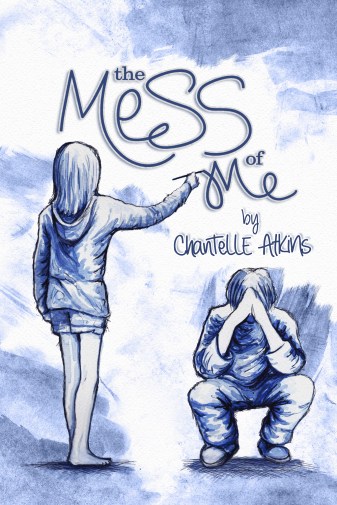
I remember struggling with this at the time though. And I’m still struggling now. Back then, I had written The Boy With The Thorn In His Side, Parts One and Two, but while it was with beta readers, I very quickly churned out The Mess Of Me. The two were written side by side for a while until eventually The Mess Of me won the race and was released first.

The Mess Of Me has a 16-year-old protagonist and is essentially a book about growing up and the many teenage issues that go with it. At the time though, I didn’t think of it as Young Adult or as being aimed at teenagers.  I just listened to the voices in my head, as I always do, and they were young.  I soon figured out that not categorising and marketing The Mess Of me as YA was foolish and ridiculous. I had to get my head around something then. Was I a YA author? Did I just write YA?

themessofme-BLANK (1)

I didn’t have a problem with this as I have never grown out of loving YA books, and although I read a lot of genres, I do frequently return to YA and always feel like I am coming home. The problem was the next book. Though also having a teenage protagonist, and dealing with teenage issues, it was far harder to classify. Partly because the teenage narrator grows up and becomes an adult, and partly because there are two narrators for Parts One and Two, and the second narrator is an adult. In my head, this book was never aimed at anyone. I just had it in my head and wrote it.

I’ve got to be honest, this has mostly been my approach since too. This Is Nowhere features a grown man, but every other chapter dives back into the past to when the character is a young boy and teenager. I always felt like this one was probably better suited to adults though, so I categorised it accordingly.

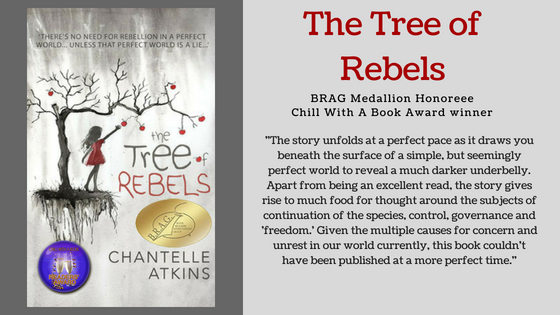
The Tree Of Rebels was the first and only book I wrote with a deliberate audience in mind, and I think I mentioned on here several times while writing it, that this made it the hardest book to write. It sort of altered how I felt about the book. It was like I was trying to write to please someone the whole time.

The Tree of Rebels

Since then, I returned to just writing what I wanted to write and not imagining the reader first. This is fine when writing, but presents all sorts of problems when the time comes to publish the book. What categories and keywords do I choose? How do I market it? What genre is it? How do I find the people who will like this book?

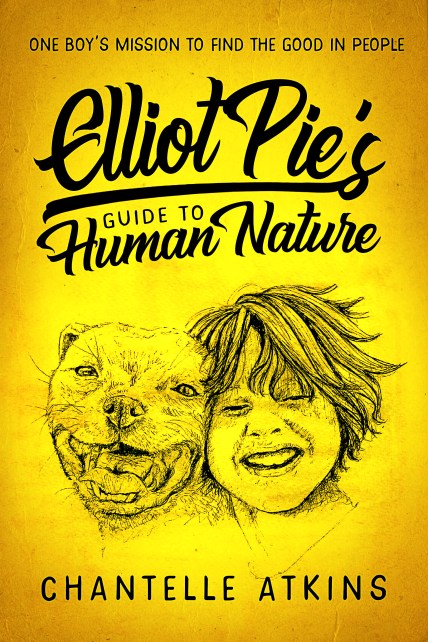
Elliot Pie’s Guide To Human Nature is a classic example of why I am still in such a muddle and still struggling to find my readers. It has a young narrator, but also an adult one. The adult themes, for me, make it more suitable for adults than teens, but Elliot’s day to day life and outlook are something that will more than likely resonate with young people. I still find it hard to describe the genre of this book. Definitely coming-of-age but also contemporary women’s fiction? Maybe even UpLit?

JshHMmZ

With Parts One and Two of the new, revised The Boy With The Thorn In His Side series almost ready to be released, and Parts Three and Four being polished up in the background, my mind has once again returned to my elusive reader. 2019 will continue to be busy as I plan to release YA novel, A Song For Bill Robinson and possibly it’s almost finished sequel, Emily’s Baby. My list of novels is growing longer, but I still don’t know who my audience is. It’s tricky when you cross over so many genres. Most of my books cross into two or more, with psychological thriller, suspense, crime, coming-of-age, mystery and dystopian all regularly showing up.

So, who is my reader? What sort of person reads my books and likes them? I only have a small audience, so it’s hard to speculate. But I suppose really, my reader must be someone quite similar to me. I imagine them as slightly scruffy, or at least not terribly groomed and over bothered with appearances. They probably make an effort when they can, and they probably berate themselves fairly often about sorting out some kind of ‘look’, but it never really feels urgent to do so. They are probably young at heart. Stuck in the past, tinged with nostalgia, reluctant to admit and give in to adulthood. I think they are a music fan. They probably like all sorts. They’re not narrow-minded about it at all. They’ll listen to anything, but they have their favourite era of course, and their favourite songs. They see life in songs. Soundtracks are everywhere.

record-player-1851576_640.jpg

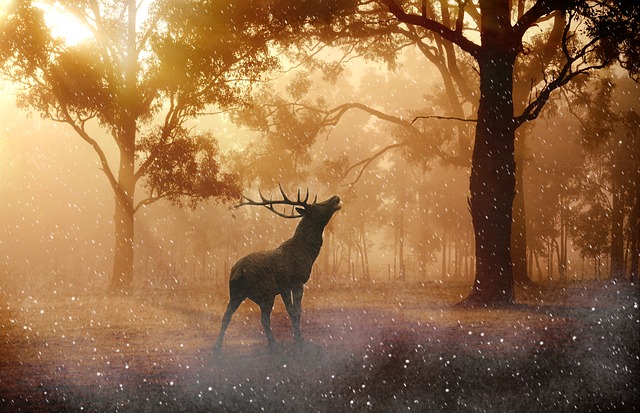
What else? I imagine them as liking animals and nature. Not in a really obsessed, or professional way, just in that seeing a bird or a deer unexpectedly will really make them smile and have a better day. I think they enjoy being outside, all weathers too. Being outside makes them feel more alive.

hirsch-643340_640

I think they are introverted but friendly and warm. A bit cynical and suspicious at times. Prone to the odd dark mood. Likely to panic about once a month about how the world is utterly doomed. But they always brighten up and soldier on. Despite being naturally shy, they are really interested in people, genuinely intrigued by them. They love a spot of people watching and love a character-driven book they can really get their teeth into. They are looking for stories about humans they can relate to and empathise with, and they are looking for characters to fall in love with, characters they wish were real.

They want to disappear inside a book and come out feeling different. They don’t want anything too formulaic or predictable. I think they are a bit of an eccentric at heart. They probably talk to themselves.

This is how I imagine my readers to be and I shall continue to do my best to try to find them. What about you? If you are a writer, do you know who your audience is? If you don’t know, does it make it harder to sell your books? If you’re sure of your audience, tell me about them. What are these people like? If you’re a reader, do you imagine yourself as part of a genre tribe, full of similar and like-minded people all connected by an appreciation of mysteries, or romance, or horror?

Please feel free to comment and share!

Stuck Inside A Story (For 28 years…)

That’s how it feels. That’s what it is. Stuck. Trapped. Held prisoner. I can’t get out. But do I really want to? Evidence would suggest not. Sometimes I wonder what exactly I have done. Created a world, created characters, used some magic and a lot of hard work, an imagination I can’t control, and there you have it, an alternative reality I can’t escape from.

I had no idea this would happen when I started writing as a child. My first attempts were hand-written stories about lost and abandoned animals, heavily influenced by my love of Watership Down and other similar books. I didn’t write my first story about real people living real lives until I was 12 years old. What happened to tear me away from my quaint tales of lost dogs and runaway bunnies? Well, weirdly, this.

download

And this.

45008420_2124373854248535_845460910603501568_o

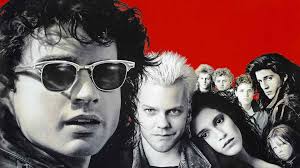
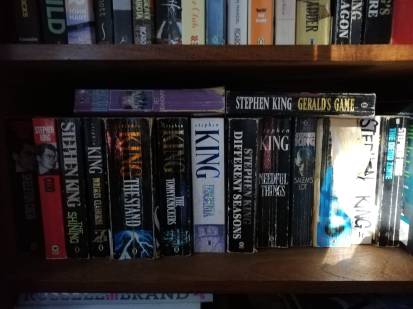
Watching The Lost Boys gave me a few vital ingredients for the story that would go on to hold me prisoner for the next 28 years. It gave me the main idea, the main concept and it gave me some characters. Or at least, it inspired me to create characters who would turn out to be the kind of people I wished I knew in real life. As for Stephen King, it was around this time that I started my collection and was well on my way to becoming a truly obsessed fan. Add to that strange mix, the recent divorce of my parents, the usual teenage angst and rebellion, and I had me a story. Remember the bit in The Lost Boys when the younger brother realises his mother is dating the head vampire? That’s where the idea for The Boy With The Thorn In His Side came from. It wasn’t called that back then. It wasn’t called anything for ages. But I kept thinking…what if your mother was dating a monster? Only not the vampire kind, the real-life kind? And what if no one believed you? And what if you only had yourself and your best friends to try to battle this person? It was a weird mix of asking ‘what if’ questions, my parents’ recent divorce playing on my own fears, a dewy-eyed fascination with the actor Corey Haim, and a love of horror and fascination with the darker side of human nature that spawned this tale.

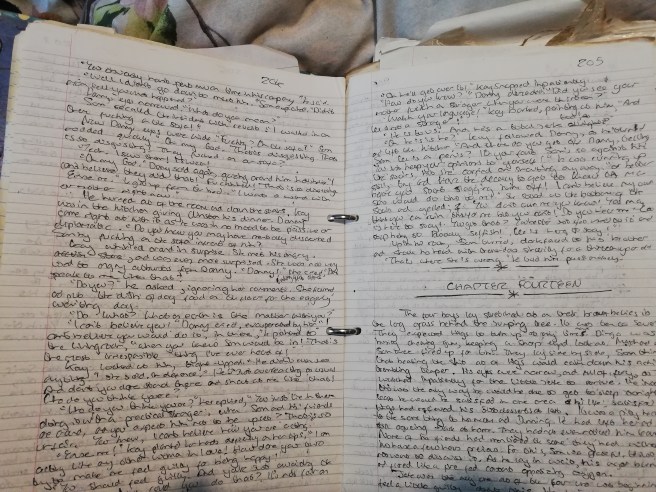
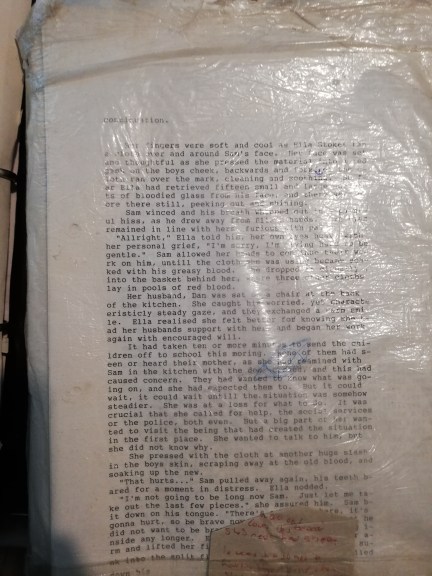
In my mind, my main character Danny, who is 13 at the start of Part 1, looked a lot like Corey Haim, who I was quite a bit in love with at that age. Once I had him in my head, his character started to grow and evolve, and I think I wrote that very early first draft pretty quickly. I remember it was my absolute obsession for a while. I hated to be away from that story. I’d rush home from school and up to my room to pick up my notebook and pen. I’d write endlessly and passionately. I suppose at the time I had no real idea of what I was doing. I was sort of trying to invent friends, I think. People I was intrigued by, people who had drama in their lives. I felt like I was a character in the book too. I was so proud when I finished it. I even started a sequel. I showed my English teacher and she read it and gave me a merit certificate I had to go up in assembly to collect. I remember being embarrassed but happy. The certificate said I had written a novel. At age 12! I don’t think I have the certificate anymore, but here’s the book.


IMG_20181030_100111.jpg

I started rewriting it after that. I had invested in an electronic word processor. It was the most exciting machine in the world to me! I could sit there and tap away and watch my words appear on this mini screen, before hitting print and then holding typed pages in my hands. What also happened to me at that age was that the story crept inside my brain. It kept me awake at night. It was company. I was never, ever bored. I’d look forward to bedtime because I knew I could lie there and think about my story before I fell asleep. I watched the scenes in my head like a movie. I heard them talking and arguing. Inevitably I came up with new ideas and extra bits, but mostly I just let them play it all out, and most of those imagined scenes have never made it into any of the books. It was just me, a fly on the wall of a made-up world, watching them live.

IMG_20181030_100519.jpg

Here’s one of the many pictures I drew of the characters. Only some of these made it into the final version.

IMG_20181030_100420.jpg

I rewrote that book again at aged 16. I’d started and not finished tons of other stories in that time. The book had opened a floodgate, forging a lifelong addiction to writing. But that one story, I couldn’t ever let it go. I rewrote it again at 19. I thought about it constantly during the non-writing years of balancing early motherhood with self-employment. The same story, the same characters always in my head, coming back to me night after night. I was 34 before I finally returned to it. I started writing in notebooks again, just like when I was a kid. Snatching spare moments, writing before bed, suddenly entirely addicted all over again, but this time it had to come out, it had to be finished.

I finally released it in 2013. The Mess Of Me snuck in and was released first because The Boy With The Thorn In His Side was so long and needed so much work. But finally, it was out. A real book I could hold in my hands! I’d done it. So now they would fall quiet, surely? I’d stop thinking about them. I’d stop playing out more scenes.

Well, no, not exactly. Before I knew it I’d penned a sequel, This Is The Day and released that too. That should have been the end of it it, but yet, it still wasn’t. The story itself was so enticing to me, and I was so invested in it, I couldn’t stop imagining other endings, and I guess, truth be told, in my head I did not want it to be over. So the stories went on. Every night, hi guys. What’s happening now?

I wrote an alternative ending in 2016 and included it in Bird People and Other Stories.That was supposed to draw a line under it, but it only made things worse. Now I couldn’t get the thought of other endings out of my head! What if this happened instead? What if? What if? For the fun of it, I started writing a screenplay in a notebook. Brand new material that led on from the original ending of book one, slotting in and delaying the ending, but finishing up before This Is The Day. This was only supposed to be for fun. To get it out of my system. To indulge myself even more than I already had. What the hell, what did it matter? It was for fun. I didn’t have to explain that to anyone!

Except now I do. Because that screenplay became a total obsession. I carried that notebook around with me everywhere. I grabbed every spare moment I had to write into it, getting this new story out. I absolutely loved it. I was so excited about it. I just couldn’t put it down. So eventually, after a lot of thinking and plotting, I came to a decision. I would do it. I would split the book back into two parts and this new material would be part three. Part Four would be This Is The day but it would need some reworking. Then suddenly, parts five and six emerged…

I’ve now accepted the truth. And that is that this story and these characters will never let me go. They are part of me and part of my life and I’m going to leave each book open, just in case I want to revisit it again.

There are new characters introduced in Parts Five and Six, and these also get their own spin-off book or possibly series with characters from both appearing in the others. So, as you can see… this thing could run and run.

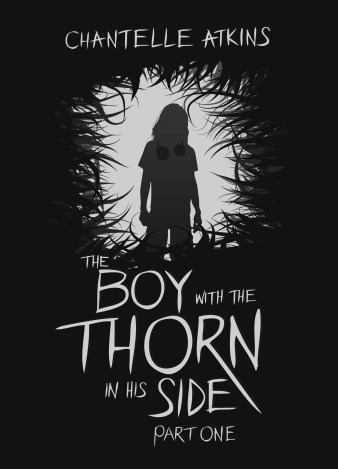
So, if you are interested in reading this story, which began when I was 12, followed me through my life and has now evolved into at least a six-part series, you can start with The Boy With The Thorn In His Side Part One which is available for pre-order on Amazon now and is released on 9th November. This is a reworked, revised edition. The Boy With The Thorn In His Side Part Two is also available for pre-order now and is also released on 9th November. Both at the special introductory price of 99p.

I plan to release the brand new Part Three in January an Part Four in February. By then I hope to be into the second or third draft of Part Five…

And the weird thing about this story is that I wrote it purely for myself, I indulged myself entirely, became utterly lost and absorbed and have still been unable to climb free from it. So I don’t really expect anyone to buy it, and I don’t really mind if they don’t. It feels weird to even try to plug it if I’m honest. Like this one is just for me. Like this is my mind, my imagination, my daydreams and to imagine anyone else wandering around in there is almost unsettling. And if it holds me prisoner for another 28 years? I think I’m okay with that…

theboywith-final-part 1