Did Choosing An Audience Ruin My Book?

I don’t know for sure, but it feels like it.

Let me explain. I am, of course, talking about The Tree Of Rebels, a book that once seemed so simple in its concept and execution. I tend to write quite hard hitting, gritty stuff, and I decided (rightly or wrongly) that I wanted to write a book my children could read. Specifically, I was aiming it at my daughters, who were at the time 11 and 12 and devouring books like The Hunger Games and The Maze Runner.

It wasn’t like I invented an idea to try to fit this genre and audience. I already had the idea for a dystopian future (one I am genuinely scared of). But I have to admit, this was the first time I ever sat down and tried to write a book knowing who the audience would potentially be.

Now, don’t get me wrong, there is absolutely nothing wrong with knowing your audience. Knowing your audience is key! How else will you know how to describe your book to potential readers? How will you know what categories to choose on Amazon etc? How will you know what cover and font to go for? All these things matter!

In fact, not knowing exactly who my audience were caused me no end of problems in the early days. You see, I didn’t know what kind of writer I was, because I had never really had to think about it before. The first two books I released, The Boy With The Thorn In His Side and The Mess Of Me featured young adults as the main characters, but this was purely incidental. In fact, if anything, I didn’t consider myself a YA writer at all and even kind of rejected the idea. I didn’t want to pigeon hole myself, I guess. I wanted adults to like my books too. It wasn’t deliberate that my characters were all young; that’s just the way it worked out. Or so I thought.

Truth is, I didn’t really understand the YA market at that time. I hadn’t looked into, or researched it as a phenomena. Since then, I’m glad to say I have learnt a lot and come to terms with the fact, that although not exclusively a YA author, YA is what I do best, YA is in my heart and soul, and YA is undoubtedly what I tend to seek out for reading material. I just didn’t really connect the dots in the beginning.

Anyway, the point I am trying to make is this. It can be good to know your audience before, during and after you write a book. It would have made things a lot easier for me when releasing The Mess Of Me if I had got on board with this and fully embraced and accepted the YA market I was aiming at.

BUT I do feel that knowing who to aim The Tree Of Rebels at has had a negative impact on writing the book. It felt like there was someone looking over my shoulder the whole time, saying no, don’t do it like that, that’s not how you write this sort of book! Looking back, knowing which audience I was aiming at definitely changed the way I approached it, making it one of the most challenging books I’ve ever written. I mean, none of the others ever felt that difficult, you know? They just kind of, happened. It’s not the only thing I can blame it on, and anyone who reads this blog regularly will know how many issues I have had with the book including the ones talked about in  Getting To Know Your Characters  and Final Draft? Patience is the key…

I’ve done so many drafts now that I have lost count. I have sent it out to beta readers three times and received very, very detailed edits and critique. I originally wrote the damned thing on Wattpad, so I had feedback on the very first version as it happened, and then posted later versions on there too. Lots of people have been involved and all of them have been incredibly helpful. Before I started this latest draft my intention was to fill it in more, add some detail and meat about how these people exist, but then towards the end I realised there was still something major missing.

Me.
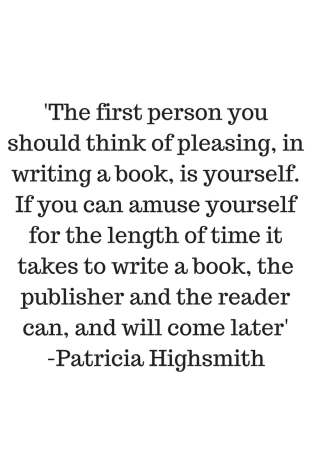
'The first person you should think of pleasing, in writing a book, is yourself. If you can amuse yourself for the length of time it takes to write a book, the publisher and the reader can, and will come later'-Patricia


It hit me one day while talking to my daughter.

I wrote this book to please them, and to please a certain type of reader who likes a certain type of book. I have never ever done that before. All of my other books were written to please me. They were written to scratch an itch. They were written to get the noisy people out of my head and onto the page. They were written out of passion and necessity. There was no other reason to write them other than that I simply had to. I’ve never known at the time of writing, who would like this book. Even with my current work-in-progress Elliot Pie’s Guide To Human Nature, I have absolutely no idea who this book would be aimed at or how I should even describe it! That for me, is familiar territory!

Of course, with my other books, on further drafts and edits I did begin to write and rewrite with my reader in mind. You have to! But they were not there in the beginning. It was just me.

So, how has this revelation helped me with The Tree Of rebels, you might ask? Is it totally ruined?

No, of course not. I still believe in the story and the characters. I have even started a sequel! But for now, I  have decided to leave this book alone. Put it to one side and focus on something else. I have decided to forget who it was aimed at, and essentially write it again. I have decided to write it the way I write all my books. I have decided to let it be whatever it needs to be and to stop trying to sculpt it into something I think it should be. In other words, forget about the perceived audience…For now.

I have a feeling it is now going to become an altogether darker book. But this is good. And would you believe it, while walking the dogs the other day, I had further revelations. Extra characters and another storyline, an important one, to feed into the others. It might make it a longer book. There might be more cutting. I’ve written the ideas down and that’s it for now. I am still not going back there yet!

But when I do I will be rewriting it entirely and writing it for me.

What do you think? How do you write a book? With the audience already decided or with just yourself to please?  Is anyone in your head when you write that first draft or do you really have no idea what sort of reader would enjoy it? Please feel free to comment! 


Take What Tortures You And Write About It

I’ve got a confession to make. Just lately I’ve been suffering from a strange, and as far as I know, nameless, affliction. The only way I can describe it to you is by asking you to recall the feeling you get in your stomach just before you sit an important exam. You know, that lurch, that turnover, that horrible tightness that takes your breath away for a moment? Yeah, that.

I first noticed it happening whenever I thought about my writing. The things I had planned to do once my littlest child was in bed. I put it down to a sort of nervous excitement, and a borderline panic about how little time there is to write all the things I have in my head.

Then I noticed it happened at other times too. Just randomly. My stomach dropping, lurching and rolling over.

So, then I blamed it on something else. I’ve always been interested and engaged in political thought and debate, but even more so in recent years. This is not a bad thing, but then it gets to the point where you are feeling angry and helpless all of the time. Post Brexit was pretty bad. It’s all pretty bad. Climate change. Inequality. Housing crisis. A rise in racism and hate crime. Endless war. The fact we’re being organised and dictated to by massive corporations hellbent on destroying the world. The fact you cannot trust the media to tell you the truth.

sadlaptop

So, I made the decision to delete Facebook from my phone. Something I never thought I would do! I was getting seriously addicted. Picking it up to check my newsfeed first thing in the morning, and pretty much every chance I got throughout the day after that.

I did feel an immediate sense of relief. That first morning stomach lurch dissipated. I picked up a book instead. I no longer check my phone throughout the day because there is nothing to check. I have a quick scroll through Facebook in the evening, once I have done enough work to deserve a little break, and I’m sad to say it’s still the same. The violence rages  on, the world gets hotter and there seem to be angry and ignorant people everywhere.

I did feel a sense of relief and freedom for a while. But that feeling in my stomach has not gone away. In fact, I am getting it more often. Maybe it is because I’ve become aware of it, nervous of it even? Confused by it, and as a consequence, fixated on it? I don’t know, but it is strange, and  very annoying. Sometimes it takes my breath away. I have to stop, hold onto something and take a very deep and deliberate breath. And then I am okay again.

I can’t blame anything in my personal life. Everything is as it should be. Everyone is in perfect health. Money is tight, but it’s never been any different at any time in my life. We have a lovely home and a huge garden. We grow our own fruit and vegetables and raise chickens and ducks. We’re outside, a lot! I’ve got my four beautiful, intelligent children, and yes they come with their own issues, and yes being a parent is sometimes stressful and exhausting. But I’m a placid, easy going sort of person. I roll with the punches. I look back on the past fondly, I focus on the now, and I don’t look too far ahead,(unless it’s my saving up for a VW Campervan.)

So why the bad feeling? What does it mean? What is it trying to tell me? I just can’t work it out. It takes me by surprise at random times of the day, creeping up and sucking the air out of me, crunching up my guts and making me think I have forgotten something important. Am I about to sit an exam? Am I about to confront some scary, aggressive person? What is it??

I don’t know, and maybe I will never know. Maybe it built up over time and my stomach got so used to being tied up in knots, it just doesn’t know how not to be. All I can do right now is try to make use of it. I wrote a short story you can find in Bird People And Other Stories called She Is… I wrote this story to keep a novel at bay, and I’ve started writing a second short story with the same characters. Basically the story is about teenage girls, bullying and revenge, but the narrator describes this constant heavy feeling in her belly. She wakes up with it, and it comes and goes throughout the day. Of course, this came from me and my own experience, and I’ve carried it on into the next story. In her mind, it’s because something bad is going to happen, she just doesn’t know what or when. It’s a sense of foreboding for her, a warning from her body.

My fears for the way the world is heading, my fight to find hope, my questions about human nature, have all been rolled out and examined in Elliot Pie’s Guide To Human Nature. (On the third draft now) I didn’t even realise I was doing it at first, but I’ve poured so much of my current state of mind into this story-line. Elliot is the child in me, the hopeful innocent looking for the good in people. His mother Laura is the cynic in me, (exaggerated a fair bit! )Through her I get to rant and rave, I get to swear and scream at the cruelty and injustice in the world. I get to indulge myself in misery and cynicism, fearing the worst and totally giving in to it. I get to hide under a duvet and pretend it’s not happening.

In The Mess Of Me Lou is the voice for my own teenage angst and body issues. She is louder and brasher than me, able to say things I was not.

In recent short stories I have released endless frustrations and anxieties. From my utter dismay that people think it’s okay to dump rubbish in the river where I live, to my constant paranoia that one day soon the Earth is just going to snap, just going to cull us all in one bloody swoop, freeing itself at last. I honestly don’t know how I would cope with this world if I were not a writer!

'Writers are desperate people and when they stop being desperate they stop being writers'Charles Bukowski.jpg

I think this is the best and sometimes the only thing we can do with something that tortures us. Use it, write about it, pass it on to a fictional character. Maybe this is one way to eventually rid yourself of it! Or at least gain a better understanding of it. I think writers do this all the time, often without even realising it. We project our fears and anxieties onto made up people, into made up worlds. So it’s not us with the problem, it’s someone else.

And then, we feel like we have some control. We can direct the proceedings, we can work out what the problem is, we can send the character on a journey and we can even create a happy ending 🙂 I truly think this ability is one of the greatest things about being a writer.

What about you? Please feel free to leave a comment!

When Fear Drives Fiction

So, I’m reading George Orwell’s 1984 for the first time and wondering if what deterred me from it for so long was fear of fear. By that I mean there is already so much to be afraid of in this world, why would I want to give myself more? I’m currently writing from a place of fear and uncertainty and it’s pretty obvious that I’m not the only human feeling like that right now. And I mean on a daily basis. It’s like that Monday morning stomach lurch, except it happens every morning. It’s like the heavy sluggish twisting guts you get before an exam, before a driving test, before you do anything you’re scared to do. Except it never goes away. It’s there all of the time. Weighing me down, wringing me out, making me pause to catch my breath. It’s like that too; like I can’t breathe properly, like there is a deep and shaking level of fear rising up to the surface, and if I am quick I can take a breath and send it back down again. Deal with it another day. Move on quickly into the light.

And there is light. It’s vital to remember that. There is light and love everywhere, and I hope you’ve got as much as I have in my life. When I feel too bad, when the sinking feeling starts to drag me down, I buck myself up and busy myself with the things I love. My beautiful children. Loud music. My garden full of flowers, vegetables and animals. Writing and books.

I’m examining the world right now and wondering if life imitates art, or if it is in fact the other way around. Does art reflect the world we have already created? Or does it project our fears for the future based on what’s going on around us right now? George Orwell must have been pretty terrified, that’s all I can think. Big Brother. Thought police. Uniforms and Two Minutes Of Hate. Chilling stuff. Which all feels rather apt and grim at the moment.

I’m writing to you from a post Brexit Britain. I hate the word Brexit. To me it sums up the dumbing down we’ve been subject to for so long now. Let’s join two words together and make a new one so we don’t have to say too many words! Now I don’t care how you voted, and I’m not going to talk here about my vote, or the whole situation in any real depth. I personally feel that there were good reasons to stay and to leave, but that as usual the government and the media focused on immigration and fed us lies, and what an ugly divisive country this now looks as a result. Let me say again, if you voted to leave, I respect that vote and your reasons for it, and I’m not going to talk about what might happen next. What saddens me most right now is the applause and delight demonstrated by far-right groups across the globe. Whether you like it or not, there are many people out there using this situation to legitimise racism and xenophobia, and that makes my heart sink. I thought we had come so much further than that, but it feels like we are slipping backwards all the time.

It feels like we are now adrift, with no one stepping in to guide us through this unchartered territory. The Labour party and the Conservatives are in turmoil. Everything feels weird and unsafe. I can’t help but wonder what future writing will evolve from this tumultuous time in politics. And that’s the only way to get through it, I feel. Write about it.

My next two books certainly reflect a lot of my current fears, thought I don’t think I was entirely conscious of it to begin with. The Tree Of Rebels was conceived one day when I signed an online petition to prevent Monsanto patenting seeds. I didn’t really know too much about the case, but some very concerned friends of mine deemed it a very serious issue, so I signed it and hoped for the best. It got me thinking though. What if a company could patent seeds? All the seeds? What if they could then, bit by bit, own nature? What if in the future, growing your own food was banned? Surely a government with complete control over nature, would have complete control over its people. The idea made me wonder further; how would this society operate without total rebellion? Well, the people would need to be thankful for what they were given, and what makes people thankful? Perceiving life to be better now than it was then. A story driven by wonder and what if’s…but ultimately fear. I’m a keen gardener myself. I worry so much about the state of the world, so I’m trying to become more self-sufficient, just in case. The thought of someone telling me it’s now illegal to grown my fruit and vegetables or raise my chickens and ducks is terrifying. The thought of a giant and powerful company with extremely dubious ethics essentially owning nature appalls me. So I wrote about it.

Writing helps me make sense of the world. Or at least it is my desperate attempt to. I guess we all have our fears. Things that keep us awake at night. I’ve felt for a while that the world and all it’s people are heading towards some kind of tipping point. Is the world now worse than it has ever been? I scroll through my Facebook feed to witness a never-ending roll call of human misery, animal abuse, environmental damage and worse than all of that; apathy. I feel sick to my stomach, as well as helpless, cynical and angry. Are these the most selfish times we’ve seen? The most brutal? Maybe it is all too easy to look back on the past too fondly. I’m guilty of this myself. I become convinced that the 1980’s and 90’s were a wonderful, simple time. Surely it was all lovely then, wasn’t it? Well no, actually. It’s just that I was a kid and totally unaware.

Fear and dismay drive fiction. We create stories we are frightened of as a way of warning ourselves and others. Helplessness spawns words and worlds and sometimes, if we are lucky, solutions. At least it makes us feel better, anyway. Elliot Pie was born of this frustration with the modern world and the way it is all heading. Elliot is 12 and he wants to do something to help his mother, who is refusing to leave the house after a number of hard knocks. How can he convince her the world is not a bad place filled with bad people?

It’s been quite a task for a writer currently so disillusioned and afraid. But I had to go back and look at it all through a child’s eyes. Elliot doesn’t want to give up on the world yet, or on life. He feels like the adults in his life have all written it off for him before he’s even had a chance to work it out for himself.

Like Elliot, and for my own children, I have to cling onto a dangerous and painful amount of hope. I stand by the very few politicians who have decent intentions. I hope the powers that be don’t prevent them trying to change things. I hope that people are not too apathetic, too far gone, too addicted to reality TV and pointless celebs to fight back before it is all too late. I hope George Orwell was wrong. I hope Elliot Pie is right.

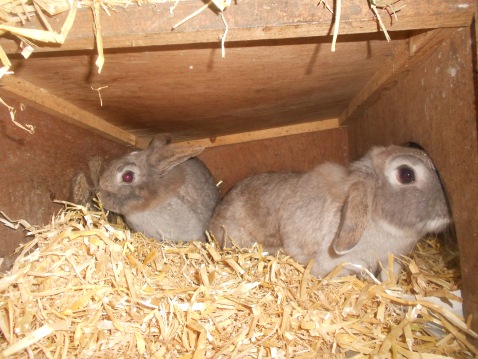
In the meantime, my advice to anyone feeling like I am right now, is to do what you can to ensure love wins. Whatever that means, in whatever way you can, make spreading love and tolerance part of everything you do. This morning I woke up feeling more positive than usual. I decided on the school run journey that I would be kinder than normal, and I let out as many waiting cars as I could. It was actually sad how many of the drivers looked genuinely surprised and thankful. I played some invigorating, uplifting music, told my kids I loved them, and decided that if the two little rabbits in the adoption centre of the pet shop were still waiting for a home, then I would get them. I’d had my eye on them for a while, and once I’d learnt their history (four years of neglect) it was a done deal. I know it’s not much in the grand scheme of things, but every little bit of love counts. And at least I changed the world for them.

DSCN3186.JPG


What Comes First? The Characters or the Plot?


What comes first? The characters of the plot? I guess the answer is different for every writer, and often different for every book. I’ve been thinking about this since one of my daughters showed a rare interest in my writing and asked me what came first; my characters or my plots? My immediate answer was the characters, as this is how it so often feels. But as I went through the novels one by one, I had to admit that it’s different each time. For example, The Boy With The Thorn In His Side was an idea that grew into a character, followed by a more complex plot. The Tree of Rebels, which will be my next release, was undoubtedly plot before characters, more so than any other book I’ve written. I’ve blogged before about how difficult this made the process, and how it has taken longer for me to understand my characters and feel comfortable with them. With Elliot Pie (a book only in its first draft) it was the character first, but his character, in being someone who was intrinsically curious about strangers, was the plot. So they evolved simultaneously.

Having thought about it for some time I realised that my novels, This Is Nowhere and The Mess Of Me both have something in common. They were both written in the same way. I had the character first, and then had to create a plot to go with them.

I’m not sure this is the best way to write a book, but it’s just the way it worked with these two. With This Is Nowhere, I had the character in my head for some time, and with the character came the whole feel and tone of the book. Slightly sombre, dark around the edges, yet gentle, confused, struggling through mystery. I knew the character was a male in his late twenties or early thirties, and I knew he was rootless and aimless, a drifter. He had never grown up, but why was that? I knew he had a bad relationship with his father but the rest of that came much later. I knew he had a recurring stomach ailment, and had turned his back on the religion he had been brought up with. I had images in my head of a boy running across a sun baked field, though running from what I had no idea. The whole thing seemed to evolve in my head through feelings and images. I got the idea for the plot involving his missing mother when I was walking my dogs in the woods one day. I’m pretty sure, though it is hard to recall now, that my daughter had spoken to me about a missing persons case, and that had set something off in my head. What if this drifter was to return to his small home town in order to find out what happened to his mother, who vanished when he was a child?

With The Mess Of Me it was harder. In this case, I would probably not advise coming up with the character before the plot, although in all honesty I had absolutely no control over this!

Lou Carling started talking to me when I was about half way through writing The Boy With The Thorn In His Side. This was fantastic to me at the time. Having had a long break from writing, in tackling The Boy I was giving it all a go again, seeing if I still had the urge and the passion. When Lou started talking and grumbling, I was overjoyed because I had that feeling again. Of fireworks and ideas exploding in my head, of panic and excitement knotting in my belly, of wanting to hurry home to the laptop, of needing to scrawl notes onto scrap paper so I wouldn’t lose a thing. Essentially, Lou let me know that it was back. Writing was back.

I let her babble on for a while, mostly because she really amused me. She had just finished her GCSE’s and had a long summer before A-Levels ahead of her. She was deeply cynical about everything and everyone, and had a rather filthy mouth. Her best friend was a boy called Joe, a lanky, hazel eyed boy whose mother was her mother’s best friend. I could see Lou and hear her. In fact she barely left me alone. She would have constant conversations in my head, really interesting little nuggets of dialogue I just had to scribble down for later. But I had no plot. What was this book going to be about? What was going to happen to her? What did she want? What did she fear?

It took a while, but I got there in the end purely by listening to her, and being witness to the world that started to build around her. The claustrophobic council estate, growing up without money, feeling exasperated and embarrassed by her family. Hating everyone, especially herself.

I’m happy to admit that large parts of Lou are based on me, on my own experiences, on my own views and feelings growing up. In many ways, she is the character closest to me, at that age anyway. But I allowed her more freedom, letting her express herself when I was too shy to. Immensely liberating, I can tell you. The plot I ended up with actually came from a strange childhood memory.

When I was young, my mother had a friend who had five sons. She was a larger than life kind of woman, large in build and large in voice. She would sweep you in for a cuddle and nearly break your bones. She used to make jokes about swapping my mum’s daughters for her sons, and I used to think she was serious, and I was just a little bit afraid of her. I loved going to her house to play though. With her two youngest sons, me and my sister and brother used to trespass onto the grounds of their local school and play games with their pet dog. We would climb and hide in trees and bushes and behind walls and the dog would look for us. I can also remember playing with a huge mound of cardboard boxes in their back garden, making dens out of them, climbing up them and leaping off to crush the boxes below.

Her three older sons were teenagers when we were small. They flitted in and out of the background, and as I was so shy I probably never spoke to any of them. I watched them get the odd clip around the ear. One even had his mouth washed out with soap one day. But they were like mysteries to me. Part of my life, and yet totally unknown. They could have been anyone. They could have had any kind of life without me knowing. I had no idea who they were, where they went to, what they did, or what they dreamed about.

One day we were coming up the front path and one of the teenage boys was sat on the doorstep with his head in his hands looking absolutely miserable. In the cool dark of the kitchen, I overheard my mother’s friend telling my mum he was in so much trouble. They muttered and murmured in there for some time, while he remained on the doorstep. I never did find out what he’d done wrong.

So somehow, for some reason, this all crept into Lou’s world. The house full of boys. The mother on the warpath, driven to distraction by her unruly brood. Having these people you’ve grown up with, and yet never really know. Mysteries that unravel just out of reach and over the heads of young children who are told to go out and play.

The drug running storyline was of course utterly fabricated. It could have been anything really, the trouble the boys were in. Everything else from here on was pure imagination!

In many ways the drug running activities of Joe’s older brothers, and the way both Joe and Lou get pulled into it all, is a sub-plot to the main one, which is simply Lou’s journey over that summer. Her determination to lose weight and get skinny. Her finding herself, without it sounding too much of a cliche, was central to it all.

So that’s the story of The Mess Of Me. Where it came from and how it happened. It is probably my most character driven book, with the plot almost taking a back seat to the characters.

What about you? As a reader, do you ever wonder what came first, the plot or the characters? Can you ever tell?

What about you writers? Is it always the plot first, the characters later? Or the other way around? Which way does it happen for you, and does it make it harder to write if it happens in a way you are not used to?

Feel free to comment below!