If At First You Don’t Succeed…

Today I’m going to be brave and talk to you about failure. My own recent failures, or at least, things that have not gone as well as I hoped. Talking about failure is not easy. We don’t like to admit failure to anyone, let alone ourselves.  It’s embarrassing when something is not a success.  Just lately, I’ve tried out a few bright ideas and they have all sort of bombed. I’m mostly an optimist and try not to feel down for too long, but I’ve got to admit, the perceived failures dented my confidence at the time. My head is ruled by two opposing voices. I have one constantly telling me how crap I am, how everything I do is utter, pointless rubbish. And then I have this other voice piping up constantly; ooh I’ve got another idea! Let’s try this! These voices have 50/50 control right now. I think I’m rubbish because something didn’t go as planned, and then the other voice suggests something new to try…so I keep going. I’m going to list the recent failures below and talk about how and why they failed, and how also they sort of succeeded as well…

Cancelled a workshop due to lack of interest… Back in March, I ran my first adult workshop under my Chasing Driftwood Writing Group business. I had already put on a few for Dorset Writers Network and I’ve been running kids workshops since 2015. It was scary to put on my first one aimed at adult writers, but Building Your Author Platform was a great success, highly enjoyable and I received terrific feedback. I ran another one a few months later which was less well attended but I still viewed it as a success. Some people requested I run the Author Platform one again so I decided to book it for November, thinking it would be nice to help these writers and make a little bit of money before Christmas. Despite my best efforts, I could not drum up enough attendees to make it worth running. I had three tickets sold before I decided to cancel it and refund them. This was a tough decision because I felt really bad about the people who had bought tickets, but I was also feeling very low about putting it on to so few people. It sucked, to be honest. I questioned my decision to apply for Chasing Driftwood to become a Community Interest Company (currently awaiting a decision on this) and I even thought about jacking it all in. The fact my last kid’s workshop also had very low attendance was playing on my mind. Maybe I should quit this. Maybe I am bad at this. But then I thought about the reasons it failed. I think a lot of it is lack of advertising, and the reason for that is financial. One of the reasons I am applying to become a CIC is to better access arts-based funding to put on various writing projects. Some of that money can go towards advertising. They say you have to spend money to make money. Well, if you don’t have any money, you have to apply for funding! Which is exactly what I’m going to do. If I still can’t fill workshops once I’m a CIC with a decent advertising campaign behind me then yeah…maybe time to think again.
keyboard-648439_640

Author Event at Library Cancelled…So, I can’t really take the blame for this one, though at the time it was frustrating and disheartening and I certainly viewed it as a personal failure. Last March my local library put on a very successful author event, where local writers paid a small fee to have a table in the library to sell books. I only sold a few but I really, really enjoyed the event. Coming up to Christmas, I wondered if we could capitalise on Christmas shoppers and have another one. The library manager was all for it, and we both contacted various writers to see how much interest we could get. We got none. Literally, none. The lovely manager said let’s leave it for now and so it never happened. I was gutted, but it did inspire me a bit too. I’ve had this idea for a pop-up bookshop for some time, and want to get started once (if) I become a CIC. The library have already agreed we could set up there anytime. If it’s just me it’s just me. But I’ve already got an email list of local writers I can contact when this happens. So, in this case, I’m viewing it as perhaps we’ll try again another time…

Hiding Books… Initially, this was fun. I had some stickers from The Book Fairies, and for ages and ages, I’d thought about hiding my novel This Is Nowhere around my village, as I set it here. I thought the local people might like to know there is a novel set where they live! It took a long time to gather the courage (I am genuinely scared of being told no) but I contacted the parish council who let me add a piece to the newsletter, detailing what I was up to. In other words, hiding four copies of the novel in the location it’s set in during a five day period. Slips of paper were included to politely ask if the finder could share pics to social media re where and when they found the book, and then rehide it to carry on the fun. It was daunting, to say the least, but I did it. I hid the four books and waited for communication. To date, I’ve heard….nothing. All four books have been taken. But I have absolutely no idea by who! They could all be slung in bins for all I know! I tried not to expect too much, but I did really hope to hear from at least one happy finder. Having said that, maybe I will. Maybe the books will get hidden again! Who knows? And I’ve talked myself out of viewing it as a total failure, as I did get one ebook sale for the novel when a local resident contacted me via Facebook asking how she could download the book… It is a shame I didn’t get more sales or communication from my local friends and neighbours, but what was nice was the response I got online from other writers. I posted on Facebook and Instagram and received such enthusiasm and lots of people excited to try the same thing. So, not a total failure. I just hope they get a better result than I did! Would I do it again? Well, considering how out of pocket I am, probably not. Not for a while anyway!

Christmas Pop-Up Book-Shop… Another great idea of mine. With the real-life pop-up shop in the pipeline, I thought why not try an online one, in the form of a Facebook event? I roped in my good friend Kate Rigby and the plan was to invite other writers to post links to their paperbacks into the event, along with other interesting things like maybe a giveaway or competition, and hope to entice some readers in to buy Christmas presents! We thought a great idea in theory. So was it a failure? Well, yes and no. If I’m having a bad day I’m going to throw it on my recent failures heap and sulk about it. But if I’m having a good day I’m going to remind myself that it was a trial run, something to learn from, something to try again bigger and better. The authors were absolutely fantastic. I bought a great book to give to Mum for Xmas, and I added some others to my to-read list. It was fun, but in terms of sales and exposure, well no, not really a great success. Hardly anyone from my friends list joined in. That always stings a bit, but then I remind myself that people are not always convinced by indie books. Also, in an online event, you can’t really pick the book up and flick through etc. Will we do it again? Yes, we definitely will.

Self-publishing… You might know by now that I have a love/hate relationship with self-publishing. I am, at times, extremely proud of my books and the platform I have been building, and everything else I have done. Then, at other times, I view self-publishing as a failure in itself, because I was rejected. Not wanted. Not good enough. I still think a lot of my friends and family have the view that self-published means not very good, and so they kind of ignore what I’m doing. I know that there are amazing self-published books out there because I mostly read indie books. It’s a bumpy ride. I don’t regret it because if I hadn’t done it, I wouldn’t have my books out there at all. But at times it leaves me with a bad feeling because I think I have not yet written anything really credible or worthy of being traditionally published and sitting proudly on the shelves of Waterstones etc. I expect I will always feel this way while sales are low. And sales are low. It’s not a nice thing to admit, but I know most indies are in the same boat, so I try not to see it as a reflection of my work. The endless problem is reaching readers when so many thousands of books are published every day. I think readers are much more likely to notice and buy and read the trad published books because they are so much more visible to them. So, the fight goes on.
chalkboard-1927332_640.jpg

Above are listed my recent attempts to better myself and my position, to achieve something new, to try an idea, and in many ways, they were all failures. But then I think, at least I tried. (In case you don’t know, I fully intend to have the Frank Turner lyrics from Eulogy engraved on my headstone; “At least I fucking tried”) Surely, the real failure would be in never trying at all? In thinking up these ideas and then ignoring them? In feeling great enthusiasm for a project, and then never trying it out in case it failed? In having dreams, but being too scared to pursue them?

I think so. And I also think that every failure shapes you and helps you progress in some way. You’ve got to be big enough to take it on the chin. You’ve got to be humble enough to admit what went wrong. You’ve got to be brave enough to get back up and try again. (After a mini-meltdown though, of course. Those are always allowed!)

And guess what? Since I started penning this post, I’ve had another big idea!!

So, what do you think folks? Do you want to be brave and tell me about your recent failures? How did you deal with them? Are you going to try again? I love it when you comment and please feel free to share!


How Self-Publishing Dragged Me From my Comfort Zone

When I started my indie journey back in 2013, I was full of optimism and excitement. I, of course, had no idea how much hard work was ahead of me. I had no clue about the amount of disappointment and frustration heading my way. I also had no way of knowing then, how far out of my comfort zone I would be pulled.

Writers are by nature, shy, introverted creatures. I’m no exception. I was a quiet, bookish child. I loved my own company and always preferred reading and writing to socialising with real people. I always thought becoming a writer would be the perfect vocation for someone like me. I was intrigued and fascinated by people. I wanted to watch them and learn about them, but all without actually getting involved. I’d build a little warm bubble of imagination around my life and spend my days tapping away at the laptop, dreaming up stories and inventing new friends. Lovely stuff.

But alas, being an indie writer is not quite like that. You can’t really get away with hiding. You certainly can’t get away with not promoting or marketing your books. This was horrifying to me, to begin with. I loathed the thought of creating social media profiles and drawing attention to myself. What the hell would I say? Who would care? What about Twitter? I’d just be ignored, wouldn’t I? How would I get my books noticed?

And yet, look at me now. I’m still me. But I’m a much braver me. And maybe I have self-publishing to thank for that after all. I’ve built a platform slowly. I’ve grown my pages and my blog. I’ve networked (God how that word used to terrify me!!) I’ve grown and matured and learned so much. I even pass things on to others now. I write articles about writing and get paid to do so! I stand up in front of new writers and deliver talks and workshops!

And last Saturday, I did my first author event.

I’d heard about these but never felt brave enough to put myself forward. The thought of sitting there with my books, hoping people would buy them chilled me to the bone. But last year I changed my mind about a lot of things and realised I had to break out of my comfort zone. I had conquered my online fears and now I needed to conquer my real life ones. I had to actually get out there and talk to people and physically sell my books. I had to reach out to my local community as well as the global one. Show my face. Be seen and be proud. I had to do the thing I had never been very good at, interacting with people.

18077267_1489261664426427_4842579535465129597_o

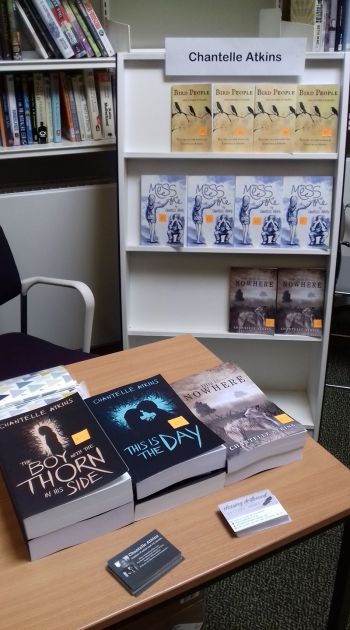
And it was fun. I only sold three books, but to be honest, I wasn’t expecting to sell much more. I didn’t really know what to expect from the event itself and was really pleased and excited to see how the library had set each author up with their own table, book shelves and a very visible name tag. I felt an unexpected surge of pride and importance! It was very quiet though, so us authors started chatting and networking. We swapped cards and advice and took photos of each other to upload to social media. We had a laugh and a moan about the life of an indie writer. I also got chatting to members of the public who wanted to know about my book or my writing group. It was fun! 

And that’s how I’m going to approach it if this chance comes again. Fun. An opportunity to network with other authors, to support each other, and to feel proud of how far we have come. No, we don’t sell a lot of books and maybe we never will. But we wrote them. We stuck with them. We finished them, edited them, proofread and revised them. We found front covers, devised blurbs and started to learn how to promote them and grow a following. If I went back now and told the introverted child version of me, I don’t think she would believe a word of it.

I’m smashing my comfort zones because of self-publishing. I’ve achieved my childhood goals because of self-publishing. I’ve met some amazing authors, read some life changing books and gained some true friends because of self-publishing. I’ve started a writing group, I put on workshops, I work for others, I write articles, I write reviews, all because of self-publishing. I was brave enough to go on local radio, because of self-publishing. I’ve made mistakes and picked myself back up. I’ve had bad days and sad days, and I know the ups and downs will never end. But I’m stronger, braver, happier, more knowledgable and experienced and positive than I ever knew was possible and it’s all because I self-published.

Don’t get me wrong, indie publishing is not the answer to all of my dreams. I still long to be traditionally published, because it still seems to me this is the best way to get visibility, sales and reviews. I made a decision very recently to submit each new book I write, to a suitable press. Just in case. You can read about my reasons for this here; Self-publishing; Good times, bad times and ugly truths

Whatever happens, I will always be proud of my self-publishing journey. Sometimes I do need to remind myself how far I have come. I think we all do, from time to time. I will always be thankful to self-publishing for allowing me to get my books out there, for enabling me to connect with readers and grow a small, loyal following. It’s opened up other doors for me too, and dragged me all the way out of the introverted little bubble I used to hide away in.

What about you? What’s your comfort zone? Have you done anything recently or in the past that has dragged you from it? I would love to hear from you, so please feel free to comment and share!

Self-publishing; Good times, bad times, and ugly truths

I am writing to you from a place of confusion. I’m unsure about so many things that I feel the need to write them down to make sense of them. The one thing I am sure about is this; I am a writer and I need to write. I will always be a writer and I will always need to write. Everything else is a muddle.

Let me try to explain. When I got back into writing in 2011, I had a decade of wasted years lying behind me. Don’t get me wrong, these years were not wasted in my personal life. I was bringing up small children and earning a wage. I was too exhausted to write. Or so I told myself. The real reason? I was too afraid to take it further. I was too shy, too anxious, too introverted and too protective of my work to send it out to agents and publishers. Ahh, I can breathe a sigh of relief now that’s off my chest!

Once I started writing again, nothing would stand in my way. Not a new job, or a new baby. And at some point in 2013 my attitude towards publishing changed. I got braver. I’d shared some work on here and had some good feedback from a few very early followers. So I started sending the two books I had written, The Mess Of Me and The Boy With The Thorn In His Side out to agents and publishers. I wrote massive lists of both and worked my way through them. It was, of course, depressing and demoralising, but I felt I had to do it. I never expected any of them to like my work, and in many ways, it felt like a rites of passage to go through this.

Self-publishing presented itself to me and appeared to be the answer to all of my problems. I didn’t need to torture myself by waiting for inevitable rejection anymore. I didn’t have to stress over how to word a query or an email. I could take full control and get my books out there on my terms. Brilliant.

philosoraptor-self-publishing-you-say-i-think-this-could-work-out-well

It was exciting to start with. I felt like I had accomplished something. I had realised a dream. I had written and published my books! I wasn’t too fussed about sales or money as that had never been my motivation, and in those early, hazy days, I was just excited.

Of course, reality soon set in, and over the last four years I have had one hell of a bumpy ride and made many mistakes. I’m actually embarrassed now to look back on the early days. I had no idea about front covers. I had no idea about social media, building an author platform or promoting my work. I soon bumped back to earth and started the real hard graft that is the life of an indie author.

Let me tell you the reality of being an indie author.

It’s good and it’s bad. It’s pretty and it’s ugly. I love it and I hate it.

Indie authors do everything themselves. Yes, they may hire editors and front cover designers. If they have oodles of spare money they may pay for adverts and promotions too. There is nothing more evil to me than the saying ‘you have to spend money, to make money.’ That’s the crappest thing ever to say to someone who has no money.

Indie authors offer their work for free. This happens in very few other areas of life. But people expect it now. They expect freebies and offers and giveaways. We expect reviews and recommendations in return but rarely get them. In essence, being an indie is like giving your all, your everything, your blood sweat and tears, and then getting very, very little back. And again, I don’t just mean sales. I keep my books priced low because I want people to be able to afford them. I give free books and stories away with my newsletter and I post free stories on Wattpad and I do the odd giveaway.

Indie authors work extremely hard. They’ll have families, and other jobs, and still keep plugging away, writing more books, building their platform, increasing their content, remaining active on social media, trying new things all of the time in the hope it enables their books to become visible. They don’t want to spam people, they don’t want to beg. They have to learn how to self-promote without getting on people’s nerves. They have to deal with people thinking they are totally wasting their time.

insanity-wolf-buy-my-books-buy-my-books

Let me be clear once again; it’s not about the money. It’s about the connection. I write books because I want people to read them. I love that connection. I love passing my stories on. I love receiving messages about how people related or reacted to the characters.

Right now I feel like I am betraying the indie scene, because I am trying the traditional route again with the next two books. I started the process the other night with The Tree Of Rebels and was instantly reminded of why I hated it so much last time. Ugh. It’s scary. I kept thinking, just self-pub it! Why are you doing this to yourself again? You’ve been here and done this! You’ve moved on! You’ve grown! You’re indie and proud! You know how to do it now, how to get the right cover, the right blurb, the right marketing plan…Yes I do, but I am also, really, really tired. My confidence is at an all time low. I am not making that connection with people. I am banging my head against a brick wall.

So, here I am again. Researching publishers and putting my heart in the firing line. I already had one rejection the day after I started this! I expect many more to come. Maybe I feel I need to do this. Give it one last try. Because I am not succeeding as an indie. I am getting better as a writer, and I am getting better at all the things you need to do to be an indie, but I am not succeeding where I really wish to, which is gaining new readers and forging that connection.

I see other authors getting promoted with their publishers and I want a piece of that action. I admit it. I am envious. I am filled with longing. I am practically drooling for the same number of sales and reviews. I want what they’ve got and I am afraid that my efforts as an indie will never be enough to get it.

So, heart in mouth, I will try the traditional route again.

But no fear, I will self-pub these books if I get nowhere. I promise you. I will self-pub the god damn hell out of them! I will market and promote the holy fuck out of them! I absolutely promise you that. I promise myself that. I will come back harder and faster and stronger.

There is no giving up. Not ever.

Either way, I will keep writing and getting better at it and if I self-pub again I will never give up trying to find more readers. This is not a post about quitting. This is a post about the realities of finding success as an indie. And by success, I mean a growing readership.

It’s just at the moment, I am tired of the indie ups and downs. The good days followed by the bad days. The endless hope that one day it will all be worth it…

And in a weird kind of way, submitting to publishers has already made me appreciate being an indie…it’s already made me feel that surge of pride and passion again about everything indie authors do, and are…I love the indie scene, I really do. I have read countless amazing books, in fact, I rarely read traditionally published books these days, because there is so much talent in the indie pool. It just makes me sad that so many of them are not getting the recognition they deserve.

Over to you. What do you think? Do you love being an indie? Is it what you thought it would be? How do you keep going when times are tough? I would love to hear your thoughts on everything I have talked about today. Join the conversation, have a moan if you need to..and then we will all get back to the writing!

Beta Readers; How and Why?

Several months ago I was convinced that my new novel, Elliot Pie’s Guide To Human Nature was ready. I sent it to a tried and trusted beta reader who very patiently and kindly informed me that it really wasn’t. I listened, realised she was right, and tackled it again. And again. And…well, you know how it goes. Finally, a few more months down the line, I thought, okay, this is it, I’m happy, really happy! I’d addressed all of her concerns and it was definitely a much better book. I then sent it to another beta reader, quite arrogantly expecting her to gush with excitement about how ready it was. She didn’t. It wasn’t. Repeating these things to my husband, he asked a very important question. How do I know the beta readers are right?

This is an excellent question and one worth addressing. But first of all what should you look for in beta readers and why do you even need them?

You need them because you are far too close and subjectively involved in your marvellous work of art to see its flaws. It is very difficult for an author who is in love with their story, to be able to see where the pace is too slow, or the information repetitive. You may not realise how much of you and your beliefs and opinions are seeping into the book. You may not realise that there is too much dialogue, or not enough. It is your baby, your child, your masterpiece. Yes, your relationship with it is up and down. You love it and then you hate it. You are filled with self-doubt one moment, only to be surging with confidence the next. Either way, you need beta readers to bring your down to earth. You need them to tell you what is good about the book and what is not so good about the book. Of course, you don’t have to accept their advice, and you certainly don’t have to act on it, but to release a book or submit it to publishers without using beta readers would be, in my opinion, insane.

So, what should you look for in a beta reader? I think this is quite a personal thing and may also depend on your genre of writing, but here are the things I look for and require in my beta readers.

  • they need to have already read my work and connected with it
  • they need to be somewhat connected to me and my life, and have some knowledge of my beliefs etc
  • they need to be highly educated, or at least way better at grammar than I am!
  • they need to be an avid reader, someone who consumes books like an addiction
  • they need to be open to most genres, not snobbish or narrow-minded
  • they need to be breathtakingly honest and not scared to offend
  • they need to be able to understand how a book could be made better
  • they need to be prepared to read the book at least twice and make notes

What sort of things should a beta reader be looking out for when reading your work? Well, again this is very personal, but I will explain the way I often approach it. With Elliot Pie, I wrote the book quite naturally, just letting it flow as you do with a clumsy first draft, worrying about the finer details later. I finished the very first messy draft just over a year ago, and I honestly didn’t think it would need too much more work! This goes to show how blind you can be about your own writing. I did a few more drafts before sending it to the first beta. At this point I was looking for opinions on the plot and the actual story and on the characters. Did they work? Were they real enough etc? What about the structure of the plot and the flow of the narration?

What I got back was very interesting and resulted in me changing a lot of the chapters around. The beta had loved the characters (yay!) and the story but she found the pace too slow in the middle of the book and she guessed the ending. Not too big a problem, as it’s not supposed to be a real twist at the end or anything, but she did help me work out ways I could knock the readers off course a bit. She was also right about the pace. It was too slow in the middle and lots of it needed to go.

Job done. I attacked the book again, and again and again. Each time I went through it, I cut bits out, added bits, fleshed the characters out more, and wrote lists as I went which consisted of the things I still needed to do when this draft was done. I considered my work done when the lists ended. As far as I was concerned I could do no more. Yes it would need some more proofreading and a few more read throughs, but I was happy. More than happy.

I sent it to the second beta reader as she is my biggest critic and I knew she would be intensely honest. There was no way she would hold back if there was anything about it she thought could be better. We ended up having several Skype chats while she went through her very detailed notes on the novel. I made lists, nodded and listened. The more she talked, the more I realised how right she was, and the more I felt my own subconcious misgivings becoming unearthed. Everything she said about the book was true. I had written it in both first and third person. A bit of a challenge, yes, but that was just the way the story presented itself to me in the first draft and so I went with it and ended up sticking with it. This meant that all of Elliot’s, (the 12-year-old protagonist) perspective is in the first person. We are entirely inside his head. And in my opinion, that’s a wonderful place to be. I find him interesting and funny and amusing, you see. Of course I do, I created him! But would the reader think the same? Or would they find the narrative repetitive as he talked them through his little world? Was I telling them far too much detail when a lot of it could be shown rather than told, or omitted altogether?

I sat and nodded grimly and knew that my beta was right. I had climbed inside his head and got lost there. I was way too close and way too involved. I loved him too much but I needed to get back out and get some distance. I suggested changing his view to third person and the beta had thought the same thing. The more we thrashed it out, the more I realised how many problems this would solve. I actually began to get excited. There were other issues too, aside from POV, but I won’t go into them now as they will probably pop up in another blog post.

We talked about how I’d had a similar problem with The Boy With The Thorn In His Side. (Again, this is where history, friendship and connection aid the beta/writer relationship) Originally written in the third person, from all the characters point of view, it was eventually rewritten into the first person, and from two points of view. At the time I was both terrified and excited to take this machete to my work, to slice it up and stitch it back together again, to tell the story in a totally different way. I knew I would lose tons of scenes and perspectives and dialogue and this saddened me beyond belief. But it worked.

With Elliot I have the same problem but in reverse. I need to lose the first person, get some distance from Elliot and tell the story in a different way. There is a lot of work to be done, but the groundwork is all there. The second beta also loved the actual story, the plot and the characters and found the pace just right.

I am so glad I gave it to her to dissect. But back to the original question? How do I know she is right? How do I know either of them are right? I know because as soon as they voiced their opinions, I knew I had been thinking the same thing all along. All they did was confirm what I already knew deep down inside. I just didn’t want to admit it to myself, because admitting it meant even more work, even more drafts, even more editing and proofreading, and it means the other books that are on hold waiting for this one to be done have to keep waiting and waiting and cramming my mind and driving me insane! I wanted the book to be ready so badly I had convinced myself it was.

But I can’t let a book go until I am sure it is the best it can be, and in my case, my betas are there to help me get to that point. I can’t thank them enough for the time and effort they invest in me and my books. I trust them implicitly and I know I am extremely lucky to have them.

But what about you? Do you use beta readers and if so how did you find them? What do you look for in a beta? Have they ever felt differently to you about a book being ready for release? How have they helped your books reach their full potential? Have they ever been totally wrong? Please feel free to comment and share!