Did Choosing An Audience Ruin My Book?

I don’t know for sure, but it feels like it.

Let me explain. I am, of course, talking about The Tree Of Rebels, a book that once seemed so simple in its concept and execution. I tend to write quite hard hitting, gritty stuff, and I decided (rightly or wrongly) that I wanted to write a book my children could read. Specifically, I was aiming it at my daughters, who were at the time 11 and 12 and devouring books like The Hunger Games and The Maze Runner.

It wasn’t like I invented an idea to try to fit this genre and audience. I already had the idea for a dystopian future (one I am genuinely scared of). But I have to admit, this was the first time I ever sat down and tried to write a book knowing who the audience would potentially be.

Now, don’t get me wrong, there is absolutely nothing wrong with knowing your audience. Knowing your audience is key! How else will you know how to describe your book to potential readers? How will you know what categories to choose on Amazon etc? How will you know what cover and font to go for? All these things matter!

In fact, not knowing exactly who my audience were caused me no end of problems in the early days. You see, I didn’t know what kind of writer I was, because I had never really had to think about it before. The first two books I released, The Boy With The Thorn In His Side and The Mess Of Me featured young adults as the main characters, but this was purely incidental. In fact, if anything, I didn’t consider myself a YA writer at all and even kind of rejected the idea. I didn’t want to pigeon hole myself, I guess. I wanted adults to like my books too. It wasn’t deliberate that my characters were all young; that’s just the way it worked out. Or so I thought.

Truth is, I didn’t really understand the YA market at that time. I hadn’t looked into, or researched it as a phenomena. Since then, I’m glad to say I have learnt a lot and come to terms with the fact, that although not exclusively a YA author, YA is what I do best, YA is in my heart and soul, and YA is undoubtedly what I tend to seek out for reading material. I just didn’t really connect the dots in the beginning.

Anyway, the point I am trying to make is this. It can be good to know your audience before, during and after you write a book. It would have made things a lot easier for me when releasing The Mess Of Me if I had got on board with this and fully embraced and accepted the YA market I was aiming at.

BUT I do feel that knowing who to aim The Tree Of Rebels at has had a negative impact on writing the book. It felt like there was someone looking over my shoulder the whole time, saying no, don’t do it like that, that’s not how you write this sort of book! Looking back, knowing which audience I was aiming at definitely changed the way I approached it, making it one of the most challenging books I’ve ever written. I mean, none of the others ever felt that difficult, you know? They just kind of, happened. It’s not the only thing I can blame it on, and anyone who reads this blog regularly will know how many issues I have had with the book including the ones talked about in  Getting To Know Your Characters  and Final Draft? Patience is the key…

I’ve done so many drafts now that I have lost count. I have sent it out to beta readers three times and received very, very detailed edits and critique. I originally wrote the damned thing on Wattpad, so I had feedback on the very first version as it happened, and then posted later versions on there too. Lots of people have been involved and all of them have been incredibly helpful. Before I started this latest draft my intention was to fill it in more, add some detail and meat about how these people exist, but then towards the end I realised there was still something major missing.

Me.

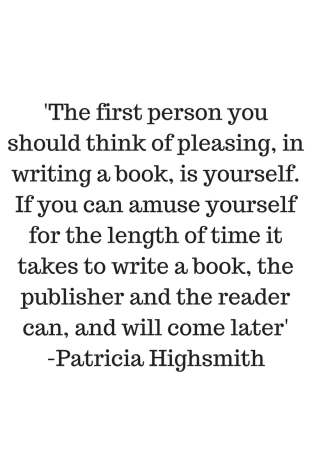
'The first person you should think of pleasing, in writing a book, is yourself. If you can amuse yourself for the length of time it takes to write a book, the publisher and the reader can, and will come later'-Patricia


It hit me one day while talking to my daughter.

I wrote this book to please them, and to please a certain type of reader who likes a certain type of book. I have never ever done that before. All of my other books were written to please me. They were written to scratch an itch. They were written to get the noisy people out of my head and onto the page. They were written out of passion and necessity. There was no other reason to write them other than that I simply had to. I’ve never known at the time of writing, who would like this book. Even with my current work-in-progress Elliot Pie’s Guide To Human Nature, I have absolutely no idea who this book would be aimed at or how I should even describe it! That for me, is familiar territory!

Of course, with my other books, on further drafts and edits I did begin to write and rewrite with my reader in mind. You have to! But they were not there in the beginning. It was just me.

So, how has this revelation helped me with The Tree Of rebels, you might ask? Is it totally ruined?

No, of course not. I still believe in the story and the characters. I have even started a sequel! But for now, I  have decided to leave this book alone. Put it to one side and focus on something else. I have decided to forget who it was aimed at, and essentially write it again. I have decided to write it the way I write all my books. I have decided to let it be whatever it needs to be and to stop trying to sculpt it into something I think it should be. In other words, forget about the perceived audience…For now.

I have a feeling it is now going to become an altogether darker book. But this is good. And would you believe it, while walking the dogs the other day, I had further revelations. Extra characters and another storyline, an important one, to feed into the others. It might make it a longer book. There might be more cutting. I’ve written the ideas down and that’s it for now. I am still not going back there yet!

But when I do I will be rewriting it entirely and writing it for me.

What do you think? How do you write a book? With the audience already decided or with just yourself to please?  Is anyone in your head when you write that first draft or do you really have no idea what sort of reader would enjoy it? Please feel free to comment! 


Author Interview: Karl Beckstrand

Karl Beckstrand is an American author and public speaker with forty ebooks under his belt. He recently contacted me to see if I would be interested in reading and reviewing his award winning YA novel To Swallow The Earth. I readily agreed, as the book sounded so intriguing;  a suspense filled Western and Winner of the 2016 International Book Award, Literary Classics Seal of Approval, and 2016 Laramie Award Finalist. You can read my Goodreads review here. Having read and enjoyed the book so much, I wanted to know more and Karl kindly agreed to an interview. Here he explains how he came upon the original manuscript for To Swallow The Earth, talks about his journey so far as a writer and offers his advice to others. Enjoy!

1SwallowWestRGBmed.jpg

1) To Swallow The Earth is authored by yourself and Ransom Wilcox. Could you tell us more about who Ransom was and how you came to co-author the book with him?
Ransom Wilcox is my grandfather. I inherited his unfinished Y.A. manuscript. It’s suspense set in the Nevada silver rush–and it won a 2016 International Book Award (also a Laramie Award finalist). My grandfather grew up exploring the Sierra Nevada Mountains on horseback nearly a hundred years ago. My challenge was to develop his characters while preserving the action and authentic language.
2) How much work did you need to do in order to prepare the book for release?
Several months’ worth. He had Carson City as the opening scene, but the other communities were fictitious. I had to look up which real cities would fit his descriptions, develop the characters, fill in some gaps, and polish the overall story.
3) Will the story of Wade and Patricia extend into any more books?
I suppose that depends on how much demand there is for sequels!
4) When did you first know you wanted to be a writer?
It kind of took me by surprise. In college I would get ideas for books and scribble them down (when I should have been doing my homework).
5) Tell us about your writing and publishing journey so far. For example, which paths you have followed and why?
After college I joined a writer’s group and met a gentleman who wanted to publish one of my juvenile manuscripts. Unfortunately, he died the day we were to print. I got a crash course in publishing/marketing. One other publisher asked me to write a true story about an immigrant child. I knew about a girl in my family history who arrived in the USA alone, not knowing English. I developed the account—and then got hooked on family history. Now I’ve written several stories on immigrants and several multicultural books. I’m also working on a graphic novel and an audio version of To Swallow the Earth.
6) What is your usual writing process? Are you a plotter, or someone who starts writing and waits to see where it will go?
I try to write or research every day in the morning. I usually get most of the plot outlined right away, but twists and extra material often strike me at any odd time. For non-fiction I have to research and get the facts right, as well as create a good beginning, middle, and end. These books are rewarding to me because they preserve true acts of courage/faith for new generations to witness.
7) What advice do you have for a new author about to launch their first book?
To launch means you’re about to embark on a lot of marketing (even if you’re with a large publishing house, authors must do a lot of the publicity). If you’re just starting a book, write every day. Write from your heart—from what you know first-hand. Don’t try to write about something that you think is popular (unless that’s what you know). You don’t have to have an agent but you should always have a professional editor. Have several people critique your work—people who won’t gloss over glitches. These people can help you be your best.
8) Can you tell us anything about your next release? What are you working on right now?
I have a book in the works that teaches how to earn and manage money. It’s called The Bridge of the Golden Wood. It will have illustrations (kind of a parable) but I will market it as a business/how-to book.
9) What would you most like readers to take away from reading To Swallow the Earth?
Pure excitement: What if you came home after a journey and your family was no longer there? What if someone else was living in your house, running what you used to manage—and trying to kill you? Could a beautiful woman be behind it? Wade Forester has to stay in the shadows. His father has disappeared, and his sister won’t speak to anyone. Patricia Laughlin is searching for her family as well. Few people gain her trust or approval. Wade must decide if risking his life to help Patricia means aiding the enemy. And Patricia must choose a killer to trust with her life.
10) Tell us three interesting things about yourself
I was raised in paradise (San Jose/Silicon Valley) —the perfect climate, much like Valparaiso (Chile, where I lived for two years [LDS mission]). I have a bachelor’s in journalism (never planned to be a reporter) and a master’s in International relations. I teach media at a state college in Utah and speak on traditional vs. digital/self-publishing. I’m an arts/media junkie (music, art, films, books, theater—oh, and history!)
Karl Beckstrand
Premio Publishing & Gozo Books
Action & language books with black, white, Asian & Hispanic characters


Thanks again to Karl for agreeing to be interviewed! I truly enjoyed To Swallow The Earth and would highly recommend it to anyone who fancies something a little different! It certainly is a page turner, and incredibly visual. Beautiful, in fact. If you want to know more about Karl you can follow him on FacebookLinkedInTwitter and YouTube. You can find his books on Smashwords and Amazon.

Author Interview; Robin Gregory

Today I am so excited to share my interview with award winning author Robin Gregory. Robin was born in Florida but grew up in California. She has worked as a journalist, a lay minister and an infant massage instructor for mothers and babies at risk. Her debut novel The Improbable Wonders Of Moojie Littleman is a beautiful and unique coming-of-age story, a mystical adventure, and quite simply one of the best books I have read in some time. Robin’s book has won the Gelett Burgess Children’s Book of the Year Award 2015, the IPPY Gold Medal – Best Cover Design – 2015, and is currently a finalist in Foreword Reviews – Indiefab Best Books of the Year and a finalist in the International Book Awards- Fiction – Young Adult 2016. Read on to find out more about Moojie Littleman and the inspiration behind it!

1-  The  Improbable  Wonders  of  Moojie  Littleman  is  a  unique  blend  of  magical   realism  and  coming  of  age.  Can  you  tell  us  how  the  book  came  about?  Where  did   the  idea  come  from?

Mostly,  my  son  inspired  the  book.  But  so  much  of  my  own  childhood  went  into  the   mix.  I  was  one  of  eight  kids  growing  up  in  a  pretty  messed  up  Catholic  family.  This   led  to  a  lot  of  heartache,  loneliness  and  feelings  of  “not  belonging.”  I  buried  most   of  those  feelings  for  a  long  time,  then  spent  twenty  years  trying  to  figure  out  why  I   was  so  unhappy.  The  healing  of  these  early  wounds  really  began  when  my   husband  and  I  adopted  a  baby  with  special  needs.  The  “not  belonging”  feelings   surfaced  when  I  witnessed  how  others  excluded  him.  His  daily  struggles  have  been   ongoing,  and  yet,  he  is  the  most  kindhearted,  courageous,  and  bright  boy  I  have   ever  known.  He  has  taught  me  to  forgive  the  past,  and  to  look  for  the  good  in   everyone  I  meet,  starting  with  those  who  exclude  him  or  look  down  at  him.

2-­How  would  you  best  describe  your  genre?  Was  there  an  intention  to  blend   genres,  or  did  the  story  just  evolve  that  way?

Oh  boy.  This  was  a  hard  one  for  me.  I  cringe  at  labels—any  kind  of  labels.  The   human  mind  wants  to  label  everything,  doesn’t  it?  It  wants  to  name,  package,  box   and  brand.  I  have  learned  that  one  of  the  best  ways  to  find  inner  peace  and   happiness  is  to  abstain  from  doing  this.  Our  opinions  are  vastly  limiting  and   troublesome.  MOOJIE  LITTLEMAN  is  about  coming  of  age,  but  also  about  spiritual   awakening.  The  book  would  probably  fall  best  into  the  “Visionary”  category,  but   few  bookstores  have  a  shelf  for  that.  Magical  Realism  works  better  as  a  category   than  Fantasy  since  the  story  is  grounded  in  physical  reality  while  encompassing   mystical  themes.  And  Magical  Realism  gave  me  a  way  to  climb  into  Moojie’s  skin,   and  live  from  a  soulful  point  of  view,  not  just  physical.  I  wrote  the  story  for  fluent   readers  of  all  ages,  but  my  publisher,  editors  and  agent  convinced  me  to  market  it   as  Young  Adult.  They  were  looking  at  Moojie’s  age,  the  PG  rating,  and  the  allusions   to  The  Odyssey,  which  students  in  the  US  study  from  age  12  to  18.  It  pleases  me  to   no  end  that  the  book  has  won  awards  in  Young  Adult  and  Adult  categories.

3-­ Do  you  have  any  personal  beliefs  or  passions  that  influenced  the  book?

To  expand  a  little  on  the  first  question,  my  spiritual  practice  has  been  key  to   shaping  the  story.  I  believe  we  are  all  coming  of  age  spiritually;  that  is  why  we  are   attending  what  a  friend  of  mind  calls  “Earth  School.”  In  the  past  twenty-­one  years,   I  have  seen  all  kinds  of  healing,  and  have  come  to  the  realization  that  nothing  is   incurable.  Several  of  the  so-­called  miracles  in  the  story  actually  did  occur  in  my   life.  A  part  of  me  has  been  wanting  to  teach  others  that  what  they  consider  to  be   miracles  are  perfectly  natural  events.  The  key  to  accessing  miracles  lies  in  our   ability  to  give  up  limiting  beliefs,  judgments  and  labels—to  stop  naming  things,   conditions  and  people  as  “good  or  bad.”  Even  Shakespeare  knew  way  back  that  we   evaluate  others  according  to  our  own  self-­image.  It  is  important  to  remember  that   messed  up  folks  are  doing  the  best  they  can.  Those  who  have  been  mistreated,   mistreat  others.  We  begin  to  stop  the  crazy  cycle  of  fear  and  hatred  by  knowing   and  living  this.  I  am  not  suggesting  that  people  should  not  be  imprisoned  for  their   crimes.  I  am  saying  that  if  we  fear  and  hate  them,  we  are  part  of  the  ongoing   problem.  People  who  fail  to  love  do  so  because  they  do  not  know  how  to  love.   MOOJIE’s  story  is  a  parable  to  help  others  examine  their  actions  and  beliefs.  To   help  stop  the  cycle  of  hatred  toward  oneself  and  others.  Compassion  is  a  mighty   healing  balm.

4-­ Tell  us  about  your  writing  process.  Are  you  a  plotter  or  someone  who  starts   writing,  and  waits  to  see  where  it  will  go?

It  may  have  been  a  great  disadvantage  to  write  MOOJIE  by  the  seat  of  my  pants.  I   had  about  500  pages  before  I  took  a  serious  look  at  story  structure.  Blake  Snyder’s   SAVE  THE  CAT,  a  book  on  scriptwriting,  and  John  Truby’s  THE  ANATOMY  OF  A   STORY,  helped  me  revise  pacing,  action  and  character  arcs.  Would  I  have  saved   myself  years  of  rewriting  had  I  had  a  clearer  vision  of  plotting  in  the  beginning?  Oh   yeah.    But,  what  can  you  do?  Sometimes  you  sit  down  to  write  and  the  bloody     characters  just  take  over.  They  just  do  not  behave  at  all.  Not  very  decent  of  them,   is  it?

5-­ All  the  characters  in  Moojie  Littleman  were  memorable  and  well  drawn  -­  tell  us   how  you  managed  to  create  such  realistic  and  believable  characters?  Are  any   based  on  people  in  real  life?

Thank  you  so  much.  You  know,  from  the  time  I  started  imagining  the  story,  I  was   taking  mental  notes  on  people.  What  was  it  that  made  them  interesting?  What   are  they  pretending  not  to  know?  How  do  language  and  appearance  reveal  their   deeper  beliefs?  And  mostly,  how  are  they  shaping  their  world  through  choices?   Almost  every  character  in  the  book  is  a  composite  of  those  observations,  warts   and  all.  Life  is  not  easy  for  anyone.  I  did  not  want  to  present  characters  as  good  or   bad  as  much  as  being  in  differing  stages  of  awakening.  Each  has  their  own  inner-­ outer  struggle;  each  has  their  limitations  to  overcome.  Like  many  of  us,  they  fail  to   live  up  to  their  own  expectations.  I  ended  up  loving  them  all  for  who  they  are,  and   who  they  are  not.

6-­ Moojie  himself  was  incredibly  endearing.  Is  his  story  over?  Or  will  there  be  any   further  stories?  

I  am  so  glad  you  feel  that  way  about  Moojie!  When  I  set  out  to  write  the  story,  I   knew  that  fictional  characters  with  physical  or  mental  challenges  are  rarely  given   front  and  center  stage.  They  are  usually  confined  to  secondary  roles.  I  felt  it  was   absolutely  imperative  that  Moojie  steal  the  readers’  hearts.  My  son,  who  has  been   blessed  with  amazing  charisma,  helped  a  lot  with  this.  I  would  love  for  Moojie’s   story  to  continue.  Now  that  I  am  acquainted  with  the  characters,  I  know  how  to   take  better  charge  of  them.  I  will  insist  that  they  go  play  elsewhere  while  I  rough­out  the  plot.  Ha!

7-­When  did  you  first  know  you  wanted  to  be  a  writer?

This  question  always  makes  me  smile.  I  often  hear  about  writers  who  knew  of   their  calling  before  they  cut  their  first  teeth.  Not  in  my  case.  I  had  a  tough  time   learning  to  read,  and  a  mother  of  eight  children  has  no  time  to  read  to  her  litter.   My  father  was  a  pilot  in  the  Korean  and  Vietnam  Wars,  and  mostly  gone.  I  didn’t   start  reading  fluently  till  high  school.  My  life  changed  when  I  discovered  Kana  and   Hemingway.  As  a  teenager  living  in  a  perpetual  state  of  underwater,  I  turned  to   journaling  to  save  me  from  the  emotional  tsunamis.  That  led  to  short  stories,   poetry,  and  eventually  longer  fiction.  I  never  thought  of  myself  as  a  writer.  Writing   was  just  something  I  did.

I  love  what  Robertson  Davies,  the  Canadian  novelist,  once  said:  “There  is   absolutely  no  point  in  sitting  down  to  write  a  book  unless  you  feel  that  you  must   write  that  book,  or  else  go  mad,  or  die.”

8-­ Tell  us  about  your  writing  and  publishing  journey  so  far  -­  which  paths  you  have   followed  and  why?

When  I  graduated  from  college,  I  took  an  internship  at  a  local  newspaper.  It  was   fantastic!  I  learned  to  get  that  first  draft  down—and  fast.  That  led  to  writing   freelance  articles,  and  book  and  movie  reviews.  Then  I  wrote  my  first  screenplay   and  novel.  They  were  pretty  awful.  But  they  taught  me  a  lot-­mostly  humility.   Writng  is  like  being  in  the  circus.  You  have  to  jump  though  hurdles  the  same  way   acrobats  jump  through  burning  hoops  in  order  to  learn  how  not  to  make  mistakes   that  get  you  burned.
It  took  thirteen  years  to  write  MOOJIE.  Thirteen  years  because  I  had  to  evolve  in   order  to  deliver  the  story  in  the  manner  it  deserved.  During  that  time,  the  book   has  been  workshopped,  shared  with  a  number  of  alpha  and  beta  readers,  put   through  2  manuscript  consultations  and  edited  by  five  pros.  After  submitting  to   agents  and  getting  nowhere,  I  contacted  publishers  directly.  Three  publishers   offered  me  sub-­standard  contracts,  which  I  turned  down.  (Thank  heavens  SCBWI,   a  writer’s  org  that  I  belong  to,  provided  a  manual  with  standard  publishing   contracts.  Holy  moly!  Publishers  will    take  your  skivvies  if  you  let  them!)  I  wanted   to  keep  my  rights,  to  choose  my  cover,  and  be  the  one  to  decide  when  the  book   was  ready  to  print,  among  other  things.  While  researching  my  options,  I   discovered  Wyatt MacKenzie  Publishing,  Inc.  (h=p:// http://www.wymacpublishing.com/),  a  traditional  publishing  house  that,  for  20  years  has   offered  consultation  and  assistance  to  indie  authors.  I  contacted  some  of  their   authors,  and  they  gave  stellar  reviews.  After  an  hour  consultation  with  Nancy   Cleary,  the  publisher,  I  knew  the  indie  consulting  program  was  right  for  me.  And  it   has  been  fantastic!  I  can’t  say  enough  about  Nancy’s  guidance,  respect,  support,   and  expertise.

9-­ What  advice  would  you  give  to  a  new  author  who  is  about  to  launch  their  new   book?

I  am  assuming  that  the  author  wants  to  be  a  pro.  In  this,  she  has  already  had  her   book  read/reviewed  by  at  least  10  people—beyond  buddies  or  family  members,   who  will  love  every  word  you  write  no  ma=er  what.  I  am  assuming  she  values   brutally  honest  feedback  because  that  is  the  way  the  public  is.  I  am  assuming  that   she  has  listened  to  the  feedback,  and  revised  for  clarity  and  tightness.  I  am   assuming  that  she  has  given  the  book  plenty  of  time  to  ripen.  Right  down  to  the   last  day  before  I  sent  my  book  to  the  presses,  I  was  deleting  or  rewriting  passages   if  they  didn’t  sparkle.  The  editor  had  to  practically  tie  me  down  to  get  me  to  let  go   of  the  manuscript.
That  said:
—  If  you  want  your  book  to  make  a  dent  in  sales,  your  manuscript  must  be   professionally  edited  and  proofed.  The  cover  (front  and  back)  needs  to  be  equally   polished  and  interesting.  Yes,  this  costs  money.  But  if  you  do  not  include  this  in   your  budget,  you  might  as  well  not  spend  the  money  to  publish  (unless  you  are   merely  doing  it  for  family  &  friends).  As  most  of  us  know  by  now,  the  key  to   marketing  rests  upon  getting  reviews.  If  your  cover  isn’t  delicious,  and  your  editing   is  sloppy,  people  won’t  even  sign  up  for  free  copies.  There  are  simply  too  many   other  professional  books  to  choose  from.  A  cover  created  by  your  amazingly   talented  brother  who  won  a  ribbon  in  the  high  school  art  fair,  might  be  beautiful,   but  can  it  stand  up  to  the  covers  on  booksellers’  shelves?  If  not,  your  book  will   probably  disappear  into  cyber  space  with  millions  of  others  whose  authors  were  a   little  too  anxious  to  go  to  press.
—  Start  marketing  your  book  four  months  before  the  release  date.  Yep.  Four   months!  Send  it  to  pro  reviewers  (Kirkus,  Foreword,  Publisher’s  Weekly).  Enter  it   in  contests.  Do  a  few  giveaways.  Create  an  audience  on  social  networks  by  posting   samples,  sharing  news  and  reviewing  similar  books.  This  will  give  you  a  chance  to   build  up  a  pre-­order  list  on  Amazon.  It  is  only  the  beginning.  And  it  is  crucial.

10-­Tell  us  a  bit  about  your  next  release. What are you working on right now?

While  playing  with  a  MOOJIE  sequel,  I  am  also  writing  a  collection  of  inspirational   prayer-­poems  and  a  guide  to  spiritual  healing.  There’s  also  the  audio  book  project   of  MOOJIE,  through  ACX.com.  It’s  an  amazing  process.  I  have  to  give  Amazon   kudos  for  providing  such  a  user-­friendly  service.  However,  my  reader  has  stepped   away  from  the  project  to  sort  out  personal  problems,  so  the  release  is  delayed.

11-­ What  would  you  like  readers  to  take  away  from  The  Improbable  Wonders  of   Moojie  Littleman?

I  would  love  for  my  dear  readers  to  realize  that  freedom  is  a  choice.  No  ma=er   what  difficulties  we  face,  be  it  loneliness,  physical  or  mental  problems,  lack  of   opportunity,  not  enough  money,  lousy  parents,  even  homelessness,  there  is  a   Source  of  unconditional  love  available  to  each  of  us.  We  can  grow  through  joy   rather  than  pain  and  suffering.    It  takes  effort  and  trust  to  rewire  our  thinking,  but   we  can  open  ourselves  to  receive  miracles  that  freely  and  gladly  offered.  When   this  Immaculate  Heart  is  felt  in  the  still,  deep  pool  of  our  being,  we  can  begin  to   experience  joy  and  freedom  beyond  your  wildest  dreams.  I  know  this  is  true.  I   have  lived  it.

Robin, thank you so much for agreeing to do this interview!

You can find out more about Robin by following her on social media;

Facebook

Website

Goodreads

Twitter


I’ve Got A New Book Out!

Happy Friday everyone!

This is just a quick and cheeky post to let you all know I have a new book out. If you follow me on Twitter or Facebook you will already be more than aware of this! But I wouldn’t be doing the whole social media thing right if I didn’t post the news to my blog too, would I?

Bird People and Other Stories is a short story collection I have been putting together for about a year now. In fact, I have another blog post and the very wise words of a follower on Goodreads to thank for this whole thing!

You see I wrote this blog post almost a year ago, which was all about getting my arse into gear the next time I had a novel out. I wrote a detailed plan regarding promotion, and some kindly fellow on Goodreads suggested writing short stories related to my novels as an added promotional tool. As soon as he suggested it, I got excited. Why hadn’t I thought of this before?

My mind went into overdrive over the next few days, and within the week I had several short stories already drafted. You all know how I feel about my characters, so the thought of writing extra stories from different character points of view was too enticing to resist. I had all sorts of ideas swimming around in my head, and the pen to paper was in overdrive. It was fantastic. I felt like there was no limit to where I could go with this.

Well, here it is and I really hope you like it. For people who have already read my work, you will find in this collection, two stories related to The Mess Of Me (one story from Leon’s point of view and one from Marianne’s.) You will find three stories related to The Boy With The Thorn In His Side ; one from Jack’s POV, one from Lucy’s, and one which is actually the ending I had in mind at one time! You will find a short story called The Collection, which is a teaser for my work in progress Elliot Pie’s Guide To Human Nature. (It’s essentially the basic plot squished into a short story.) You will also find two stories related to a book I wrote when I was sixteen and discovered fairly recently in a suitcase under my bed (blog post here) I have since plotted the book and titled it A Song For Bill Robinson. Nightprowler is a prequel to the novel, and Bird People a character snapshot. You will also find a short story called She Is… This is another fledgling idea for a novel, one that I do not have the time to write for a while, but writing the short story helped ease the pressure! And finally, Tales From Province 5 includes three short stories which are teasers for my next novel The Tree Of Rebels.

Hopefully, there is something here for everyone. For loyal readers, something new, something different, and lots to tease! And for newcomers, a genuine taste of the way I write and what I write about…all for the attractive promotional price of 99p/99c.

Enjoy! And thank you 🙂