Second Draft Joy

Back in December, I penned this post Why My Favourite Draft Is The Second, while I was busy writing the first draft of a YA novel called A Song For Bill Robinson. I was enjoying the first draft, but also realistic about its ugliness, and I was excited about going back to the second draft for the reasons I mentioned in the post.

Well, three months on, I am now well into that second draft, and enjoying it every bit as much as I said I would! It is easier than the first because the basic framework is there and the hard work has been done getting the story out of my head. I already know I can make it better and I have already listed and made notes of how to do this. The second draft is just fun!

I had to have a think about this earlier. Has this been the case with all my books? And I think the answer is yes. The first draft is the hardest for me. The later drafts are the most tedious because you know the story, and really you want to be writing something new, but you have to polish this thing up, cut bits out, sharpen it and refine it and make it as good as it was when it first appeared in your head. I think of the first and the final drafts as the real hard graft. The second, for me, is much more fun.

can you tell I'mhaving fun-

In many ways, the second is more of a read through than a rewrite or a detailed edit. After a break, I am familiarising myself with the story and getting to know the characters again. I read through each chapter, getting a sense of them and their motivations, making notes and finding my way back into it all. Of course, I fix any typos I come across, and I do a lot of deleting unnecessary and repetitive words or phrases. I tidy it up as much as I can, but at the same time, I know the more brutal cuts, the reshuffles and the changes in direction will all come much later. This is still very early days, and I want to enjoy it. I don’t feel the need to make any major decisions at this point.

At the moment, I am totally addicted to this particular story, which is also how I felt when I first wrote it. I suppose it’s more familiar ground for me as an author and a person. A gritty, contemporary YA drama with lots of dysfunctional family behaviours and social issues thrown in. I feel a passion for it. I want to tell these stories. And there are so many stories in this novel…

It’s fast paced. Which is good. I hope! On later drafts I might feel the need to slow things down a bit, my niggling worry being that it might come across as unrealistic for teens to have a life this dramatic. It’s literally a roller coaster of events, repercussions, consequences and drama. It’s full of highs and lows with plenty of unrequited love, dangerous lust, and familial miscommunication and resentment. Oh and of course, a rather wonderful soundtrack (the male protagonist is a talented singer) which ranges from The Four Tops and The Foundations, to Arctic Monkeys and Jamie T. There is just so much to play around with!

And I know I haven’t got it all right yet. I know I need to keep fleshing out the characters and finding stuff out about them. I know I need to work on the visuals, the environment, such as their homes and bedrooms and so on. I tend to forget about all that stuff on a first draft, knowing that no one else is going to read it for a long time. I just want to get the nitty gritty down first.

But at the moment I am enjoying the ride, and just felt the need to share that with you. Adding bits and cutting bits. Reading it like a reader and bloody enjoying the process. I can’t get enough of it.

I doubt I will feel this way by the time draft ten comes around, so this is why I savour the second draft so much. I know the time will come when I almost come to hate this book. I have been there with The Tree Of Rebels many times, and Elliott Pie reached that point just recently before I sent it out to a second round of betas. I was sick of it. I am sick of it. Diving into this much fresher book has been just what I needed.

So, for me anyway, I give my thanks to the wonderful second draft, with the foundations laid down and the really hard work yet to come. I shall enjoy the party while it lasts.


Message and Themes; What Are You Trying To Say?

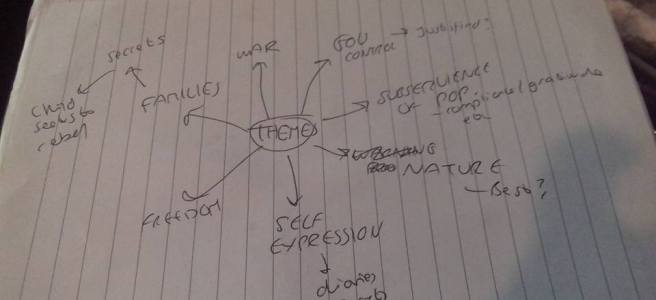
When I was at school, English Literature was always my favourite subject. I was a total book-worm who dreamed of becoming an author, so you can kind of see why I adored English Literature. Reading books, talking about books and writing about books was my idea of heaven. Having said that, there was always one part of the subject that annoyed me at times. When analysing a text, the teacher would often ask us to think about what message the author was trying to get across. It was a question akin to the equally confusing one; what are the themes of the novel? I remember thinking, I bet the author didn’t know there was a message or a theme, or that we would try to work one out. I always considered that Shakespeare, Bronte and Steinbeck just wrote books because they had great ideas, great characters, and could string some pretty awesome sentences together.

But English Lit demands we find the messages and the themes, and yes, when you pick apart a text and analyse it within a classroom setting, you do tend to find them. But were they intended? I suppose I’m asking, did the author write the book with a theme or a message in mind? Or is it the reader who later determines what the potential messages are? I mean, did Steinbeck write Of Mice and Men because he had something to say about society or human nature? When I was a kid, I thought not. But it turns out I was wrong;

In every bit of honest writing in the world there is a base theme. Try to understand men, if you understand each other you will be kind to each other. Knowing a man well never leads to hate and nearly always leads to love. There are shorter means, many of them. There is writing promoting social change, writing punishing injustice, writing in celebration of heroism, but always that base theme. Try to understand each other.

John Steinbeck in his 1938 journal entry
I remember trying to distinguish the themes of the novel when I was at school. What seemed so obvious to the teacher, had to be pointed out to us. I haven’t read the book since then, but it is on my to-read list as part of a reading challenge I’m undertaking, where one of the books has to be one I read in school. But I think I will see things differently now.
Why? Because I am approaching my fourth decade and I’ve seen enough of life, love, people and society to know that Of Mice and Men is not ‘just a story’ as I once mistakenly believed. It’s a book about dreams and aspirations, loneliness and solitude and the author had plenty to say about all of these things. I am now the writer I hoped I would be, and writing books is a fascinating process, which involves the seed of an idea germinating into an intricate plot full of characters who become real to you and set up camp in your head. But more than that, writing is about what you want to say to the world.
I’ve been thinking about this a lot lately after I received feedback from a beta on my still unfinished novel Elliot Pie’s Guide To Human Nature. One of the things she picked up on was the messages or themes of the book, and in particular, her observation that some of the characters had views very similar to my own. She felt this at times made the narrative somewhat preachy, or at least, it was in danger of heading in that direction.
I had to stop and think about what she meant. None of the characters are me, or based on me, or anyone I know. I plucked them up out of the thin air to build around the character and story of Elliot, who I really did know and believe in.
However, I have to admit that unintentionally, or at least sub-consciously, bits and pieces of the writer and the writer’s viewpoints seep into the writing. I knew what this book was about, and I knew from the beginning what I was trying to say, so as you can see, I have come a long way from my previous scepticism that books did not contain deliberate messages. On the contrary, I have had something to say in all of my books, and I think it very much depends on what is going on in my life at that time. For this book in particular, Elliot and his mother are like the two sides of me. One side is heartbroken and terrified about the state of our world and wants to withdraw from it all, while the other side is perpetually hopeful and joyful, determined to the best in everything.
So is this a good thing or a bad thing? I think my beta was right to point out the danger of appearing preachy in the narrative. I certainly don’t want my books to come across that way. I have to be sure it is the character’s viewpoint being explored, not the author’s. I have to be conscious of what is being portrayed as ‘right’ or ‘wrong.’ So at the moment, I am going through the book again, with the beta’s notes beside me. Sometimes it just needs a tweak, some words rearranged or deleted. Sometimes I don’t need to do anything because I think the character truly believes in what they are saying, and in doing so is remaining true to character.
This brings me to another question, though. Do people pick up books looking for messages or themes? Do most readers notice them, even if they are supposed to be there? I suspect that what one reader picks up as a message or theme, is very different to anothers. Do readers want to be spoken to in this way? I don’t think many people pick up a book looking for clarity or persuasion. I think they pick up books looking for stories. And stories involve people and their messy human lives, and messy human lives contain messages, whether intentional or not. Because they are written by one person, created by one person, and whether they were totally aware of it or not at the time, that person had something to say.
So, what do you think? As a reader, do you choose a book because of the message it seems to be conveying? Do you notice the themes of a novel as you are reading it, or do they become obvious to you afterward? Do you ever feel like the writer is trying to tell you something about the world or about life? Does this every feel like you are being preached to?
And what about you writers? Do you know what you are trying to say before you start to write the book, or does the message reveal itself to you in time? Are you aware of any themes in your book, and again, are these intentional? Do you ever worry that you are trying too hard to get a message across?
Please feel free to join in the conversation!

Growing Your Own; A Positive Rebellion

Gardening is a lot like writing. It starts with a seed, and with love, care, attention, commitment and imagination, it grows into something much, much more. For me, gardening and writing are similar because they both involve creating something positive and injecting it into the world. They both make the world brighter and better. They both involve hope, love and rebellion.

seedsproverb

I’ve always been attracted to gardening. My parents grew vegetables when I was a kid, and so did my grandparents. I have fond memories of sitting on cool concrete steps with a plastic bowl on my lap, popping peas from their pods. There is nothing in this world quite as divine as the pungent scent of a full grown tomato plant. As soon as I had my own place, I started growing my own. There is something so deliciously simple and satisfying about planting a seed and growing it into a plant, from which you can pick and eat food. If you’ve never had the pleasure, I can assure you it’s an incredible feeling. Like all is well with the world. Like you’ve just solved all the world’s problems, by tugging out a handful of carrots and shaking the dirt from their roots. It never fails to make me smile, the sight of home grown food, picked and ready to eat. It just makes you want to sit back and go ‘ahh’.

13920054_1231406820211914_1274144773204141057_o.jpg


We live in tumultuous times. There are many days when I want to avoid the news, for fear of what will dismay or horrify me next. I sometimes wish I could turn the clock back for all of us, back to a simpler time, where we all grew our own food, worked the fields, and reaped what we sowed.

When I am feeling distraught, just like writing, gardening will make me feel better. I forces me to take a deep breath, it forces me to get on with things, to get on with life, and to do something positive. Getting my hands dirty, feeling the soil under my finger nails, pushing seeds into the earth, it all helps me to feel grounded again and more in control. Being outside, kneeling in the dirt, choosing what to plant, putting my back into turning over the earth, it helps me remember where I come from, where we all come from. Gardening is therapeutic; I keep telling people this. I get my little man out there with me, and I want him to feel the earth and take care of the seeds, and tend them and watch them grow. Right now, I can’t think of anything more important for him to know and understand.

dscn3095

Gardening grounds me, calms me and satisfies me. From the beginning, it is a labour of love and good intentions. I have the old adage of ‘you reap what you sow’ in mind nearly always, for I know I will get back what I put in. The seeds are the hope, you see. Like new life, bursting with potential. A freshly dug and turned over plot is like the womb, spongey and fresh, eager to provide and sustain. It’s exciting from the first moment you plant the seed. When it rears its head, it’s like birth. You care for it, water it, protect it and finally, you are rewarded with food. The cycle of life right there. And around it goes again, the plant itself providing the seeds from which to start the whole process again.

13923592_1231407403545189_8560900702571823766_o.jpg

When I’m in my garden, I’m calmer and happier, but I am also filled with grit and determination. For I am taking back control. Working the land, growing our own food used to be the norm. It was how we survived. But over time the food industry grew into a monstrous thing, delivering us convenience, but taking away so many other things. What have we traded, what have we compromised on in order to be able to do all our shopping under one huge roof? We’ve not only handed over control of the food chain to massive faceless corporations, we’ve compromised on animal cruelty and environmental damage and destruction. We’ve increased waste massively, through packaging, delivery, and distribution. We’ve lost contact with what is put into our food, what it actually is, where it comes from, and what or who has suffered in order for us to have it exactly as we demand it.

When you try to grow your own food, you remember how it used to be, how it could be again, how important it is to get back that control and to reconnect our roots with the earth we walk on. We have no respect for nature when we are removed from it. When all the hard work is done for us, when we have no idea how foods are made or what is in them, or what damage has been done to the planet in order to obtain them. I believe it’s crucial we teach our children where food comes from. Reconnecting them with the earth and their own wild roots is going to become increasingly important.

429116_371518756200729_1266579260_n.jpg

It’s not easy for everyone to grow their own food. Not everyone has the space and barely anyone has the time. But in years to come, I truly believe it’s going to become imperative to learn how. We are going to struggle to feed people on this planet for many reasons. Climate change may be the biggest challenge of our generation, endless war, struggling economies and falling wages will all take their toll. I’m sure I’m not the only one who has noticed that food prices are rising.

Growing your own food, planting a vegetable patch, may be just about the most positive and rebellious thing we can do right now. It’s two fingers up to the establishment, it’s a break away from slavery to the supermarkets, and a refusal to be complicit in animal cruelty, environmental destruction and the taking from those who have less.

Growing your own is saying, go away, I don’t need you, I can do this on my own. I’ve got a new motto this year in my house. It’s ‘I won’t buy it, if I can make it myself.’ Now this only applies to food so far, and is a work in process, but a good intention heading in the right direction. I’m digging my heels in and saying no. I don’t need to buy supermarket naan bread when I make a curry, because I can save the packaging and make my own. I don’t need to buy pizzas, or jam, or pastries or pies, sauces, breads, cakes or biscuits, because I can make my own.

I need to be outside right now. This world is breaking my heart and filling me with terror. I need to be planting things, growing things, nurturing things. I need to be responsible for new life and hope and potential. I need to believe that good things can happen if you are a good person. I need to believe that there is a possibility for a greener, brighter future for my children.

When I am writing or gardening, I am reminded that I still have power.


Beta Readers; How and Why?

Several months ago I was convinced that my new novel, Elliot Pie’s Guide To Human Nature was ready. I sent it to a tried and trusted beta reader who very patiently and kindly informed me that it really wasn’t. I listened, realised she was right, and tackled it again. And again. And…well, you know how it goes. Finally, a few more months down the line, I thought, okay, this is it, I’m happy, really happy! I’d addressed all of her concerns and it was definitely a much better book. I then sent it to another beta reader, quite arrogantly expecting her to gush with excitement about how ready it was. She didn’t. It wasn’t. Repeating these things to my husband, he asked a very important question. How do I know the beta readers are right?

This is an excellent question and one worth addressing. But first of all what should you look for in beta readers and why do you even need them?

You need them because you are far too close and subjectively involved in your marvellous work of art to see its flaws. It is very difficult for an author who is in love with their story, to be able to see where the pace is too slow, or the information repetitive. You may not realise how much of you and your beliefs and opinions are seeping into the book. You may not realise that there is too much dialogue, or not enough. It is your baby, your child, your masterpiece. Yes, your relationship with it is up and down. You love it and then you hate it. You are filled with self-doubt one moment, only to be surging with confidence the next. Either way, you need beta readers to bring your down to earth. You need them to tell you what is good about the book and what is not so good about the book. Of course, you don’t have to accept their advice, and you certainly don’t have to act on it, but to release a book or submit it to publishers without using beta readers would be, in my opinion, insane.

So, what should you look for in a beta reader? I think this is quite a personal thing and may also depend on your genre of writing, but here are the things I look for and require in my beta readers.

  • they need to have already read my work and connected with it
  • they need to be somewhat connected to me and my life, and have some knowledge of my beliefs etc
  • they need to be highly educated, or at least way better at grammar than I am!
  • they need to be an avid reader, someone who consumes books like an addiction
  • they need to be open to most genres, not snobbish or narrow-minded
  • they need to be breathtakingly honest and not scared to offend
  • they need to be able to understand how a book could be made better
  • they need to be prepared to read the book at least twice and make notes

What sort of things should a beta reader be looking out for when reading your work? Well, again this is very personal, but I will explain the way I often approach it. With Elliot Pie, I wrote the book quite naturally, just letting it flow as you do with a clumsy first draft, worrying about the finer details later. I finished the very first messy draft just over a year ago, and I honestly didn’t think it would need too much more work! This goes to show how blind you can be about your own writing. I did a few more drafts before sending it to the first beta. At this point I was looking for opinions on the plot and the actual story and on the characters. Did they work? Were they real enough etc? What about the structure of the plot and the flow of the narration?

What I got back was very interesting and resulted in me changing a lot of the chapters around. The beta had loved the characters (yay!) and the story but she found the pace too slow in the middle of the book and she guessed the ending. Not too big a problem, as it’s not supposed to be a real twist at the end or anything, but she did help me work out ways I could knock the readers off course a bit. She was also right about the pace. It was too slow in the middle and lots of it needed to go.

Job done. I attacked the book again, and again and again. Each time I went through it, I cut bits out, added bits, fleshed the characters out more, and wrote lists as I went which consisted of the things I still needed to do when this draft was done. I considered my work done when the lists ended. As far as I was concerned I could do no more. Yes it would need some more proofreading and a few more read throughs, but I was happy. More than happy.

I sent it to the second beta reader as she is my biggest critic and I knew she would be intensely honest. There was no way she would hold back if there was anything about it she thought could be better. We ended up having several Skype chats while she went through her very detailed notes on the novel. I made lists, nodded and listened. The more she talked, the more I realised how right she was, and the more I felt my own subconcious misgivings becoming unearthed. Everything she said about the book was true. I had written it in both first and third person. A bit of a challenge, yes, but that was just the way the story presented itself to me in the first draft and so I went with it and ended up sticking with it. This meant that all of Elliot’s, (the 12-year-old protagonist) perspective is in the first person. We are entirely inside his head. And in my opinion, that’s a wonderful place to be. I find him interesting and funny and amusing, you see. Of course I do, I created him! But would the reader think the same? Or would they find the narrative repetitive as he talked them through his little world? Was I telling them far too much detail when a lot of it could be shown rather than told, or omitted altogether?

I sat and nodded grimly and knew that my beta was right. I had climbed inside his head and got lost there. I was way too close and way too involved. I loved him too much but I needed to get back out and get some distance. I suggested changing his view to third person and the beta had thought the same thing. The more we thrashed it out, the more I realised how many problems this would solve. I actually began to get excited. There were other issues too, aside from POV, but I won’t go into them now as they will probably pop up in another blog post.

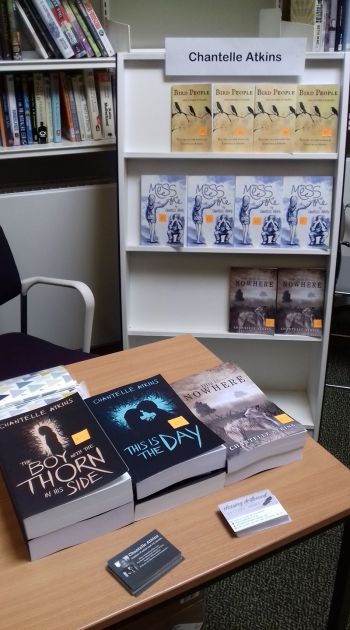
We talked about how I’d had a similar problem with The Boy With The Thorn In His Side. (Again, this is where history, friendship and connection aid the beta/writer relationship) Originally written in the third person, from all the characters point of view, it was eventually rewritten into the first person, and from two points of view. At the time I was both terrified and excited to take this machete to my work, to slice it up and stitch it back together again, to tell the story in a totally different way. I knew I would lose tons of scenes and perspectives and dialogue and this saddened me beyond belief. But it worked.

With Elliot I have the same problem but in reverse. I need to lose the first person, get some distance from Elliot and tell the story in a different way. There is a lot of work to be done, but the groundwork is all there. The second beta also loved the actual story, the plot and the characters and found the pace just right.

I am so glad I gave it to her to dissect. But back to the original question? How do I know she is right? How do I know either of them are right? I know because as soon as they voiced their opinions, I knew I had been thinking the same thing all along. All they did was confirm what I already knew deep down inside. I just didn’t want to admit it to myself, because admitting it meant even more work, even more drafts, even more editing and proofreading, and it means the other books that are on hold waiting for this one to be done have to keep waiting and waiting and cramming my mind and driving me insane! I wanted the book to be ready so badly I had convinced myself it was.

But I can’t let a book go until I am sure it is the best it can be, and in my case, my betas are there to help me get to that point. I can’t thank them enough for the time and effort they invest in me and my books. I trust them implicitly and I know I am extremely lucky to have them.

But what about you? Do you use beta readers and if so how did you find them? What do you look for in a beta? Have they ever felt differently to you about a book being ready for release? How have they helped your books reach their full potential? Have they ever been totally wrong? Please feel free to comment and share!