Things I Fail At On Social Media

When I first started my indie author journey, I had a very rocky relationship with social media. In truth, I didn’t like it or understand it. But over the last few years, I have stuck with it, worked hard at it, and yes, even grown to enjoy it. However, I do still feel like I am not quite getting it right. I’d say I am definitely most comfortable on Facebook, still don’t understand Twitter, and really need to learn how to better utilise the ones I enjoy such as Instagram and Pinterest. Sometimes I feel like I have no idea what I am doing! Here is a list of things I currently and consistently fail at;

  • What to add when I Tweet. I see other people write some brilliant tweets. I know you’re meant to ask a question or come at it from another angle, not just retweet the post without comment, but all to often I click share to Twitter and then sit there for ages thinking what can I say about this? Great post? I really liked this article? Great tips here? Read this? And then I give up because life is passing me by and I just hit Tweet.
  • Remembering what hashtags to use. I really should list them and stick them on my wall. I remember #amwriting but that’s about it! And I know you shouldn’t go over crazy on hashtags anyway, but again, how many to use? How many are too many? Which ones are the most useful or relevant? Sometimes I have a moment of clarity but mostly I pick a few boring ones and hit share feeling like a total Twitter loser.
  • Twitter in general. I really want to like Twitter and get more out of it. Every now and then I do make a conscious effort to play the game right. I do understand that like with all social media sites you’ve got to give, in order to expect anything back and you’ve got to build relationships not just tweet but never comment, share or engage in return. I get it. I just don’t have time for it. It’s more fun on Facebook for some reason so I find myself retreating there.
  • Making memes. Some writers/bloggers are soooooo good at this. I am terrible. I can never find the right picture and if I do I can never think of a witty line for it. I am one of those people who can’t be funny if I try. I’m only funny when I don’t mean to be.
  • Finding images. I hate looking for images. For Pinterest, or the blog or anything. I know images are good because they make your post more visual and interesting but bloodyhell it takes a lot of time searching for the right ones, and they never seem to be quite right.
  • Knowing how much time to spend on it. It’s always a bit hit and miss with me. I can get very easily distracted by Facebook and Pinterest, and to a certain extent Twitter if I actually go on it, but knowing whether this is time well spent or not is never a certainty. I’m very good at blogging on a weekly basis and keeping my Facebook author page busy, but the rest of it is totally inconsistent. Maybe that doesn’t matter, or maybe I should be spending equal amounts of time on each site?
  • Turning social media into sales. Then again, this is a tricky one. How do you know your social media engagement has resulted in sales unless people tell you? There is the shop button now on my Facebook page, which is helpful and depressing in equal measures. But other than that…? Who knows what is working and what is not?

I’d like to get better at all of these things. How about you? What are your social media strengths and weaknesses? Please feel free to share and comment! And let me know what has worked for you!

 

Dealing with Self-Doubt

Writers are often plagued with crippling self-doubt and I am no exception. It’s always there, lurking, waiting for opportune moments to show up and throw me into a panic. I’m preparing a book for release, and I always find self-doubt shows up in a big way around about now, so it is something I am currently dealing with. But there are lots of other times I’ve experienced self-doubt about my writing, so I thought I would list them here as well as my tips for dealing with it.

  1. Childhood. When I was a child, I didn’t know what self-doubt was. Sure, I was shy and introverted, but I also had the child’s innocent optimism and I was utterly convinced that one day I would be a world famous author. Of course, life happens to children. Reality is dictated to them. You can’t do that, you can’t be that, you won’t make money, not many writers are successful, and so on. The worst thing you can do to a child is squash their creativity. If you were that child, be kind to yourself now. Remember that people probably had good intentions. Perhaps their ideals and aims in life differed greatly from yours. And if you know a child who wants to be a writer, for God’s sake don’t crush their dreams. Let them make mistakes. Don’t pick on their grammar, their spelling or their lack of plot. Just let them write! It can all too easily be discouraged in children these days.
  2. Adolescence. Writing helped me get through my teenage years. Without a doubt, it was my greatest friend and comfort. From the diaries I wrote daily, to the lyrics I scrawled onto my bedroom wall, I wrote endlessly. I was in a constant dream and my head was full of wonderful words. Self-doubt had found me though, and I now accepted I needed a realistic Plan B. I would have to decide on a day job to pay the bills. My advice to anyone at this stage would be this; keep writing. Keep dreaming. Don’t worry about structure or plot, or how many drafts it will take, or how similar your work is to your favourite films or books, or how pointless it seems putting down words that are unlikely to be read by anyone else. Perhaps right now they are only meant for you. Don’t let anyone tell you it’s not useful, worthwhile or beautiful. Keep going. In private, in your bedroom, in your head, in snatched moments. It will all take you somewhere one day.
  3. Writing Group. Self-doubt may lead you to attend a writers group and they can be a wonderful help. Just remember not to compare yourself to anyone else. No doubt you will all be of different ages, backgrounds and cultures. There will be people there with more and less experience than you. There will be people there with a better grasp of grammar. There will be people there who can write the most beautiful prose. Don’t be intimidated. You are not them. Only you can do what you do. Use writing groups as sound boards and listen to any advice that is helpful but don’t let exposure to other writers encourage self-doubt. You are there to get better and to move forward.
  4. Twenties. Real life. Graduation. Jobs, Careers. Marriage and babies. All these things get in the way when you are becoming an adult, leaving less and less time and energy for writing. This is the period of life when so many leave writing behind, viewing it as a childish, foolish habit they must move on from. After all, very few writers earn a living from it, and there are bills to pay and rent to find and debts to cover and there will just never be enough time to sit down and write like you used to. And then every now and then someone you used to know will ask if you still do the writing. And saying no, not anymore, will break your heart. So write anyway. Even if it’s just a diary. Or a blog. Or scribbles and rants into a notebook. Even if it’s five minutes or ten minutes a day. Even if you don’t think it will ever go anywhere. Get back in the habit. NOW.
  5. First draft, We all get there eventually. The first draft. Self-doubt will plague you more than ever before. Are you wasting your precious time? Is everyone laughing at you? Is everyone expecting you to fail? Can you even write? Is anyone ever going to care? Something keeps you going, but self-doubt is clawing at you every step of the way telling you to go back, to quit, to stop before you waste any more energy. Don’t listen. Keep going. The first draft is just the beginning of a long journey, but if you can get it done, if you can get over that hurdle, then all the rest will come. You’ll have fostered the stamina and grit needed to pursue this idea until the finish.
  6. Feedback. Getting feedback is hard. You need it, but you dread it. You sort of hope everyone is going to gush over your work and say it is the best thing they’ve ever heard. But being realistic, what you really need right now is the cold hard truth. You need to be able to take it. If your characters suck, if your dialogue is stiff, if your middle drags or your ending is unsatisfying, you need someone to tell you. Then you need to take the time to think about it, digest the information and decide what you agree with. Don’t let self-doubt hijack you now. Writers never stop getting better. That is part of the fun.
  7. Submissions. Submitting your work is a brave step. Maybe it’s competitions, or magazines, or articles. Maybe it’s your novel to agents or publishers. You’ve done all the hard work and now you are handing it over to the ‘experts’. If you are lucky you might get some feedback. It might sting, it might be encouraging. Or you may get the long cold silence. Whatever happens, self-doubt will creep in to remind you that you are a crap writer and nothing you write will ever be published by anyone. Just keep writing and remind yourself that the more you write, the better you get. That rejection is part of the process for ALL writers and that all you can do is learn from it, and refuse to let it make you quit.
  8. The Final Draft. Nearing the end of a project is exciting and thrilling. Seeing the end in sight after a bumpy road of stops and starts and endless highs and lows, can be a huge reward for a writer. You have finished the book. You have rewritten and edited and proofread and copyread the book and you have probably done all of this so many times you have lost count. In your head, at last, the book is ready. It’s done. It’s the best it can possibly be so it’s time to let it go. But hang on…suddenly the doubts are back in full force. A dark paranoia that you were wrong all along, that no matter what you do to it, no matter how many more times you rewrite or go over it, it still hasn’t worked. It’s not the book you had in your head. It’s failed. You’ve failed. I don’t know why this happens when the final draft is done, but it always seems to happen to me. One moment I will be basking in the relief and the joy of a completed, polished manuscript, ready to move onto the next project, and the next I will be doubting every single word I have written. I will want to change my mind entirely, consider scrapping the entire book even. The only way I get through this is by reminding myself that I felt exactly the same about the previous books. And would I change anything about them now they are out there? No. When it’s time to let go, I think you get a gut feeling, followed by a flood of doubt and fear. Try to accept this as natural and ease it gently to one side.

Feelings of self-doubt are part and parcel of being a writer. They follow you about, peering over your shoulder and niggling at you. They will never go away, and that is perfectly normal. If we were full to the brim with endless confidence, I suspect we might start turning out some pretty poor writing. Self-doubt forces you to aim for perfection, to question yourself and your work again and again, until one day you know you have done all that you can.

The Story Of A Book

While I await and fully expect a complete set of rejections from the small publishers I have submitted The Tree Of Rebels to, I am not resting on my laurels, not for one moment. I am busy planning my launch for this YA dystopian novel, when I inevitably place it with Pronoun, along with my other books. (If you’re interested in my book launch plan, you can read about it here )

I am hoping for a July, possibly August release. At the moment I am having the cover looked at and having an illustration added to the back of the book. I am also reading the book on my kindle to check for any last lingering typos. It’s all systems go, and if I do self-publish again, I predict the next few months to be both hectic and a lot of fun.

But this all got me thinking about the journey this book has had. From the first seed of an idea to the almost finished and ready to be released product. It’s had more ups and downs than any of my other novels and has been a love/hate project in more ways than one. So for the fun of it, and for those who are interested in how an idea becomes a book, here is the story of a book from start to finish. This book, The Tree Of Rebels.

  • A seed is sown. Sometime in 2014 I became interested in the controversy surrounding companies like Monsanto and the altering and patenting of seeds. I’m not going to go into the details here and now, but after reading, researching and signing all the petitions that came my way, I found a seed had planted itself in my head and was starting to grow. I began to imagine a future world where many of my fears had come true. Where people were even more disconnected from nature, had no idea what or who destroyed the old world, and were all living in blind, grateful happiness for the ‘utopia’ the survivors exist in. Then I imagined a young girl finding something she shouldn’t…
  • A character is born…Having read and enjoyed books like The Hunger Games and The Giver, at this time I was devouring dystopian fiction and so were my daughters. I wanted to write a book that would interest them and I wanted to create a character who they could relate to. Lissie Turner is a rebel at heart, only she doesn’t know it to begin with. I went on a long journey with this kid, getting to know her, draft by draft, watching her develop, and encouraging her to resist and rebel.
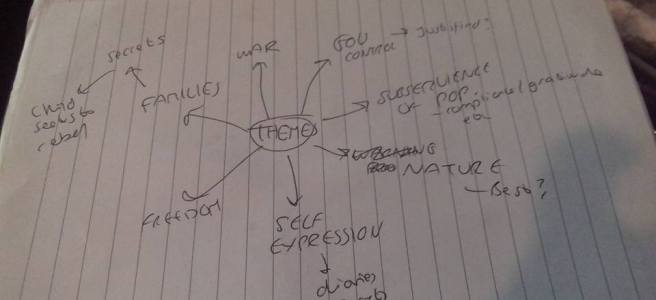
  • A book was plotted…During 2015 I plotted The Tree Of Rebels in a notebook. I arranged a timeline, wrote character bios, decided on themes, and started to write scenes and pieces of dialogue. I also had a ton of research to do…

18402839_1506886719330588_1701810434062864961_n

  • It all began on Wattpad…The very first draft of this book was written straight onto Wattpad, with people reading and commenting as I went. I shared the chapters to social media and tried to stick to a schedule of writing a chapter a day. I even had one lovely reader design a fantastic cover for me, which provided the inspiration for the cover I later had put together.
  • It got hijacked by another book…Just as I was about to start writing The Tree Of Rebels I got an idea for another book. I really did not want this to happen. I was all geared up to write this dystopian adventure that would surely enthral my daughters when a new idea and a very persistent character started knocking. The idea for Elliot Pie’s Guide To Human Nature was so strong, I had to start writing things down instantly. And so began to two-year battle between these two very different novels. With me working on one, only to hand it over to betas and work on the other, then swap around and so on. This was not easy!
  • Every time I thought I was finished, I wasn’t…If you are a loyal reader of this blog (and wow, thank you if you are!) then you will already know how many drafts this novel has had. So many I have lost count. Every time I got to the end, it still didn’t feel right. I ended up leaving it alone for months, while I finished Elliot Pie and started another YA novel set in the present day, and at that time I had no inclination whatsoever to rewrite The Tree of Rebels. I’d had enough of it.
  • When I picked it up again, I realised it was done…Funny, that. After finishing what I hoped was the last draft of Elliot Pie and sending to a final beta reader, and completing the messy first draft of the present day YA novel, I decided to look at The Tree of Rebels again. Was it useless? Did it need an entire rewrite? Would it ever see the light of day? And weirdly, when I read it through, I felt something I had not experienced before with this book. Relief and satisfaction and a sense of letting it go. I amended a handful of typos and left everything else alone.
  • I’m proud of the messages in this book…I am proud of this book. Finally. It’s been a long and difficult slog. I’ve struggled with so many aspects of it. I am currently reading it through and enjoying it. I like Lissie Turner and I think her journey into rebellion is an important one.
  • Nearly there now…All that is left to do is finish the read-through, amend any typos and send the document to the lovely girl who does my formatting for Pronoun. I will also send it to the other lovely girl who does my Createspace formatting. The cover is basically done but we’re just playing around with fonts at the moment, and there will be an extra illustrationo at the back of the book. My launch plan is written and in the next few weeks, I will decide a date for release!

And that’s it. That’s the story of this book. That’s the journey it has had; from an idea that grew while scrolling through my Facebook feed… to something that is almost ready to be released into the world.

The Tree Of Rebels; Book Launch Plan

To update, The Tree Of Rebels is finished, has a front cover and is ready for release. But I have decided to try the small press route first, just in case. So far I have sent it out to seven independent publishers and been rejected already by two. I am going to try to add another three to the list and then leave it at that. My reasons for trying the traditional route for this book are all in this recent blog post; Self-Publishing; Good times, bad times and ugly truths.

Obviously, I want this book released as soon as possible, which is why I am only trying ten suitable publishers and I have given myself until July. This particular book has been two years in the making and I feel it is very relevant to the times we are currently living in, so I am itching to get it out there. But if I self-publish again I’m going to do a proper book launch, which is something I have never done before! I need to start working on this now so that come July I can kick everything into action and give this novel the best start possible. So here is my plan which I am going to print out and stick it on my wall like a check list!

Book Launch Plan (month in advance)

  1. Send out ARC’s to potential reviewers and book bloggers.
  2. Read and write blog posts about similar books in the genre to mine. Let the authors know, and share the books on social media
  3. Use Instafreebie to set up a free sample of ARC’s of the book a month in advance
  4. Set the book up for pre-order a month in advance
  5. Post quotes/teasers to social media by using Canva graphics
  6. Send out ARC’s to email subscribers a month in advance
  7. Arrange a paid book promotion to coincide with launch week
  8. Launch the book at discount price 99p
  9. Send the Street Team ARC’s a month in advance and invigorate them to share my posts about the book
  10. Sort out either and Amazon ad or a Facebook ad
  11. Make sure Amazon book description contains relevant keywords
  12. Upload Createspace paperback version so it’s ready for release at same time

Book Launch Week

  1. Set up a Facebook Event for book launch day
  2. Set up a giveaway for the event day
  3. Share event and book link to promotional groups
  4. Share event and book link to Street Team
  5. Send out another newsletter
  6. Schedule a blog post about the book this week
  7. Arrange a suitable guest post if possible
  8. Post quotes and teasers leading up to the event
  9. Reveal the cover a week before
  10. Start posting chapters back onto Wattpad which is where the book was originally written.

Now, I am sure I have forgotten something, so if you’ve ever launched a book yourself, please let me know what else you did! As always, please feel free to share and comment! I am thinking about having a physical launch as well, possibly in the library.

This list has excited me and I can’t wait to get this book out there! Not long now folks!